There is no technology in modern sport that generates as much conversation, controversy, and outright fury as VAR. In football stadiums across the world, the moment a referee raises a finger to the ear and pauses the game for a screen review is the moment 50,000 people simultaneously hold their breath and prepare to erupt in either celebration or rage.
VAR — Video Assistant Referee — has been part of football since 2018. At the 2026 FIFA World Cup, it returns with significant rule changes, new technology, and a set of expanded powers that will shape how every one of the tournament’s 104 matches is officiated.
This is the complete, honest guide. How VAR works, what it gets right, what it gets wrong, what is new in 2026, and whether the game is better with it than without.
What Is VAR? The Simple Version
VAR is technology that was introduced to support the on-field refereeing team when they have not seen — or were unable to see — an important piece of information, resulting in a clear error being made in a key decision.
The key phrase is “clear and obvious error.” VAR is not designed to second-guess every decision. It is not supposed to intervene every time someone falls in the penalty area. It exists specifically to correct mistakes that the on-field referee could not reasonably have seen, or got demonstrably wrong.
In practice, this creates the system’s central tension: what counts as “clear and obvious”? The answer, as eight years of implementation has demonstrated, varies significantly between referees, competitions, and cultures. That subjectivity is the engine of the controversy.
How VAR Actually Works
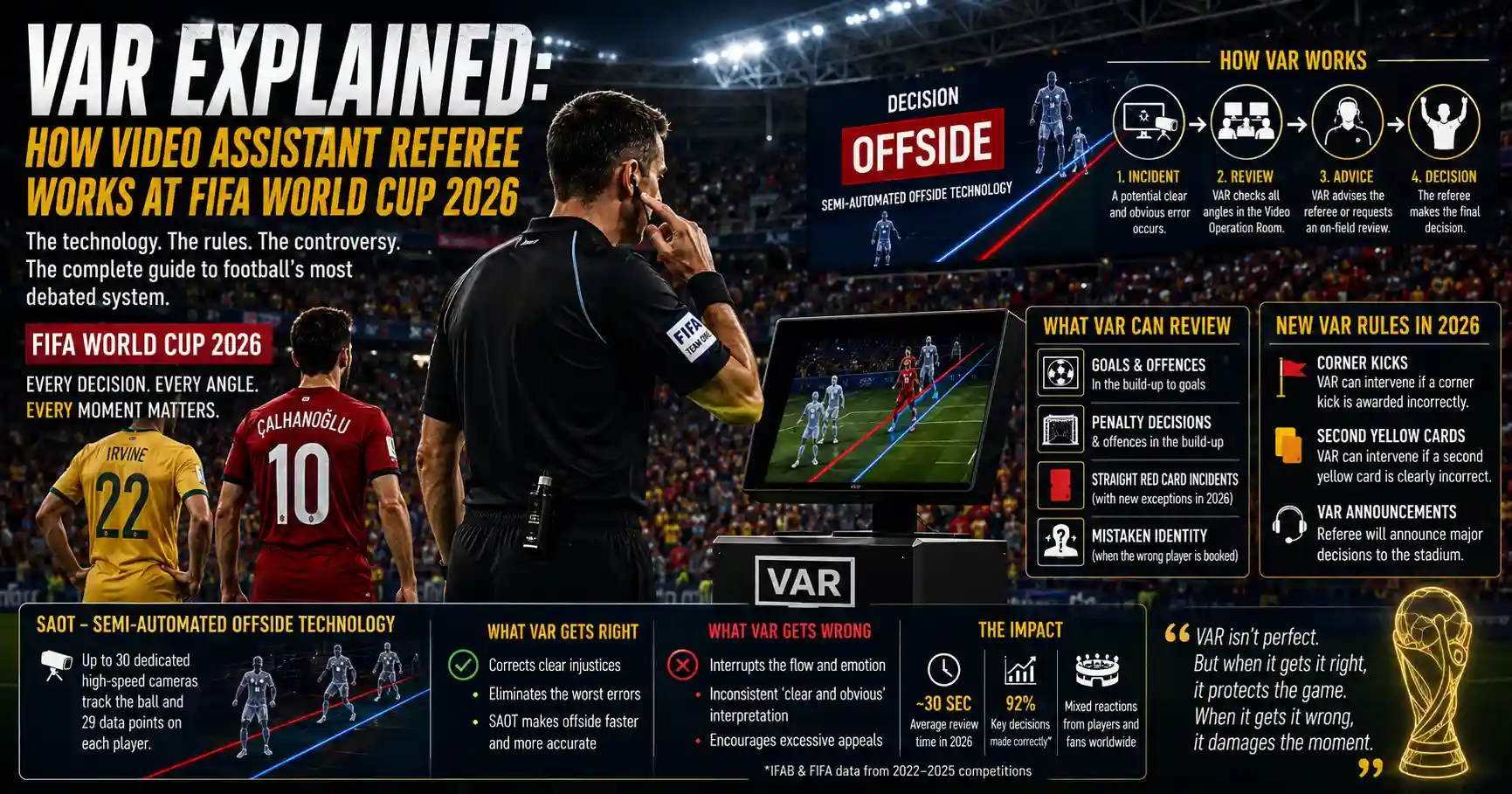
At the 2026 FIFA World Cup, a team of officials in a centralised Video Operation Room (VOR) watches every match live on multiple monitors, covering every angle through up to 33 cameras at each stadium. When a potential error occurs in a reviewable category, the VAR team checks the footage.
Four categories can be reviewed by VAR:
- Goals and offences in the build-up to goals
- Penalty decisions and offences in the build-up to penalties
- Straight red card incidents (not second yellow cards, with new exceptions — see below)
- Mistaken identity (when the wrong player is shown a card)
If the VAR team identifies a potential error, they can either:
- Advise the referee to check the pitch-side monitor themselves (a Referee Review Area, or RRA)
- Provide the information directly if the decision is based on objective data (like whether a ball crossed the line, or an offside position)
The referee always makes the final call. VAR advises. It does not decide.
For offside specifically, the 2026 World Cup uses SAOT — Semi-Automated Offside Technology. SAOT uses up to 30 cameras — separate to the VAR cameras — some shooting at twice the normal frame rate. The system automatically detects offside positions and generates 3D graphics to show the decision. It has made offside checks significantly faster and more accurate than the manual line-drawing system that frustrated fans for years.
What VAR Gets Right
Before the arguments against VAR, the honest assessment requires acknowledging what the system actually achieves.
It corrects genuine injustices. The 2018 World Cup — VAR’s debut — produced multiple interventions where clear errors were reversed before they could affect match results. A goal that was offside by a centimetre, correctly disallowed. A handball penalty that the referee missed from distance, correctly awarded. These are the cases VAR was designed for, and it handles them well.
It eliminates the grossest errors. Pre-VAR, a striker could be four metres offside and the flag might not go up. A red-card tackle might be missed in a crowded area. A goal might stand that was scored with a clear handball. VAR has made these outcomes significantly less likely. The worst refereeing decisions — the game-changing, career-defining mistakes that haunt tournaments — are largely gone.
SAOT has solved the offside problem. The manually drawn offside lines of the early VAR era — often taking three minutes to produce, sometimes showing incorrect armpit angles — were genuinely ridiculous. SAOT’s automated 3D system, used from the 2022 World Cup onward, is fast, accurate, and visually intelligible. The technology here is working as intended.
What VAR Gets Wrong
The case against VAR is equally grounded in evidence and is important to take seriously.
It disrupts the emotional rhythm of football. The spontaneous goal celebration — the most visceral moment in sport — has been altered fundamentally by VAR. Fans now hesitate to celebrate fully because the goal might be reviewed. That hesitation is a real cost. The emotions of football are woven into its value, and VAR has diminished one of its most powerful moments.
“Clear and obvious” is not consistently applied. A handball that one referee considers “clear and obvious” is dismissed by another as “not deliberate.” A challenge that one VAR team upgrades to a red card is left alone by another. The inconsistency is maddening — not because the system is wrong in principle, but because the human interpretation of its threshold varies too widely.
It has created a culture of protest. Players now appeal for VAR reviews on every contact, every ball over the line, every potential offside. The time-wasting potential of the review system has been exploited by players and managers who understand that disrupting the game’s flow benefits the leading side. This was not part of the original design.
The New VAR Rules at World Cup 2026
The 2026 World Cup introduces the most significant changes to VAR since its inception, driven by IFAB’s decision to expand the system’s scope in specific situations.
For the first time, the 2026 World Cup will see VAR intervene in two additional situations: corner kicks — if it believes a corner kick has been awarded incorrectly — and second yellow cards, when VAR can intervene if a player receives one that, after review, is judged to be an incorrect decision by the referee.
New Rule 1: VAR at Corners Every decision that results in a corner kick will be checked by VAR. If the ball last touched a defending player before going out — and the referee incorrectly awards a goal kick — VAR can reverse the decision and award the corner. And vice versa: if a corner is incorrectly awarded when it should be a goal kick, VAR intervenes.
This is a significant expansion. Corners are among the most frequent set-piece situations in football and create direct opportunities for goals. Incorrect corner/goal kick decisions have previously affected matches without remedy. That gap is now closed.
New Rule 2: VAR on Second Yellow Cards VAR has previously been unable to get involved in yellow-card decisions, even when a player receives a second yellow and is therefore sent off. Moving forward, VAR can intervene in cases of mistaken identity for a second yellow card. Additionally, VAR can intervene when a “clear and obvious error” has been made in showing a player a second yellow card.
This rule was driven partly by the 2026 World Cup Group A opener’s disciplinary chaos: three red cards in the opening match highlighted exactly the kind of cascading yellow-card situations that previously had no VAR remedy.
New Rule 3: Red Card for Covering the Mouth Under the new rules for the 2026 FIFA World Cup, any player who covers their mouth “in a confrontational situation” with their hand, arm, or shirt will be shown a red card. This addresses the issue of potentially abusive language being hidden from lip-readers and officials. It was driven by a specific Champions League incident where a player used his shirt to hide his mouth during a confrontation involving Vinícius Júnior.
The Technology Behind the Technology: SAOT
Semi-Automated Offside Technology deserves its own section because it represents the most successful piece of football officiating technology ever implemented.
SAOT uses up to 30 dedicated cameras at each World Cup venue — separate from the standard broadcast and VAR cameras. Some cameras operate at twice the normal frame rate. The system tracks 29 body points on each player simultaneously, generates a 3D skeleton model, and produces an automated offside decision in seconds.
The result: offside decisions that previously took three to four minutes under the manual line system now take under 60 seconds. The accuracy is higher because human line-drawing at specific body angles introduced error margins that 3D skeletal tracking eliminates.From Backyards to Academies: USA Youth Soccer World Cup 2026 and the Making of a New Generation
The 3D graphics generated by SAOT are also publicly visible — shown on stadium screens and broadcast internationally. This transparency is crucial: fans can see the data that produced the decision, rather than being told a decision was made.
The Honest Verdict
Is football better with VAR than without it?
The honest answer is: yes, but not as much better as it should be, and in some specific ways worse.
VAR has corrected genuine injustices that would have been uncorrectable in previous eras. It has eliminated the grossest refereeing errors from the game’s highest stages. SAOT has specifically solved the offside-decision problem that the early VAR era created. The principle behind VAR — using available technology to make correct decisions — is sound and will not be reversed.
But the implementation remains inconsistent. The emotional cost to celebration culture is real. The exploitation of the review system by time-wasters is a genuine problem. The “clear and obvious” threshold is too variable between officials.
The 2026 World Cup’s rule changes are improvements: expanding VAR to corners closes a genuine gap, the second-yellow intervention prevents specific injustices, and SAOT continues to deliver on the technology’s promise.
VAR is here. It is not leaving. The question is no longer whether football should use it — that argument is settled. The question is how to make its implementation more consistent, its decisions faster, and its integration with the game’s emotional rhythm less disruptive.
Those questions will be asked again, loudly, at some point during the 2026 World Cup. They always are. VAR guarantees it.
Relates articles :
The 4-3-3 Formation Explained: Roles, Strengths, Weaknesses and Why It Dominates Modern Football
🔹🔹 Follow us on Facebook 🔹🔹
About the Author



3 thoughts on “VAR in Football Explained: How It Works, Why It Divides Fans and What’s New at World Cup 2026”