 The 1998 World Cup: France’s Greatest Moment and Football’s Most Dramatic Night
No World Cup has ever meant quite what the 1998 tournament meant to France. It wasn’t just a trophy, it was a six-week transformation of how an entire country saw itself, delivered by a team that almost nobody, including much of the French press, believed in until the very end. This is the story of how a home tournament turned a doubted, defense-first squad into national heroes, and how one unforgettable July night on the Champs-Élysées became a symbol far bigger than football itself.
Is This Spain Team Better Than the 2010 Champions?
Every Confirmed Character in Avengers: Doomsday
A Nation That Didn’t Believe
To understand how remarkable France’s triumph actually was, you have to understand how little faith the country had in its own team heading into the summer of 1998. Manager Aimé Jacquet had spent much of the two years before the tournament being openly mocked in the French press, most notably by the sports newspaper L’Équipe, which questioned his tactical conservatism, his squad selections, and his perceived lack of the flair supposedly required to win a home World Cup. The criticism became so personal and so relentless that Jacquet later described the period as one of the most painful of his professional life, and he made a point of publicly settling the score after the final whistle blew in the tournament’s climactic match.
Part of the skepticism stemmed from France’s approach itself. Jacquet had built his squad around a rock-solid defense and a dominant midfield, prioritizing organization and discipline over the free-flowing attacking football that French fans traditionally associated with success. Even more controversially, Jacquet went into the tournament without a proven, prolific out-and-out striker, opting instead for Stéphane Guivarc’h, a hard-working forward who would go on to play every single minute of France’s championship run without scoring a single goal, an almost unthinkable statistic for a World Cup-winning number nine.
What Jacquet did have, even if the press was slow to appreciate it, was arguably the best collection of defensive and midfield talent assembled by any nation in the tournament. Fabien Barthez marshaled the goal with confidence bordering on theatrical. Marcel Desailly and Laurent Blanc anchored a back line that would concede remarkably few goals throughout the competition. Lilian Thuram and Bixente Lizarazu provided pace and energy from full-back. And in midfield, France possessed a genuinely rare blend of steel and elegance, with Didier Deschamps as captain and defensive conductor, Emmanuel Petit and Christian Karembeu offering energy and coverage, and, at the heart of it all, Zinedine Zidane, a playmaker already recognized as one of the most gifted footballers of his generation, even before the tournament that would make him a global icon.
A Cautious Start
France’s group stage performances didn’t exactly silence the doubters, even as the results held up. Les Bleus opened with a comfortable 3–0 win over South Africa, followed by a routine victory over Saudi Arabia, a match remembered largely for Zidane’s moment of madness, a stamp on a Saudi opponent that earned him a red card and a two-match suspension, a suspension that briefly threatened to derail France’s entire campaign before it had really begun. With their talisman sidelined, France still managed to beat Denmark to top their group, a result that spoke to the depth and discipline Jacquet had built into the squad, even without its most gifted individual player available.
The knockout stage brought France’s first genuine scare. Their round of 16 tie against Paraguay, marshaled by the eccentric and typically outfield goalkeeper José Luis Chilavert, went goalless deep into extra time, with Paraguay’s compact defensive structure frustrating France’s attack at every turn. It took a golden goal, football’s now-retired sudden-death extra time rule, from defender Laurent Blanc to finally break the deadlock, sending France through by the narrowest possible margin and sparing Jacquet’s team from the ignominy of an early exit on home soil.
The Italy Test and a Semifinal for the Ages
France’s quarterfinal against Italy proved to be one of the tournament’s most tactically tense encounters, a genuine chess match between two sides built on defensive solidity. Neither team could find a breakthrough across ninety minutes and extra time, sending the match to penalties, still a nerve-shredding lottery for host nations under the weight of an entire country’s expectation. Barthez’s composure in goal and a string of confident French penalties saw Les Bleus advance, though the manner of the win did little to convince skeptics that this France side had genuine title-winning quality rather than simply the good fortune of a favorable home draw.
Then came the semifinal against Croatia, a team enjoying a stunning debut World Cup campaign built around Davor Šuker’s clinical finishing. It was here that France finally produced a performance that matched the scale of the occasion. Croatia actually took the lead early in the second half through Šuker himself, silencing the Stade de France and threatening to end France’s home dream in devastating fashion. What followed was one of the most improbable individual contributions in World Cup semifinal history: Lilian Thuram, a defender who had never before scored for his country at any level, scored twice in the space of ten second-half minutes, driving forward from right-back to net both of France’s goals in a 2–1 win. Thuram would never score for France again in his entire international career, making his brace against Croatia one of the most statistically bizarre and dramatically perfect moments in World Cup history.
The Final: France vs Brazil
The final itself carried a subplot that overshadowed the buildup almost entirely: the fitness and mental state of Brazil’s Ronaldo, already recognized as the best player on the planet at just 21 years old. Hours before kickoff, reports emerged that Ronaldo had suffered a convulsive fit in the Brazilian team hotel, sparking chaos and confusion within the Brazilian camp about whether he would even be able to play. He was initially left off the starting lineup submitted to FIFA, before a last-minute reversal saw his name reinstated, and Ronaldo ultimately did take the field at the Stade de France, though visibly subdued and a shadow of the explosive, unstoppable forward who had terrorized defenses throughout the tournament. To this day, the full truth of what happened to Ronaldo that afternoon remains a subject of debate and speculation among those who were there.
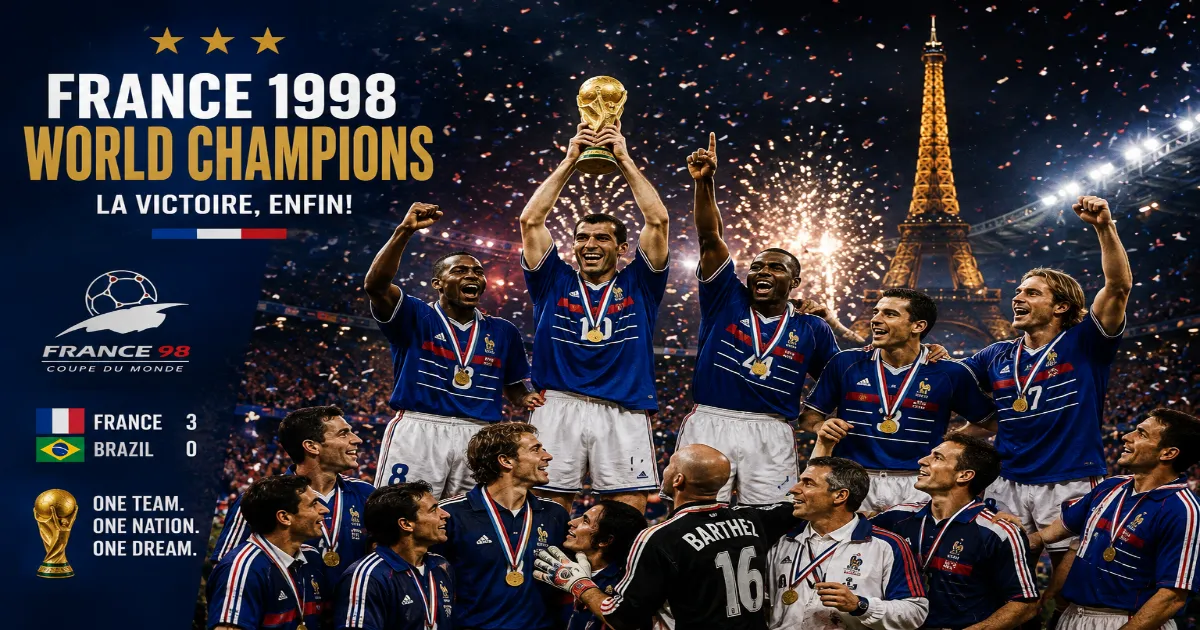
Brazil’s talisman being compromised gave France the platform they needed, and Zidane, so often accused throughout the tournament of drifting through matches without decisive end product, delivered the two most important headers of his career. Twice, from near-identical corner kicks swung in by Petit and Djorkaeff, Zidane rose above Brazil’s marking to head France into a 2–0 lead before halftime, a stunning statistical anomaly for a player not widely regarded as an aerial threat. Brazil, shorn of a fully functioning Ronaldo and increasingly disorganized as the match wore on, never found a way back into the contest.
France’s victory was confirmed in the most fitting way possible in stoppage time, when Marcel Desailly, already on a yellow card, was sent off, reducing France to ten men against a Brazilian side still theoretically capable of a comeback. Instead, it was Emmanuel Petit who delivered the final word, breaking clean through Brazil’s depleted defense to slot home France’s third goal in the dying seconds, sending the Stade de France into delirium and confirming a 3–0 victory that had looked almost unthinkable to much of the French press just weeks earlier.
A Country Transformed Overnight
What happened after the final whistle mattered just as much as the match itself. An estimated one and a half million people flooded the Champs-Élysées in Paris that night, turning the world’s most famous avenue into one enormous, spontaneous street party that stretched long into the following morning. The Arc de Triomphe was illuminated with Zidane’s face projected across it, an image that instantly became one of the defining visuals of French sport in the twentieth century.
What made the celebration so significant wasn’t just its scale, but its symbolism. France’s championship squad was built from players with roots across the country’s former colonial territories and immigrant communities, Zidane’s Algerian heritage, Thuram’s roots in Guadeloupe, Karembeu’s New Caledonian background, Desailly’s Ghanaian birth, among others. The team quickly became shorthand for a phrase that dominated French media coverage in the tournament’s aftermath: “Black-Blanc-Beur,” a reference to the team’s Black, white, and North African heritage, held up as a symbol of a multicultural France succeeding together on the world’s biggest stage.
That symbolism wasn’t without controversy or complication. Some commentators and politicians used the team’s diversity to argue for a more inclusive vision of French national identity, while others pushed back against reading too much sociopolitical meaning into a sporting result, arguing the unity was real but fleeting, unlikely to resolve deeper social tensions that existed in France well before and long after the tournament ended. Nonetheless, the “Black-Blanc-Beur” narrative became one of the most enduring cultural legacies of the 1998 World Cup, discussed and debated in France for decades afterward, particularly whenever questions of immigration, integration, and national identity resurfaced in French public life.
The Football Legacy
Beyond the cultural impact, the 1998 triumph reshaped French football for years to come. The same core group of players, now battle-tested and newly confident rather than doubted, went on to win Euro 2000 in Belgium and the Netherlands, becoming the first nation since West Germany in the early 1970s to hold both the World Cup and European Championship simultaneously. That back-to-back success cemented the golden generation of Zidane, Deschamps, Henry, and their teammates as one of the most decorated groups in football history, and it fundamentally altered how the football world viewed French football, from a talented but often underachieving footballing nation to a genuine global powerhouse capable of producing both silverware and world-class individual talent on a consistent basis.
The tournament also validated Jacquet’s much-criticized approach, proving that a World Cup could be won through defensive solidity, tactical discipline, and squad cohesion rather than pure individual flair alone, a lesson subsequent French national team setups, and plenty of other footballing nations, would draw on for years to come. Jacquet himself stepped down as manager immediately after the tournament, handing the reins to his assistant Roger Lemerre, but his vindication was total, transforming him almost overnight from a nationally mocked figure into one of the most respected coaches in French football history.
Why 1998 Still Resonates
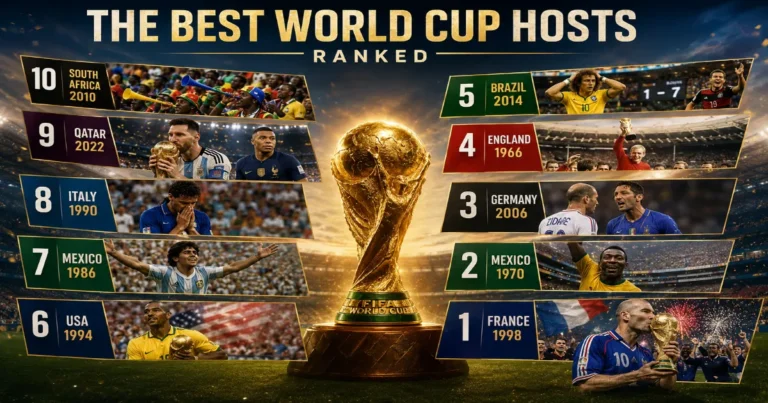
More than two decades on, the 1998 World Cup remains a reference point every time France hosts, or even discusses hosting, a major sporting event, and every time questions of national identity and unity resurface in French public discourse. It’s frequently cited as one of the clearest examples in modern sporting history of a host nation’s tournament victory transcending the sport itself, alongside moments like England’s 1966 triumph or South Africa’s 1995 Rugby World Cup win under Nelson Mandela.
For a footballing nation that had never previously won the World Cup, and had often struggled to live up to its own talent on the biggest stages, 1998 wasn’t just a first title. It was proof that France could win on its own terms, with its own unique blend of players, philosophy, and identity, and that victory, delivered against all the pre-tournament doubt, remains one of the most complete and culturally significant triumphs in the history of the World Cup.
The Tactical Blueprint Behind the Trophy
Looking back with the benefit of hindsight, Jacquet’s much-maligned approach was, in many ways, ahead of its time. Rather than building the team around a single superstar forward, as many previous World Cup winners had done, Jacquet distributed creative responsibility across midfield, trusting Zidane, Deschamps, and Petit to control games through possession and positional discipline rather than isolated moments of individual brilliance up front. This structure meant France could grind out results even on nights when the attack misfired entirely, a pattern that repeated itself throughout the tournament, from the goalless slog against Paraguay to the penalty shootout against Italy.
The defensive record France compiled across the tournament remains one of the most impressive in modern World Cup history. Barthez, Desailly, Blanc, Thuram, and Lizarazu conceded remarkably sparingly across seven matches, a testament to a back line that trained and played together with a cohesion few international sides manage to build in a single tournament cycle, let alone the two years of preparation Jacquet had available as host nation manager. That defensive foundation gave France’s more limited attacking players, Guivarc’h chief among them, the freedom to focus on pressing and link-up play rather than carrying the burden of goalscoring alone, since the team’s balance of power sat firmly in defense and midfield rather than up front.
The Players Who Became Legends
Almost every member of that 1998 squad saw their career and reputation transformed by the tournament, but a handful of individual stories stand out. Zidane’s two headers in the final turned him from a hugely promising but still-developing talent into an instant global superstar, a status he would cement further with a stunning Champions League final volley for Real Madrid a few years later, but which truly began on that July night at the Stade de France. Thuram’s improbable brace against Croatia, a defender’s finest attacking moment against the run of his entire career, remains one of the most statistically freakish performances in World Cup semifinal history, and it’s still the primary highlight fans associate with an otherwise defense-first career.
Even players in more understated roles found their careers reshaped. Guivarc’h, despite failing to score a single goal across the entire tournament, still holds a World Cup winner’s medal, a fact often cited in football writing as one of the sport’s more curious statistical footnotes. Meanwhile, a young Thierry Henry, still just twenty years old and not yet the world-class striker he would become at Arsenal, played a role off the bench during the tournament, gaining invaluable experience that would help shape the attacking force he became for both club and country in the years that followed.
A Blueprint Other Host Nations Studied Closely
France’s success as tournament hosts also became something of a case study for future World Cup organizers, both in terms of tournament logistics and squad-building strategy. The tightly organized, defensively secure approach Jacquet deployed offered a template that several subsequent host nations, aware of the unique pressure that comes with a home World Cup, would study and partially replicate, prioritizing cohesion and control over expansive attacking risk. It’s a pattern that’s been referenced repeatedly in football analysis whenever a new host nation prepares for its own tournament, a reminder that 1998 didn’t just change France, it left a lasting mark on how football thinks about the pressure, and opportunity, of playing a World Cup on home soil.
🔹🔹 Follow Us on Facebook 🔹🔹
About the Author