The 3-5-2 Revolution: Why More Teams Are Playing Three at the Back in 2026
At some point between Antonio Conte’s Chelsea winning the Premier League in 2017 and the 2026 FIFA World Cup, something fundamental shifted in how elite football teams defend.
The back four — the foundational defensive structure that has governed football for sixty years — is no longer universal. More coaches at the highest level are choosing to defend with three central defenders, two wing-backs, and a five-player midfield than at any point in modern football history.Spain’s Dominant Era: How Tiki-Taka Won Three Tournaments in a Row (2008-2012)
What Is a False 9? The Role That Changed Modern Football
This is not a trend. It is a structural evolution. And the 3-5-2 formation is at its centre.
First: Who Invented It and Why?
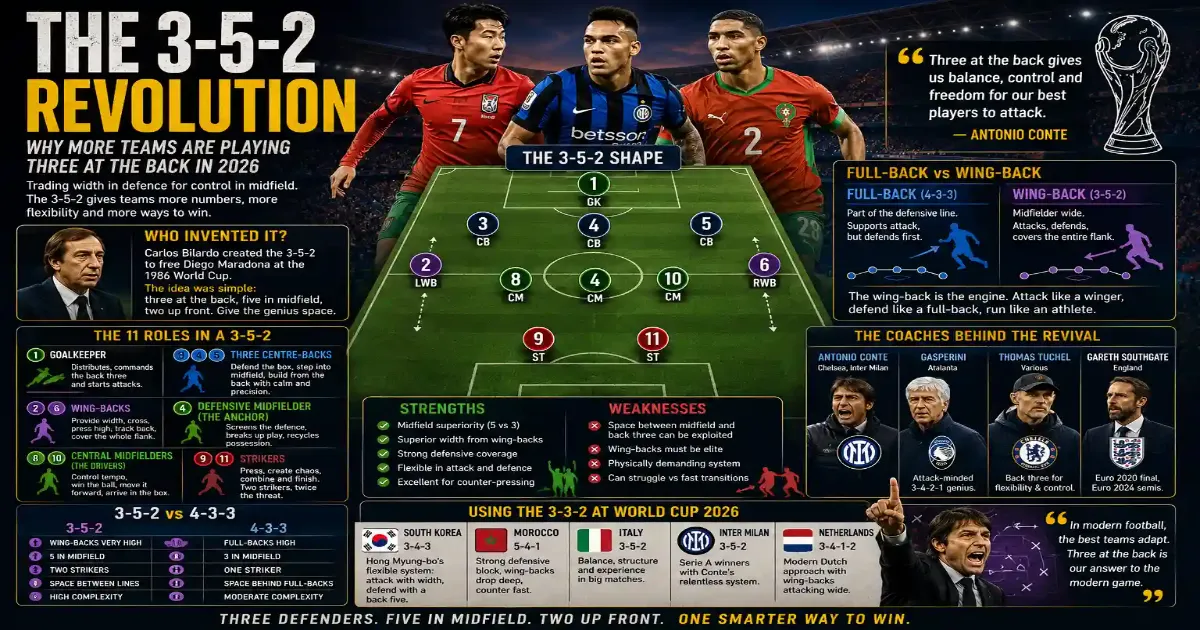
Argentine coach Carlos Bilardo is credited with being the inventor of the 3-5-2 system. Manager of the famous World Cup-winning Argentina team of 1986, he developed this shape as a way of creating space upfront for star player Diego Maradona to exploit.
Let that context sit for a moment. The system that is reshaping elite football in 2026 was built in the 1980s specifically to give one player — arguably the greatest who ever lived — more room to operate. The tactical logic is identical today: three at the back gives the midfield numbers. Numbers give the creative players space.
At the 2014 World Cup, top teams like Holland, Italy, Chile, Mexico and Costa Rica deployed the 3-5-2 and enjoyed success, while three centre-back formations had been pushed into obscurity before the tournament. That tournament represented the first major modern signal that the back four was no longer football’s default answer.
What Does 3-5-2 Actually Look Like?
A 3-5-2 lines up with three central defenders, two wing-backs, three central midfielders and two strikers. It trades width in defence for extra bodies in midfield, with the wing-backs providing all the attacking width.
        GK
   CB    CB    CB
LWB               RWB
      CM  CM  CM
        ST  ST
The crucial intelligence about this formation is the distinction between full-backs and wing-backs. They are different positions with completely different roles.
A full-back in a 4-3-3 or 4-4-2 sits in the defensive line. They provide width going forward but are fundamentally defenders who attack when appropriate.
A wing-back in a 3-5-2 is something closer to a midfielder. They start wide, attack like wingers, defend like full-backs, and cover the entire flank from penalty area to penalty area for 90 minutes. It is the most physically demanding position in modern football.
This formation starts with a modern back three. These 3 central defenders are supported by two wing-backs who can drop back and become part of a back five if a team is defending deep. Usually, though, these wing-backs will be the widest part of a midfield 5, with 3 central midfielders between them.
The Wing-Back Problem (And Why It Is Also the Solution)
Here is the central tension of the 3-5-2: the wing-back role is almost impossibly demanding, but it is also the system’s greatest weapon.
When attacking, wing-backs become advanced wingers, delivering crosses and cutting back from deep positions. When defending, they drop into the back five and become one of the widest defenders. The distance they cover in 90 minutes is extraordinary. Reece James at Chelsea, who has operated in this role under various managers, regularly covers 11+ kilometres per match — among the highest distances of any outfield player.
The demand is so high that teams without genuine wing-backs — athletic, technically proficient players who can defend and attack over a full flank — cannot run the 3-5-2 at elite level. It simply does not work.
But when those players exist? The system becomes the most flexible in modern football. Unlike with the 4-3-3 formation, having your full-backs attack doesn’t leave so much space to be exploited in defensive areas, because there are 3 central defenders providing added cover.
Why Are More Teams Switching to 3-5-2 in 2026?
Three specific reasons explain the accelerating adoption of three-at-the-back systems entering the 2026 World Cup.
Reason 1: The Counter-Press Era Made Back Fours Vulnerable The dominance of high-pressing 4-3-3 systems — Liverpool under Klopp, Man City under Guardiola, Spain under de la Fuente — has created a problem for teams playing traditional back fours. When pressed intensely with three forwards, a back four’s full-backs are often caught high and out of position. The result is dangerous space in behind that elite forwards exploit.
The 3-5-2’s answer: three centre-backs provide the cover that allows teams to play higher and wider without leaving the space behind the defence as exposed. The wing-backs can push high precisely because there are always three defenders behind them.
Reason 2: The Striker Pairing Makes Attackers Unpredictable Nowadays, single-striker systems have become so prevalent all across Europe that defending against two out-and-out strikers has become a thing of the past. The 3-5-2’s two-striker system exploits precisely this defensive unfamiliarity.
Two strikers who interchange — one holding and one running behind, or both pressing aggressively in tandem — create problems for centre-back pairings that are calibrated to handle a lone striker. The tactical mismatch is real and growing.
Reason 3: Midfield Numerical Superiority Five-man midfields dominate three-man midfields. The mathematical reality is that a 4-3-3’s three central midfielders face a 3-5-2’s five midfield players in every central zone. The result is that a well-organised 3-5-2 can control the game’s tempo through sheer positional superiority in the most contested area of the pitch.
The Weakness: The Space Between the Lines
Every formation has its exploitation point, and the 3-5-2 has a specific one: the area between the midfield five and the back three.
When a 3-5-2 team is pressing high and the wing-backs are advanced, a fast opponent playing through the press with quick vertical passes can expose the gap between the midfield and the defensive line. If the three central defenders do not work in concert — communicating about when to step and when to hold — a diagonal pass into that gap creates a one-vs-one situation against a single centre-back with space to run into.
The best 3-5-2 teams manage this by disciplined midfield pressing triggers that avoid this exposure. The worst 3-5-2 teams suffer repeated transitions that put their defensive three in one-vs-one positions against quick forwards.
The Coaches Who Made the 3-5-2 Elite
Antonio Conte is the most important figure in the 3-5-2’s modern revival. His Chelsea (2016-18), Inter Milan (2019-21), and subsequent club roles have been built almost entirely on variations of three-at-the-back with attacking wing-backs. Conte’s Inter won Serie A in 2021 using the most efficient 3-5-2 in Europe that season. His system demands absolute positional discipline — and when he gets it, the formation is extremely difficult to beat.
Gian Piero Gasperini at Atalanta built one of European football’s great overachievement stories using a 3-4-2-1 — a close variation of the 3-5-2. His system created attacking wing-backs and deep-lying forwards before those concepts were widely understood in mainstream tactical analysis.
Thomas Tuchel and Gareth Southgate both brought the back-three to England — Southgate reaching the Euro 2020 final and Euro 2024 semi-final using a 3-4-3/3-5-2 hybrid, demonstrating that the formation can function with international-quality but not world-elite wing-backs when the defensive structure is sufficiently disciplined.
3-5-2 vs 4-3-3: The Fundamental Trade-Off
| 3-5-2 | 4-3-3 | |
|---|---|---|
| Defensive width | Wing-backs cover full flank | Full-backs cover flank |
| Midfield numbers | 5 central players | 3 central players |
| Attacking width | Wing-backs push very high | Wingers hold width |
| Vulnerability | Space between midfield and back three | Space behind high full-backs |
| Striker role | Strike partnership — two forwards | Lone striker with support from midfield runners |
| Complexity | High — wing-backs must be elite | Moderate — system suits most squads |
The 3-5-2 at World Cup 2026
At the 2026 FIFA World Cup, teams deploying variations of the three-at-the-back formation include South Korea (3-4-3), Morocco (5-4-1 defensive block), and several South American nations.
South Korea’s Hong Myung-bo uses a 3-4-3 that demonstrates precisely the formation’s flexibility: with the ball it looks like a 3-4-3, attacking with wing-backs and inverted forwards. Without the ball it compresses into a 5-4-1 that prioritises defensive compactness.
The 3-5-2 revolution is not a replacement for the 4-3-3. It is a counter-measure — an answer that the tactical arms race has produced in response to the dominance of the high press. Whether it continues to grow depends on one question: can your wingers also be defenders? If the answer is yes, the 3-5-2 is available to you. If the answer is no, the back four remains your only viable option.
From Backyards to Academies: USA Youth Soccer World Cup 2026 and the Making of a New Generation
About the Author




1 thought on “The 3-5-2 Revolution: Why More Teams Are Playing Three at the Back in 2026 — and What It Means for Football”