How Is the World Cup Draw Done?
Every four years, football’s greatest tournament gathers its 48 competing nations and sorts them into groups in front of a global television audience of hundreds of millions. A presenter pulls a ball from a bowl. A group is announced. Somewhere in the world, a national football federation instantly begins calculating knockout bracket paths, training camp logistics, and travel itineraries.
The draw looks simple. It is not.
Behind the spectacle of the Kennedy Center ceremony — the venue for the 2026 FIFA World Cup draw held on December 5, 2025, in Washington D.C. — is a system of rankings, regional restrictions, seeding logic, and host-nation privileges that has been refined across nearly a century of World Cup draws.
This is the complete explanation of how the World Cup draw actually works, from the FIFA ranking system that determines who goes in which pot, to the rules that prevent France meeting Spain before a semi-final, to the precise choreography of the ceremony itself.
Why the Draw Even Exists
A World Cup draw is required because 48 teams must be sorted into 12 equal groups of four before competitive play begins. The groups must be as balanced as possible — giving every team a legitimate chance to progress — while distributing the world’s best teams across different sections of the bracket so that the final is, as much as possible, a contest between the tournament’s two best teams rather than a product of bracket luck.
The tension the draw must resolve is this: if the draw were entirely random, Group A might contain Brazil, France, Spain, and Argentina — eliminating three of the world’s four best teams in the group stage and producing a World Cup where the eventual winner beat only modest opposition. Simultaneously, Group F might contain Curaçao, Jordan, Haiti, and South Africa — advancing two teams that face no serious test until the Round of 32.
The seeding and pot system prevents both outcomes. Pots spread the best teams across different groups. Regional restrictions prevent the same confederation’s teams from meeting too early. Host-nation placements guarantee the domestic audiences a home team in each country’s primary viewing slots.
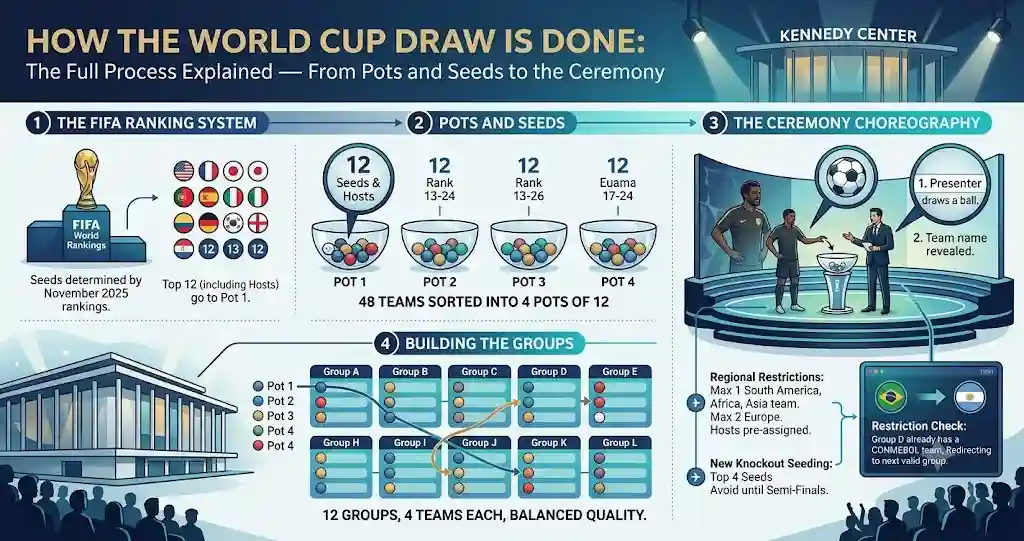
Step 1: The FIFA Ranking System — How Seeds Are Determined
Before a single ball enters a bowl, FIFA’s seeding process begins with the FIFA Men’s World Rankings — specifically the rankings published in the month before the draw.
For the 2026 draw, the rankings used were from November 2025. The seeding logic for the 2026 World Cup draw worked as follows:
Pot 1 — The 12 Seeded Teams:
- The three host nations: USA, Mexico, and Canada. Host nations receive automatic placement in Pot 1 regardless of their FIFA ranking. This is a longstanding FIFA convention — the co-hosts are given a seeded position because they have already received a fixed group assignment (Mexico to Group A, Canada to Group B, USA to Group D).
- The nine highest-ranked qualified nations based on the November 2025 FIFA rankings: Spain, Argentina, France, England, Belgium, Brazil, Germany, Netherlands, and Portugal.
Together, these 12 teams formed Pot 1. One team from Pot 1 was drawn into each of the 12 groups — guaranteeing that every group contained one of the world’s best teams.
Pots 2, 3, and 4: The remaining 36 qualified teams were ranked by FIFA ranking and distributed across Pots 2, 3, and 4 in descending order. The teams in Pot 2 were generally ranked 13th through 24th globally. Pot 3 contained teams ranked 25th through 36th. Pot 4 contained the lowest-ranked qualifiers.
Each group ultimately contained one team from each pot — guaranteeing a spread of quality from top to bottom.
Step 2: The Pots — Building the Balance
For the draw, the 48 teams were divided into four pots of 12. One team from Pot 1 is placed into each of the 12 groups, followed by one team from Pot 2, Pot 3 and Pot 4. By the end of the process, each group contains exactly one team from each pot.
This structure produces 12 groups where every group has one elite team, one strong team, one competitive team, and one team that qualified despite being a lower-ranked nation. The balance is not perfect — drawing the world’s top-ranked team from Pot 1 against the three lowest-ranked teams from Pots 2, 3, and 4 produces a different group from drawing the 12th-ranked Pot 1 team against the strongest Pots 2, 3, and 4 teams. But the structure prevents the catastrophic imbalances that a fully random draw would create.
Step 3: Regional Restrictions — The Rules Within the Rules
This is where the draw’s hidden complexity lives. FIFA rules prevent teams from the same region from landing in the same group.
Specifically: a group that already includes a South American team cannot take a second one. A group that already includes an African team cannot take a second. An Asian team cannot be in the same group as another Asian team.
The European exception: Europe sends significantly more teams to the World Cup than any other confederation — 16 qualifiers at the 2026 tournament. Since there are only 12 groups, it is mathematically impossible to keep all European teams out of each other’s groups. The rules therefore allow a maximum of two UEFA teams per group. No group can contain three European nations.
The host nation restriction: No two host nations can be in the same group. USA (Group D), Mexico (Group A), and Canada (Group B) were pre-assigned to different groups before the draw began.
These restrictions mean the draw is not a simple random process. Each time a ball is pulled from the pot, the system must check whether the drawn team’s confederation has already been placed in the destination group and, if so, redirect them to an eligible group. This is why experienced observers watching the draw live will sometimes notice that an apparently straightforward draw produces a slightly unexpected result — the regional restriction system is working behind the scenes.The 3-5-2 Revolution: Why More Teams Are Playing Three at the Back in 2026 — and What It Means for Football
Step 4: The New Knockout Seeding — Tennis-Style Bracket Protection
The 2026 World Cup introduced a significant innovation to the format: the top four seeded countries cannot face each other until at least the semi-finals.
FIFA introduced a new system for the 2026 World Cup knockout stages that sees the top four seeded teams avoid each other until at least the semi-finals of the 48-team tournament. In a tennis-style system similar to the one adopted by FIFA during the Club World Cup, the top two teams in the FIFA rankings — Spain (1) and Argentina (2) — are on opposite draw pathways, as are the third and fourth-ranked sides, France and England.
This means:
- Spain and Argentina are in opposite halves of the bracket — they cannot meet before a potential final.
- France and England are also in opposite halves — they cannot meet before a potential final.
- Spain cannot meet France until at least the semi-finals.
- Argentina cannot meet England until at least the semi-finals.
England will avoid European champions Spain and world champions Argentina until a potential semi-final. France, who beat England in the World Cup quarter-finals in 2022, cannot meet Tuchel’s side until a potential final.
This is a genuine change in World Cup philosophy — prioritising competitive quality at the tournament’s most-watched stages over the pure randomness that previously governed bracket formation.
Step 5: The Six Mystery Teams — Playoff Placeholders
The 2026 draw had a unique complication: six of the 48 teams had not yet qualified at the time of the ceremony in December 2025. Four spots were reserved for UEFA playoff winners (whose playoff matches were scheduled for March 2026). Two spots were reserved for inter-confederation playoff winners.
The draw therefore included six placeholder entries — teams that would be confirmed in March 2026 but whose group position needed to be determined in December. Each placeholder was drawn into a group and their eventual identity (whichever nation won the relevant playoff) would join that group.
The regional restrictions applied even to placeholders. FIFA rules prevent teams from the same region from landing in the same group — and for the inter-confederation playoff placeholders, the confederation constraint applied to all three teams within each pathway. For example, Pathway 2 of the inter-confederation play-off spots, consisting of Bolivia, Suriname and Iraq, must avoid South America, CONCACAF and Asia — ensuring that whichever team from that pathway qualified would land in an appropriate group.
The Ceremony: What Actually Happens at the Draw
The draw ceremony will take place at the John F. Kennedy Center for the Performing Arts in Washington D.C. — a venue that combines American cultural prestige with proximity to the political centre of the host nation. The draw is scheduled to take about 45 minutes during a show lasting about an hour and a half.
The physical mechanics: Numbered balls corresponding to each team are placed in transparent spherical bowls — one bowl per pot. A celebrity or football legend (a role historically filled by former World Cup winners or host nation icons) reaches into the bowl, removes a ball, and hands it to the presenter. The number is checked, the country name is read out, and the placement on the group-stage grid is confirmed.
The choreography: The ceremony is not a dry administrative process. It is a broadcast production watched by hundreds of millions globally. Former players announce the draws. Video packages show each nation’s qualification story. The FIFA World Cup trophy is displayed. Host country celebrities appear alongside football legends.
For the 2026 draw, the Trump administration promoted the ceremony at the White House, with President Trump calling the World Cup “the biggest event in sports.” FIFA President Gianni Infantino declared the 104 matches would be like “104 Super Bowls.”
What happens if a restriction is violated: If a drawn team cannot go into the destination group due to a regional restriction, the presenter draws another ball from the same pot until a compliant team is drawn. In practice, the system is often managed by a digital overlay that pre-checks compliance — but the ceremonial balls remain the physical mechanism for the draw.
After the Draw: The Bracket
Once all 48 teams are drawn into their 12 groups, the knockout bracket structure is established. Each group is numbered A through L. The bracket for the Round of 32 and beyond is pre-determined based on group positions — the winner of Group A will face a third-place team from specific other groups, the runner-up will face a different third-place team, and so on.
The bracket is designed to reflect the seeding protections established before the draw — ensuring that the teams from Pot 1 who win their groups are placed into appropriate knockout paths that honour the top-four separation established for Spain, Argentina, France, and England.
The Draw as Drama
In football culture, the draw is an event. Fans gather in supporter bars around the world to watch balls emerge from pots and generate reactions of joy, dread, or resignation. National coaches and directors of football watch from hotel rooms and broadcast studios, immediately calculating scenarios and identifying the specific matches they need to win.
The draw determines the next two months of every nation’s professional football life. In the 45 minutes during which a presenter pulls balls from transparent bowls at the Kennedy Center — in the most powerful city in the most powerful country on earth hosting the most attended sporting event in history — the entire landscape of a World Cup is set.
Understanding how it works makes watching it more satisfying. The seedings, the pots, the regional restrictions, the bracket protection for the top four seeds, the six mystery placeholder teams — none of this is visible in the ceremony. But all of it shapes what you see on the pitch from June 11 onward.
▪️▪️ Follow us on Facebook ▪️▪️
About the Author