 Spain’s Dominant Era: How Tiki-Taka Won Three Tournaments in a Row (2008-2012)
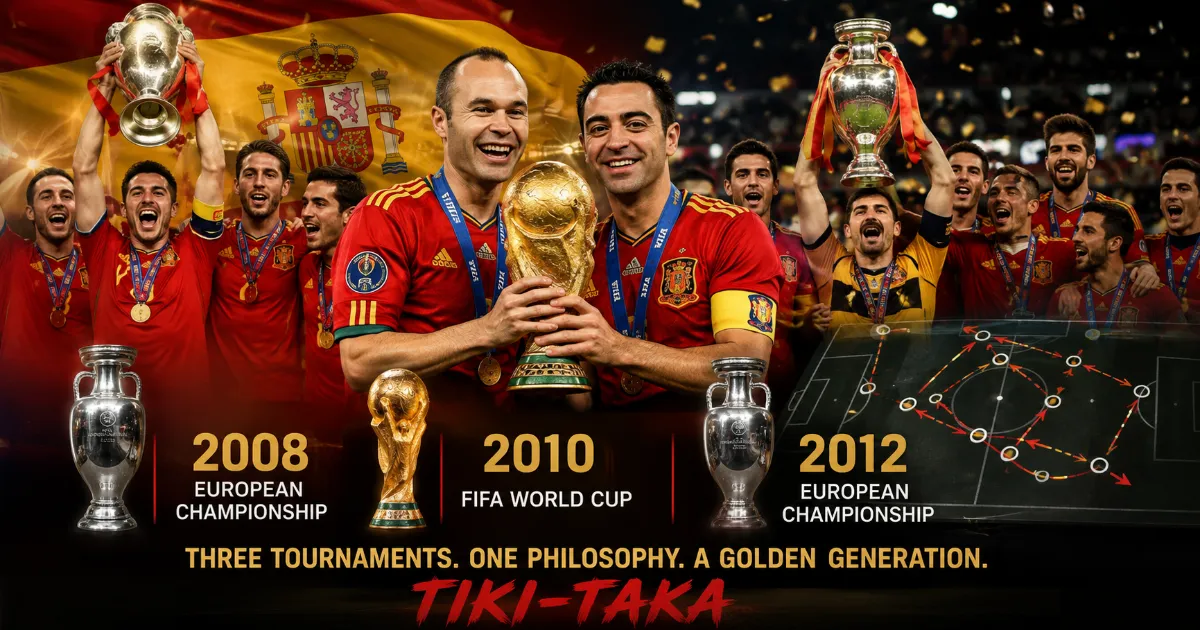
Between 2008 and 2012, Spain achieved something no international side had ever managed before or has managed since: winning three consecutive major tournaments, back-to-back European Championships bookending a World Cup title, all built on a possession-based playing style that came to be known worldwide as tiki-taka. This is a tournament-by-tournament look at how a golden generation of Spanish players turned patient, relentless passing into the most dominant run in the history of international football.
LaLiga 2026/27 Schedule: Fixtures, Dates & Times
The 10 Highest-Paid Footballers in the World
Football League Structure Explained: Promotion, Relegation & Cups Made Simple
Setting the Stage: A Nation Known for Underachievement
Before 2008, Spain’s national team carried a reputation almost entirely opposite to what it would become. Despite regularly producing individually gifted players and entering tournaments as one of the pre-tournament favorites on paper, Spain had a long, frustrating history of underperforming on the biggest stage, exiting tournaments earlier than their talent seemed to warrant and earning a reputation, fair or not, as perennial “nearly men” of international football. Their only previous major title had come at the 1964 European Championship, a trophy so distant that an entire generation of Spanish fans had grown up never having seen their country win anything of significance.
That underachievement made what followed all the more remarkable, and it makes understanding the shift in approach under manager Luis Aragonés, who took charge in 2004, essential to the entire story. Aragonés made a deliberate decision to build his squad around technically gifted, possession-oriented players rather than more physically dominant, direct alternatives, prioritizing control of the ball above almost everything else. It was a philosophy that would come to define Spanish football for the better part of a decade, even if few fully appreciated its significance heading into the summer of 2008.
Euro 2008: The Breakthrough
Spain arrived at the European Championship in Austria and Switzerland with talent to spare but decades of tournament disappointment hanging over the squad. Aragonés’s team, built around a midfield trio of Xavi Hernández, Andrés Iniesta, and Marcos Senna, alongside David Villa and Fernando Torres leading the attack, played a brand of quick, patient passing football that stood in sharp contrast to the more direct, physical approach favored by several of the tournament’s other contenders.
Spain cruised through the group stage before eliminating Italy on penalties in the quarterfinals, a symbolically important win given Italy’s reputation for shutting down attacking sides through defensive discipline. A commanding semifinal win over Russia, the same opponent Spain had thrashed in the group stage, set up a final against Germany, one of international football’s most consistently successful nations. Fernando Torres’s first-half goal, a clinical finish after rounding German goalkeeper Jens Lehmann, proved to be the only goal of the match, delivering Spain’s first major trophy in 44 years and, more importantly, validating the passing-based approach Aragonés had spent years building. Xavi was named player of the tournament, an early sign of the central role his metronomic passing would play throughout Spain’s coming era of dominance.
The Transition to Del Bosque
Aragonés stepped down after the Euro 2008 triumph, handing the reins to Vicente del Bosque, a manager with his own considerable pedigree from a hugely successful spell at Real Madrid. Rather than overhaul a winning formula, del Bosque largely preserved and refined the tiki-taka approach, integrating Barcelona’s rapidly emerging young talents, most notably Sergio Busquets and eventually a teenage Pedro, alongside the core group that had triumphed in Austria and Switzerland. This continuity mattered enormously, since much of Spain’s tactical identity during this era was inseparable from the specific players executing it, several of whom had grown up playing together at Barcelona’s La Masia academy and understood the demands of the system on an almost instinctive level.
2010 World Cup: History in South Africa
Spain traveled to South Africa in 2010 as one of the clear tournament favorites, but their campaign began in the worst possible fashion, a shock opening defeat to Switzerland that immediately raised familiar questions about Spanish tournament fragility. What followed instead was one of the most remarkable recoveries in World Cup history. Spain won every remaining match of the tournament, a run that included knockout victories over Portugal, Paraguay, and Germany, each secured by the same narrow scoreline that would come to define their entire tournament: a single goal.
That pattern held all the way to the final against the Netherlands, an intensely physical, at times openly hostile match that saw Dutch players repeatedly attempt to disrupt Spain’s rhythm through aggressive, occasionally reckless challenges, most infamously a chest-high lunge from Nigel de Jong on Xabi Alonso that many observers felt warranted a red card rather than the yellow it received. Despite the physical battle, Spain’s patience eventually told, and deep into extra time, Andrés Iniesta struck a controlled, first-time volley into the bottom corner, securing Spain’s first-ever World Cup title with virtually the last meaningful action of the match. It was a fittingly understated goal for a tournament built almost entirely on control rather than spectacle, Spain’s lowest-scoring World Cup triumph in the competition’s history, yet one of its most statistically dominant in terms of overall possession and territorial control.
Euro 2012: The Peak of Tiki-Taka
If Euro 2008 was the breakthrough and the 2010 World Cup was validation on the sport’s biggest stage, Euro 2012 in Poland and Ukraine represented tiki-taka pushed to its most extreme, and most devastatingly effective, conclusion. Del Bosque made one of the most tactically daring decisions of the entire era during the tournament, at times fielding a lineup without a recognized center-forward at all, instead deploying Cesc Fàbregas in a fluid false-nine role, surrounded by the interchanging movement of Xavi, Iniesta, Silva, and Xabi Alonso. The approach prioritized total control of possession and space over traditional attacking structure, a style so extreme that it drew criticism from some pundits even as it continued to produce results.
Spain dropped points only once across the entire tournament, a draw against Italy in the group stage, before dispatching France in the quarterfinals and edging past Portugal on penalties in a tense semifinal. The final delivered the most emphatic possible statement of Spain’s dominance: a 4–0 demolition of Italy, the same opponent they’d drawn with in the group stage, in a match that saw David Silva open the scoring with a header before Jordi Alba, Fernando Torres, and substitute Juan Mata added further goals against an Italian side reduced to ten men in the second half due to injuries after exhausting their substitutions. It remains the largest winning margin in any European Championship final, and it made Spain the first nation in football history to win three consecutive major international tournaments.
Why Tiki-Taka Worked
At its core, tiki-taka was built on a deceptively simple principle: keep the ball, deny opponents the chance to attack, and wait patiently for the right moment to break through a defense that had been worn down by relentless, low-risk passing. What made Spain’s execution of the philosophy so effective wasn’t just the technical quality of individual passes, but the positional intelligence and off-the-ball movement of players like Xavi and Iniesta, who consistently found space between opposition lines that conventional defensive structures struggled to account for. This was reinforced by an aggressive pressing trigger the moment possession was lost, a tactic sometimes referred to as the “five-second rule,” designed to win the ball back immediately rather than allow opponents any time to counter-attack while Spain’s own players were still out of defensive shape.
The approach also placed extraordinary physical and mental demands on the players executing it, something that became increasingly apparent as the era wore on. Maintaining the intensity of the pressing triggers and the sheer volume of passes required across a full ninety minutes, repeated across seven matches in a single tournament, took a toll that became more visible as Spain’s core group aged, a factor widely cited when the team’s fortunes began to decline in the years that followed this unprecedented run.
The Beginning of the End
Spain’s dominance didn’t survive much beyond 2012. Their title defense at the 2014 World Cup in Brazil ended in humiliating fashion, with a group-stage exit that included a 5–1 thrashing at the hands of the Netherlands, the very team they had beaten in the 2010 final, a result that many pundits pointed to as evidence that opposing sides had finally worked out effective countermeasures against tiki-taka’s reliance on patient possession. Age, tactical predictability, and the natural erosion of a golden generation all played a role in the sudden and dramatic fall from a team that had, just two years earlier, been utterly untouchable on the international stage.
The Lasting Legacy
Regardless of how quickly the dominance faded, Spain’s 2008 to 2012 run remains one of the most significant achievements in football history, and its influence on the sport’s tactical evolution is still visible today. The core principles of tiki-taka, patient buildup, positional interchange, and coordinated pressing to win the ball back quickly, have been absorbed and adapted by coaches and national teams across the world, even as pure, unmodified tiki-taka has largely fallen out of fashion in its most extreme form. For an entire generation of Spanish players, and for Xavi and Iniesta in particular, that three-tournament run remains the definitive answer to decades of questions about whether Spanish football’s obvious talent could ever translate into sustained success on the biggest stages, and for a few unforgettable years, the answer was an emphatic, historically unprecedented yes.
The Players Who Made It Possible
No account of Spain’s dominant era is complete without recognizing the specific individuals who made the system function so effectively. Xavi Hernández, often described as the metronome of the entire operation, dictated the tempo of nearly every match Spain played across the three tournaments, completing passes at a volume and accuracy rate that redefined expectations for what a deep-lying midfielder could control in a match. His partnership with Andrés Iniesta, a player whose close control and ability to glide past defenders in tight spaces made him uniquely suited to breaking down deep, organized defensive blocks, formed the beating heart of Spain’s midfield throughout the entire era.
Behind them, Sergio Busquets quietly performed one of the most underappreciated roles in the whole system, shielding the back line and recycling possession with a positional discipline that allowed Xavi and Iniesta the freedom to focus on progressing play further up the pitch. Iker Casillas, Spain’s captain and goalkeeper throughout the era, provided a calm defensive foundation, while Carles Puyol and Gerard Piqué anchored a defense that rarely faced the volume of shots typical opponents might expect, simply because Spain controlled the ball so completely for such long stretches of every match. Even the attacking players in this system, David Villa in particular, had to adapt their game to fit the collective rhythm, often working with fewer direct scoring chances than a traditional striker might expect, yet still finding ways to convert the moments Spain’s relentless possession eventually created.
The Barcelona Connection
It’s impossible to separate Spain’s tiki-taka era from what was happening simultaneously at club level with FC Barcelona. Under Pep Guardiola, who took charge of the Catalan club in 2008, Barcelona was developing and refining an almost identical possession-based philosophy with many of the same players who would go on to define Spain’s national team success, Xavi, Iniesta, Busquets, and Piqué all featured prominently for both club and country during this period. The two teams effectively became mirror images of one another tactically, with innovations tested and honed at club level frequently finding their way into the national team setup, and vice versa.
This overlap meant that by the time major tournaments arrived, several of Spain’s key players had already spent an entire club season executing an almost identical system together, developing an instinctive understanding of each other’s movement and decision-making that opposing national teams, who typically only assembled a few weeks before a tournament, simply couldn’t replicate. Some football analysts have argued that this Barcelona-Spain overlap was arguably as important to the era’s success as any single tactical innovation, since it effectively gave the national team a head start in cohesion that no rival could match.
How Opponents Tried, and Mostly Failed, to Stop It
Across the three tournaments, various opponents experimented with different approaches to disrupting Spain’s control, with limited success. Physical, aggressive man-marking, as the Netherlands attempted in the 2010 World Cup final, occasionally slowed Spain’s rhythm but rarely stopped it entirely, and often resulted in disciplinary problems for the team attempting it. Deep, defensive blocks designed to deny Spain space between the lines proved more effective in limiting clear scoring chances, but still struggled to prevent Spain from eventually wearing down a defense’s concentration and discipline over ninety minutes of sustained pressure. Only in the years following Euro 2012 did teams begin to develop more consistently effective counters, often built around fast transitions designed to exploit the space Spain’s high defensive line left in behind, an approach the Netherlands executed to devastating effect in their 2014 World Cup group-stage demolition of the reigning champions.
A Style That Changed How Football Is Coached
Beyond the trophies themselves, Spain’s 2008 to 2012 run left a lasting mark on how football is taught and coached at every level, from academy setups to senior international teams. Concepts that were relatively niche before this era, positional play, coordinated pressing triggers, and deliberate patience in possession rather than direct, vertical attacking, became standard vocabulary across coaching courses worldwide in the years that followed. Even national teams and clubs that never fully adopted tiki-taka in its purest form absorbed elements of its underlying principles, a testament to just how influential this specific golden generation’s success proved to be, far beyond the borders of Spain itself.
🔹🔹 Follow Us on Facebook 🔹🔹
Bangladesh Create History in Darwin, Defeat Australia by Nine Wickets in Landmark Test Victory
About the Author