What Is Football’s Financial Fair Play Rule? How It Works in 2026
Almost every football fan has heard the phrase “Financial Fair Play,” usually shouted at a referee, a rival club, or a transfer rumor that seems too good to be true. Far fewer could explain what it actually requires, why it exists, or how dramatically it has changed since the term first entered the sport’s vocabulary back in 2010. The short version: Financial Fair Play, in its original form, doesn’t technically exist anymore. What replaced it in 2026 is stricter in some ways, looser in others, and split across three competing systems that don’t always agree with each other.
Where Financial Fair Play Actually Came From
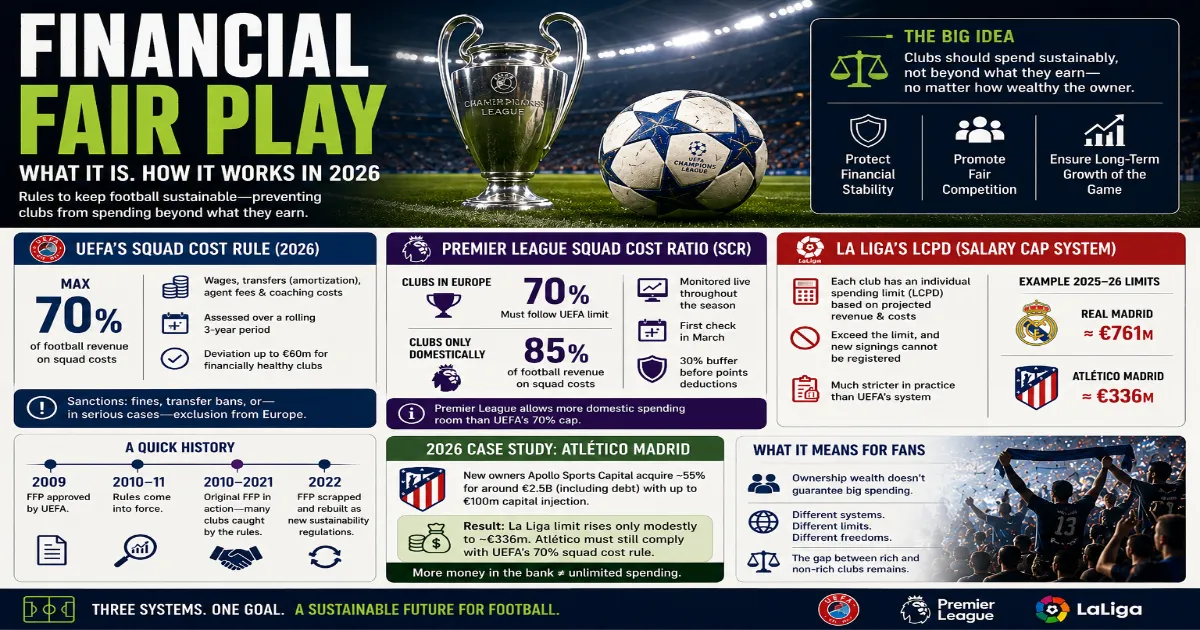
The original Financial Fair Play rules were approved by UEFA’s Executive Committee in 2009 and came into force for the 2010-11 season, introduced after a study found that more than half of roughly 650 European clubs surveyed were operating at a financial loss. The principle behind the rules was simple: clubs should not spend significantly more than they earn, regardless of how wealthy an owner might be willing to be. The phrase most associated with the era’s architects was that clubs should be helped to live within their own means, not punished for ambition.
In practice, FFP rested on three pillars. Clubs had to avoid overdue payables to other clubs, employees, and tax authorities. They had to meet a break-even requirement assessed across rolling three-year periods, with some permitted deviation. And they had to satisfy general club licensing criteria covering everything from stadium standards to youth development infrastructure. The system caught plenty of smaller clubs out, and prize money was withheld from over twenty clubs within just a couple of years of its introduction. But its biggest test cases, involving Manchester City and Paris Saint-Germain, exposed how clubs backed by wealthy ownership groups could use related-party sponsorship deals to inflate revenue figures in ways the original rules struggled to police effectively.
Why FFP Was Scrapped and Rebuilt
By 2022, UEFA accepted that the break-even model had run its course. The organization rebuilt the framework from scratch and renamed it the Club Licensing and Financial Sustainability Regulations, though almost everyone in football, media included, still defaults to calling it FFP out of habit. The new system kept two of the old pillars in modified form — the no-overdue-payables rule and a reworked “football earnings” stability test — but added something the original version never had: a hard cap on squad spending relative to revenue, known as the squad cost rule.
That squad cost rule is the single biggest shift the 2026 version of these regulations represents, and it’s worth understanding in detail, because it’s the part that actually determines what clubs can spend on transfers and wages right now.
How the Squad Cost Rule Works
Under UEFA’s current regulations, a club competing in the Champions League, Europa League, or Conference League cannot spend more than 70% of its defined football revenue on player and coaching wages, transfer amortization, and agent fees. That 70% threshold was phased in gradually to avoid shocking clubs that had built squads under the old system — set at 90% for the 2023-24 season, tightened to 80% for 2024-25, and locked at 70% from the 2025-26 season onward, where it remains in 2026.Premier League vs MLS vs Saudi Pro League vs ISL 2026: Full Comparison of Fans, Tickets & Streaming
The “revenue” side of that equation isn’t simply turnover. It excludes one-off, non-footballing income and focuses specifically on money generated through football operations — matchday revenue, broadcasting rights, sponsorship, and commercial income tied to the club’s footballing activity. A club showing strong growth in sponsorship or a deep Champions League run sees its allowable spending ceiling rise alongside it, while a club whose European participation, and the broadcast revenue that comes with it, dries up will see that ceiling fall just as quickly. Clubs deemed financially healthy by UEFA’s monitoring body can be granted slightly more flexibility around permitted deviations, with the allowed three-year deviation increased from an original €30 million to €60 million for clubs that demonstrate strong underlying financial health.
Breaching the rule doesn’t trigger an automatic points deduction the way some fans assume. UEFA’s Club Financial Control Body applies a graded scale of sanctions depending on the severity and frequency of breaches over a rolling four-year period, ranging from fines and transfer restrictions up to, in the most serious and repeated cases, exclusion from European competition altogether.
The Premier League’s Own, Different System
Here’s where it gets genuinely confusing, even for people who follow this closely. The Premier League has historically run its own domestic rules in parallel with UEFA’s, called Profitability and Sustainability Rules, which limited clubs to losses of no more than £105 million across a rolling three-year period. From the 2026-27 season, the Premier League is scrapping that loss-based model entirely in favor of its own version of a squad cost system, called the Squad Cost Ratio.
Under the Premier League’s version, clubs playing only domestically can spend up to 85% of football revenue on squad costs, while clubs competing in Europe must stick to UEFA’s stricter 70% limit to remain eligible for those competitions. Compliance will be monitored live throughout the season rather than retrospectively, with an initial check scheduled for March each year, and clubs get an additional 30% buffer above the relevant threshold before facing points deductions. UEFA’s financial sustainability leadership has openly criticized the Premier League’s looser domestic limit, arguing that the gap between the two systems risks concentrating an outsized share of the world’s best players inside one league, since clubs not competing in Europe under the 85% Premier League cap can outspend their continental peers who remain capped at 70%.
La Liga’s Separate Salary Cap System
Spain runs an entirely different model again, one that has nothing to do with UEFA’s revenue ratio at all. La Liga imposes its own club-by-club spending limit, known as the LCPD, calculated individually for every club each season based on projected revenue and costs. The gap between clubs under this system can be enormous. Real Madrid’s limit for the 2025-26 season sits at roughly €761 million, while a club like Atlético Madrid operates with a limit closer to €330 million — more than twice as restrictive.The 4-3-3 Formation Explained: Roles, Strengths, Weaknesses and Why It Dominates Modern Football
What makes Spain’s system distinct, and arguably stricter in practical terms than UEFA’s approach, is that a club exceeding its limit simply cannot register new player signings at all, regardless of intent to comply eventually. Barcelona experienced this directly and very publicly, with the club unable to register Jules Koundé for weeks after his 2022 transfer, and again during a prolonged saga over Dani Olmo’s registration that stretched from late 2024 into 2025. UEFA’s question, broadly, is whether a club is losing more than it can sustainably absorb. La Liga’s question is blunter: can this specific club genuinely afford this specific signing right now.
The Ongoing Argument Nobody Has Settled
Even within football’s own administrative circles, there’s no real consensus that the current setup is an improvement worth celebrating just yet. La Liga’s president has been openly critical of the divergence between leagues, arguing that allowing England’s top clubs more domestic spending room while the rest of Europe operates under tighter limits will simply push transfer fees and wages higher across the board, since clubs everywhere ultimately compete in the same global market for the same pool of elite players. UEFA’s own financial sustainability leadership has pointed out that England’s top flight now generates close to a quarter of all European club football revenue on its own, and warned that pairing that financial advantage with a looser domestic spending cap risks pulling an even larger share of the sport’s best talent into one country, regardless of which clubs there actually play in Europe each season.VAR in Football Explained: How It Works, Why It Divides Fans and What’s New at World Cup 2026
The Premier League’s position is essentially the opposite: that a domestic competition should be free to decide its own competitive balance without having UEFA’s continental framework imposed on clubs that may not even qualify for European football in a given season. Both arguments have some merit, which is part of why this debate hasn’t gone away just because FFP got rebranded and tightened. If anything, having three separate systems now running simultaneously — UEFA’s squad cost rule, the Premier League’s new SCR, and La Liga’s club-by-club LCPD — has made the overall picture more layered rather than simpler, even if each individual system on its own is more rigorous than the original FFP framework it grew out of.
A 2026 Case Study: Atlético Madrid’s New Ownership
The clearest real-world illustration of how these rules interact with club ownership changes arrived in March 2026, when Apollo Sports Capital completed a deal to become Atlético Madrid’s majority shareholder, acquiring roughly 55% of the club at an enterprise valuation near €2.5 billion including debt, alongside an approved capital injection of up to €100 million. New ownership and fresh capital might suggest a club suddenly freed from spending restrictions. It isn’t. Atlético remains bound by both UEFA’s 70% squad cost rule for European competition and La Liga’s individually calculated LCPD limit, which only adjusted modestly upward to around €336 million following the investment. A wealthy new owner can strengthen a club’s balance sheet, but neither UEFA nor La Liga’s rules allow that wealth to simply translate into unlimited transfer spending overnight.
What This All Means for Fans in 2026
The practical upshot of all this for anyone following a club through this transfer window is that headline ownership wealth no longer guarantees uncapped spending power the way it might have a decade ago, but the rules a club faces now genuinely depend on which competitions it plays in and which league it calls home. A mid-table Premier League club with no European football enjoys considerably more room to spend than a Champions League regular operating under UEFA’s tighter 70% ceiling, while two Spanish clubs in the same league can face wildly different individual limits based purely on their own financial profile.Football vs Soccer? The Surprising Truth Behind the Argument
None of this has fully resolved the underlying tension that originally inspired Financial Fair Play back in 2009 — the gap between clubs with enormous broadcast and commercial revenue and those without it. If anything, the divergence between UEFA’s stricter pan-European cap and the Premier League’s more generous domestic one has opened a new front in that same argument, just with more complicated math behind it. Understanding the actual mechanics, rather than just the now-outdated phrase still doing the rounds in pundit shorthand, is the only way to make sense of why some clubs can spend freely in a transfer window while seemingly wealthier rivals suddenly cannot.

▪️▪️ Follow us on Facebook ▪️▪️
About the Author







1 thought on “Inside Football’s Financial Fair Play Rule and the New Squad Cost Era”