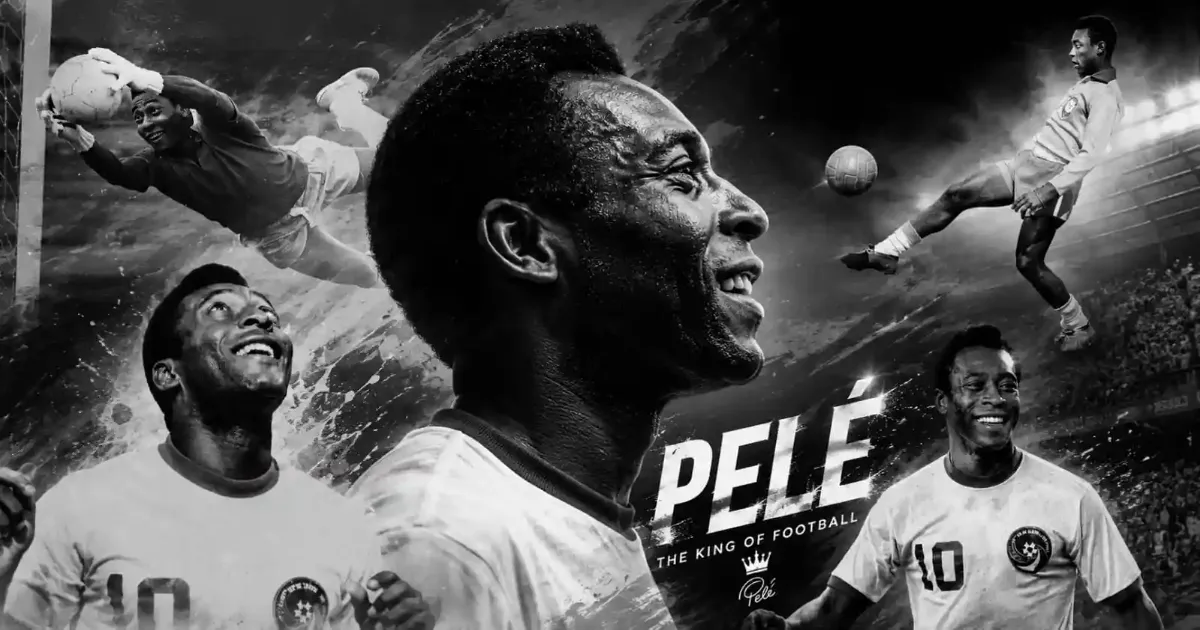
The Question That Never Quite Goes Away
Every major football tournament resurrects the same conversation, and the 2026 World Cup — the biggest, loudest, most globally-watched edition in the sport’s history — is no different. Who is the greatest footballer of all time? The candidates are offered with familiar reverence: Messi, Ronaldo, Cruyff, Zidane, Ronaldo Nazário. The debate is conducted with statistics, highlight reels, and the passion that only football seems capable of generating at this frequency and volume. And yet, at every tournament, the same name keeps surfacing — not as an entry in the debate so much as the fixed point around which the debate orbits.
Who Is Gianluigi Buffon? The Journey of Italy’s Legendary Goalkeeper
More Than a Footballer: How David Beckham Built a Global Brand That Will Outlast His Career
Diego Maradona: The Rise, the Ruin and the Religion He Became
He passed away in December 2022, just over three years ago. He is not here to see a World Cup played on the continent where, in 1994, he served as the sport’s living, breathing ambassador. He cannot add to his records, cannot give new interviews, cannot respond to the comparisons. And yet as the 2026 World Cup kicks off at the Estadio Azteca — the same stadium where, in 1970, he turned the World Cup final into a personal exhibition — his presence is felt across the tournament in a way no other absent player’s could be.
His name is inscribed on youth academies. FIFA still includes his story in their educational programmes. Brazilian football authorities have proposed a national holiday in his honor. The footage, the interviews, the speeches — all of it continues to circulate, to inspire, to inform a generation of players who were born long after he retired. Six years on from a career that formally ended in 1977, Pelé’s legacy is not fading. It is, if anything, intensifying.
This is an attempt to understand why.
The Boy Who Became a Benchmark
Edson Arantes do Nascimento was born in Três Corações, in the state of Minas Gerais, on October 23, 1940, into a family without money in a country where football was already a national religion. His father, Dondinho, was a professional footballer of modest talent, which meant the house had love for the game but not much else. The nickname “Pelé” came from childhood — likely a mispronunciation of the name of a local goalkeeper his friends admired — and Pelé himself claimed for years that he disliked it initially, that it felt like a nickname rather than a name. By the time he was fifteen and on the books at Santos FC, the name that had started as a taunt was already being whispered in circles that mattered.
At sixteen, he scored his first league goal. The trajectory from there is one of sport’s great biographical rocket launches — steep, almost vertical, and sustained at height for longer than the physics of athletic careers should permit.
But before we get to the numbers — and there are numbers here that demand to be sat with — it’s worth pausing on what Pelé actually looked like when he played. In the era before full televised football, before VHS and streaming, before every moment was captured and dissected from seventeen angles, the way Pelé played was transmitted primarily through description. And the descriptions are astonishing in their consistency. Players who played against him, journalists who watched him, coaches who tried to prepare for him — they all use the same vocabulary, across decades and across languages: extraordinary, impossible, inhuman, joy.
That last word comes up more than any other. Joy. The player who scores 77 international goals and wins three World Cups is supposed to be described in terms of power, precision, ruthlessness. And Pelé had all of those. But what the people who were actually there always come back to, in the end, is joy — the sense that Pelé played football as though he genuinely couldn’t imagine anything he’d rather be doing, and that this feeling was contagious, spreading from the player to the pitch to the stands in a way that statistics simply cannot capture.
The Numbers That Cannot Be Argued Away
With that caveat acknowledged, the numbers genuinely are extraordinary. Pelé is the only player in history to win three FIFA World Cups — in 1958, 1962, and 1970. Across more than six decades since he first lifted the trophy as a seventeen-year-old in Stockholm, no other player has come close. Maradona won one. Zidane won one. Messi won one. Ronaldo Nazário won two. The greatest players across the sport’s entire modern history have collectively managed what Pelé did alone.
The youngest angle of the 1958 achievement refuses to lose its force, no matter how many times you return to it. At the Sweden World Cup, Pelé lifted the trophy aged just 17 years and 249 days — the youngest player in history to win a World Cup, a record that has survived intact through every tournament since, including the 2026 edition now underway in North America. What makes the achievement even more striking is that he wasn’t a peripheral participant, a squad player who happened to be on the right team. He scored six goals at that tournament — the most by any teenager in a single World Cup edition, another record that remains unmatched. He scored twice in the 5-2 final victory over Sweden, one of those goals a breathtaking improvised chip that became one of the most replayed moments in football history.
At club level, the numbers carry a different kind of force — the force that comes from volume accumulated over time. Pelé scored a record 1,281 goals in 1,363 games when unofficial matches are included. Even his official international tally — 77 goals in 92 appearances for Brazil — made him the country’s all-time leading scorer for decades, a record he held jointly with Neymar until the present era. His goals-per-game ratio at international level, across a career spanning the late 1950s to 1971, remains extraordinary by any contemporary standard.
There is also the assists record that tends to get overlooked. Pelé holds the record for most assists in FIFA World Cup history — 10 in total, with seven of those coming in the 1970 edition alone, another single-tournament record. That the man associated primarily with spectacular personal goals is also the World Cup’s all-time assist leader reflects something important about how he actually played — generously, with an awareness of teammates that his individual brilliance sometimes obscures in the historical retelling.
The Records That Survived Everyone
As of the 2026 World Cup, several of Pelé’s records remain completely intact. This matters partly because of who has tried and failed to surpass them. Messi and Ronaldo — the two players who have most credibly entered the modern GOAT debate — have both had careers of extraordinary length, quality, and statistical output. And yet neither has won three World Cups. Neither has scored more goals in a single World Cup as a teenager. Neither can claim to have been voted World Player of the Century by the International Federation of Football History and Statistics, as Pelé was in 1999. Neither was selected as Athlete of the Century by the International Olympic Committee that same year. Neither appeared on Time magazine’s list of the 100 most influential people of the 20th century.
That last distinction is worth dwelling on. Time’s list encompasses politics, science, art, literature, medicine, and activism. Pelé appears alongside figures whose names represent world-historical movements and discoveries — and he appears there not as a sports footnote but as a genuine representative of the sport’s capacity to shape culture at a global scale. He was, as one analysis put it, the person who led the globalization of football — the player whose worldwide fame, amplified by Santos’s international touring schedule, helped transform a sport that was primarily European and South American in its global reach into something genuinely planetary.
The Three Worlds He Conquered
To fully understand Pelé’s legacy is to understand that he operated across three entirely different eras of football and remained dominant in all of them.
The first era was the late 1950s — a period of limited television coverage, when football was primarily experienced live or through radio, and when a seventeen-year-old from Brazil arriving at the World Cup in Sweden was largely unknown outside his own country. He left Sweden as the tournament’s standout player, known around the world. That transformation — from anonymous teenager to global name in the space of three weeks — is staggering by any era’s standard, but it was particularly staggering in 1958, when communication was slow and international media coverage of non-European players was thin.
The second era was the 1960s, when Santos built a touring model around Pelé’s fame that took them across Europe, North America, Africa, and Asia — turning the club into a travelling exhibition of what Brazilian football looked like at its finest. It was during this period that Pelé’s role shifted from footballer to something closer to the sport’s global spokesperson, the figure that FIFA and football federations around the world pointed to when they needed to explain why this game mattered.Lionel Messi on Retirement: His Thoughts on Legacy, Argentina, and World Cup 2026
The third era was 1970 — the Mexico World Cup, the first to be broadcast in color around the world, a tournament that turned Pelé and Brazil’s team into perhaps the most celebrated side in the sport’s history. The 1970 Brazilian squad — Pelé, Jairzinho, Rivelino, Tostão, Carlos Alberto — is discussed by coaches and historians not merely as a great team but as the articulation of an ideal, a version of what football could look like when skill, intelligence, and athleticism were perfectly combined. Carlos Alberto’s goal in the final, completed by a sweeping move involving most of the team and finished by a thundering shot into the corner, was assisted by Pelé with a characteristic combination of awareness and restraint — the pass placed not where the teammate was, but where he was about to be.
What 2026 Owes to 1958
The 2026 World Cup is, in many ways, a direct descendant of the transformations Pelé helped set in motion. The tournament’s expansion to 48 teams — bringing in nations from every corner of the globe — reflects the sport’s genuinely universal reach, a reach that Pelé spent his post-retirement career actively promoting. As a UNESCO Goodwill Ambassador, he traveled continuously, not to watch football but to advocate for it as a vehicle for social development, for youth engagement, for the kind of cross-cultural communication that the sport, at its best, uniquely provides.
The tributes visible across this 2026 tournament — stadium names, youth academies bearing his name, FIFA’s continuing educational programmes built around his story — are tangible expressions of an influence that operates beyond the reach of scoring statistics or trophy counts.
The irony is that no amount of tribute can fully capture what made Pelé extraordinary, because what made him extraordinary was not primarily measurable. The records — three World Cups, 77 international goals, 1,281 career goals, the youngest World Cup winner in history — are real and impressive and unbroken. But they are the residue of something that preceded them: a particular relationship with the football, with teammates, with the crowd, with the occasion itself, that produced moments which even people who weren’t alive to witness them can recognize as different in kind from ordinary sporting excellence.
The Benchmark That Holds
In 1999, the former Ballon d’Or winners gathered by France Football were asked to name the football player of the century. They chose Pelé. The International Federation of Football History and Statistics voted him World Player of the Century the same year. The IOC named him Athlete of the Century.
These are not sentimental distinctions awarded to the most famous name. They are judgments made by people who know the sport and the athletes better than most — peers, experts, historians — and they converge on the same answer from different directions.
As the 2026 World Cup unfolds across the stadiums of Mexico, Canada, and the United States — as Mbappe and Vinicius and Yamal and Pedri contest the sport’s highest stage in search of their own legacies — the benchmark they are being measured against is not their immediate predecessors. It is a seventeen-year-old who arrived in Sweden in 1958 and never really left. The greatest footballer who ever lived isn’t playing in 2026. But in every argument about who might become him, he’s still the standard.
🔹🔹 Follow us on Facebook 🔹🔹
About the Author

3 thoughts on “Pelé: The Untouchable Legacy That Still Defines Football in 2026”