 The Legend Maradone
Let’s set the scene precisely, because precision matters when the details are this extraordinary.
Estadio Azteca, Mexico City. 114,000 people inside the largest football stadium in the world. Argentina vs England in the quarter-final of the 1986 FIFA World Cup — a match loaded with a kind of tension that extended well beyond football. Just four years earlier, the two countries had gone to war in the South Atlantic over a chain of islands that Argentina called the Malvinas and Britain called the Falklands. 255 British soldiers died. 649 Argentine soldiers died. Three Falkland Island civilians died. The wounds were still raw, the anger still immediate. No diplomatic protocol had been established. The political relationship between the two nations remained deeply strained.
Diego Maradona: The Rise, the Ruin and the Religion He Became
Pelé’s Age in 2026: His Story, Legacy, and Lasting Records
Football, as it so often does, was being asked to stand in for something it wasn’t equipped to resolve.
Diego Armando Maradona was 25 years old and already widely accepted as the best player in the world. He had arrived in Mexico carrying the full weight of Argentina’s expectations — not just as a footballer, but as a cultural totem, the kid from Villa Fiorito who had survived poverty and the early pressures of astronomical fame to become the living argument for why football was Argentina’s greatest export. After the disappointment of the 1982 World Cup in Spain, where he was sent off in Argentina’s match against Brazil and watched his country exit, this was understood, in a deeply personal way, as his redemption tournament.
He had already proved it. Five goals, five assists, 27 chances created — statistical leadership of his 1986 World Cup in every attacking category — going into the quarter-final against England. The question was not whether Maradona was the best player at the tournament. That was settled. The question — the one that would be answered with astonishing finality in the next forty minutes — was what kind of legend he would become.
The First Goal: What Actually Happened
Steve Hodge, England’s midfielder, received the ball in the Argentine half and attempted to clear it back toward his goalkeeper, Peter Shilton. The clearance was awkward, the ball looping back over both Hodge and the advancing Shilton toward the six-yard box, where Maradona had continued his run from a previous attack.
What happened next was captured on film from multiple angles and has been analyzed thousands of times. Maradona, at 5 feet 5 inches, had no business out-jumping Peter Shilton, at 6 feet tall, in an aerial duel at the near post. He didn’t, in any physical sense, out-jump him. He raised his left arm above his head — specifically, his left fist — and punched the ball into the net. The referee, Ali Bin Nasser of Tunisia, had his view of the contact blocked. The linesman, Bogdan Dotchev of Bulgaria, was too far away to be certain. The goal stood. Argentina 1, England 0.
The English players reacted with immediate fury, surrounding the referee, pointing at their arms, protesting in the universal body language of a team that has just been robbed. Maradona, in the immediate aftermath, joined his teammates in celebration. He did not behave like a player who had done something straightforwardly wrong. He behaved like a player who had done something and was processing what it meant.
After the match, he offered the phrase that would become one of the most quoted sentences in football history. The goal, he said, was scored “a little with the head of Maradona and a little with the hand of God.” It was not, at that moment, a full confession — that would come nearly two decades later, when he admitted plainly that the handball was deliberate. In 1986, it was something more mischievous: a wink at the universe, a statement that acknowledged the ambiguity of the moment while attributing it to something beyond human jurisdiction.
The name stuck immediately. The Hand of God.
Four Minutes Later: The Other Goal
What makes June 22, 1986 uniquely extraordinary in football history is not that one of the most controversial goals ever scored happened that afternoon. Controversial goals happen. Referees miss things. In a sport without technology to correct them in real time, they miss things that change matches and careers. That’s not remarkable in itself.
What is remarkable — what has no real parallel in the sport’s history — is what happened four minutes after the Hand of God. Because in the 55th minute, Diego Maradona picked up the ball in his own half and scored a goal that was, by consensus vote of FIFA’s audience in 2002, the greatest goal in World Cup history. Immediately after the most infamous goal, the most celebrated one.
The sequence has been described in exact detail many times, but it gains nothing from abbreviation. Maradona received a pass from Jorge Valdano around the halfway line, slightly to the right of centre in Argentina’s defending half. He took one touch to control, one touch to begin moving, and then ran. The English midfield — Terry Butcher, Peter Reid, Terry Fenwick — arrived and were passed. Maradona changed direction, accelerated, changed direction again. The full-backs arrived and were passed. Then Peter Shilton, coming off his line, arrived — and was passed, the ball rolled into the net with Maradona continuing his run in the same direction as if the finish were merely the logical conclusion of a sentence he’d been writing since the halfway line.
He had beaten five players individually and run 60 metres from his own half. The move took eleven seconds. He touched the ball twelve times.
England’s Terry Butcher, one of the most intimidating defenders in European football at the time, later said it simply: “He just went past me as if I wasn’t there.” That sentence, from a man of Butcher’s physical reputation, is its own kind of tribute.
The Falklands Dimension
It would be dishonest to discuss this match without confronting what Maradona himself said about it. He was not ambiguous, in later life, about how he understood the goals within their political context. He described the handball goal explicitly as “symbolic revenge” for the Falklands War — revenge for Argentina’s military defeat at the hands of the British, channelled through a football match, delivered in plain sight of a billion television viewers, by a left fist that the referee couldn’t see.
This framing has made many people, particularly in England, uncomfortable with the idea of celebrating anything Maradona did that afternoon. It hardened the handball from an accidental advantage taken into a deliberate, politically-charged act of defiance. And it is, by any straightforward reading, cheating — a point the sport’s modern VAR technology would have corrected instantaneously. The goal would be disallowed today before the celebration had even begun.
But — and this is where the Maradona story refuses the simple moral framework — the context of Argentina in 1986 also needs to be understood honestly. The country had emerged from years of military dictatorship. The junta that had launched the Falklands War had collapsed. Young Argentines who died in that conflict were conscripted, many of them teenagers who had no real comprehension of what they were being sent to fight. Maradona grew up in Villa Fiorito, one of the poorest barrios in Buenos Aires. He understood what it meant to be from the parts of Argentina that institutions failed. The weight he was carrying into Azteca that afternoon was not just about football.
None of that makes the handball goal a legal goal. It was not. But it does complicate what it meant — to Maradona, to Argentina, to football as a political and cultural space — in ways that a simple verdict of “cheating” doesn’t fully address.
The Game in Full: A Maradona Masterclass
Remove the controversy entirely — pretend the 51st-minute goal didn’t happen — and the 1986 World Cup quarter-final against England is still one of the finest individual performances in a major tournament match in the sport’s history. Maradona’s numbers across the entire tournament tell their own story: 5 goals, 5 assists, 27 chances created, 30 shots, 53 fouls drawn — he led the tournament in every attacking category, and in some defensive categories too, pressing from the front with an intensity that teammates said was as demanding for opponents to deal with as his individual quality.
Against England specifically, he was everywhere. He dropped deep to collect the ball, drove forward, spread play, created angles for runners, and produced moments of individual skill that had English defenders shaking their heads in something approaching disbelief. Peter Reid, one of the most accomplished midfielders in England’s squad, recalled simply that Maradona was “unplayable” that afternoon — which is a large thing to say about a player your team was specifically tasked with stopping.
The Golden Ball that Maradona won as the 1986 World Cup’s best player is one of the most comprehensively earned individual awards in major tournament history. Argentina won the tournament, beating West Germany 3-2 in the final in Mexico City. But Maradona’s contribution was of a different order to a typical World Cup winner’s contribution — more central, more personal, more decisive. Many experienced football observers have attributed Argentina’s 1986 World Cup title as essentially a product of one man’s exceptional tournament, in a way that can be said of almost no other champion in World Cup history.
The Myth Takes Shape
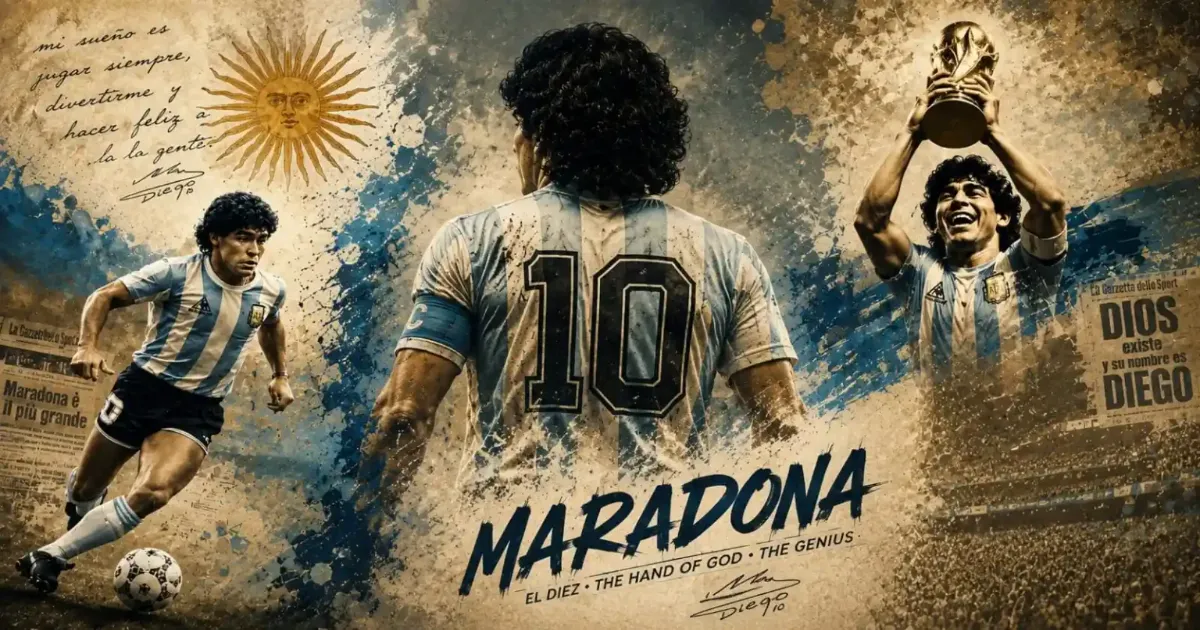
The afternoon of June 22, 1986 did something that a mere World Cup winner’s medal, or a Golden Ball award, or a record-setting tournament performance could not on its own do. It turned Maradona into a myth.
Myths require contradiction. They require something that the rational mind struggles to fully reconcile. The Hand of God and the Goal of the Century, delivered four minutes apart, by the same player, in the same match, represent the most complete single-match embodiment of contradiction in football history. He cheated and then produced the greatest piece of individual skill the sport has ever seen, in the same 90 minutes. He was simultaneously the devil and the angel, the blemish and the brilliance, the flaw and the genius.
As one analysis put it: “Some goals win matches. Some goals win championships. And then there is the goal that won immortality. The goal that turned a footballer into a myth. The goal that gave Maradona something no trophy could ever provide: footballing divinity.”
That framing captures something real. The Goal of the Century is frequently cited as the greatest individual goal in football history — a status confirmed by an official FIFA poll in 2002 that asked fans around the world to vote. The Hand of God goal, voted in a separate context among the most controversial moments in football history, would have been disallowed by VAR in under thirty seconds today. Together, they define a human being rather than simply a footballer — someone capable of extraordinary beauty and extraordinary moral complexity in the same afternoon.
After 1986: The Weight of the Myth
The years after 1986 were not simple. Maradona’s Naples chapter — where he transformed SSC Napoli from a modest club into the champions of Italy in 1987 and 1989, winning Serie A and the Coppa Italia — added to the legend but also added to the complexity. Drug use, legal troubles, health crises, the struggles of a man who had been a global superstar from adolescence and whose relationship with the adulation that entailed was always fraught. He coached Argentina’s national team from 2008 to 2010, guiding them to the quarter-finals in South Africa before a 4-0 defeat to Germany ended his tenure.PELÉ: WHY THE GREATEST FOOTBALLER WHO EVER LIVED STILL DEFINES THE GAME IN 2026
He passed away on November 25, 2020, at the age of 60, from cardiac arrest at his home in Buenos Aires. The outpouring that followed was unlike anything football had seen for a living player — streets filled with mourners in Buenos Aires, Naples, and Buenos Aires’s Villa Fiorito specifically, the neighborhood where the myth had its origin. Pope Francis, an Argentinian himself, sent condolences. Governments lowered flags. Players who had never seen him play in real time stopped training.
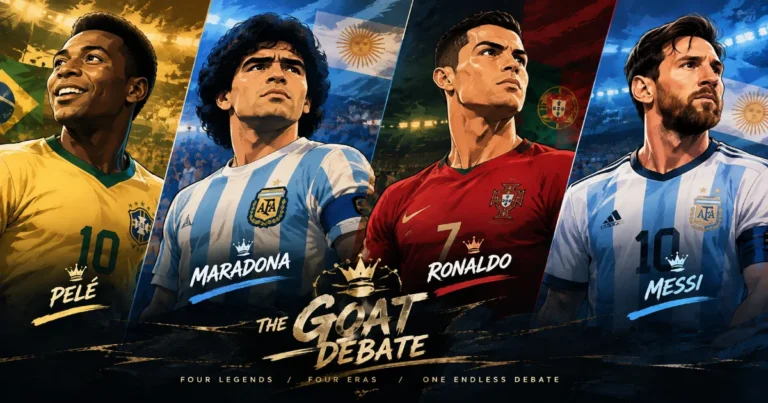
He had scored 34 goals in 91 appearances for Argentina. He had played in four World Cups. He had won one. By the mathematics of the sport alone, his legacy should be narrower than Pelé’s, more debated. And in purely statistical terms, it is. But mythology doesn’t run on statistics. It runs on moments that are impossible to forget, on performances that exceed what the mind expected was possible, on contradictions that make a story feel human rather than merely exceptional.
Why It Still Matters in 2026
The question of why Diego Maradona still matters four decades after that Sunday afternoon in Mexico City has a simple answer: because the match on June 22, 1986 contains, in concentrated form, more of what football actually is than almost any other 90 minutes in the sport’s history. It contains brilliance and controversy, politics and sport, a player at the absolute height of his powers and a player operating outside the rules that govern everyone else. It is beautiful and it is wrong and it is unforgettable.
The 2026 World Cup will produce its own moments of brilliance and controversy, its own goals that are celebrated and dissected, its own arguments that continue long after the tournament ends. But the standard against which those moments will inevitably be measured, consciously or not, was set in four minutes at the Azteca in 1986. Two goals, four minutes apart, by one man, in the same match.
Football has never produced anything quite like it. Probably it never will again. Which is precisely why, forty years on, the myth refuses to quiet down.
NBA Schedule 2026-27: Christmas Day Rivalries, Ring Night and the Games to Watch
About the Author