What Is the Offside Rule in Football? The Clearest Explanation You’ll Ever Read
If you have ever watched football with someone who does not understand the offside rule, you will know the conversation. The flag goes up. The goal is disallowed. And from somewhere in the room comes the question: “But they were running towards goal. How is that offside?”
The 4-3-3 Formation Explained: Roles, Strengths, Weaknesses and Why It Dominates Modern Football
What Is Tiki-Taka? Spain’s Football Philosophy Explained Simply
5 Tactical Formations That Will Define World Cup 2026
This article answers that question completely — starting from the most basic possible definition and building toward the most advanced technology in the history of sport that is currently calling offside decisions at the 2026 FIFA World Cup.
Start Here: The Simplest Possible Definition
The offside rule in football prevents attacking players from simply standing next to the opposition goalkeeper and waiting for the ball to be played to them. That is the purpose. That is why it exists.
Without the offside rule, a striker could station themselves permanently in front of the goalkeeper for an entire match, waiting for a long ball from a teammate fifty metres away. The goalkeeper would be alone against them. The defender would never be able to leave their position. Football would become a game of long passes and tap-ins. It would be neither skilful nor entertaining.
The offside rule forces attacking players to be in legal positions when the ball is played. That requirement is what creates the tactical tension between attackers and defenders that makes football the game it is.
The Official Definition — Law 11
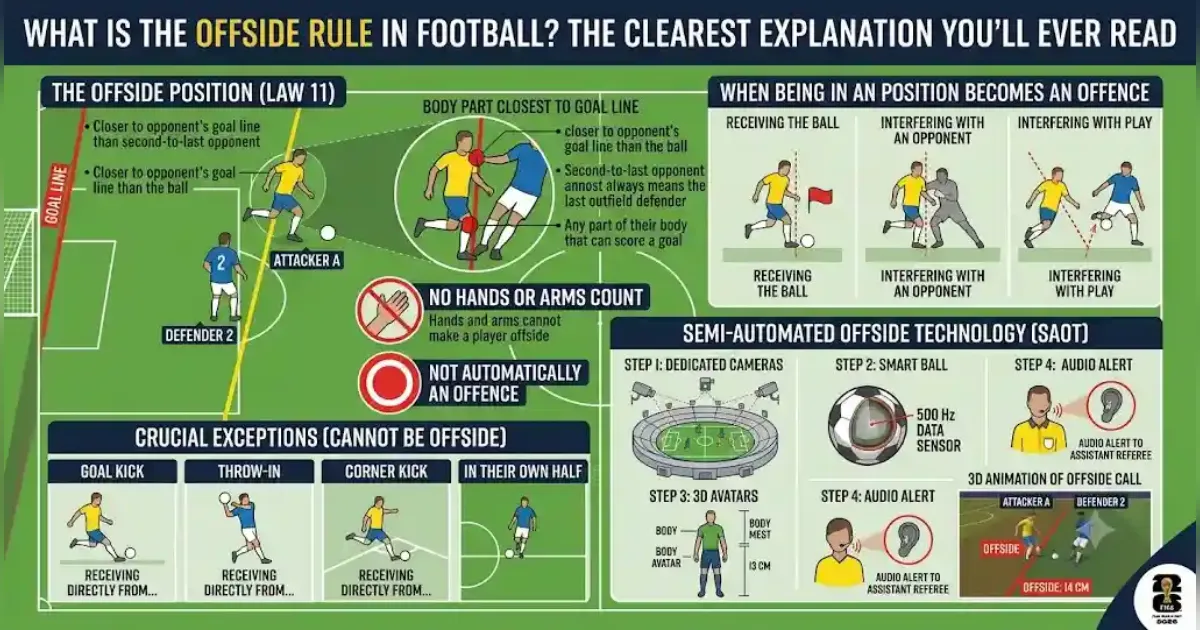
The Laws of the Game describe offside in Law 11. In straightforward language: a player is in an offside position if any part of their body that can score a goal is closer to the opponent’s goal line than both the ball and the second-to-last opponent.
Three elements matter:
1. “Any part of their body that can score a goal” This means any body part except the hands and arms. A shoulder counts. A knee counts. A toe counts. A hand or arm does not count, because the laws do not allow players to score with those body parts.
2. “Closer to the opponent’s goal line than the ball” If the ball is ahead of the attacker when it is played, the attacker cannot be offside regardless of where they are. A player standing in an offside position is immediately onside the moment the ball passes them on its way forward.
3. “Second-to-last opponent” In practice, this almost always means the last outfield defender — because the goalkeeper is typically the last opponent. But if the goalkeeper has advanced and is not between the attacker and the goal, the second-to-last opponent calculation changes. The rule says “second-to-last” rather than “last outfield defender” specifically to account for unusual defensive configurations.
CRUCIAL: Being in an Offside Position Is Not Automatically an Offside Offence
This is the distinction that confuses the majority of casual football viewers.
A player can be in an offside position without being offside.
Being in an offside position only becomes an offside offence if the player becomes involved in active play. The Laws define involvement in active play as:
- Receiving the ball — the ball is played to them from a teammate while they are in an offside position
- Interfering with an opponent — their presence in an offside position affects an opponent’s ability to play the ball. This includes running toward the ball, making a gesture, or obstructing the goalkeeper’s line of sight
- Interfering with play — they touch a ball that rebounds to them off the post or a defending player, if they were in an offside position when the ball was originally played
A striker standing five metres offside who does not go near the ball, does not attempt to receive a pass, and does not interfere with any defender’s ability to play is technically in an offside position but is not offside. Play continues.
The moment that same striker moves toward the ball, or a teammate passes to them — at that point, the offside offence is called.
The Moment That Matters: When Is the Offside Position Assessed?
Offside is assessed at the exact moment the ball is played by the teammate. Not when the ball arrives. Not when the player receives it. Not when they shoot. The moment the ball leaves the passer’s foot.
This creates the race to judge timing that defines the offside call: the assistant referee must freeze the image of the field at the precise millisecond the ball is kicked and assess where every relevant player’s body part is at that single instant.
A player can be onside when the ball is played, then sprint forward and be in a seemingly offside position when they collect it. They are legally onside — because they were behind the second-to-last defender when the ball left their teammate’s foot.
This timing precision is the reason offside has been one of the most contested and controversial decisions in football for over a century. Human assistants were expected to judge millisecond-precise positions across 100 metres of pitch, simultaneously tracking the ball, the passer, and the potentially offside player. The margin for error was significant. The consequences of error were enormous.
Which is why technology intervened.
The Exceptions: When Can a Player Not Be Offside?
There are specific situations where the offside rule does not apply. These are the most commonly misunderstood parts of the rule.
1. Receiving directly from a Goal Kick A player cannot be offside if they receive the ball directly from a goal kick. No matter how far ahead of the defence they are standing, the moment the goalkeeper or defender takes a goal kick, every attacker becomes immediately onside for that specific ball.
2. Receiving directly from a Throw-in A player cannot be offside if they receive the ball directly from a throw-in. The same principle applies: the restart of play from a throw-in neutralises any offside positions.
3. Receiving directly from a Corner Kick A player cannot be offside when they receive a corner kick directly. A striker standing in front of the goalkeeper at a corner cannot be called offside if the ball comes directly to them from the corner delivery.
4. In Their Own Half A player cannot be in an offside position if they are in their own half of the field at the moment the ball is played. Offside only applies in the attacking half — technically, at or beyond the halfway line, the rule does not apply to that player.
The Debate That Never Ends: The Deliberate Save
One of the most nuanced recent changes to Law 11 involves what happens when a ball ricochets off a defender. Previously, if a defender deliberately attempted to play the ball and failed — making what the referee judged as a deliberate save — the attacker remained offside. If the deflection was accidental, the defender had “played” the ball and the attacker was considered onside.
This distinction between “deliberate play” and “deflection” was the source of enormous controversy. Referees were asked to judge a defender’s intent — an impossible assessment in real time at professional speed.
IFAB simplified the rule: any ball that rebounds off a defending player is now treated consistently in terms of the offside law. The important application is this: if an attacker is in an offside position and the ball rebounds off the goalkeeper or a defender who was attempting to play it, the attacker is offside when they subsequently collect that rebound.
How the Flag System Works (And Its Biggest Flaw)
For most of football’s history, the assistant referee — the official running the touchline with the flag — was the sole mechanism for calling offside. They would raise the flag when they judged an offside offence had occurred.
The flaw: the assistant referee had to make their decision in real time. If they raised the flag immediately (which prevented dangerous play from continuing), they might be wrong and interrupt a legitimate goal-scoring opportunity. If they held their flag and waited, a player might collide with a goalkeeper or sustain an injury in a move that was always going to be called back.
This structural problem caused real harm. The tragedy of Nottingham Forest striker Taiwo Awoniyi — who reportedly had to be placed in an induced coma in May 2025 after colliding with a post when an assistant delayed raising an offside flag — has given this reform urgency beyond mere technicality.
The 2026 World Cup’s upgraded offside technology directly addresses this problem.
Semi-Automated Offside Technology (SAOT) at World Cup 2026
The Semi-Automated Offside Technology — SAOT — was first introduced at the 2022 World Cup in Qatar. The 2026 version is significantly more advanced.
Here is exactly how it works:
Step 1: The Cameras Sixteen dedicated cameras inside each World Cup 2026 stadium track the positions of the ball and players more than 50 times per second. These cameras use optical tracking technology from Hawk-Eye Innovations — the same company whose technology operates goal-line detection systems in the Premier League. The cameras are separate from the standard broadcast cameras and the VAR camera network.
Step 2: The 3D Avatars FIFA has generated lifelike 3D digital avatars of all 1,248 players participating in the tournament by capturing precise body dimensions during pre-tournament shoots. These digital models help track limb positions more accurately and reduce delays in offside decisions. Each avatar contains the specific body proportions of the individual player — their arm length, leg length, torso height, and shoulder width — allowing the system to calculate whether a knee, shoulder, or foot is ahead of the defensive line with a precision no human linesperson can match.
Step 3: The Smart Ball The official tournament ball contains integrated motion sensors that send data 500 times per second. These sensors detect the exact moment the ball is kicked — the critical instant at which offside position must be assessed.
Step 4: The Audio Alert This is the most significant upgrade at the 2026 World Cup. Rather than routing all offside data through the isolated video booth first — which caused the painful delays of early VAR offside checks — the upgraded SAOT system sends automated, real-time audio alerts directly into the earpieces of the assistant referees on the touchline.
The system sends instant audio alerts to match officials when a player is judged to be clearly offside by more than 10 centimetres. This removes the need for VAR officials to manually draw lines in many situations.
In previous tournament trials, the automated voice was only triggered if an attacking player was at least 50 centimetres clear of the defensive line. The threshold at World Cup 2026 has been reduced to 10 centimetres — capturing a far higher proportion of marginal calls automatically and reducing the need for time-consuming manual review.
Step 5: The 3D Animation When an offside is confirmed, the 3D rendering of the offside moment is displayed on stadium screens and broadcast internationally. Fans in the ground and viewers at home see the same three-dimensional visualisation — showing the player’s body, the defensive line, and the margin of the offside call with precise measurement. This transparency is a genuine improvement on the crude, flat VAR lines of previous tournaments.The 4-3-3 Formation Explained: Roles, Strengths, Weaknesses and Why It Dominates Modern Football
The Wenger Rule: The Proposal That Wasn’t Used in 2026
No discussion of the offside rule in 2026 is complete without acknowledging the proposal that almost changed everything. FIFA has continued testing a more lenient offside rule proposed by Arsène Wenger, although the standard Laws of the Game remain in use during the tournament.
Wenger’s proposal: a player would only be offside if their entire body was ahead of the last defender — rather than any single body part. Under this rule, a player whose shoulder was fractionally ahead of a defender but whose feet were behind the line would be considered onside.
The logic is that the current law creates a situation where a player physically behind the defence can be called offside because of a millimetre of protruding shoulder — a margin no human could deliberately engineer and no legitimate football action depends on.
The proposal has been tested in development environments but not applied at major tournaments. The 2026 World Cup uses the standard Law 11. The Wenger Rule remains under consideration for future implementation.
Summary: Offside in Seven Sentences
- A player is offside if any goal-scoring body part is closer to the goal line than both the ball and the second-to-last opponent when the ball is played.
- Being in an offside position is not an offence unless the player becomes involved in active play.
- Offside is assessed at the exact moment the ball leaves the passer’s foot — not when it arrives.
- Players cannot be offside from goal kicks, throw-ins, or corner kicks received directly.
- Players in their own half cannot be offside.
- At World Cup 2026, SAOT uses 16 cameras, 3D player avatars, and smart ball sensor data to make offside calls in seconds rather than minutes.
- Audio alerts now go directly to assistant referees when an attacker is more than 10 centimetres offside — eliminating the dangerous delay that injured players while flags were held.
The offside rule has been part of football since 1863. It has been amended, debated, and disputed in every decade since. At World Cup 2026, the technology deciding it is more precise than any human mechanism in the sport’s 163-year history.
Understanding it makes football better. Not because the goal matters less when it stands — but because the moment you understand why the flag went up, you understand the game more completely.
▪️▪️Follow us on Facebook ▪️▪️
About the Author