 Hat-Trick in Football: History, Records and the Greatest Three-Goal Performances
StrikerReport.com | Football Explained | Records & History
Three goals. One player. One match.
Few achievements in football are as instantly recognizable as a hat-trick. The moment a striker scores a third goal, the match changes: teammates celebrate differently, supporters start thinking about the match ball, and the player’s name becomes part of the game’s statistical history.
Messi to Saka: Every Hat-Trick Scored at FIFA World Cup 2026
Ousmane Dembélé Hat-Trick: The Numbers Behind the Most Clinical 32 Minutes of the Tournament
But where did the phrase hat-trick come from? What exactly qualifies as one? Who has scored the most? What is a perfect hat-trick? And which hat-tricks have become part of football folklore?
From Victorian England to the modern World Cup, here is the complete guide to the hat-trick in football.
What Is a Hat-Trick in Football?
A hat-trick in football occurs when one player scores three goals in a single match.
The goals do not have to be consecutive. They can come in different halves, and another player can score between them. As long as the same player scores three official goals during the match, it counts as a hat-trick.
For example, if a striker scores in the 12th, 54th and 88th minutes, they have completed a hat-trick even if their team conceded several goals in between.
Hat-tricks can occur in league matches, domestic cups, continental competitions, international fixtures and World Cup games.
What Is a Perfect Hat-Trick?
A perfect hat-trick is a more unusual version of the achievement.
It traditionally means a player scores:
One goal with the right foot
One goal with the left foot
One goal with the head
The order does not matter.
A perfect hat-trick is particularly admired because it demonstrates different forms of finishing rather than simply three successful attempts.
Do Penalty Goals Count?
Yes.
A penalty scored by the player counts toward their hat-trick total. A player who scores two open-play goals and converts a penalty has officially scored three goals.
However, statistics and historical discussions sometimes distinguish between penalty-heavy hat-tricks and performances featuring three open-play goals.
Own goals do not count toward a player’s hat-trick.
Where Did the Term “Hat-Trick” Come From?
The expression did not originate in football.
It came from cricket.
In 19th-century cricket, a bowler who dismissed three batsmen with three consecutive deliveries was said to have taken a “hat-trick.” The achievement was extremely difficult and became associated with special recognition for the bowler.
The phrase eventually crossed into football journalism in Britain.
Football reporters already used language borrowed from other sports, and “hat-trick” became a convenient description for a footballer scoring three goals in one game.
Unlike cricket, football does not require the goals to be consecutive.
The expression eventually spread around the world and became part of football’s universal vocabulary.
In Italy, the achievement is commonly called a tripletta, while other football cultures have developed their own variations. Yet “hat-trick” remains the internationally recognizable term.
The Evolution of the Hat-Trick
Hat-tricks have existed almost as long as organized football itself.
During the early years of the Football League, matches frequently produced enormous scorelines. Tactical organization was far less sophisticated than it is today, and dominant forwards could find huge amounts of space.
Three goals were therefore impressive, but not necessarily extraordinary.
The evolution of defensive tactics changed that.
As teams became more organized, defensive lines became compact, goalkeepers became more specialized and tactical preparation became increasingly sophisticated. Scoring three goals in one match became considerably more difficult.
Modern football makes the achievement even more impressive because elite defenses can devote entire tactical plans to stopping one particular attacker.
That is why a hat-trick remains one of football’s clearest individual milestones.
Dixie Dean and the Golden Age of Goalscoring
Few players illustrate the historic importance of the traditional centre-forward better than Dixie Dean.
The Everton legend scored an extraordinary 60 league goals during the 1927-28 English First Division season, a record that remains unmatched in England’s top flight.
Dean’s era was built around powerful centre-forwards who could dominate defenders physically, attack crosses and finish chances from close range.
His goalscoring numbers demonstrate just how productive elite forwards could be before modern defensive systems transformed the game.
Another extraordinary performance came from Joe Payne, who scored ten goals for Luton Town against Bristol Rovers in 1936-37.
It remains one of the most remarkable individual scoring performances in English league history.
The Greatest Hat-Trick Records
Hat-trick records are complicated because historical statistics are incomplete and different competitions use different definitions.
Nevertheless, several records stand out.
Cristiano Ronaldo’s Extraordinary Hat-Trick Record
Cristiano Ronaldo has established himself as one of the most prolific hat-trick scorers in elite men’s football.
His hat-tricks have come across multiple leagues and competitions, including:
Premier League
La Liga
Serie A
UEFA Champions League
Portugal internationals
Saudi Pro League
His remarkable longevity has allowed him to accumulate an extraordinary number of three-goal performances.
Ronaldo’s hat-trick record is especially impressive because he continued producing them across different tactical systems, countries and stages of his career.
Lionel Messi
Lionel Messi is another modern master of the hat-trick.
Many of Messi’s three-goal performances came during his extraordinary Barcelona years, when his combination of dribbling, passing and finishing made him almost impossible to defend.
Unlike a traditional penalty-box striker, Messi could create his own hat-tricks from distance, free kicks, individual runs and combinations with teammates.
The Ronaldo-Messi comparison is therefore one of the most fascinating statistical battles in modern football.
The Fastest Hat-Trick in Football
The record for the fastest hat-trick depends on the competition and how historical matches are classified.
One of the most famous claims belongs to Tommy Ross, who reportedly scored three goals in just 90 seconds for Ross County against Nairn County in 1964.
The extraordinary performance remains one of football’s most frequently cited rapid hat-trick records.
Fastest Premier League Hat-Trick
Sadio Mané holds the Premier League record.
Playing for Southampton against Aston Villa in 2015, Mané scored three goals in just 2 minutes and 56 seconds.
The performance was astonishingly efficient.
Mané scored his first goal in the 13th minute and completed the hat-trick before three minutes had passed.
He eventually finished with four goals in Southampton’s 6-1 victory.
Fastest Hat-Trick in World Cup History
The fastest hat-trick in FIFA World Cup history belongs to László Kiss of Hungary.
Kiss scored three goals against El Salvador during the 1982 World Cup in Spain.
His three goals came within approximately seven minutes, making the performance one of the most remarkable bursts of goalscoring ever seen at the tournament.
Hungary eventually won the match 10-1, one of the largest victories in World Cup history.
Hat-Tricks at the FIFA World Cup
A World Cup hat-trick carries a special level of prestige.
Unlike league football, where players have dozens of opportunities each season, the World Cup provides only a limited number of matches.
That makes three goals in one game considerably harder to achieve.
Some of the tournament’s most famous hat-tricks include performances from:
Geoff Hurst
László Kiss
Sándor Kocsis
Gerd Müller
Gabriel Batistuta
Cristiano Ronaldo
Kylian Mbappé
Sándor Kocsis: Two Hat-Tricks in 1954
Hungary’s Sándor Kocsis produced two hat-tricks during the 1954 World Cup.
His goalscoring was central to Hungary’s extraordinary tournament run, although the “Mighty Magyars” ultimately lost the final to West Germany.
Geoff Hurst: The Only World Cup Final Hat-Trick
For decades, Geoff Hurst held a unique place in football history.
In the 1966 World Cup final, Hurst scored three goals as England defeated West Germany 4-2 after extra time at Wembley.
He remains the only player to score a hat-trick in a men’s FIFA World Cup final.
His third goal became one of the most debated moments in football history, with the famous shot striking the underside of the crossbar before bouncing near the goal line.
The goal was awarded.
Hurst later completed his hat-trick with a fourth goal, making his performance even more remarkable.
Kylian Mbappé’s World Cup Final Hat-Trick
For 56 years, Geoff Hurst was the only player to score a hat-trick in a World Cup final.
Then came Kylian Mbappé.
In the 2022 World Cup final against Argentina, Mbappé scored three times as France fought back from behind.
His first two goals arrived during an extraordinary late comeback, before he completed the hat-trick with a penalty in extra time.
France eventually lost the final on penalties, despite Mbappé scoring three times.
That made the performance one of the most unusual hat-tricks in football history: Mbappé became only the second player to score three goals in a men’s World Cup final, yet his team still failed to lift the trophy.
Cristiano Ronaldo vs Spain: The Modern World Cup Classic
One of the most famous modern international hat-tricks came at the 2018 World Cup.
Portugal faced Spain in Sochi in a group-stage thriller.
Ronaldo scored all three Portugal goals in a 3-3 draw, including a spectacular late free kick that completed his hat-trick.
The performance demonstrated almost every element associated with Ronaldo’s career:
Penalty finishing
Movement inside the box
Explosive shooting
Mental resilience
Long-range technique
Set-piece quality
It also became one of the defining individual performances of the 2018 tournament.
Hat-Tricks in the Champions League
The UEFA Champions League has produced countless memorable three-goal performances.
Because the competition brings together Europe’s strongest clubs, a Champions League hat-trick can be more difficult than scoring three goals in a domestic league match.
Players such as Ronaldo, Messi, Robert Lewandowski and Karim Benzema have repeatedly delivered spectacular performances on Europe’s biggest club stage.
Ronaldo became particularly associated with Champions League hat-tricks during his Real Madrid career.
His ability to score three goals against elite opposition helped establish him as one of the competition’s greatest individual performers.
What Makes a Hat-Trick So Difficult?
Three goals sounds simple.
It isn’t.
Once a player scores twice, the opposition knows exactly what is at stake.
Defenders become more cautious. Teammates begin looking for the player. Supporters anticipate the third goal. The goalkeeper becomes aware that another save will prevent a historic moment.
The psychological pressure increases.
A striker may also become overly conscious of completing the hat-trick, forcing shots that they would normally pass or making poor decisions in front of goal.
That is why the third goal often feels different.
It isn’t simply another goal.
It is the goal that completes the story.
The Match Ball Tradition
One of football’s most recognizable traditions is the match ball presentation.
After a player scores a hat-trick, they are often allowed to keep the ball used during the match.
Teammates may sign it before presenting it to the player.
For professionals, the ball becomes a physical reminder of an exceptional performance.
Some players keep collections of match balls from important hat-tricks, while others donate them to charity or give them to family members.
The tradition has helped turn the hat-trick from a statistical achievement into a tangible footballing memory.
Famous Hat-Tricks That Became Football History
Geoff Hurst — England vs West Germany, 1966
Three goals in a World Cup final.
No further explanation is really required.
Hurst’s performance remains unique in men’s World Cup history.
Cristiano Ronaldo — Portugal vs Spain, 2018
A three-goal performance against one of the tournament favorites, completed by a sensational late free kick.
It remains one of the defining moments of Ronaldo’s international career.
Kylian Mbappé — France vs Argentina, 2022
Three goals in a World Cup final and still a losing performance.
Mbappé’s hat-trick demonstrated how extraordinary individual brilliance can coexist with team heartbreak.
Sadio Mané — Southampton vs Aston Villa, 2015
Three goals in 176 seconds.
The Premier League’s fastest hat-trick remains one of the clearest examples of pure finishing efficiency.
Michael Owen — England vs Germany, 2001
Owen scored three goals as England famously defeated Germany 5-1 in Munich.
It became one of the most iconic performances in England’s modern international history.
What Is a Four-Goal Performance Called?
There is no universally accepted football equivalent of a hat-trick for four goals.
Different countries and football cultures use different terms.
“Poker” or “póquer” is commonly used in parts of Europe and Latin America, while some English-speaking football coverage simply describes it as “four goals.”
Five goals are similarly sometimes referred to as a “glut” or “five-goal haul,” but these terms do not have the same universal recognition as hat-trick.
The hat-trick remains special because three goals represent the point at which a strong individual performance becomes a footballing event.
Hat-Trick vs Brace: What’s the Difference?
The terminology is straightforward:
Brace: Two goals by one player in a match.
Hat-trick: Three goals by one player in a match.
Perfect hat-trick: Three goals using the right foot, left foot and head.
Four-goal haul: Four goals by one player.
Five-goal haul: Five goals by one player.
The terms can vary between football cultures, but the basic distinction remains the same.
Why Hat-Tricks Matter in Football
Statistics increasingly dominate modern football.
Expected goals, progressive passes, pressing numbers, shot-creating actions and dozens of other metrics help analysts evaluate performances.
Yet the hat-trick remains remarkably simple.
Three goals.
Everyone understands it.
A hat-trick can transform a player’s reputation, decide a title race, produce a historic international victory or become the defining moment of a career.
It is one of football’s rare statistics that requires almost no explanation.
Hat-Trick Quick Facts
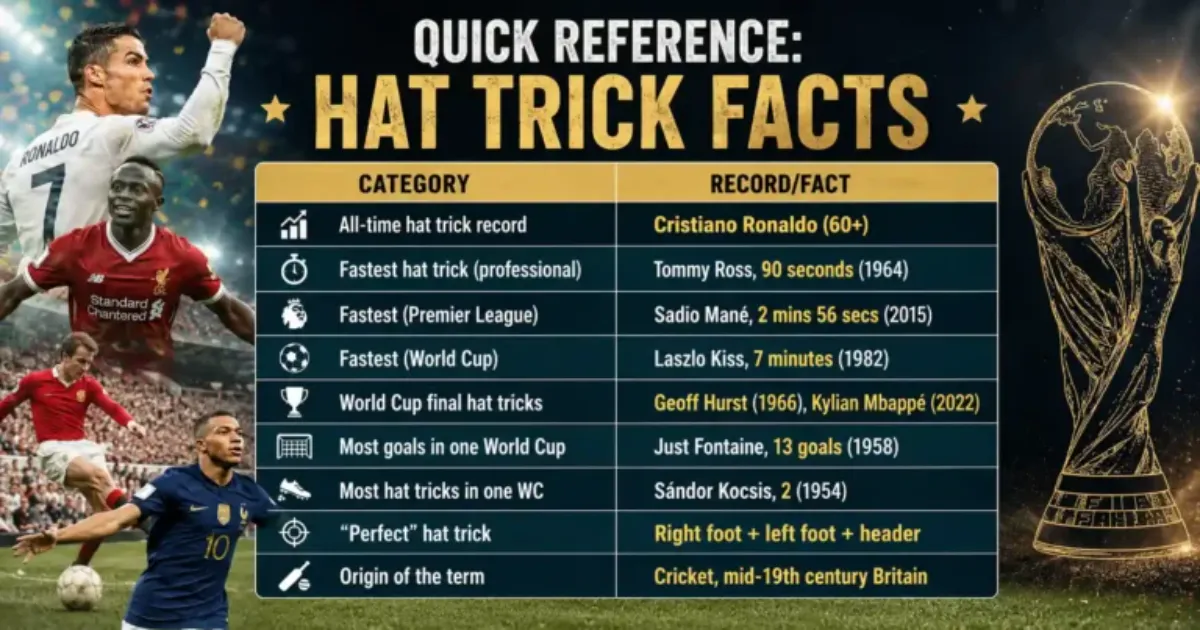
| Category | Record / Fact |
|---|---|
| Definition | Three goals by one player in one match |
| Origin of term | Cricket |
| Fastest widely recognized professional hat-trick | Tommy Ross, 90 seconds |
| Fastest Premier League hat-trick | Sadio Mané, 2:56 |
| Fastest World Cup hat-trick | László Kiss, about 7 minutes |
| World Cup final hat-tricks | Geoff Hurst (1966), Kylian Mbappé (2022) |
| Most goals in one World Cup | Just Fontaine, 13 in 1958 |
| Perfect hat-trick | Right foot + left foot + header |
| Famous modern hat-trick | Ronaldo vs Spain, 2018 |
| Most iconic World Cup final hat-trick | Hurst, 1966 |
The Final Word
A hat-trick is one of football’s simplest achievements and one of its most enduring.
Three goals can represent domination, survival, brilliance or even heartbreak.
Hurst’s hat-trick helped England win its only World Cup. Ronaldo’s three against Spain produced one of the greatest group-stage matches in tournament history. Mbappé scored three in a World Cup final and still walked away without the trophy.
That contrast explains why the hat-trick matters.
It is not simply about putting three goals into the net.
It is about creating a moment that supporters remember, teammates celebrate and football history records.
From the cricket fields of Victorian Britain to the biggest stadiums in the modern game, the hat-trick in football has retained its magic.
Three goals.
One player.
One unforgettable match.
Cristiano Ronaldo Jr.: Club, Lifestyle, Career and Future Prospects
Thiago Messi: Club Career, Playing Style, Lifestyle and Future Prospects
▪️▪️Follow us on Facebook ▪️▪️
About the Author