 A match that mattered to no one in the table — and everything to the players on the pitch
There is a particular cruelty to the final group stage game when both teams are already out. The crowd knows it. The broadcasters know it. On some level, the players know it too. But nobody told Habib Diarra.
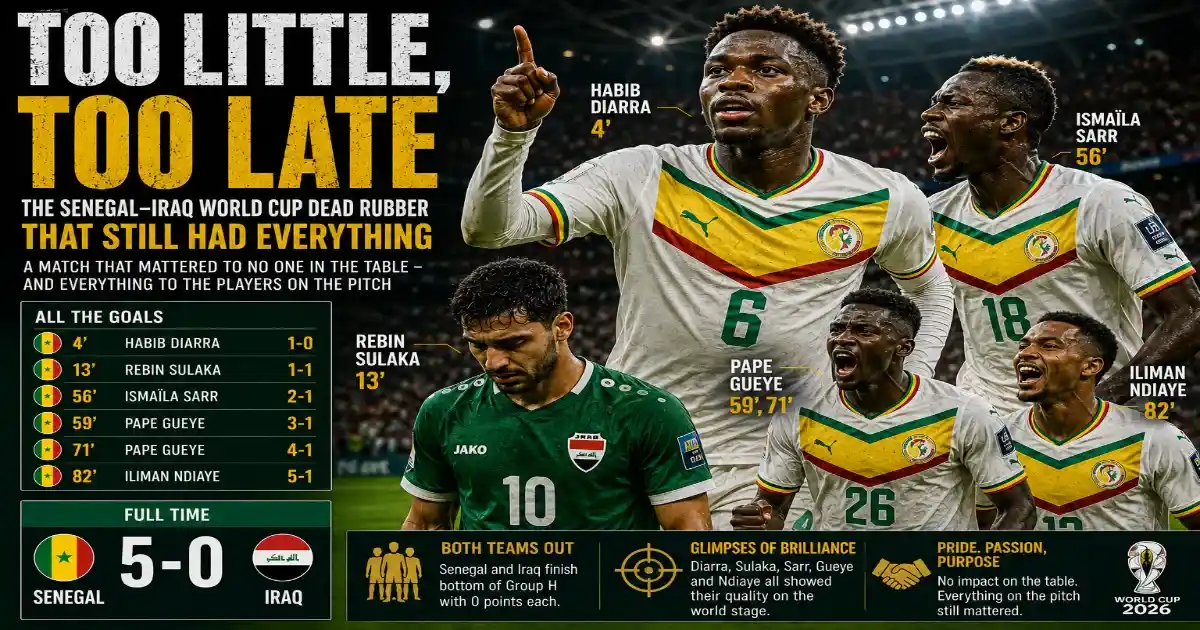
The 21-year-old Strasbourg midfielder had the ball at his feet in the fourth minute of the Senegal Iraq World Cup finale, and he scored the kind of goal that makes scouts in the stands reach immediately for their phones. A turn, a burst, a finish — all before most supporters had settled into their seats. It was the goal of a player auditioning for a bigger stage, even if this particular stage was already closing its curtains.
Champions League 2026/27 Schedule: Fixtures, Dates & Times
LaLiga 2026/27 Schedule: Fixtures, Dates & Times
Iraq Hit Back Through Sulaka
If Diarra’s opener felt like a statement, Rebin Sulaka’s equaliser in the 13th minute was a reminder that Iraq came here to compete regardless of circumstance. The Kurdish-born forward, who has become one of the most discussed stories of this World Cup simply through the consistency of his performances in a struggling side, latched onto a cross from the right and finished with composure that belied the occasion’s irrelevance in the table.
For a stretch of the first half, this felt like the match both teams had been trying to play all tournament. Senegal pressed with intensity they had rarely sustained in earlier games. Iraq organised intelligently and tried to hit on the break. The problem, for both coaches watching from the touchline, was that this version of their teams arrived too late.
The Senegal Floodgates
What followed in the second half turned a competitive game into a lopsided final chapter. Ismaïla Sarr, who has carried Senegal’s attacking threat almost entirely on his own throughout the group stage, made it 2-1 in the 56th minute with a burst of pace down the left that Iraq’s right side simply could not handle.
Then came Pape Gueye. Twice. The 59th minute goal was a header, precise and powerful. The 71st minute goal was a driven finish after a swift combination in the box. Two goals in twelve minutes from a central midfielder is not what anyone expected from a dead rubber, but Gueye looked like a player with something to prove — perhaps to his own coaches, perhaps to himself.France Dominates World Cup Group I With Perfect Nine Points After Norway Win
Iliman Ndiaye completed the rout in the 82nd minute. At 4-1, Senegal had produced their best attacking performance of the tournament in a game that changed absolutely nothing about their fate.
What the Scoreline Cannot Explain
The Senegal Iraq World Cup result — 5-0 to Senegal on the day, 0 points each in the group — tells you the numerical story but not the human one. Senegal, African champions not long ago, arrived in this tournament with genuine belief and leave it winless. The squad that beat Egypt in a penalty shootout to lift AFCON has not replicated that resilience in the group stage, and that gap between continental pedigree and World Cup delivery will define the conversation around this squad for the next four years.
Iraq’s story, meanwhile, is quietly remarkable even in failure. A nation still rebuilding its football infrastructure, still navigating the complexity of fielding a squad drawn from diaspora populations across three continents, still finding its tactical identity at the highest level. Rebin Sulaka will be better for this. So will Diarra, on the other side.
Both teams leave the tournament without a win. Both teams leave it with players who have shown, in brief, brilliant glimpses, exactly what they might become. Sometimes a dead rubber is the most honest football you will see in a group stage.
About the Author