France Dominates World Cup Group I — What Makes This Side So Difficult to Stop
A system-level analysis of why Les Bleus have been the group stage’s most complete unit
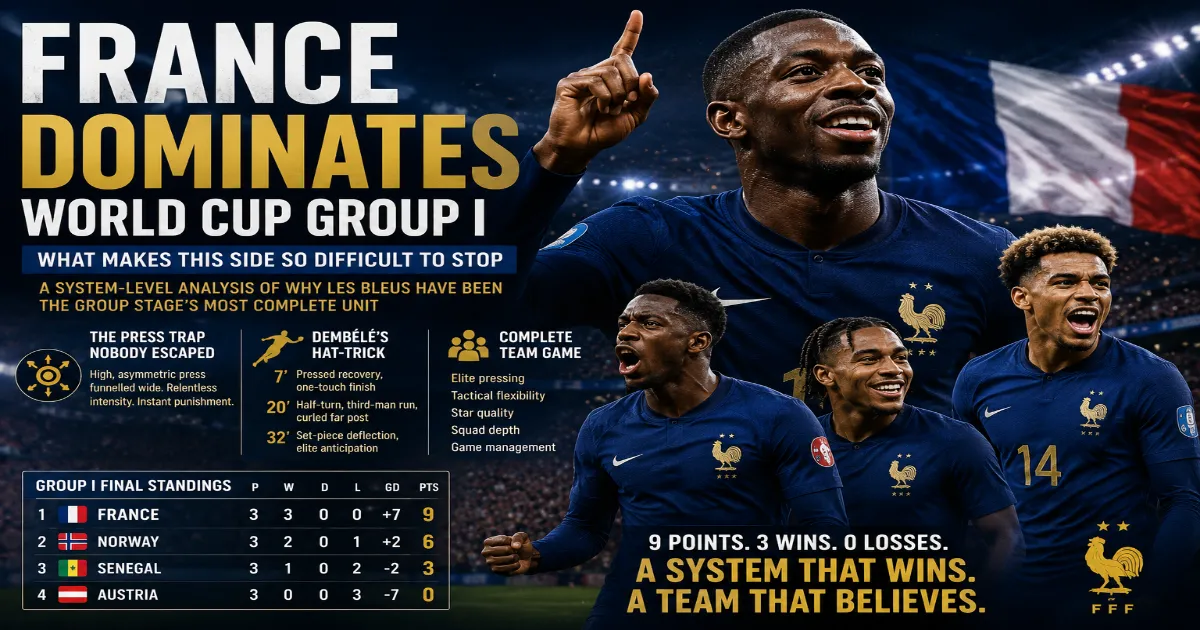
Les Bleus entered Group I as heavy favourites. They are leaving it as the best team in the group stage. With a maximum nine points from three matches and a goal difference that flatters nobody, France dominates World Cup Group I not by accident but by design — and the Norway match was the most complete demonstration of that system yet.
Premier League 2026/27 Schedule: This Week and Next Week
LaLiga 2026/27 Schedule: Fixtures, Dates & Times
The Press Trap Nobody Escaped
France’s opener against Norway came in the seventh minute, and it told you everything you needed to know about how Didier Deschamps has set this team up. Norway attempted to build from the back, as they had successfully done for much of qualifying. France pressed high, funnelled the ball wide, and Ousmane Dembélé — beginning what would become a historic evening — punished the hesitation with clinical precision.
What makes this press so effective is its asymmetry. The left side, where Dembélé operates, is deliberately overloaded. Norway’s right back Elias Solberg found himself caught in a press-trap he had no answer for throughout the first half. Dembélé’s ability to win the ball, combine quickly, and shoot early makes him arguably the most dangerous wide forward in the tournament right now.In His Own Words: 10 Kylian Mbappe Quotes That Define the Man Behind the Myth
Dembélé’s Hat-Trick: Three Goals, Three Different Mechanisms
- 7′ — Pressed recovery, one-touch finish inside the box. Pure instinct.
- 20′ — Receiving on the half-turn after a third-man run, curled finish far post. Intelligence.
- 32′ — Set-piece delivery that deflected, but Dembélé anticipated the ricochet before anyone else moved. Elite positioning.Ousmane Dembélé FIFA World Cup 2026: Profile, Stats & Career | StrikerReport
Three goals, three completely different technical problems solved. Norway’s defensive unit had no answer for any of them because each required a different response.
Thelo Aasgaard’s Consolation and What It Reveals
Norway’s 21st-minute goal from Thelo Aasgaard deserves tactical respect. The 22-year-old Wigan Athletic midfielder has been one of the group stage’s best players in a losing team — a frustrating category — and his goal came from exactly the kind of pressing transition Norway needed more of. It briefly made the score 2-1, put France under momentary pressure, and suggested an alternative tactical timeline where Norway started bolder.Erling Haaland World Cup 2026 Journey: Norway’s Return and a New Superstar Era
France responded immediately. The 3-1 lead was restored before half-time. That resilience — absorbing a goal and reasserting control within eight minutes — is the mark of a team that knows exactly what it is.
Désiré Doué: The 90+4 Exclamation Mark
Doué’s goal in stoppage time was not cosmetic. It came from a sustained France possession phase that Norway, 3-1 down and exhausted, simply could not match physically. At 19, Doué is already showing the composure in front of goal that typically takes players years to develop. His role as the squad depth behind the first XI may be underestimated by opponents who study only France’s starting line-up.
Group I Final Standings and What Comes Next
France finishes first in Group I with 9 points, 3 wins, 0 losses. Norway qualified in second with 6 points — a genuinely respectable return against a group that contained the world’s form team. For Les Bleus, the round of 16 brings a fresh challenge, but on current evidence, very few squads in this tournament have the tactical answers to stop what France are doing.
The system works. The players within it are performing at their ceiling. France dominates World Cup Group I, and the message for the knockout rounds is clear: you will need something extraordinary to stop them.
About the Author



1 thought on “France Dominates World Cup Group I With Perfect Nine Points After Norway Win”