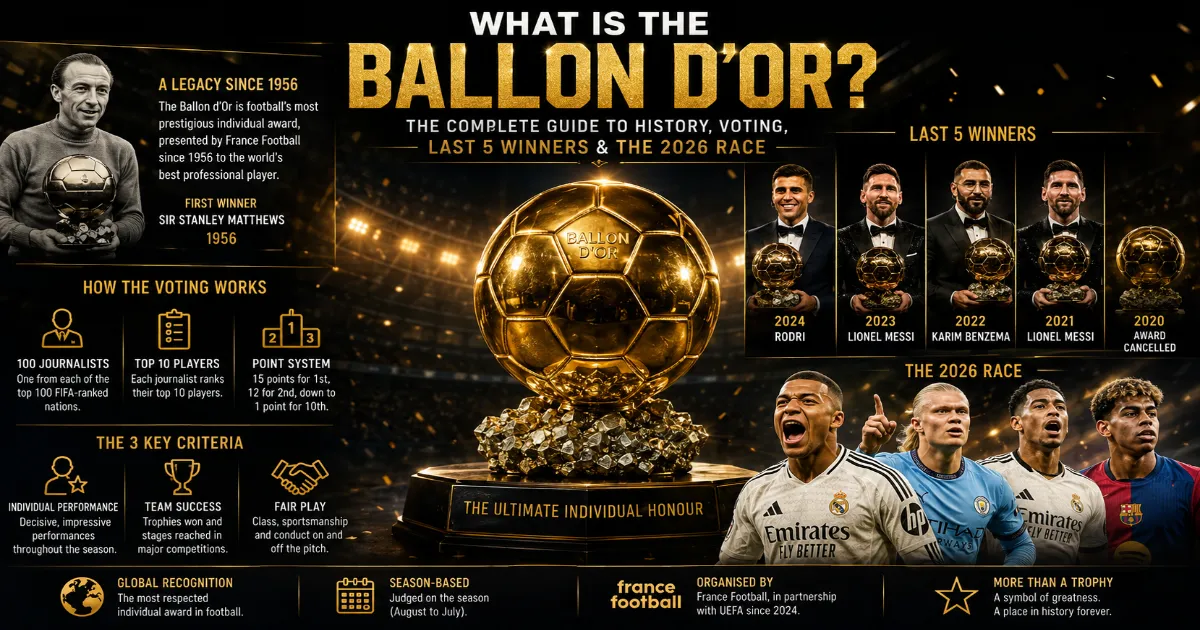
 Complete Guide to History, Voting, Winners & the 2026 Race for Ballon d’Or
StrikerReport.com | Football Explained | Awards & Accolades
Every year, football’s biggest individual prize brings together the world’s elite players, legendary winners and the game’s most influential figures. The trophy is instantly recognizable: a golden football awarded to the player judged to have produced the outstanding season.
That trophy is the Ballon d’Or.
Golden Glove Winner Unai Simon: The Historic World Cup Goalkeeping Masterclass
Complete FIFA World Cup 2026 Awards List: Every Winner
Since its creation in 1956, the award has evolved from a European-only honour into football’s most prestigious individual prize. It has been won by legends including Johan Cruyff, Michel Platini, Marco van Basten, Cristiano Ronaldo and Lionel Messi, while recent winners have demonstrated that midfielders and all-round performers can challenge the traditional dominance of forwards.
The 2026 edition is particularly significant. The voting period includes the FIFA World Cup, where Spain defeated Argentina 1-0 after extra time to become world champions. With the tournament now complete, the World Cup has dramatically reshaped the Ballon d’Or conversation.
What Is the Ballon d’Or?
The Ballon d’Or — French for “Golden Ball” — is an annual individual football award organized by France Football, in partnership with UEFA since 2024.
The men’s award recognizes the footballer judged to have been the best over the relevant season. The women’s Ballon d’Or follows the same basic principle.
Unlike a statistical award based solely on goals or assists, the Ballon d’Or considers a broader picture. Individual performances, team achievements, major competitions and a player’s conduct all contribute to the final judgment.
The award has become one of the ultimate measurements of individual excellence in football.Erling Haaland: The Goal Machine Rewriting Football’s Record Books
When Was the Ballon d’Or Created?
The Ballon d’Or was established in 1956 by French journalist Gabriel Hanot of France Football.
The inaugural winner was England and Blackpool legend Stanley Matthews, who remains the oldest player ever to win the award. Matthews was 41 years, 10 months and 17 days old when he received the trophy.
Initially, the Ballon d’Or was restricted to European players.
That changed in stages:
1956: Award introduced for European players.
1995: Eligibility expanded to include non-European players playing for European clubs.
2007: Eligibility became global, regardless of where a player played.
2018: The Women’s Ballon d’Or was introduced.
2022: The eligibility period changed from the calendar year to the football season.
2024: UEFA became a co-organizer alongside the Amaury Group.
The modern award therefore looks very different from the trophy first handed to Matthews in 1956.
Harry Kane World Cup Impact: Goals, the Penalty, and England’s Unfinished Story
Mostafa Zico: The Late Bloomer Who Took Egypt’s Winger Spot and Never Looked Back
How Does Ballon d’Or Voting Work?
The Ballon d’Or is decided by an international jury of football journalists rather than a public vote.
For the men’s award, 100 journalists representing the top 100 countries in the FIFA rankings participate. The women’s award uses 50 journalists from the top 50 nations.
Each voter selects and ranks ten players from a shortlist of 30 nominees.
The points system is:
| Position | Points |
|---|---|
| 1st | 15 |
| 2nd | 12 |
| 3rd | 10 |
| 4th | 8 |
| 5th | 7 |
| 6th | 5 |
| 7th | 4 |
| 8th | 3 |
| 9th | 2 |
| 10th | 1 |
The player collecting the most points wins.
The official Ballon d’Or rules identify three central criteria:
Individual performance
Team achievements
Class and fair play
The award therefore isn’t simply a race for the most goals. A midfielder, defender or goalkeeper can build a winning case through influence, consistency and collective success.
Why the World Cup Matters So Much
The World Cup has historically carried enormous influence in Ballon d’Or voting.
That influence became particularly important in 2026 because the tournament falls inside the 2025-26 Ballon d’Or eligibility period. The official Ballon d’Or organization confirmed that domestic and international competitions, including the 2026 World Cup, are considered.
The tournament also produced a major narrative shift.
Spain defeated Argentina 1-0 after extra time in the final in New Jersey, winning its second World Cup. Ferran Torres scored the decisive goal, while Spain dominated the match statistically.
That result immediately elevated the cases of several Spanish players, particularly Lamine Yamal, Rodri, Pedri and other members of Luis de la Fuente’s championship-winning squad.
Ballon d’Or’s Greatest Winners: Messi and Ronaldo
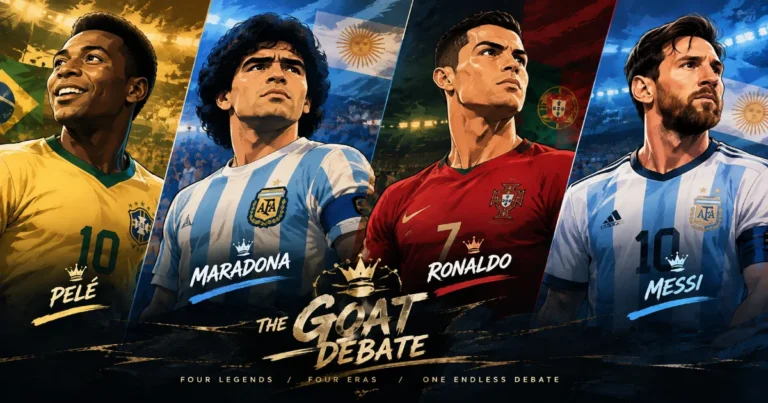
No discussion of the award can avoid the extraordinary rivalry between Lionel Messi and Cristiano Ronaldo.
Lionel Messi — 8 Ballon d’Ors
Messi holds the men’s record with eight Ballon d’Or victories:
2009
2010
2011
2012
2015
2019
2021
2023
His eighth award followed Argentina’s 2022 World Cup triumph, when Messi won the Golden Ball and played a decisive role throughout the tournament.
Cristiano Ronaldo — 5 Ballon d’Ors
Ronaldo has won the award five times:
2008
2013
2014
2016
2017
Between 2008 and 2022, Messi and Ronaldo won every Ballon d’Or except Luka Modrić’s 2018 victory.
Their dominance transformed the award into one of the defining individual rivalries in sporting history.
The Last Five Ballon d’Or Winners
2021 — Lionel Messi
Messi won his seventh Ballon d’Or after a season featuring extraordinary individual production and, most importantly, Argentina’s Copa América triumph.
The international success was particularly important because Messi had endured years of criticism over his inability to win a major senior trophy with Argentina.
2022 — Karim Benzema
Karim Benzema produced the finest season of his career as Real Madrid won both La Liga and the Champions League.
He scored 44 goals in 46 appearances and delivered one of the great Champions League knockout campaigns, including memorable performances against Paris Saint-Germain and Chelsea.
The award represented the culmination of years of elite-level consistency.
2023 — Lionel Messi
Messi claimed his record eighth Ballon d’Or following Argentina’s World Cup victory in Qatar.
His 2022 World Cup campaign included seven goals, three assists and the Golden Ball, making the award one of the clearest examples of the World Cup influencing the Ballon d’Or.
2024 — Rodri
Rodri broke the dominance of attacking superstars by winning the 2024 Ballon d’Or.
The Manchester City midfielder combined another Premier League title with a brilliant Euro 2024 campaign for Spain, where he was named Player of the Tournament.
He finished ahead of Vinícius Júnior in an extremely close vote.
Rodri’s victory was particularly significant because it demonstrated that controlling midfield and influencing games tactically could outweigh the spectacular scoring statistics normally associated with the award.
The official winners list confirms Rodri as the 2024 men’s Ballon d’Or winner.
2025 — Ousmane Dembélé
Ousmane Dembélé won the 2025 Ballon d’Or after a transformative season with Paris Saint-Germain.
The French forward became the central figure in PSG’s historic Champions League triumph and helped the club collect major domestic honours.
Dembélé’s victory also represented a remarkable career transformation. Once criticized for inconsistency and injuries, he became one of Europe’s most decisive attackers at precisely the moment PSG needed him most.
He defeated Lamine Yamal in the final voting, with Yamal finishing second.
The 2026 Ballon d’Or Race After the World Cup
The 2026 race is now dramatically different from the one that existed before the World Cup.
The tournament has been completed, Spain are world champions, and several leading candidates have strengthened — or weakened — their cases.
Lamine Yamal: The Young Superstar
Lamine Yamal entered the World Cup as the 2025 Ballon d’Or runner-up after finishing behind Dembélé.
His 2026 campaign strengthened his historical case.
Yamal helped Spain win the World Cup and became the first player under 20 to win both the European Championship and the FIFA World Cup. He also completed more dribbles than any other player at the tournament, according to Ballon d’Or’s official coverage.
At only 19, Yamal is now arguably the most compelling young candidate in the Ballon d’Or conversation.
Rodri: The World Champion Midfield Architect
Rodri already knows what it takes to win the award.
The 2024 Ballon d’Or winner returned from a serious knee injury and helped Spain capture another major international title.
His influence goes beyond traditional statistics. Rodri controls tempo, protects the defense, dictates possession and provides the structural foundation for Spain’s football.
His 2026 World Cup campaign could therefore give him another serious Ballon d’Or argument.
Kylian Mbappé
Mbappé’s 2026 World Cup was another major chapter in his individual legacy.
The French forward produced a spectacular tournament and established himself among the leading goalscorers of the competition. His club season with Real Madrid also gives him a powerful foundation for the award.
The challenge is that France did not win the World Cup.
Harry Kane
Kane entered 2026 after an extraordinary scoring season with Bayern Munich and carried that form into the World Cup.
His case is based heavily on goals, consistency and his club achievements. England’s final tournament position will be an important part of how voters assess his overall campaign.
Michael Olise
One of the biggest risers in the 2026 conversation is Michael Olise.
The Bayern Munich winger produced a remarkable 2025-26 season and then carried his creativity into the World Cup with France.
Ballon d’Or’s official World Cup review noted that Olise registered 31 assists for Bayern Munich during the 2025-26 season and added seven more at the World Cup.
His combination of club production and international influence makes him one of the most interesting candidates.
Ousmane Dembélé
The reigning winner cannot be ignored.
Dembélé entered 2026 attempting to become the first player since Cristiano Ronaldo to win consecutive men’s Ballon d’Or awards.
His club form, Champions League success and performances for France give him another credible case, although the competition is considerably stronger after the World Cup.
Spain’s Ballon d’Or Generation
Spain’s World Cup triumph has also created an interesting subplot.
The Spanish squad contained several players already connected with the Ballon d’Or ecosystem, including:
- Rodri
- Lamine Yamal
- Pedri
- Nico Williams
- Fabián Ruiz
- Gavi
- Alejandro Grimaldo
- Unai Simón
The official Ballon d’Or site highlighted eight Spanish internationals with previous Ballon d’Or or related award recognition before the tournament.
The biggest beneficiaries of Spain’s World Cup victory are likely to be Yamal and Rodri, although the final voting will determine how much the tournament ultimately changes the rankings.
Is the World Cup Winner Always the Ballon d’Or Winner?
No.
Winning the World Cup provides an enormous advantage, but it does not automatically guarantee the Ballon d’Or.
The history of the award contains numerous examples where the eventual winner was not a member of the World Cup-winning team.
The Ballon d’Or is ultimately an assessment of the entire season, not a World Cup-only award.
That distinction matters in 2026. A player can win the World Cup and still lose the Ballon d’Or to someone who delivered a stronger overall club and international campaign.
Companion Awards
The Ballon d’Or ceremony also recognizes excellence in several other categories.
Kopa Trophy
Awarded to the best young men’s player.
Lamine Yamal has won the award in both 2024 and 2025, establishing himself as the dominant young player of his generation.
Yashin Trophy
Awarded to the world’s best goalkeeper and named after Soviet goalkeeping legend Lev Yashin.
Gerd Müller Trophy
Recognizes the leading goalscorer across club and international football.
Johan Cruyff Trophy
Presented to the best men’s and women’s coaches.
Sócrates Award
Recognizes outstanding humanitarian and social contributions.
Club of the Year
Recognizes the strongest men’s and women’s clubs across the relevant season.
Women’s Ballon d’Or
The women’s Ballon d’Or was introduced in 2018 and follows the same broad philosophy of recognizing the world’s outstanding player.
Ballon d’Or 2026 Ceremony: When and Where?
The 2026 Ballon d’Or ceremony will be particularly historic.
For the first time in the award’s 70-year history, the ceremony will leave Paris and take place in London, England.
The official ceremony is scheduled for:
Date: Monday, October 26, 2026
Location: London, England
Edition: 70th Ballon d’Or ceremony
The move to London carries symbolic significance because the inaugural winner, Stanley Matthews, was English.
The winners of the men’s and women’s Ballon d’Or will be revealed during the ceremony.
Ballon d’Or 2026 Quick Reference
| Category | Details |
|---|---|
| Founded | 1956 |
| Founder | Gabriel Hanot |
| First winner | Stanley Matthews |
| Men’s record winner | Lionel Messi — 8 |
| Women’s award introduced | 2018 |
| 2021 winner | Lionel Messi |
| 2022 winner | Karim Benzema |
| 2023 winner | Lionel Messi |
| 2024 winner | Rodri |
| 2025 winner | Ousmane Dembélé |
| 2026 eligibility period | 2025-26 season |
| 2026 World Cup | Included in eligibility |
| 2026 ceremony | October 26, 2026 |
| 2026 location | London, England |
Why the Ballon d’Or Still Matters
Football has never had a shortage of debates about who is the best player in the world.
Statistics can measure goals, assists, chances created, tackles and passes. Trophies can measure collective success. But the Ballon d’Or attempts to bring those different elements together into one judgment.
That is why the award remains so important.
From Stanley Matthews to Lionel Messi, from Cristiano Ronaldo to Rodri and Ousmane Dembélé, the history of the Ballon d’Or mirrors the evolution of football itself.
And in 2026, after Spain’s World Cup triumph, the debate has entered another fascinating chapter.
Lamine Yamal’s historic emergence, Rodri’s midfield influence, Mbappé’s scoring power, Kane’s extraordinary production, Olise’s creative explosion and Dembélé’s status as reigning champion have created one of the most intriguing Ballon d’Or conversations of the modern era.
The answer will come in London on October 26.
Until then, football has one final question to settle:
Who was the best player in the world during the 2025-26 season?
Cristiano Ronaldo Jr.: Club, Lifestyle, Career and Future Prospects
Thiago Messi: Club Career, Playing Style, Lifestyle and Future Prospects
▪️▪️ Follow us on Facebook▪️▪️
About the Author

1 thought on “What Is the Ballon d’Or? History, Winners & How It’s Voted”