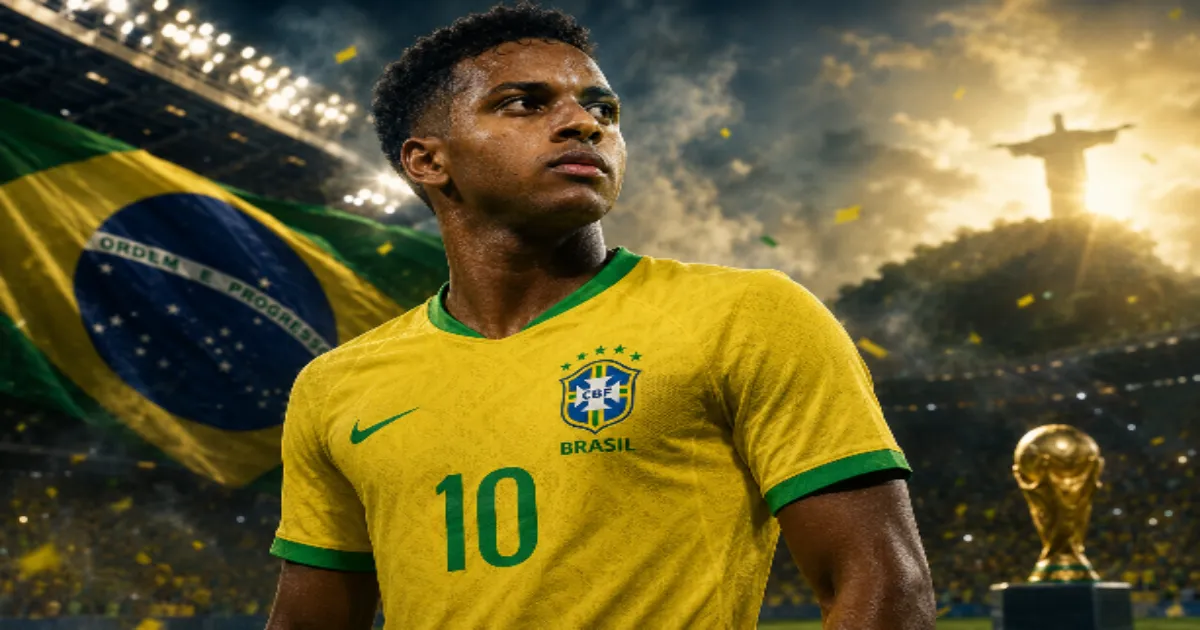
Rodrygo Brazil World Cup 2026: The Quiet Assassin Ready to Explode on the Biggest Stage
StrikerReport.com | Player Profiles | Brazil | FIFA World Cup 2026 Published: June 29, 2026
There are players who announce themselves with noise. They arrive at a tournament with headlines and pressure and the weight of a nation pressing against their shoulders from the first whistle. Then there are players who do not announce themselves at all — who simply appear, in the moments that matter most, and do something that changes everything.
Rodrygo Goes is the second type.
At 25 years old, the Real Madrid forward arrives at the FIFA World Cup 2026 as arguably the most underestimated name in Brazil’s formidable squad. While Vinícius Júnior claims the spotlight, while Raphinha accumulates headlines, while Neymar’s cameo appearances generate emotional noise — Rodrygo works in the space between, clever and sharp and utterly capable of delivering the decisive contribution when Brazil need it most.
This is the Rodrygo Brazil World Cup 2026 story. The boy from Osasco who was too small and too slight and not nearly imposing enough — until he was.
The Origin: Osasco to Santos, Santos to the World
Rodrygo Silva de Goes was born on January 9, 2001, in Osasco, a working-class city in the metropolitan sprawl of São Paulo state. He grew up the son of Diego Goes, a former professional footballer who played in the lower tiers of Brazilian football — a detail that shaped everything about how Rodrygo was taught to understand the game.
His father was his first coach, his first critic, and his most demanding voice. The boy who began kicking a ball in the small apartment courtyard in Osasco had access to footballing knowledge that most academy players don’t encounter for years — the positional intelligence, the reading of movement, the understanding of where the ball needed to go before it arrived.
Santos FC identified him at the age of ten. By fifteen, he was training alongside the senior squad at a club whose academy has produced some of the most celebrated Brazilian players in football history. By seventeen, he was making his senior debut in the Brasileirão. By eighteen, he was a Real Madrid player — signed in a deal reportedly worth €45 million before he had played 50 professional matches.
The trajectory was almost comically steep. But those who watched him closely at Santos will tell you the trajectory made perfect sense.
The Madrid Education: Where Boys Become Assassins
Real Madrid does not make players better. It reveals who they already are, under conditions of maximum pressure, and those who cannot handle it disappear quietly. Those who can — Benzema did, Bale sometimes did, Modric always did — become something permanent.
Rodrygo’s first two seasons in Madrid were exactly what anyone with reasonable expectations might have predicted: a young Brazilian learning what European football demands, accumulating minutes carefully, showing flashes of the quality that justified his transfer fee without yet providing the volume that would silence the sceptics.
The Champions League nights changed that conversation permanently.
It was in those specific evenings — the ones that make or break legacies at the Bernabéu — that the Rodrygo who would eventually be central to Brazil’s World Cup plans was truly revealed. Goals against significant opponents. Late interventions when the match needed rescuing. The ability to arrive in positions that his movement had created rather than his strength had forced — a distinction that matters enormously in how the Brazilian coaching staff assess and use him.
For Carlo Ancelotti, who manages Brazil at the 2026 World Cup after a distinguished club career at the Bernabéu, Rodrygo is not simply a squad player filling a wide forward role. He is a known quantity — a player Ancelotti has watched, used, trusted, and understood at close quarters for years. That relationship is part of why Rodrygo’s World Cup place, despite his challenging 2025-26 La Liga season, was never seriously in question.
The 2025-26 Season: Complications and Context
Honesty demands acknowledging what the season data shows. In the 2025-26 La Liga campaign, Rodrygo recorded 1 goal and 3 assists in limited appearances, with an average FotMob rating of 6.9 across those matches. His minutes were restricted by a combination of tactical decisions under Madrid’s transitional management — Xabi Alonso replaced by Álvaro Arbeloa mid-season — and a period of reduced form that briefly made his squad selection for the World Cup a topic of debate in Brazilian media.
What Rodrygo’s raw La Liga numbers do not capture is the Champions League contribution, the training ground influence that Ancelotti referenced specifically in his pre-tournament press conferences, and the fact that when Rodrygo played meaningful minutes in decisive matches — Copa del Rey, select Champions League fixtures — his quality was entirely apparent.
Context matters. A player adjusting to a managerial transition at the world’s most demanding club is not the same as a player who has lost his ability. Rodrygo had not lost his ability.
Career stats at a glance (to June 2026):
- Club career goals: 70+ across all competitions
- Champions League goals: 20+
- Brazil senior caps: 35+
- Brazil international goals: 8
- Age at World Cup: 25
- Right-footed, plays primarily on the left wing
Playing Style: The Ghost in Brazil’s Attack
Understanding Rodrygo requires understanding what he is not. He is not Vinícius — raw, electric, built on explosive acceleration that leaves defenders stationary. He is not Raphinha — relentless workrate allied to a predatory final touch. He is not Neymar, whose entire identity is the dribble and the moment of individual invention.
Rodrygo is the connector. The intelligent mover. The player whose positioning, off the ball, creates the space that the other attackers exploit.
In technical terms, this is what analysts call “third-man running” — the movement of a player who is not directly involved in an immediate combination but whose positioning forces the defensive structure to adjust, opening space elsewhere. Rodrygo does this compulsively and brilliantly. He drifts into half-spaces, attracts markers, and releases the full-backs into the channels. Or he holds his position on the left, makes his marker hold theirs, and watches Vinícius exploit the gap that should have been covered.
His dribbling, when he chooses to use it, is quick and close to the body — not the take-on-and-sprint approach of a pace merchant but the touch-and-cut of a player who understands that one sharp change of direction at the right moment is more valuable than five metres of pure speed.
His finishing, in his best moments, is clinical. He tends to score from positions he has created through movement rather than individual brilliance — arriving late into the box, finding the right angle, placing the shot. This efficiency from the positions he reaches is what makes him genuinely dangerous rather than simply lively.
Rodrygo at FIFA World Cup 2026: The Group Stage Picture
Brazil qualified from Group C as group winners with seven points — a record including a 1-1 draw with Morocco, a 3-0 win over Scotland, and a victory against Haiti. Vinícius Júnior scored in all three group matches. Raphinha contributed consistently. Neymar made his emotional cameo appearance in the final group game.
Rodrygo’s role across Brazil’s group stage was primarily that of a rotation option from the left flank, with Ancelotti using him in measured bursts designed to preserve his physical freshness for the knockout rounds. His group stage contribution was characterised more by intelligent pressing and creative link-up play than by the direct goal contributions that generate headlines — a pattern consistent with how Ancelotti has used him throughout his time at Real Madrid.
The critical observation for the Round of 32 and beyond: Rodrygo’s best football has consistently arrived in knockout competition. He has scored Champions League goals in elimination matches. He has delivered at the Bernabéu when the stakes were highest. He is, in the specific vocabulary of the professional analyst, a big-match player who raises his level rather than maintaining it.
Brazil face Japan in the Round of 32. They could face the Netherlands in the Round of 16 thereafter. Against either opponent — compact, organised, capable of suffocating Vinícius through careful defensive planning — Rodrygo’s intelligence and movement become more, not less, important.
Why He Could Be Brazil’s Most Important Player in the Knockouts
Here is the counterintuitive analyst’s argument: when the tournament reaches the stage where opponents no longer aim simply to compete but to suffocate Brazil’s attacking rhythm, the player who most disrupts defensive organisation without the ball becomes the most valuable in the squad.
Vinícius can be man-marked. Raphinha’s direct running can be contained by deep-sitting wing-backs. Neymar’s creativity can be disrupted by physical pressing before he receives.
What is much harder to defend against is a player who constantly moves to positions that require defensive adjustment without demanding the ball. That player pulls the defensive shape apart at the seams, silently. Every time Rodrygo makes his run and doesn’t receive the ball, the defender who followed him has moved. And the defender who followed him has left a space.
In the knockout stages of a World Cup, those spaces decide matches.
The Verdict
Rodrygo at the Brazil World Cup 2026 is the profile of a player whose impact will likely be most visible in the moments between the moments — in the spaces he creates rather than the goals he scores, in the pressure he applies without the ball, in the runs that make the goalkeeper and the defender look at each other uncertainly.
But he will also score. Almost certainly. In a match that matters.
He is 25. He has learned his craft at Real Madrid under Carlo Ancelotti. He understands big-game football in his bones, because he has lived it on the nights that produce career-defining memories.
Brazil will need Vinícius to be Vinícius. They will need Raphinha to be Raphinha. But they will also need Rodrygo to be Rodrygo — the quiet assassin working in the spaces, waiting, and then arriving exactly when Brazil need him most.
Rodrygo Brazil World Cup 2026 key stats summary:
| Stat | Figure |
|---|---|
| Age at World Cup | 25 |
| Club | Real Madrid |
| Position | Left winger / Forward |
| Senior Brazil caps | 35+ |
| International goals | 8 |
| Champions League goals (career) | 20+ |
| 2025-26 La Liga goals | 1 |
| 2025-26 La Liga assists | 3 |
| World Cup 2026 group stage | Rotation role, pressing, 1 assist |
Neymar Lifestyle Comeback: The Fortune, the Fight, and the Final World Cup
About the Author

2 thoughts on “Rodrygo Brazil World Cup 2026: The Quiet Assassin Ready to Explode on the Biggest Stage”