A Life Built for Headlines, A Comeback Built on Pain
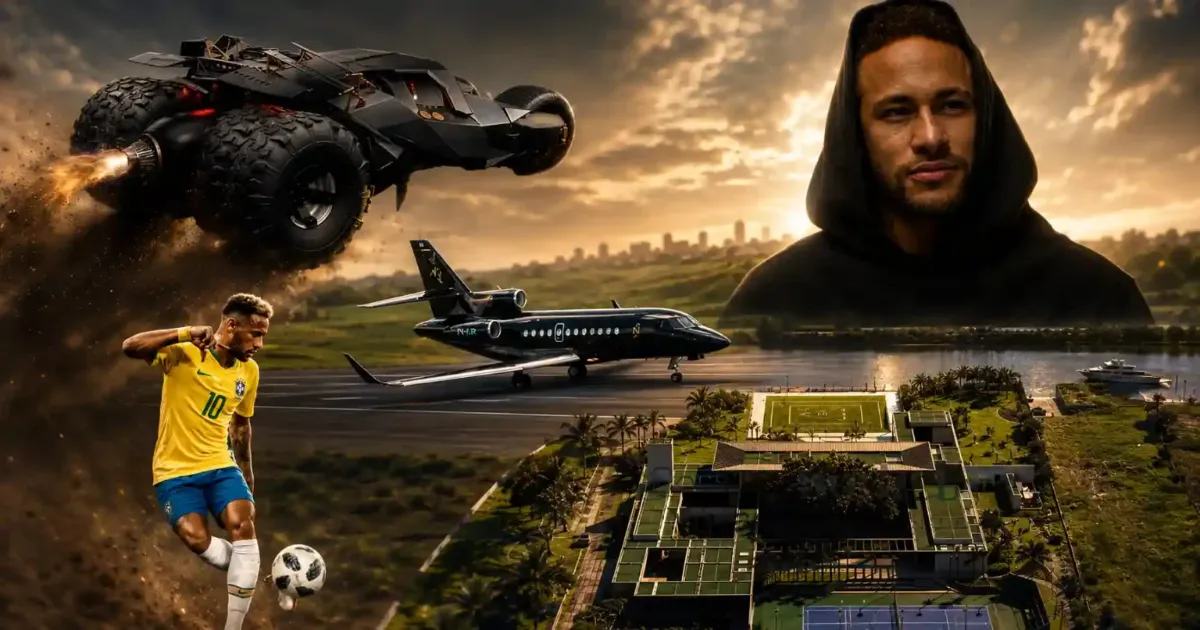
There are footballers whose lives feel like they were designed for tabloid front pages, and then there is Neymar — a man whose entire existence seems to operate at a volume the rest of football simply doesn’t have access to. Private jets, supercars, mansions with underground kart tracks and helipads, a $450 million fortune by some estimates, 220 million Instagram followers, and a personality so magnetic that even his training-ground appearances generate headlines. And yet, as the 2026 FIFA World Cup approaches, the most remarkable thing about Neymar isn’t any of that.
It’s that he’s here at all.
The Neymar lifestyle comeback story isn’t just about a wealthy athlete returning to football after injury — though it is certainly that. It’s about a 34-year-old who has spent the better part of three years being written off, who tore his ACL in a Brazil shirt and faced a recovery so brutal that many assumed his international career was simply over, and who has somehow, against the tide of expectation, fought his way back into Carlo Ancelotti’s World Cup squad for what he has openly described as his final tournament.
LaLiga 2026/27 Schedule: Fixtures, Dates & Times
Premier League 2026/27 Schedule: This Week and Next Week
To understand why this comeback matters — and why it has captured the imagination of football fans well beyond Brazil — you first have to understand the life Neymar has built, the fortune he’s amassed, and just how far he’s fallen, physically, before climbing back.
The Boy From Mogi das Cruzes
Neymar da Silva Santos Júnior was born on February 5, 1992, in Mogi das Cruzes, Brazil, into a family that, by his own description, did not have much money. His father — also a footballer, though never at his son’s level — became Neymar’s earliest and most consistent advisor, a relationship that has remained central throughout his career, including during the darkest periods of injury and public criticism.
Like countless Brazilian children before him, Neymar learned the game on the streets — playgrounds, local fields, anywhere a ball could roll. His family eventually moved to Santos, where he joined the legendary Santos FC youth academy, the same club that produced Pelé. By the age of 11, he had already attracted attention from scouts. The talent — close control, audacious flair, a seemingly innate sense of where defenders weren’t — was visible even then, in a way that made his eventual trajectory feel, in hindsight, almost predetermined.
What followed is one of the most well-documented careers in modern football: a record-breaking move to Barcelona, a world-record transfer to Paris Saint-Germain, Champions League nights, World Cup campaigns, and a global brand that grew to rival — and at certain points exceed — that of his most famous contemporaries.
The Fortune: A Financial Empire Built on More Than Football
By 2026, Neymar’s net worth is estimated by various sources to sit somewhere in a wide range — figures cited range from around $200 million to as high as $450 million, depending on methodology and which assets are counted. The variance itself tells a story: Neymar’s wealth isn’t a single, easily-quantified salary figure. It’s a sprawling financial ecosystem.
His five-year deal with PSG was reportedly worth €36.8 million per season — at the time, making him the highest-paid player in France and one of the highest-paid in all of European football. But the salary is only one stream. Neymar has built one of the most expansive endorsement portfolios in world football, with around 35 separate brand partnerships spanning multiple industries — reportedly generating an estimated $30 million per year from sponsorships alone. Long-term partnerships with Nike and Red Bull have anchored that portfolio for over a decade, supplemented by deals with companies ranging from Qatar Airways to Epic Games.
Then there’s the social media dimension — something that simply didn’t exist as a meaningful revenue stream for footballers a generation ago. With over 220 million Instagram followers, each sponsored post Neymar shares is reportedly worth tens of thousands of dollars on its own. Add in investments across NFTs, fashion collaborations, and lifestyle brands, and you arrive at a financial empire that exists almost entirely independent of his on-field performance — which, as we’ll see, has mattered enormously during the years he’s spent unable to play.
The Mansions: A Tour Around the World
If Neymar’s bank account is sprawling, his real estate portfolio is its physical manifestation — properties spread across Brazil, Paris, Beverly Hills, Spain, and Saudi Arabia, each one a statement in its own right.
The crown jewel sits in Mangaratiba, on the coast of Rio de Janeiro — a mansion reportedly worth around $10 million, featuring an underground kart track and a private helipad. It’s the kind of property detail that sounds almost like fiction until you remember that this is, in fact, real estate that exists, that Neymar actually owns, and that he has actually used. The mansion has become something of a symbol in Brazilian media discussions about wealth in sport — a single property that regularly appears in conversations about the country’s richest athletes.
Premier League 2026/27 Schedule: This Week and Next Week
NBA Schedule 2026-27: Christmas Day Rivalries, Ring Night and the Games to Watch
In Alphaville, near São Paulo, Neymar purchased a seven-bedroom mansion for $2.7 million back in 2021 — relatively modest by his later standards, but still a property that most people would consider a dream home. Further afield, he owns a mansion in Beverly Hills, and has rented a grand five-story house in Paris for $14,000 per month since 2017 — a rental arrangement that, on its own, costs more annually than most people earn.Neymar FIFA World Cup 2026: Profile, Stats & Career | StrikerReport
Taken together, these properties aren’t just places Neymar lives. They’re a map of his career — Santos and Rio represent home and roots; Paris represents the PSG era and its accompanying global superstardom; Beverly Hills represents the celebrity-adjacent lifestyle that has always orbited around him; and more recent additions in Saudi Arabia reflect the most recent, and most financially lucrative, chapter of his playing career.
The Cars: Ferraris, Lamborghinis, and a Private Jet
Neymar’s relationship with luxury vehicles is, by most accounts, genuine rather than purely performative — a real passion that happens to also be extremely photogenic. His collection includes multiple Ferraris, Lamborghinis, and high-end Audis, reflecting a well-documented love of high-performance automobiles that has followed him since his earliest days of wealth at Barcelona.
But the vehicle that perhaps best captures the scale of Neymar’s lifestyle isn’t a car at all — it’s his private jet, an Embraer Legacy 450, used for the kind of rapid, international movement that a global superstar’s schedule demands. Combined with reported yacht ownership and a habit of throwing lavish parties that have themselves become recurring news stories in Brazilian and international media, the picture that emerges is of someone living about as close to the platonic ideal of “footballer excess” as currently exists in the sport.Neymar Returns as Ancelotti Targets Sixth Title: Brazil’s Powerful 26-Man Squad for FIFA World Cup 2026
And yet — and this is the crucial pivot — none of it has been enough to buy back the one thing Neymar has spent the last three years desperately trying to recover: his place on a football pitch, in a Brazil shirt, at a World Cup.
The Fall: An ACL Tear and a Career on the Brink
To understand the scale of Neymar’s comeback, you have to understand how far down it started. Neymar suffered a torn ACL while playing for Brazil — an injury that required surgery and triggered what became one of the longest and most uncertain recovery periods of his career. He has not played for Brazil since October 2023 — an absence now stretching close to three years by the time the 2026 World Cup begins.
For context, three years is an eternity in the career of a 31-to-34-year-old elite athlete. Careers end during stretches like this. Reputations are quietly rewritten. The conversation around Neymar, for long stretches of this period, shifted from “is he still one of the best players in the world” to “will he ever play meaningful football again” — a brutal recalibration for a player who, at his peak, was genuinely discussed in the same breath as Messi and Ronaldo.
His move to Al-Hilal in Saudi Arabia, part of the broader wave of high-profile players joining the Saudi Pro League, added another layer of complexity. Football fans in markets like India, for instance, didn’t even get to see Neymar face certain opponents in continental competition during this period — his recovery kept him out of fixtures that, in a healthier timeline, would have been routine appearances.
The Return: Santos, Ancelotti, and One Final World Cup
And then, gradually, the story began to turn. Neymar returned to Santos — the club where it all started, where an 11-year-old from Mogi das Cruzes first caught a scout’s eye more than two decades earlier. He currently captains the Brazilian club, a role that carries enormous symbolic weight in a country where Santos remains permanently associated with Pelé’s legacy.
The truly significant moment, though, came with his inclusion in Carlo Ancelotti’s squad for the 2026 World Cup — Neymar’s return to the Brazilian national team after the long injury layoff. For a player who many had quietly assumed would never wear the yellow shirt again, simply being named in the squad represented a comeback in itself, regardless of what happens once the tournament begins.
Neymar himself has been candid about what this World Cup represents — almost certainly his final appearance on this stage, a chance to add to a Brazilian legacy that already includes 79 goals in 128 appearances, making him the nation’s all-time leading scorer. Ancelotti’s own framing of the situation has been measured but supportive: “Neymar can be at the World Cup. If he can reach the World Cup at 100 percent, he can be there.” The honest caveat — “if he can reach 100 percent” — speaks to just how uncertain this comeback has remained, even at the final stage.
The injury complications haven’t fully disappeared, either. Brazil’s medical staff diagnosed Neymar with a grade-two calf injury upon his arrival at the team’s pre-tournament training camp — a fresh physical setback layered on top of the long-term ACL recovery, threatening to delay his first appearances of the tournament even after he’d cleared the much larger hurdle of simply making the squad.
What His Peers Are Saying
Perhaps the most telling indicator of how the football world views Neymar’s situation came from an unexpected source: Kylian Mbappe, responding directly to questions about Neymar’s fitness from France’s training camp. “The World Cup is a competition of stars,” Mbappe said. “All the stars are here, and in my book, Neymar is one of the biggest stars. I can’t imagine the World Cup without Neymar.”
It’s a remarkable thing for a rival nation’s captain — and arguably the best player in the world right now — to say unprompted about an opposing player’s fitness situation. It reflects something genuine: across the sport, regardless of allegiances, there’s a recognition that Neymar’s story — the talent, the wealth, the years of injury, the fight to get back — has become bigger than any single match result. People want to see him play, not necessarily because Brazil need him to win, but because his absence from the World Cup stage for three years has left a genuine void in the sport’s biggest spectacle.
The Lifestyle Comeback, Reconsidered
There’s a temptation, when discussing a player with Neymar’s wealth, to view the mansions and supercars as evidence of a life of pure indulgence — disconnected from the struggle and sacrifice that football fans tend to associate with genuine sporting comebacks. But spend any time with the actual details of the last three years, and a different picture emerges.
The Ferraris and the helipad mansion didn’t make the ACL heal faster. The private jet couldn’t fly Neymar back onto a football pitch. For three years, all of that wealth — the $450 million, the 220 million followers, the 35 brand deals — sat essentially inert while Neymar did the unglamorous, repetitive, often painful work of rehabilitation, the kind of grinding physical therapy that happens far from cameras and far from the lifestyle content that usually surrounds him.
That’s what makes the Neymar lifestyle comeback story genuinely compelling, rather than just another wealthy-athlete profile. The life he’s built — the mansions, the cars, the global fame — was already secure, regardless of what happened next on a football pitch. He didn’t need this comeback financially. He needed it for reasons that no amount of money can provide: to walk onto a World Cup pitch one more time, in the yellow shirt, as Brazil’s all-time leading scorer, on what he knows will be his final chance to do so.
Whatever happens for Brazil in the United States, Mexico, and Canada this summer — whether Neymar plays twenty minutes or ninety, scores or doesn’t — the comeback itself, the simple fact of his name appearing on that squad list after everything, is already one of the most remarkable stories heading into the 2026 World Cup. The cars and mansions were never really the point. They were just the backdrop to a much simpler story: a man who refused to let his career end the way it looked like it might, and who fought his way back to the only stage that, for him, has ever really mattered.
About the Author




2 thoughts on “Neymar Lifestyle Comeback: The Fortune, the Fight, and the Final World Cup”