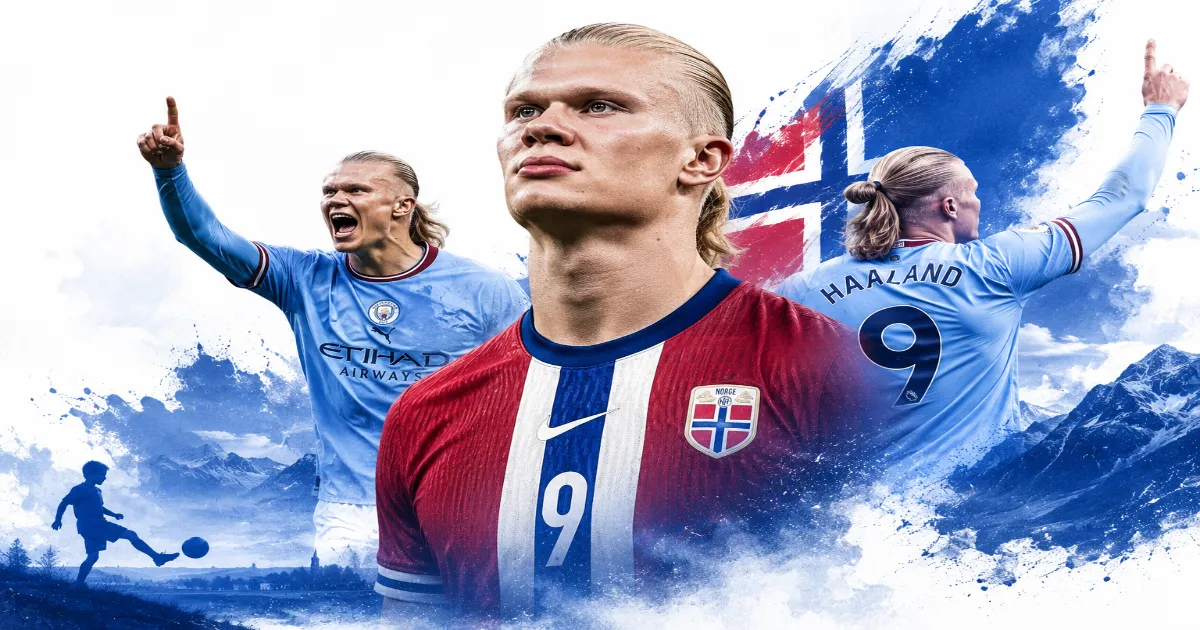
From a small Norwegian town to the world’s biggest stages, Erling Haaland has transformed Norway’s football identity and inspired a generation of supporters
Erling Haaland Norway: The Love Story Between a Nation and Its Greatest Ever Footballer
Some footballers represent their country. A very few of them become their country — the thing people from that place point to when they want to explain, to someone who has never been there, what their home feels like. Erling Haaland is that thing for Norway. He is blond and enormous and frightening to play against and he scores goals that seem to belong to a slightly different, more extreme version of football than the one everyone else is playing. And he is, unmistakably, unmistakably Norwegian.Erling Haaland: The Goal Machine Rewriting Football’s Record Books
Erling Haaland Baby Names Peru: Why Hundreds of Newborns Are Being Named After the Norway Star
There is a town called Bryne in the Rogaland county of southwestern Norway. It has a population of approximately twelve thousand people. It sits on the Jæren plain, surrounded by flat agricultural land and the particular grey-green light of a Scandinavian autumn. It is not the kind of place that produces footballers who score fifty goals a season in the Premier League. And yet.
Erling Braut Haaland was born on July 21, 2000, in Leeds, England — a geographical accident produced by the fact that his father, Alfie Haaland, was then playing for Leeds United. But the family returned to Bryne when Erling was young, and it is Bryne that shaped him: the cold training pitches, the small-club atmosphere, the Norwegian football culture that values hard work and directness and the kind of physical commitment that the English Premier League later turned out to reward enormously.
He grew up the son of a professional footballer who had his career shortened by a catastrophic knee injury inflicted by Roy Keane in a Manchester derby in 2001 — an incident that has taken on near-mythological status in football, particularly after Haaland joined Manchester City and, in his first season, scored a hat-trick against the Manchester United team that Keane once captained. Whether Erling thinks about that connection is something he has deflected with characteristic brevity: a smile, a shrug, the next question please. He does not trade in symbolism. He trades in goals.
The Background: A Norwegian Football Education
Erling Haaland’s journey from Bryne to the top of world football followed a route that is distinctly Norwegian in its patience and pragmatism. He joined Bryne FK’s youth academy and progressed through the system without the early fanfare that accompanies most future superstars. He was tall, yes — he was always tall — but the explosive pace that would later make him the most feared striker in Europe took time to develop alongside his frame.
In 2017, he joined Molde FK, managed at the time by a certain Ole Gunnar Solskjær — himself one of the most beloved Norwegian footballers in history and a man who understood, perhaps more instinctively than most, what Haaland was going to become. Solskjær has since spoken about the seventeen-year-old who trained with an intensity that made the senior players around him slightly nervous: not hostile, not aggressive, just relentless. Always wanting more repetitions. Always wanting to stay after training. Always, already, treating football with the seriousness of someone who knew what they were for.
From Molde, the move came to Red Bull Salzburg in Austria in 2019, where Haaland did something that the football world had not seen in the Champions League group stage before: he scored a hat-trick on his debut, against Genk. He was nineteen. He had been playing senior football for two years. The European game had its first proper introduction to what was coming.
Borussia Dortmund signed him in January 2020. In his first Bundesliga match, he came on as a substitute and scored a hat-trick. This was no longer an anomaly. This was a pattern. This was a player who treated the highest levels of European club football as a natural habitat rather than an intimidating challenge.Erling Haaland World Cup 2026 Journey: Norway’s Return and a New Superstar Era
Every Penalty Miss at FIFA World Cup 2026, Explained
The Norway Relationship: What He Means at Home
To understand what Erling Haaland means to Norway, you have to understand what Norway’s relationship with football has historically been.
Norway is not a football superpower. The national team’s most celebrated era — the late 1990s, when a side featuring Ole Gunnar Solskjær, Tore André Flo, Henning Berg, and Ronny Johnsen competed seriously at international level — ended without a major tournament. Since then, the national team has lived in the frustrating middle ground of European football: good enough to matter, not quite good enough to win.
Haaland changed the emotional register of the conversation. From the moment he made his senior international debut in September 2019 — scoring within eleven minutes against Honduras in a friendly — there was a shift in how Norwegians talked about their national team. Not necessarily in expectations, because Norwegians are not by nature given to overconfidence. But in the kind of warm, private certainty that something might actually be happening.
The Norwegian media’s coverage of Haaland is, by international standards, remarkably restrained. He is celebrated, but not in the feverish tabloid mode of English football coverage. The Norwegian press treats him with a combination of pride and protectiveness that reflects the broader cultural relationship between public figures and the national media — less invasive, more respectful, and perhaps because of that, more genuinely warm.
In the towns and villages where he grew up and trained, the feeling is different again. In Bryne, the local pride is real but quiet — the way small communities carry their successful children, with a warmth that doesn’t need to announce itself. The club he started at has a modest ground and a dedicated local following, and on the wall of the club there is now a photograph of a boy who became the world’s best striker. It sits there without fanfare. It doesn’t need any.
The Popularity: Why the World Fell for Him Too
Outside Norway, Erling Haaland’s popularity has grown at a rate that even his most optimistic supporters could not have predicted. When Manchester City signed him in the summer of 2022, he was already one of the most recognised names in European football. By the end of his first Premier League season, he was arguably the most famous outfield player on the planet.
The goals came first: 36 in 35 Premier League appearances in 2022-23, breaking the single-season record set by Andrew Cole and Alan Shearer that had stood for nearly thirty years. The hat-tricks came frequently enough that they ceased to be remarkable, which is itself remarkable. The Champions League winners’ medal came. The Treble came.
But what made Haaland genuinely popular — beyond the goals, beyond the records — was something harder to quantify. He was entertainingly straightforward in a sport that had become increasingly managed and media-trained. He talked about eating a lot. He talked about sleeping a lot. He talked about the meditation practices and the pre-match routines with the seriousness of a Zen monk who had decided that football was his spiritual practice. He wore pyjamas to press conferences. He attributed his goalscoring form to the quality of the water in Manchester. He was, in short, absolutely himself — and in a world of carefully constructed footballer personas, being absolutely yourself turns out to be deeply appealing.
Social media loved him for exactly these reasons. The content was irresistible: a six-foot-four Norwegian who scored goals at a rate that had never been seen before in the Premier League and who, when asked about his diet, said he ate heart and liver and cited studies about the nutritional value of offal. Football had not had a character quite like this before.
The Performances: What the Numbers and the Eyes Both Say
The statistical case for Erling Haaland as the most prolific striker in modern European football history is straightforward to make. As of the 2024-25 season, his career goals-per-game ratio across all senior club competitions exceeds 0.97 — meaning he scores, on average, almost a goal every game. No striker with a comparable volume of appearances at elite club level has maintained this rate.
At Manchester City specifically, the transformation he produced in the team’s attacking output was measurable and immediate. City had won three consecutive Premier League titles before his arrival, playing a system built around a false nine or no striker at all. With Haaland, the system evolved: the same intricate, possession-based build-up play now had a target capable of converting even the smallest advantages in the penalty area into goals with frightening regularity.
What makes him specifically dangerous is the combination of attributes that individually exist in other elite strikers but have never before coexisted in one body at this level. He has the pace of a winger. He has the aerial ability of a classic target man. He has the positioning of a player who has spent twenty years studying where the ball will land before it is kicked. He has the finishing technique — both feet, varying angles, varying distances — of someone who has done nothing but practice finishing since childhood. And he has the physical strength to hold off any centre-back in world football while doing all of the above.ERLING HAALAND’S DIET, SLEEP & RECOVERY: THE SCIENCE BEHIND THE MACHINE
His Champions League record — a goal roughly every 78 minutes across the competition, with hat-tricks on multiple occasions at the tournament’s highest-pressure moments — confirms that this is not a player who flattens in big games. He gets bigger in big games. The hat-trick on his Champions League debut at nineteen. The goals in the final. The hat-tricks against elite defensive opposition. He treats elevated stakes as personal invitations.
Haaland and Norway: The International Question
The one complicated dimension of Erling Haaland and Norway’s relationship is the question of international success. Norway failed to qualify for the 2022 World Cup despite having Haaland in their squad, a failure that became a minor scandal — how does a team with arguably the world’s best striker not qualify for a World Cup?
The answer is structural: Norwegian football, for all its virtues, does not have the depth of talent across eleven positions to build a team around even a generational striker. Haaland scores international goals at a remarkable rate — his goals-per-game ratio for Norway is similarly elite — but football is not an individual sport, and the players around him cannot consistently create the quantity and quality of chances that Pep Guardiola’s Manchester City machine generates.
This has not diminished the relationship between Haaland and his national supporters. If anything, it has intensified it — the particular Norwegian warmth toward him carries a trace of collective determination, a sense that this extraordinary player deserves the international stage his club career has provided, and that the national team must collectively rise to give it to him.Erling Haaland World Cup 2026 Journey: Norway’s Return and a New Superstar Era
At World Cup 2026, Norway qualified from a difficult group. Haaland is twenty-five. He is, physically and statistically, at the peak of his powers. The tournament that his father never reached with Norway — and that Erling himself has waited for across his entire professional career — is now, finally, happening. And Norway, the country of twelve thousand towns and flat plains and grey-green light, is watching with the quiet, private certainty that something might actually be happening.
It usually does, when he is involved.
The Legacy, Already Being Written
At twenty-four, Erling Haaland already has enough records and honours to constitute a complete career for most footballers. He has not finished. He has, by every measure, barely started. The conversation about where he ultimately sits in the historical pantheon of strikers — alongside Ronaldo Nazario, alongside van Nistelrooy, alongside the great number nines of football’s history — will be conducted over the next decade.
What is already clear is what he means to Norway: not just a footballer, not just a record-breaker, but a proof of something. A proof that from a flat plain in Rogaland, from a small club in a town of twelve thousand people, from a football culture that prizes hard work and directness and doesn’t much care for glamour, something extraordinary can emerge. That quiet Norwegian pride — in the water, in the training habits, in the liver and the heart he eats for breakfast — is not misplaced. It has been tested by the Premier League, by the Champions League, by the biggest stadiums in the world. And every time, it has delivered.
▪️▪️ follow us on facebook ▪️▪️
About the Author

4 thoughts on “Erling Haaland Norway: How One Superstar Became the Face of a Football Nation”