Colombia vs Ghana Preview: The World Cup 2026 Knockout Clash Nobody Is Talking About Enough
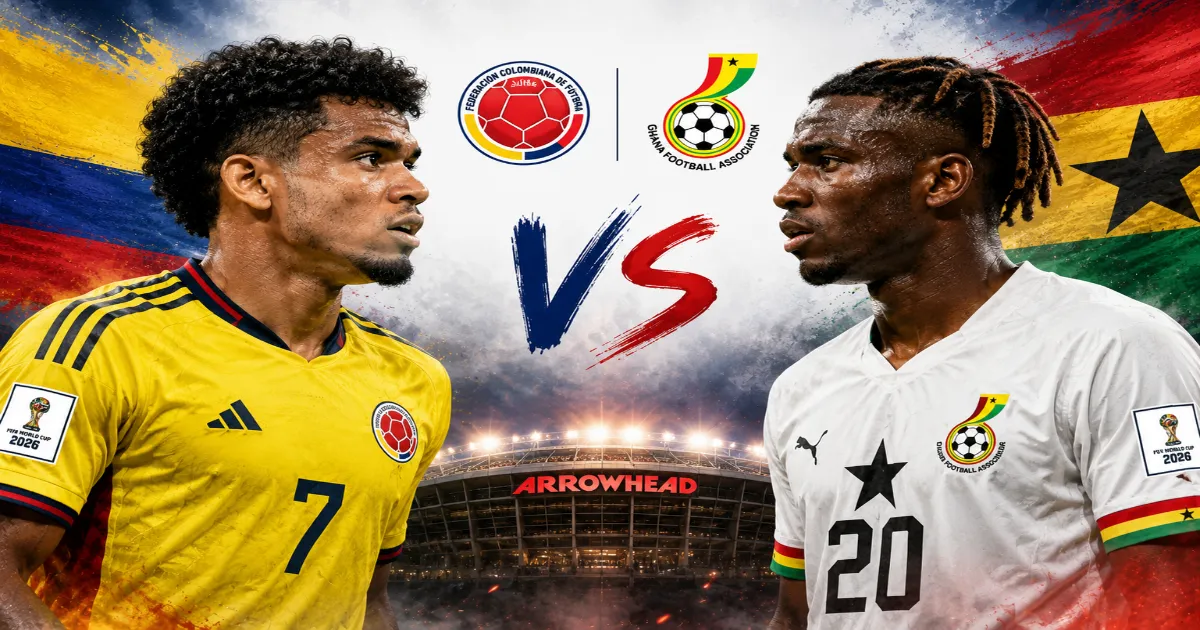
Date: Friday, July 3, 2026 | Venue: Arrowhead Stadium (Kansas City Stadium), Kansas City | Kick-off: 9:30 PM ET / 2:30 AM BST
There is a particular kind of World Cup match that gets undersold — not because it lacks quality or stakes, but because it happens to sit in the same day’s schedule as Argentina vs Cape Verde and doesn’t involve Messi. Colombia vs Ghana at Arrowhead Stadium is exactly that kind of match. Two nations with legitimate knockout ambitions, genuinely contrasting styles, and the first competitive meeting in their histories, playing in a stadium that Guinness World Records certifies as the loudest outdoor sports venue on earth. If you’re sleeping on this Colombia vs Ghana preview, here’s why you shouldn’t be.
Colombia: Group Winners, Proven Credentials
Colombia finished top of what was arguably the most competitive group of the tournament. Group K contained Portugal — a genuine title contender — and still Colombia came through with seven points, including wins over Uzbekistan and DR Congo before holding Portugal to a goalless draw that confirmed their credentials as a side capable of matching elite European opposition defensively while creating genuine danger going forward.
Luis Díaz, now at Bayern Munich, scored in the tournament opener and has been Colombia’s most dangerous attacker throughout the group stage. years old and operating at the very peak of his club form, Díaz brings to this match the kind of directness and pace that full-backs find genuinely difficult to prepare for in the short turnaround between knockout games.James Rodríguez, with over 120 caps behind him, continues to pull the strings in midfield at 34 years old — a player who has scored six goals and four assists in World Cup matches since his tournament debut in 2014 and who treats this stage as the most natural environment in football.
The collective profile is of a Colombia side that knows exactly how to win, doesn’t overcomplicate its game plan, and is capable of producing both a scrappy 1-0 and a flowing three-goal display depending on what the match demands. Colombia have not lost in five matches heading into this knockout tie, with their three World Cup outings producing six goals against genuinely competitive opposition.
Ghana: More Dangerous Than Their Group Stage Suggests
Ghana’s route to this fixture has been messier than Colombia’s, and honest assessment requires acknowledging both the difficulty and the limitations that shows. Ghana finished third in Group L behind England and Croatia, qualifying as one of the best third-placed teams with four points from a win over Panama, a draw with England, and a 2-1 defeat to Croatia in their final group match.
The Colombia narrative around this match tends to dwell on Ghana’s single goal against Panama and their goalless draw with England as evidence of a limited attacking threat. That reading is partially but not entirely fair. Ghana proved against England that they are capable of keeping out high-quality opposition, and the national side certainly have the tools to upset Colombia. Antoine Semenyo — who picked up a knock in Ghana’s loss to Croatia but is expected to feature — brings exactly the kind of direct, explosive attacking energy that can disrupt even well-organized South American defensive structures. Kamaldeen Sulemana offers similar pace from the opposite flank. Thomas Partey provides the midfield anchor that keeps Ghana’s shape disciplined even under sustained pressure.
Carlos Queiroz, two months into his role as Ghana head coach after a shock appointment, has expressed frustration with the defensive errors which led to the Croatia defeat. Queiroz has forgotten more about knockout football preparation than most managers know, and his ability to set up a specific defensive game plan — closing spaces, pressing triggers, and counter-attacking through the wide forwards — makes Ghana a considerably more complex proposition than their group-stage record alone suggests.
Head-to-Head Record: Zero, Nil, Nothing
Friday’s clash at the 2026 World Cup will represent the first-ever meeting between Colombia and Ghana. No history, no psychological baggage, no prior tactical blueprint to draw from. Both managers are building their pre-match preparation purely from video analysis, squad intelligence, and the evidence of three World Cup group matches apiece. That absence of prior meetings is not a neutral factor — it tends to benefit the more tactically complex side, because there is no shorthand memory the opponent can fall back on. Queiroz will have studied Colombia’s group stage in granular detail. Lorenzo will have done the same for Ghana. Neither has seen the other react to specific high-pressure situations directly.
The Tactical Matchup That Decides It
Ghana’s defensive shape vs Colombia’s midfield creativity
Queiroz will deploy a disciplined 4-3-3 or 4-4-2 defensive block designed to deny Colombia the central passing lanes that James Rodríguez exploits. Thomas Partey’s presence at the base of midfield will be central to how effectively Ghana can prevent Colombia from building rhythm. If Partey wins the midfield battle — restricting Rodríguez’s space and breaking early passing moves before they develop — Ghana have the defensive compactness to make this a tight, low-scoring contest that remains genuinely open deep into the second half.
If Rodríguez finds time and space, Colombia’s combination play becomes very difficult to shut down. His vision over longer distances is not matched by anyone else in this match, and a single well-weighted through ball to Díaz in behind Ghana’s defensive line is enough to change a scoreline that has been 0-0 for seventy minutes.
Semenyo and Sulemana vs Colombia’s fullbacks
Ghana’s best chance of an upset runs through their wide forwards’ ability to carry the ball forward quickly on the counter. Semenyo in particular — direct, strong, technically capable of shooting with both feet — has the profile to hurt Colombia on the transition if they lose the ball high up the pitch while pressing. Colombia’s fullbacks, Davinson Sánchez and Caua Emmanuel, will need to manage the defensive transition phase carefully in the second half if the match remains tight.
The Wider Significance
For Colombia, this is a tournament they arrived at after missing the 2022 World Cup entirely, and the hunger to make this home-region tournament count — with all three host nations in the same bracket — is a genuine motivating factor. Reaching the quarterfinal would match their best ever World Cup performance from 2014.
Erling Haaland World Cup 2026 Journey: Norway’s Return and a New Superstar Era
For Ghana, context matters too. Ghana’s two previous World Cup knockout-stage encounters with South American opposition both ended in defeat — against Brazil in the 2006 Round of 16 and Uruguay in the 2010 quarterfinals. That second one, specifically, carries the particular pain of Luis Suárez’s deliberate handball on the goal line in the last minute of extra time and Asamoah Gyan’s subsequent missed penalty, a moment that still defines how that generation of Ghanaian football is remembered. This Colombia match carries none of that specific emotional baggage, but the broader pattern of South American opposition in knockout rounds is one Queiroz’s squad will be aware of.
Key Players to Watch
Luis Díaz (Colombia): Already scored once in this tournament, consistently Colombia’s most direct and dangerous forward, and the player best equipped to punish any defensive error on the counter.
James Rodríguez (Colombia): At 34, he is slower than the James of 2014 but no less intelligent. In a tight knockout match where one moment of quality decides everything, he is exactly the player capable of providing it.
Antoine Semenyo (Ghana): Carrying a knock but expected to start, Queiroz has flagged that Ghana need Semenyo to fire if they are going to progress. His combination of physicality and technical ability suits a match where Ghana will look to hurt Colombia in transition.
Thomas Partey (Ghana): The midfield battle runs through him. If Partey dominates, Ghana stay competitive. If he’s isolated or bypassed, Colombia’s quality tells.
The Verdict
Colombia are the rightful favourites and have done enough in this group stage to deserve genuine respect as a side capable of going deep in this tournament. The quality of their midfield-to-attack combination, built around Rodríguez’s creativity and Díaz’s directness, should ultimately be enough to create the decisive chance even in a tight match.
Colombia 1-0 Ghana — a narrow, hard-fought win built on quality rather than dominance, with Ghana making Colombia work for every single yard. But don’t dismiss the Black Stars. If Semenyo is fit, if Partey commands the midfield, and if Colombia take a minute too long to find their rhythm, Arrowhead Stadium on July 3 could produce the evening’s biggest surprise.
▪️▪️ follow us on facebook ▪️▪️
About the Author