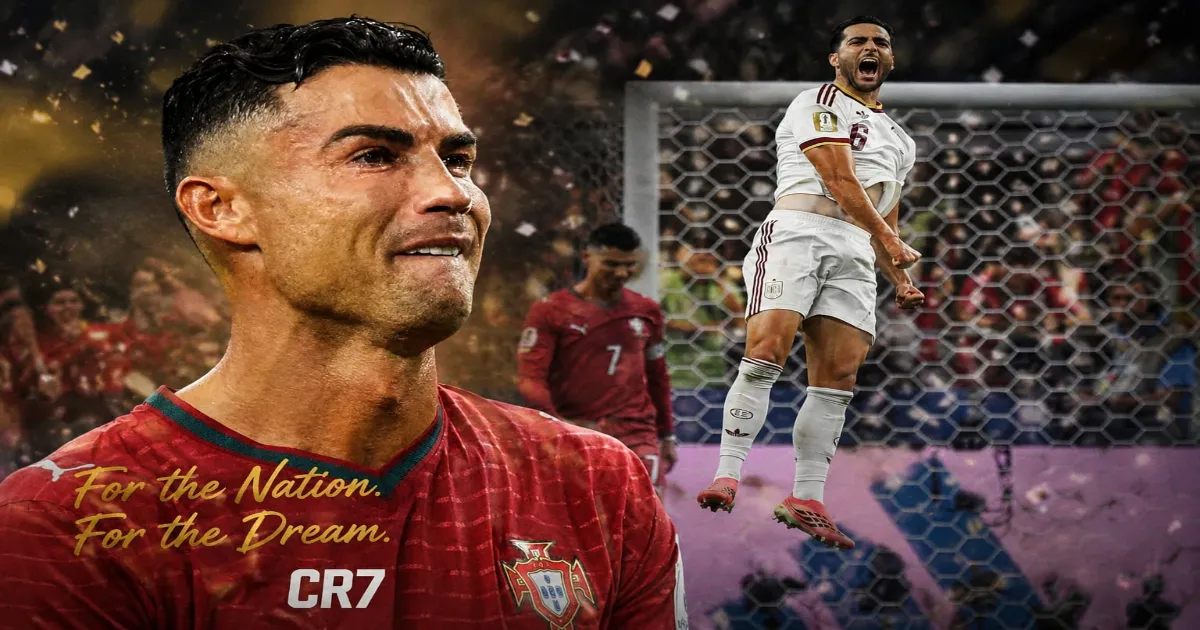
Portugal vs Spain World Cup Report: Mikel Merino’s stoppage-time winner sends Spain into the quarter-finals and brings the curtain down on Cristiano Ronaldo’s World Cup career
In front of a tense crowd at AT&T Stadium in Dallas, Spain edged Cristiano Ronaldo’s Portugal 1-0 in a Portugal vs Spain Round of 16 clash that lived up to its billing as the tie of the knockout stage. Substitute Mikel Merino struck in the first minute of stoppage time to send Luis de la Fuente’s side through to the quarter-finals, while also confirming what Ronaldo himself had announced only a day earlier — that this would be his final World Cup appearance.We Called It: How Our Spain World Cup Prediction Came True
Spain Are World Champions: The Story of Their 2026 Triumph
Match Report: A Tight Battle Decided Late
Spain started the brighter of the two sides, with Mikel Oyarzabal presented with a golden opportunity inside the opening ten minutes after being played through by a clever move involving Dani Olmo and Álex Baena — only to drag his effort agonizingly wide of the far post. Ronaldo tested the Spanish defense from distance shortly after, his effort drifting just wide, before Diogo Costa produced two smart saves in quick succession in the 16th minute, first denying a curling Lamine Yamal effort before pushing away a follow-up attempt from Baena.Ronaldo World Cup 2026: Six Tournaments, One Missing Trophy, One Last Chance
What Cristiano Ronaldo Doesn’t Have: The One World Cup Trophy That Couldn’t Define His Greatness
Portugal’s clearest chance of the half came four minutes before the break, when Nuno Mendes’s goal-bound strike from a set piece took a heavy deflection off Pedro Porro and cannoned back off the crossbar — the closest either side came to breaking the deadlock in a cagey opening 45 minutes defined by Portugal’s aggressive, man-oriented defensive setup nullifying much of Spain’s build-up play.
The second half followed a similar pattern until midway through, when Dani Olmo teed up Pedri on the hour mark, only for the midfielder’s effort to be blocked by a last-ditch deflection off Renato Veiga. Spain continued to dominate territory and possession without carving out a truly clear-cut opening, with Yamal’s free kick tipped over by Costa and Baena’s low effort comfortably saved. With eight minutes remaining, Oyarzabal spurned arguably Spain’s best chance of the second half, mistakenly believing he was offside and pulling out of a shooting opportunity that would have almost certainly resulted in a goal.
The decisive moment finally arrived in the first minute of second-half stoppage time. Substitutes Ferran Torres and Mikel Merino, both introduced by de la Fuente in the closing stages, combined for the winner — Torres slipping a low ball into the box for Merino, who finished coolly at the near post to send the traveling Spanish support into raptures and end Portugal’s tournament in heartbreaking fashion.
Spain finished the match well on top statistically, with 1.77 expected goals to Portugal’s 0.60, 56% possession, 15 shots to Portugal’s 10, and seven corners to Portugal’s three — a fair reflection of a match Spain controlled for long periods without ever making the result safe until the very end.Messi vs Yamal: One Last Master Against Football’s Future
Portugal’s Tournament Journey: A Flattering Finish to an Underwhelming Run
Portugal’s road to the Round of 16 was far less convincing than their reputation suggested it should be. In Group K, Roberto Martínez’s side drew 1-1 with DR Congo, thrashed Uzbekistan 5-0, and were then held scoreless by Colombia, finishing second in the group behind the Colombians. The Round of 32 brought late drama against Croatia, as Portugal came from behind to win 2-1, with Ronaldo converting a penalty for his first-ever World Cup knockout-stage goal — remarkably, in his sixth World Cup appearance — and, at 41 years and 147 days old, becoming the oldest goal scorer in World Cup knockout stage history.
That Round of 32 comeback ultimately proved to be Portugal’s tournament peak. Against Spain, Ronaldo made little impact in the first half, and although he forced a save from Unai Simón after being fouled by Rodri in the box, Portugal never found the cutting edge needed to trouble their fiercest rivals when it mattered most.
Portugal’s Weakest Point: A Toothless Attack Beyond Ronaldo
Across the tournament, Portugal’s clearest vulnerability was their over-reliance on moments of individual quality rather than sustained attacking cohesion. The goalless draw with Colombia and the underwhelming stalemate against DR Congo both exposed a team short on ideas in open play, needing a Ronaldo penalty simply to survive the Round of 32 against Croatia. Against Spain, Portugal generated just 0.60 expected goals across 90-plus minutes — a damning number for a squad containing the talent of Bruno Fernandes, Vitinha and João Félix — and their best chance of the match, Nuno Mendes’s deflected strike off the crossbar, arrived from a set piece rather than open play. When Ronaldo faded from the game in the second half, Portugal simply had no alternative route to goal.The Weirdest Football Superstitions Even Messi, Ronaldo and Neymar Swear By
Four Portugal Players Rated From the Tournament
Cristiano Ronaldo — A fitting, if bittersweet, final bow. Ronaldo’s penalty against Croatia was a genuinely historic moment, but his quiet second half against Spain — just one touch inside the opposition box across 81 minutes in that Croatia game, and a similarly muted final appearance against Spain — reflected a legendary career reaching its natural end rather than fading dramatically.
Bruno Fernandes — Creativity without end product. Portugal’s midfield conductor was heavily involved in build-up play throughout the tournament, but like his teammates, struggled to turn Portugal’s possession into clear chances against a well-organized Spanish defense.
Nuno Mendes — Portugal’s most dangerous attacking outlet. His deflected strike off the crossbar against Spain was Portugal’s best chance of the match, and his marking assignment on Lamine Yamal for large stretches of the game also underlined his two-way importance to Martínez’s side.
Vitinha — Tireless but ultimately blunted. Vitinha covered ground relentlessly in midfield across the tournament, but like the rest of Portugal’s attacking unit, found few gaps in Spain’s compact defensive setup when it mattered most.
Spain’s Tournament Journey: Ruthlessly Efficient, Rarely Troubled
Spain’s route to the quarter-finals has been built on defensive control rather than emphatic scorelines. In Group H, the reigning European champions were held to a surprising 0-0 draw by World Cup debutants Cape Verde, before a statement 4-0 win over Saudi Arabia and a controlled 1-0 victory over Uruguay — a match that saw their South American opponents finish with ten men — sealed top spot. A comfortable 3-0 win over Austria in the Round of 32 set up the mouthwatering tie with Portugal, in which Spain extended their extraordinary defensive record to five consecutive clean sheets, having now outscored their opponents 9-0 across the tournament heading into the win over Portugal.
Spain’s Weakest Point: A Lack of Killer Instinct in Front of Goal
For all their defensive solidity, Spain’s underlying issue throughout this tournament has been an inability to consistently convert their control of matches into comfortable scorelines. The scoreless draw with Cape Verde was the clearest example, but the pattern recurred against Portugal — Oyarzabal’s dragged early miss, Yamal’s saved efforts, and a series of half-chances that could easily have been buried far earlier than the eventual 90th-minute breakthrough. Spain’s dominance in underlying numbers like expected goals and possession has rarely translated into games being settled with any real margin for comfort, meaning every knockout match to this point has remained tighter, and more nervous, than their overall superiority would suggest it should be.
Four Spain Players Rated From the Tournament
Lamine Yamal — The teenage sensation continuing to rewrite history. Yamal became, alongside Pau Cubarsí, one of the first pair of teenagers to start a World Cup knockout match together in 68 years, and Spain remain unbeaten in every major tournament match he has started — a genuinely historic run for a player still just a teenager.Nico Williams Player Profile: Spain’s X-Factor at World Cup 2026
Mikel Oyarzabal — Spain’s most clinical finisher, missed chances aside. Oyarzabal became the first Spanish player to score two or more goals in two different matches at the same World Cup, even if his glaring miss against Portugal will be remembered as one of the game’s key moments.
Pedri — The metronome of Spain’s midfield. Pedri continued his rise as one of the most technically complete midfielders in the world, dictating tempo throughout the Portugal match even as his best individual chance was blocked at the last moment.
Mikel Merino — Arsenal form translated to the international stage. Merino’s stoppage-time winner against Portugal continued his habit of scoring decisive goals in the biggest moments, a trait he has carried seamlessly from club football into a genuinely pressurized World Cup knockout tie.
What’s Next for the Star Players?
Ronaldo’s international career is now over in all likelihood, with Monday’s exit marking his sixth and final World Cup — an extraordinary legacy that includes the tournament’s all-time record for goals and appearances, but never the trophy that has eluded him throughout his career. Portugal boss Roberto Martínez also signaled after the match that his own time in charge may be ending, meaning Portugal’s next cycle will likely be built without either its greatest-ever player or the manager who guided this campaign.
For Spain, the focus turns immediately to Friday’s quarter-final against the winner of USA vs. Belgium in Los Angeles. Yamal, still a teenager, continues to build a resume that already places him among the most talked-about players of his generation, while Oyarzabal and Merino will look to carry their knack for big-tournament goals deeper into the competition. With their defensive record still unblemished and genuine title contenders like France and Argentina also alive in the draw, Spain remain one of the clearest favorites to go all the way — provided they can finally start turning control into more comfortable results.
▪️▪️ follow us on facebook ▪️▪️
About the Author