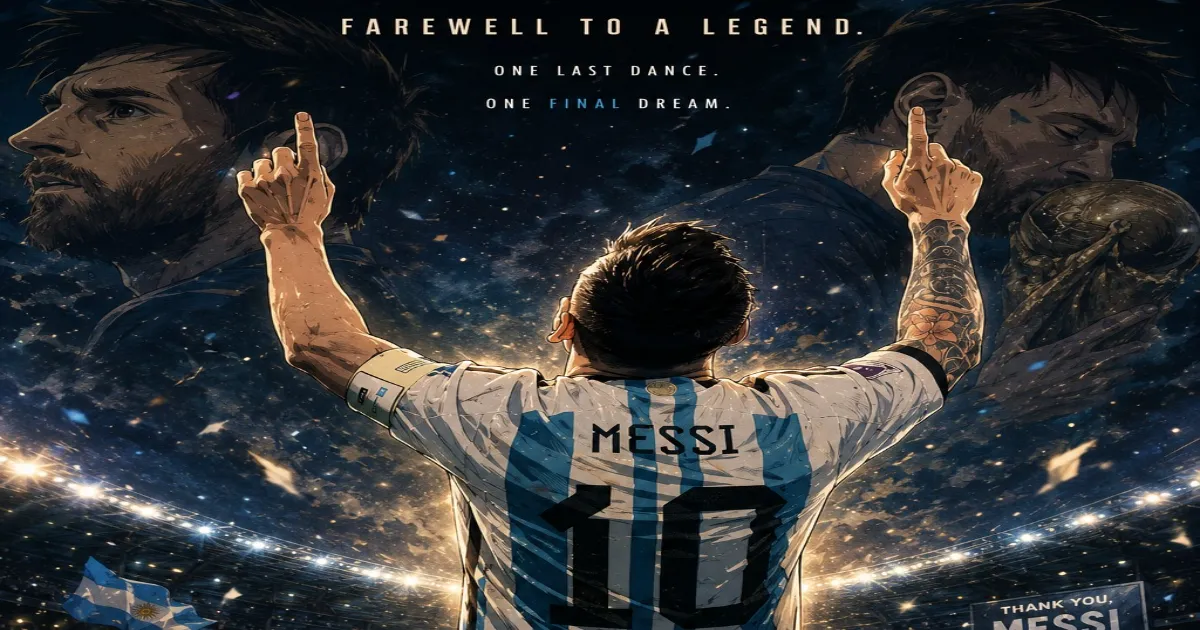
 Messi’s Last World Cup: Every Clue Points to a Final Bow
By StrikerReport Football Desk
Some questions don’t need an answer to already feel true. Lionel Messi has not stood in front of a microphone and announced that this is it — that Argentina’s quarterfinal against Switzerland at Arrowhead Stadium, or whatever comes after it, will be the last time he wears the number 10 shirt at a World Cup. He hasn’t needed to. Everything about the way this tournament has unfolded around him carries the unmistakable texture of an ending, and the accumulation of small details, big performances, and quiet admissions is now difficult to read any other way.
Thiago Messi: Club Career, Playing Style, Lifestyle and Future Prospects
Cristiano Ronaldo Jr.: Club, Lifestyle, Career and Future Prospects
Football’s New Generation Has Arrived: The Young Stars Who Shined at World Cup 2026
Messi turned 39 during Argentina’s build-up to this tournament. By the time the next World Cup arrives in 2030, he will be 43 years old — a age at which almost no outfield player in the sport’s history has competed at anything resembling this level, let alone at a World Cup. Cristiano Ronaldo, his great rival across two decades, has already answered this exact question for himself this tournament, confirming after Portugal’s round of 16 exit to Spain that his own World Cup career, at 41, has ended. The symmetry is impossible to ignore. If the player long considered Messi’s equal has already closed the book, the pressure on Messi to do the same only intensifies with every match Argentina plays.
The Numbers Tell Their Own Story
Whatever else this tournament has been for Messi, it has not been a farewell built on decline. Eight goals in five matches, including a hat-trick in the opening group game against Algeria at the very same Arrowhead Stadium where Argentina now face Switzerland in the quarterfinals, put him alone at the top of the Golden Boot race. He has scored in four of Argentina’s five matches so far, a level of sustained output that would be remarkable for a player half his age, let alone one entering his fifth decade of life. His overall World Cup goal tally now stands at 21, and he has become just the second man, alongside Ronaldo, to appear in six separate World Cup tournaments — a marker of longevity that may never be matched again given how physically brutal the modern international calendar has become.
And yet the numbers alone don’t capture what makes this feel like an ending. It’s the way Messi has looked on the pitch in the moments between the moments of brilliance — the visibly more measured movement off the ball, the increased reliance on dropping deep to dictate rather than sprinting in behind, the sense that Argentina’s system has been quietly reshaped around protecting him physically for ninety minutes rather than assuming he can influence every phase of a match the way he once did. Argentina’s 1-1 draw with Cape Verde in their final group match, followed by a nervy 3-2 comeback win over Egypt in the round of 16 after trailing 2-0, both point to a team that looks considerably more human than the ruthless, dominant version of Argentina that lifted the trophy in Qatar four years ago. Some of that is simply Switzerland, Cape Verde, and Egypt being better-organized opponents than anticipated. Some of it, inevitably, is a team no longer able to lean quite so heavily on its captain to fix every problem on his own.
What Ronaldo’s Exit Changes for Messi’s Narrative
There is no getting around the fact that Ronaldo’s World Cup ending — an emotional, tearful exit in Dallas after Portugal’s 1-0 loss to Spain, followed by his own confirmation that “it was my last World Cup” — has changed the emotional weather around this entire tournament for Messi. The two men have defined an era of football together, their rivalry so total and so prolonged that an entire generation of fans has never watched the sport without both of them somewhere near the center of it. Ronaldo’s departure removes half of that pairing from the World Cup stage permanently. It would be a strange kind of symmetry if Messi continued on to 2030 alone, chasing a tournament that Ronaldo has already walked away from — not impossible, but strange enough that most people inside and outside the game now expect Messi’s own exit, whenever it comes, to follow a similar script.
Football After Messi and Ronaldo: 7 Ways the Game Will Change After an Unforgettable Era
Messi himself has been characteristically guarded on the subject throughout this tournament, declining to confirm or deny his own future in the same way Ronaldo initially resisted the question before eventually giving in to it on the eve of Portugal’s elimination. That reluctance to speak plainly is, in its own way, one of the signs worth reading. Players who genuinely intend to return for another cycle tend to say so, plainly and often, precisely to manage expectations and take the pressure off the current tournament. Messi’s silence on the matter has instead allowed the speculation to grow louder with every passing round, an accumulation of unanswered questions that itself starts to feel like an answer.Lionel Messi World Cup 2026 Inspiration: The Legacy That Inspired a Generation
7 Reasons Why FIFA World Cup 2026 Became Messi’s Most Emotional Tournament
Whatever Happens Next, Messi Is Already the Biggest Winner of World Cup 2026
The Weight of an Unfinished Story
Part of what makes this tournament feel so loaded for Messi is that, unlike Ronaldo, he already has the trophy. Qatar 2022 gave Messi the one achievement that had eluded him across a career that had already redefined what greatness in football could look like, and that context changes what’s at stake here in a fundamental way. Ronaldo left this World Cup without ever lifting the trophy, an emptiness he has spoken about with real candor even while insisting he leaves with a clear conscience. Messi does not carry that same unfinished business. Whatever happens against Switzerland, and whatever happens beyond it, he will not be chasing redemption in the way Ronaldo was in Dallas.
That should, in theory, make this easier for Messi — a victory lap rather than a desperate final pursuit. But the football has not always looked like a victory lap. Argentina have needed to dig in against Cape Verde and claw back from two goals down against Egypt, hardly the imperious form of a team cruising toward a coronation. If this genuinely is Messi’s last World Cup, there is a growing sense among analysts and former players alike that he would want it to end not with another trophy secured through grinding results, but with one more moment of pure, unmistakable Messi magic — the kind of goal or performance that closes the book on his international career in a way that matches the way he opened it.
Switzerland and the Immediate Test
None of this larger narrative changes the immediate reality facing Argentina at Arrowhead Stadium: Switzerland have never beaten them in seven previous meetings, but Murat Yakin’s side arrive as considerably more than a footnote. Their tournament has been built on defensive discipline around captain Granit Xhaka, and their goalless draw against Colombia in the round of 16, won on penalties, demonstrated a genuine capacity to frustrate strong opposition for a full 120 minutes. If Switzerland’s central midfield shield of Xhaka and Remo Freuler can cut off the supply lines that usually feed Messi and Lautaro Martínez, Argentina’s path forward narrows considerably, and the possibility of Messi’s World Cup career ending not in a blaze of glory but in a tense, low-scoring elimination becomes uncomfortably real.
That possibility is precisely what makes the coming days must-watch television regardless of how the question of Messi’s future ultimately resolves itself. Every touch now carries the weight of possibly being one of his last at this level of the sport. Every celebration, every moment of the trademark drop of the shoulder and burst of pace that has terrorized defenders for two decades, gets read through the lens of finality whether Messi intends it that way or not.
A Question That May Never Get a Clean Answer
The uncomfortable truth is that Messi may never give football the clean, definitive answer that Ronaldo provided in Dallas. Players of Messi’s stature have historically preferred to let their body and their performances make the decision for them rather than announcing a hard deadline that removes all flexibility. It’s entirely possible he finishes this tournament, takes time to reflect exactly as Ronaldo has, and leaves the door open for 2030 regardless of what the calendar and conventional wisdom suggest. Stranger things have happened in a sport built on defying expectations about age and longevity.Football’s Greatest Players Ever: The Definitive 25-Player Ranking
But the signs, taken together — his age, Ronaldo’s own confirmed exit, the visibly altered role Argentina have built around him, the guarded silence when asked directly, and the sheer improbability of playing at an elite level deep into his forties — are difficult to argue against. Whether or not Messi ever says the words out loud, this tournament increasingly looks like the closing chapter of the greatest individual World Cup story the sport has ever produced. Kansas City, and whatever comes after it for Argentina, may be remembered less for the result on the scoreboard and more for being the moment the ending finally became impossible to ignore.
🔹🔹 Follow us on Facebook 🔹🔹
World Cup Retirement: Ronaldo, Neymar and the Legends Saying Goodbye
The Weirdest Football Superstitions Even Messi, Ronaldo and Neymar Swear By
Ronaldo World Cup 2026: Six Tournaments, One Missing Trophy, One Last Chance
About the Author




5 thoughts on “Messi’s Last World Cup? The Signs Are Hard to Ignore”