 From Nowhere to Everywhere: The Unexpected Heroes of World Cup 2026
Every World Cup has its household names, the players expected to define the tournament before a ball is kicked. Then there is the other list — the one nobody writes in advance. The unexpected heroes of World Cup 2026 have included a 40-year-old goalkeeper playing in his country’s first-ever tournament, a super-sub who scored more goals in 56 minutes than most strikers manage in a full match, and a handful of players whose names most casual fans had never heard before June 11.
The Players Who Became Household Names This Summer 2026
France vs England Live Score: Third-Place Playoff FIFA World Cup 2026, Goals & Highlights
Mostafa Zico: The Late Bloomer Who Took Egypt’s Winger Spot and Never Looked Back
This is the story of the players who turned World Cup 2026 into their own personal breakthrough — proof, once again, that the tournament’s biggest stage doesn’t only belong to the players who arrive on it already famous.
Vozinha: The 40-Year-Old Who Silenced Spain
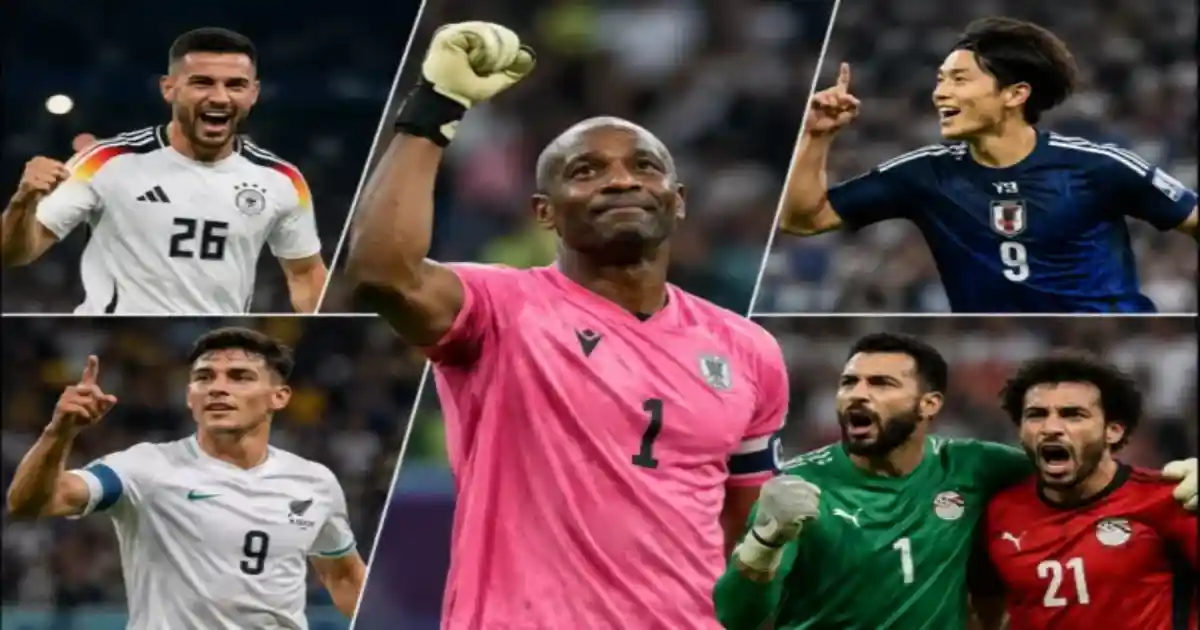
No unexpected hero at this World Cup has a more unlikely profile than Vozinha, Cape Verde’s veteran goalkeeper, who at 40 years old became one of the most talked-about players of the entire group stage. In Cape Verde’s tournament opener against reigning European champions Spain, a nation of just over 500,000 people faced a footballing power many times its size — and Vozinha simply refused to be beaten. He produced seven crucial saves across the match, was named Man of the Match, and helped secure a goalless draw that instantly became one of the defining shock results of the tournament.
What made Vozinha’s story so compelling wasn’t just the performance itself, but the age and the journey behind it. Most goalkeepers his age are coaching youth teams or working as understudies in their domestic leagues, not turning in career-defining displays against the reigning European champions on football’s biggest stage. He followed the Spain result with another vital performance in a 2-2 draw against Uruguay, helping push Cape Verde toward a Round of 32 meeting with Argentina that came agonisingly close to producing the shock of the entire tournament, before Cristian Romero’s deflected header ended the dream in extra time. By the time Cape Verde’s remarkable run finally ended, Vozinha had already cemented himself as one of the most unexpectedly important players of the summer.
Deniz Undav: Germany’s Super-Sub Turned Match-Winner
Not every unexpected hero needs 90 minutes to make his mark. Germany’s Deniz Undav has built his entire World Cup impact from the bench, and the numbers are almost hard to believe: in just 56 minutes across two substitute appearances, Undav scored three goals and provided two assists. He opened his account in Germany’s emphatic 7-1 demolition of Curaçao, the tournament’s largest victory margin, before coming off the bench again to score twice and inspire a dramatic comeback win over Ivory Coast that secured Germany’s progression to the knockout rounds.
Undav’s impact is a reminder that “unexpected hero” doesn’t always mean an unknown player having the tournament of his life from nowhere — sometimes it means a squad player seizing a specific tactical role and executing it so effectively that he becomes indispensable regardless of whether he starts. Germany’s coaching staff have leaned on his substitute impact so heavily that his introduction has become one of the more predictable, and effective, in-game adjustments of the tournament — which is precisely what makes it remarkable.
Ayase Ueda: Japan’s Record-Breaking Finisher
Japan have long been one of Asian football’s most reliable World Cup performers, but even by their standards, Ayase Ueda’s tournament has stood out. His two goals and an assist in Japan’s dominant 4-0 victory over Tunisia made him the first Japanese player ever to score twice in a single World Cup match, and the result itself became Japan’s highest-scoring World Cup victory in the nation’s history. Ueda’s movement in behind defensive lines and his composure in front of goal have made him one of the most efficient finishers at this tournament, and his emergence has given Japan a focal point up front that previous Samurai Blue sides, often praised more for discipline and organisation than out-and-out firepower, have sometimes lacked.
Elijah Just: New Zealand’s Golden Boot Surprise
Before the tournament began, few outside New Zealand’s own footballing circles could have named a single player on the All Whites’ roster likely to challenge for individual honours at a World Cup. Elijah Just changed that within a single match. His two-goal performance against Iran instantly established him as one of the tournament’s early Golden Boot conversation pieces and turned New Zealand — a nation with a modest World Cup history — into one of the more closely watched underdog stories of the group stage. Just’s rise captures something essential about what makes an unexpected hero: it isn’t simply talent that was always there waiting to be noticed, but talent that arrives at precisely the moment a global audience is finally watching.
Mostafa Shobeir and Mostafa Zico: Egypt’s Twin Surprises
Few nations produced as many unexpected heroes in a single match as Egypt did in their Round of 16 collision with defending champions Argentina. Goalkeeper Mostafa Shobeir, not a household name outside Egyptian football before this tournament, saved a Lionel Messi penalty in the first half — one of the biggest individual moments of the entire knockout stage — before adding further crucial stops to keep Egypt in front deep into the second half. At the other end of the pitch, forward Mostafa Zico, uncapped before this year and only recently handed his senior debut, scored the goal that briefly put Egypt 2-0 up against the reigning champions, having already seen an earlier effort controversially disallowed by VAR.
Egypt ultimately lost that match in agonising fashion, beaten 3-2 after Argentina scored three times in the final quarter-hour. But the manner in which two relatively unheralded Egyptian players pushed the tournament favourites to the very brink, on the biggest stage either had ever played on, ensured both names left the tournament with reputations transformed regardless of the final scoreline.
Thapelo Maseko: South Africa’s History-Maker
Sometimes an unexpected hero’s impact is measured less in individual brilliance and more in what their goal actually means for their country’s football history. South Africa’s Thapelo Maseko provided exactly that kind of moment, scoring a 63rd-minute strike in the nation’s final group match that lifted Bafana Bafana above their rivals and into the World Cup knockout stage for the very first time. It was a goal that risked being overshadowed by louder storylines elsewhere in the tournament on the same day, but for South African football, it represented a genuinely historic breakthrough — the kind of moment a nation’s football history pivots on.Messi’s Last World Cup? The Signs Are Hard to Ignore
Jonathan David: Canada’s Quiet Record-Breaker
Not every unexpected hero at this World Cup emerged from total obscurity — some simply exceeded expectations by a wider margin than anyone predicted. Canada’s Jonathan David entered the tournament as a known quantity at club level, but few anticipated the sheer scale of his group-stage impact. His hat-trick in Canada’s 6-0 demolition of Qatar was as clinical as any individual performance in the tournament’s opening weeks, and it instantly elevated Canada from co-host afterthought to a team genuinely capable of frightening bigger nations. Though Canada’s run ultimately ended in the Round of 16 against Morocco, David’s group-stage form stood as one of the tournament’s most efficient individual finishing displays, and a reminder that co-host status alone rarely guarantees this kind of individual brilliance.Bad Refereeing and VAR Controversy Rock World Cup 2026: Is FIFA’s Biggest Innovation Becoming Its Biggest Problem?
Wagner Pina and Cape Verde’s Collective Story
While Vozinha carried much of Cape Verde’s attention, he was far from the only unexpected contributor to the smallest nation ever to qualify for a World Cup. Right-back Wagner Pina, a relatively unheralded 23-year-old before the tournament, provided the kind of relentless two-way running that helped Cape Verde control matches against opposition with vastly larger playing pools to draw from. Centre-back Logan Costa anchored a defence that conceded remarkably few clear chances across the group stage, giving Vozinha the platform to produce his heroics rather than facing a constant, unmanageable barrage. Cape Verde’s story was never about one individual hero operating in isolation — it was a collective performance from a nation of roughly 500,000 people that, for a few unforgettable weeks, played like it belonged among the sport’s traditional powers.
What Connects Them All
Pull these stories together and a pattern starts to emerge. Nearly every unexpected hero at this World Cup has shared at least one of two circumstances: either they were entering the tournament with essentially no outside pressure or expectation attached to their name, freeing them to play without the weight that follows established stars, or they found themselves in a tactical role — a substitute, a set-piece specialist, a goalkeeper facing far more shots than his team’s talent level should reasonably allow — that maximised a specific strength at exactly the right moment.
That pattern is not an accident of this particular tournament. It is, in many ways, a direct product of the World Cup’s expansion to 48 teams, which has handed a far wider pool of nations, and therefore a far wider pool of players, a genuine platform on the sport’s biggest stage. A 40-year-old goalkeeper from a nation of half a million people, a Japanese forward rewriting his country’s scoring records, and a previously uncapped Egyptian striker going toe-to-toe with the reigning champions would all have been considerably less likely to find themselves in these positions in a more restrictive, 32-team format.
Why These Stories Matter More Than the Scorelines
It would be easy to file each of these performances away as a footnote beneath the tournament’s bigger headlines — Messi’s record-breaking goal tally, the co-hosts’ collective early exit, Brazil’s earliest departure in 36 years. But the unexpected heroes of World Cup 2026 arguably capture something the biggest storylines can’t: proof that the World Cup remains one of the very few sporting stages left where a goalkeeper nobody outside his own country had heard of in May can be the single biggest reason Spain fail to beat Cape Verde in June.
That unpredictability, more than any individual result, is what keeps a global audience of billions returning to this tournament every four years. The favourites will always draw the pre-tournament headlines. But it is players like Vozinha, Undav, Ueda, Just, Shobeir, Zico, and Maseko — names that meant little to the wider footballing world before this summer — who end up providing some of its most unforgettable moments.
◾◾ follow us on facebook ◾◾
About the Author