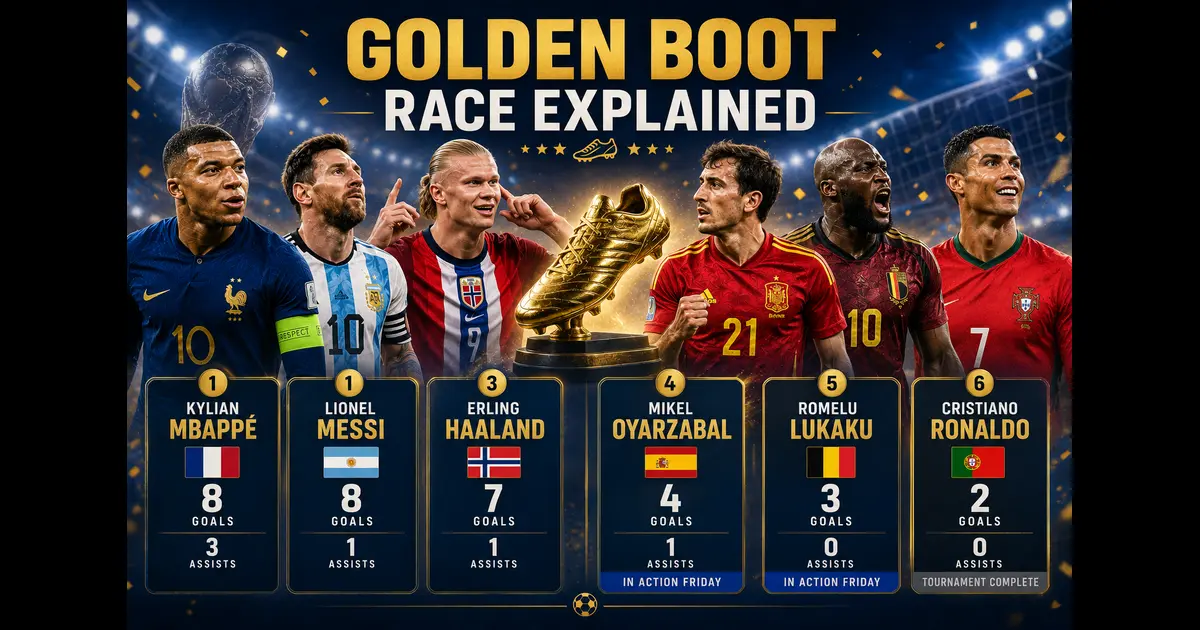
Two quarterfinals down, two to go — the Golden Boot race explained, with Mbappe and Messi locked together at the top and a handful of contenders still capable of overtaking them both.
By StrikerReport Football Desk
The Golden Boot has always been one of the World Cup’s simplest storylines to follow and one of its hardest to predict. Whoever scores the most goals across the tournament takes it home, with assists used as the first tiebreaker if scorers finish level — a format simple enough to track match by match, but volatile enough that a single quarterfinal can completely reshuffle the standings. With two of this year’s four quarterfinals now complete and two more still to come, here’s the Golden Boot race explained: who’s currently on top, who’s chasing hardest, and what needs to happen over the coming days for the race to be settled one way or another.
How the Golden Boot Actually Works
Before getting into the standings, it’s worth being precise about the mechanics, since they matter more than casual fans often realize. The award goes to the tournament’s top goalscorer across all matches, group stage through the final. If two or more players finish level on goals, FIFA’s official tiebreaker is total assists, followed by total minutes played, with fewer minutes breaking the tie in the scorer’s favor. That assist tiebreaker has already become relevant this tournament, and it’s likely to matter even more as the goal totals at the top continue to converge.
The Standings Through Thursday’s Quarterfinal
Kylian Mbappé (France) — 8 goals. Mbappé moved level at the top of the race in the most dramatic way possible during France’s 2-0 quarterfinal win over Morocco, missing a first-half penalty before recovering to curl in a superb second-half strike, then setting up Ousmane Dembélé’s second with a defense-splitting pass. That goal was his eighth of the tournament, matching Lionel Messi at the summit, and it made Mbappé the only player in World Cup history to record ten or more direct goal involvements — goals plus assists combined — at two separate tournaments. Crucially for the tiebreaker situation, Mbappé now has three assists to go with his eight goals, giving him a real edge over Messi if the two finish level when the tournament ends.
Lionel Messi (Argentina) — 8 goals. Messi’s tally has been built on a signature opening statement — a hat-trick against Algeria on the opening matchday at the same Arrowhead Stadium where Argentina’s quarterfinal against Switzerland is being played — followed by a mixture of composed finishes and, notably, a rare miss: Messi became the first player to miss two penalties in regulation time at a single World Cup after a saved effort against Egypt in the round of 16. He sits level with Mbappé on goals but behind him on the assist tiebreaker, with just one to Mbappé’s three, meaning Messi likely needs outright goals rather than a shared total to guarantee the award for himself.
Erling Haaland (Norway) — 7 goals. One goal back from the co-leaders, Haaland has been the single biggest reason Norway reached their first-ever World Cup quarterfinal. His seven goals across four matches include a stoppage-time winner against Côte d’Ivoire in the round of 32 and a brace that eliminated five-time champions Brazil in the round of 16 — arguably the single most eye-catching individual contribution to any result so far this tournament. Haaland’s route to the Golden Boot runs directly through Saturday’s quarterfinal against England, a considerably tougher defensive examination than anything Norway has faced so far.
Mikel Oyarzabal (Spain) — 4 goals, heading into Friday’s quarterfinal. Oyarzabal’s tally looks modest next to the three names above him, but it comes with a crucial piece of context: Spain haven’t needed him to carry the same offensive burden, given their historically stingy defense has conceded nothing across five matches. Oyarzabal has been Spain’s most reliable finisher regardless, converting the kind of composed chances that a controlled, possession-heavy system tends to generate, and Friday’s quarterfinal against Belgium — statistically the tournament’s third-highest scoring team — represents his clearest opportunity yet to close the gap on the leaders.
Romelu Lukaku (Belgium) — 3 goals, heading into Friday’s quarterfinal. Lukaku’s case for climbing the standings rests on recent history rather than raw numbers alone: he became the first player in World Cup history to score as a substitute in four separate matches, most recently in Belgium’s 4-1 demolition of co-host USA in the round of 16. Belgium’s attack has been genuinely collective rather than one-dimensional — Charles De Ketelaere and Youri Tielemans also have two goals apiece — but Lukaku remains the player with the clearest individual path to a significant late run at the Golden Boot if Friday’s quarterfinal breaks in his favor.
Cristiano Ronaldo (Portugal) — 2 goals, tournament complete. Ronaldo’s World Cup, and quite possibly his international career, ended with Portugal’s 1-0 round of 16 loss to Spain, finishing this tournament with two goals — both against Uzbekistan in the group stage, plus a penalty against Croatia that made him the oldest goalscorer in World Cup knockout-stage history at 41 years and 147 days. His Golden Boot chase is now over, but the historical footnotes he leaves behind — 11 goals across six World Cups, the most ever by a men’s player across that many editions — remain a significant part of this tournament’s broader story.
What Friday’s Quarterfinal Could Change
With France’s quarterfinal against Morocco complete, Friday’s meeting between Spain and Belgium in Los Angeles is the one fixture still capable of reshuffling the standings among the chasing pack before the semifinals begin. Oyarzabal and Lukaku both enter that match with a genuine chance to close the gap on the co-leaders, and the contrast in how they might do it is itself part of the story: Oyarzabal scoring within Spain’s patient, control-based system versus Lukaku adding to Belgium’s more chaotic, multi-source attack. Neither is likely to leapfrog Mbappé or Messi outright from a single match, but a goal or two apiece would meaningfully tighten what is currently a two-goal gap separating the co-leaders from the chasing group.
What to Watch as the Race Enters Its Final Stretch
With two quarterfinals still to be played — Norway against England and Argentina against Switzerland — and a semifinal round and final still to come, the Golden Boot race remains genuinely unresolved. Messi and Argentina’s path runs through Switzerland’s notoriously difficult defensive structure, built around captain Granit Xhaka, which could easily limit further scoring opportunities regardless of Messi’s individual quality. Haaland’s route through England presents a similarly stern defensive test, against a side that has conceded only a handful of goals all tournament. Mbappé, by contrast, faces a run-in defined more by opportunity than obstacle, given France’s dominant attacking form and their favorable path to a potential final.
The single clearest takeaway from where the race currently stands: Mbappé’s three assists to Messi’s one could prove decisive if the two finish level on goals when the tournament ends, making every additional assist — not just goal — worth tracking closely over the coming week. Whether Haaland, Oyarzabal, or Lukaku can mount a genuine late surge remains to be seen, but with a semifinal and final still to be played, this is a race that will very likely go down to the tournament’s final whistle in New Jersey on July 19.
StrikerReport.com will update the Golden Boot standings after every remaining match through the final.
◾◾ follow us on facebook ◾◾
About the Author


1 thought on “Golden Boot Race Explained: Who Leads Right Now at World Cup 2026”