 FIFA World Cup 2026 Results: Final to Group Stage Complete Scores
The FIFA World Cup 2026 is officially complete, and the final result delivered a dramatic ending to the expanded 48-team tournament. Spain defeated Argentina 1-0 after extra time at New York New Jersey Stadium on July 19 to win their second World Cup title. Ferran Torres scored the decisive goal in the 106th minute after Spain had dominated the final statistically, finishing with 20 attempts to Argentina’s two.
Spain Are World Champions: The Story of Their 2026 Triumph
Below is the complete World Cup 2026 results list, arranged in reverse chronological order. The final, bronze final, semi-finals, quarter-finals, Round of 16, Round of 32 and group-stage results are all included, making this a single reference for the entire tournament.
Why So Much of the World Wanted Argentina to Fail
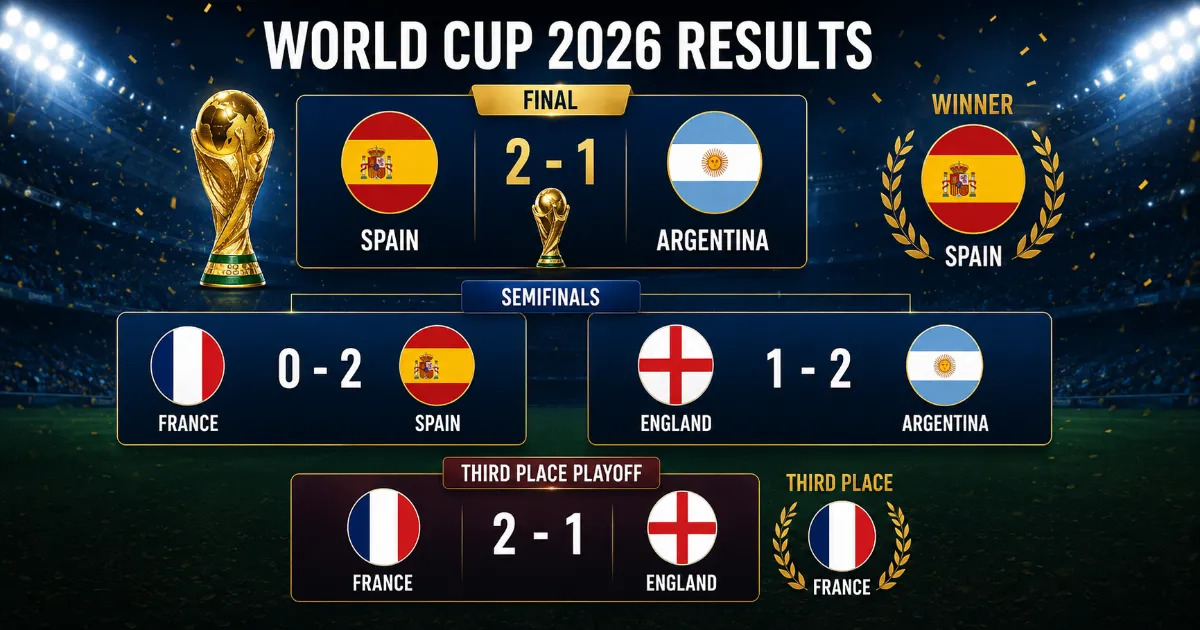
FIFA World Cup 2026 Final
| Match | Date | Score | Winner |
|---|---|---|---|
| Spain vs Argentina | July 19 | 1–0 AET | Spain |
Goal: Ferran Torres 106′
Spain became world champions for the second time after defeating Argentina 1-0 in extra time. Luis de la Fuente’s team completed an outstanding tournament by conceding only one goal across eight matches. Argentina had entered the final as defending champions but were eventually denied a second consecutive title.
FIFA World Cup 2026 Final Standings
| Position | Team | Finish |
|---|---|---|
| 1 | Spain | Champions |
| 2 | Argentina | Runners-up |
| 3 | England | Bronze medal |
| 4 | France | Fourth place |
England secured third place by defeating France 6-4 in the bronze final, with Bukayo Saka scoring a hat-trick in a record-breaking ten-goal match.
FIFA World Cup 2026 Third-Place Match
| Match | Date | Score | Winner |
|---|---|---|---|
| France vs England | July 18 | 4–6 | England |
England produced one of the wildest results of the tournament, beating France 6-4 after leading 4-0 at half-time. Saka scored three times, while Jude Bellingham added England’s sixth goal in stoppage time. France’s goals came from Kylian Mbappé’s brace, Bradley Barcola and Ousmane Dembélé.FIFA World Cup Third-Place Match Report: England Survive France Rally, 6-4
FIFA World Cup 2026 Semi-Final Results
| Match | Date | Score | Winner |
|---|---|---|---|
| France vs Spain | July 14 | 0–2 | Spain |
| England vs Argentina | July 15 | 1–2 | Argentina |
Spain reached the final after a commanding 2-0 victory over France. Argentina then completed the final pairing with another dramatic comeback, defeating England 2-1 in Atlanta. England led through Anthony Gordon, but Enzo Fernández and Lautaro Martínez scored late to send the holders into the final.
FIFA World Cup 2026 Quarter-Final Results
| Match | Date | Score | Winner |
|---|---|---|---|
| France vs Morocco | July 9 | 2–0 | France |
| Spain vs Belgium | July 10 | 2–1 | Spain |
| Norway vs England | July 11 | 1–2 AET | England |
| Argentina vs Switzerland | July 11 | 3–1 AET | Argentina |
The quarter-finals produced four contrasting contests. France ended Morocco’s historic run with a 2-0 victory, while Spain survived Belgium 2-1. England needed extra time to overcome Norway 2-1, and Argentina also required extra time before beating Switzerland 3-1
FIFA World Cup 2026 Round of 16 Results
| Match | Score | Winner |
|---|---|---|
| Paraguay vs France | 0–1 | France |
| Canada vs Morocco | 0–3 | Morocco |
| Brazil vs Norway | 1–2 | Norway |
| Mexico vs England | 2–3 | England |
| Portugal vs Spain | 0–1 | Spain |
| USA vs Belgium | 1–4 | Belgium |
| Argentina vs Egypt | 3–2 | Argentina |
| Switzerland vs Colombia | 0–0 (4–3 pens) | Switzerland |
The Round of 16 provided one of the tournament’s biggest shocks when Norway eliminated five-time champions Brazil 2-1. Spain edged Portugal 1-0, Belgium defeated the United States 4-1 and Argentina survived Egypt 3-2. Switzerland advanced after a penalty shootout against Colombia.
FIFA World Cup 2026 Round of 32 Results
| Match | Score | Winner |
|---|---|---|
| Mexico vs Ecuador | 2–0 | Mexico |
| Germany vs Paraguay | 1–1 (Paraguay won on pens) | Paraguay |
| South Africa vs Canada | 0–1 | Canada |
| Switzerland vs Algeria | 2–0 | Switzerland |
| Brazil vs Japan | 2–1 | Brazil |
| Netherlands vs Morocco | 1–1 (Morocco won on pens) | Morocco |
| France vs Sweden | 3–0 | France |
| Belgium vs Senegal | 3–2 | Belgium |
| Australia vs Egypt | 1–1 (Egypt won on pens) | Egypt |
| Argentina vs Cape Verde | 3–2 AET | Argentina |
| Spain vs Austria | 3–0 | Spain |
| Portugal vs Croatia | 2–1 | Portugal |
| Colombia vs Ghana | 1–0 | Colombia |
| England vs Congo DR | 2–1 | England |
| USA vs Bosnia and Herzegovina | 2–0 | USA |
| Ivory Coast vs Norway | 1–2 | Norway |
The introduction of the 32-team knockout bracket meant that the Round of 32 became the first elimination stage. It immediately produced several memorable moments, including Paraguay eliminating Germany on penalties, Morocco surviving the Netherlands in a shootout and Norway advancing at the expense of Ivory Coast.The Fastest NBA Players Ever, Ranked
FIFA World Cup 2026 Group Stage Results
All 12 groups completed their three-match round-robin schedules before the knockout phase began.
Group A
| Pos | Team | Pts |
|---|---|---|
| 1 | Mexico | 9 |
| 2 | South Africa | 4 |
| 3 | Korea Republic | 3 |
| 4 | Czechia | 1 |
Results: Korea Republic 2–1 Czechia · Mexico 2–0 South Africa · Czechia 1–1 South Africa · Mexico 1–0 Korea Republic · South Africa 1–0 Korea Republic · Czechia 0–3 Mexico
Group B
| Pos | Team | Pts |
|---|---|---|
| 1 | Switzerland | 7 |
| 2 | Canada | 4 |
| 3 | Bosnia and Herzegovina | 4 |
| 4 | Qatar | 1 |
Results: Qatar 1–1 Switzerland · Canada 1–1 Bosnia and Herzegovina · Switzerland 4–1 Bosnia and Herzegovina · Canada 6–0 Qatar · Switzerland 2–1 Canada · Bosnia and Herzegovina 3–1 Qatar
Group C
| Pos | Team | Pts |
|---|---|---|
| 1 | Brazil | 7 |
| 2 | Morocco | 7 |
| 3 | Scotland | 3 |
| 4 | Haiti | 0 |
Results: Brazil 1–1 Morocco · Haiti 0–1 Scotland · Scotland 0–1 Morocco · Morocco 4–2 Haiti · Scotland 0–3 Brazil · Brazil 3–0 Haiti
Morocco and Brazil finished level on seven points, with Brazil taking top spot on goal difference.
Group D
| Pos | Team | Pts |
|---|---|---|
| 1 | USA | 6 |
| 2 | Australia | 4 |
| 3 | Paraguay | 4 |
| 4 | Turkiye | 3 |
Results: USA 4–1 Paraguay · Australia 2–0 Turkiye · Turkiye 0–1 Paraguay · Paraguay 0–0 Australia · USA 2–0 Australia · Turkiye 3–2 USA
Group E
| Pos | Team | Pts |
|---|---|---|
| 1 | Germany | 6 |
| 2 | Ivory Coast | 6 |
| 3 | Ecuador | 4 |
| 4 | Curacao | 1 |
Results: Germany 7–1 Curacao · Ivory Coast 1–0 Ecuador · Germany 2–1 Ivory Coast · Ecuador 0–0 Curacao · Ecuador 2–1 Germany · Curacao 0–2 Ivory Coast
Group F
| Pos | Team | Pts |
|---|---|---|
| 1 | Netherlands | 7 |
| 2 | Japan | 5 |
| 3 | Sweden | 4 |
| 4 | Tunisia | 0 |
Results: Netherlands 2–2 Japan · Sweden 5–1 Tunisia · Tunisia 0–4 Japan · Netherlands 5–1 Sweden · Japan 1–1 Sweden · Tunisia 1–3 Netherlands
Group G
| Pos | Team | Pts |
|---|---|---|
| 1 | Belgium | 5 |
| 2 | Egypt | 5 |
| 3 | IR Iran | 3 |
| 4 | New Zealand | 1 |
Results: Belgium 1–1 Egypt · IR Iran 2–2 New Zealand · Belgium 0–0 IR Iran · New Zealand 1–3 Egypt · Egypt 1–1 IR Iran · New Zealand 1–5 Belgium
Group H
| Pos | Team | Pts |
|---|---|---|
| 1 | Spain | 7 |
| 2 | Cape Verde | 3 |
| 3 | Uruguay | 2 |
| 4 | Saudi Arabia | 2 |
Results: Spain 0–0 Cape Verde · Saudi Arabia 1–1 Uruguay · Spain 4–0 Saudi Arabia · Uruguay 2–2 Cape Verde · Uruguay 0–1 Spain · Cape Verde 0–0 Saudi Arabia
Spain’s goalless opening draw against Cape Verde proved to be their only dropped points of the tournament.
Group I
| Pos | Team | Pts |
|---|---|---|
| 1 | France | 9 |
| 2 | Norway | 6 |
| 3 | Senegal | 3 |
| 4 | Iraq | 0 |
Results: France 3–1 Senegal · Iraq 1–4 Norway · France 3–0 Iraq · Norway 3–2 Senegal · Senegal 5–0 Iraq · Norway 1–4 France
Group J
| Pos | Team | Pts |
|---|---|---|
| 1 | Argentina | 9 |
| 2 | Austria | 4 |
| 3 | Algeria | 4 |
| 4 | Jordan | 0 |
Results: Argentina 3–0 Algeria · Austria 3–1 Jordan · Jordan 1–2 Algeria · Argentina 2–0 Austria · Algeria 3–3 Austria · Jordan 1–3 Argentina
Argentina were among the tournament’s strongest group-stage teams, winning all three matches before beginning a much more dramatic knockout journey.
Group K
| Pos | Team | Pts |
|---|---|---|
| 1 | Colombia | 7 |
| 2 | Portugal | 5 |
| 3 | Congo DR | 4 |
| 4 | Uzbekistan | 0 |
Results: Uzbekistan 1–3 Colombia · Portugal 1–1 Congo DR · Colombia 1–0 Congo DR · Portugal 5–0 Uzbekistan · Congo DR 3–1 Uzbekistan · Colombia 0–0 Portugal
Group L
| Pos | Team | Pts |
|---|---|---|
| 1 | England | 7 |
| 2 | Croatia | 6 |
| 3 | Ghana | 4 |
| 4 | Panama | 0 |
Results: England 4–2 Croatia · Ghana 1–0 Panama · Panama 0–1 Croatia · England 0–0 Ghana · Croatia 2–1 Ghana · Panama 0–2 England
Best Third-Place Teams
The eight third-placed teams advancing to the Round of 32 were:
Bosnia and Herzegovina, Paraguay, Ecuador, Sweden, Senegal, Algeria, Congo DR and Ghana.
How the FIFA World Cup 2026 Story Ended
The final stages ultimately produced a Spain-Argentina showdown that brought together the reigning European champions and defending world champions. Spain had progressed through the tournament with extraordinary defensive consistency, conceding only once — in their quarter-final against Belgium. That goal ended Unai Simón’s remarkable run without conceding, but Spain recovered to beat Belgium 2-1 and then defeated France 2-0 in the semi-final.
Argentina’s route to the final was considerably more dramatic. After winning all three group matches, Lionel Scaloni’s side survived Cape Verde, Egypt and Switzerland before producing another late comeback against England in the semi-final. Enzo Fernández and Lautaro Martínez scored in the closing stages after Anthony Gordon had given England the lead.
That set up the decisive meeting in New York New Jersey Stadium. Spain controlled the final for long periods but needed extra time to break through. Ferran Torres finally found the winning goal in the 106th minute, securing Spain’s second World Cup title.
The tournament also produced a remarkable individual achievement for Spain’s goalkeeper. Unai Simón won the adidas Golden Glove after recording seven clean sheets in eight matches, the most clean sheets ever recorded by a goalkeeper in a single World Cup. Spain’s only goal conceded throughout the tournament came against Belgium.
England completed the podium with their 6-4 victory over France, while France finished fourth. FIFA’s final standings confirm Spain as champions, Argentina as runners-up, England in third and France in fourth.
FIFA World Cup 2026 Results: Final Tournament Summary
| Stage | Result |
|---|---|
| Champions | Spain |
| Runners-up | Argentina |
| Third place | England |
| Fourth place | France |
| Final | Spain 1–0 Argentina AET |
| Bronze Final | France 4–6 England |
| Golden Glove | Unai Simón |
| Spain’s record | 7 wins, 1 draw, 1 goal conceded |
| Final venue | New York New Jersey Stadium |
The 2026 tournament therefore closes with Spain at the top of the world, Argentina narrowly denied a second consecutive championship, England claiming their best finish since 1966, and France completing the top four. The complete results above provide the full path from the opening group games to the final whistle of a World Cup that featured 104 matches across 48 teams.
Who Is Gianluigi Buffon? The Journey of Italy’s Legendary Goalkeeper
◾◾ follow us on facebook ◾◾
About the Author