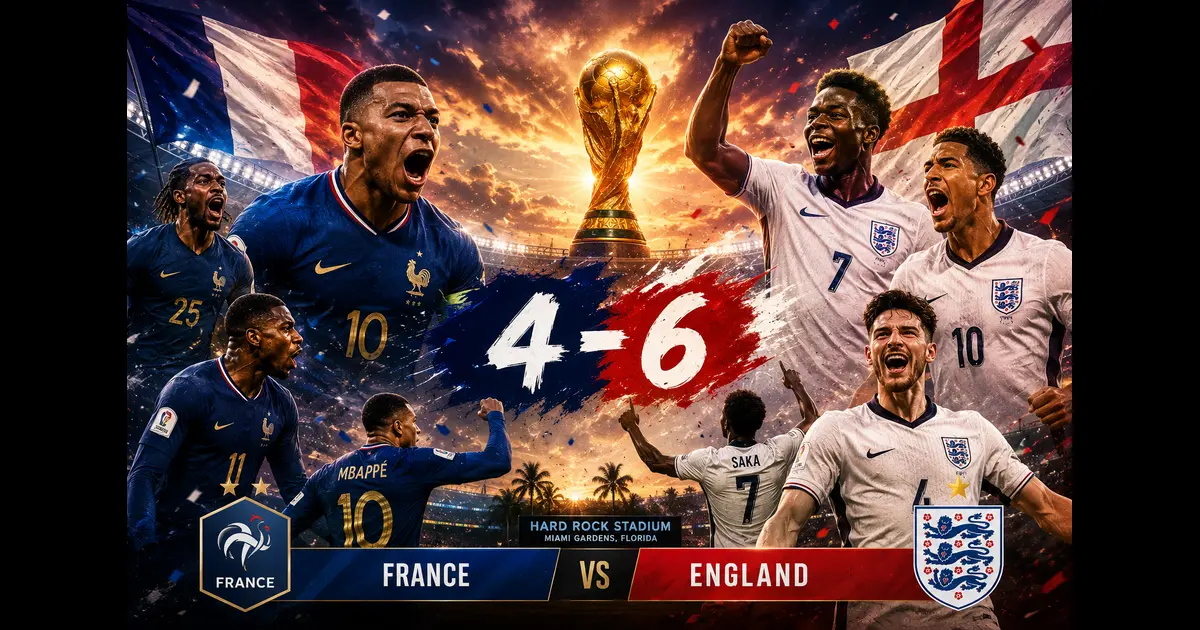
 FIFA World Cup 2026, Third-Place Playoff France 4-6 England Hard Rock Stadium, Miami Gardens, Florida Goals: Kylian Mbappé 48′, 66′, Bradley Barcola 58′, Ousmane Dembélé 90+5′ (France); Declan Rice 3′, Ezri Konsa 8′, Bukayo Saka 22′, 35′, 87′ (pen), Jude Bellingham 90+7′ (England)
Nobody expected the World Cup’s meaningless consolation match to become one of the most entertaining games of the entire tournament, but that’s exactly what England and France delivered in Miami, producing a stunning 6-4 England win that stands as the highest-scoring third-place match in FIFA World Cup third-place match history and the most goals in any World Cup fixture since Hungary’s 10-1 demolition of El Salvador back in 1982.
15 Champions League Players to Watch in 2026/27: Superstars & Young Guns
LaLiga 2026/27 Schedule: Fixtures, Dates & TimesA Match Neither Team Looked Like They Wanted to Play
The occasion began exactly as low-stakes bronze-medal matches usually do: with both sets of fans still nursing genuine heartbreak from Wednesday’s semifinal defeats, and both managers making it clear through team selection that this match ranked well below full commitment. Thomas Tuchel left out captain Harry Kane and star midfielder Jude Bellingham entirely from his starting eleven, while also benching first-choice goalkeeper Jordan Pickford in favor of Dean Henderson. Tuchel himself was booed onto the touchline before kickoff, supporters still raw from England’s semifinal exit and clearly unconvinced by his squad rotation for a match many England fans felt deserved a stronger response.
Whatever message England’s team sheet sent about the occasion’s priority, Declan Rice, handed the captain’s armband for the day, had other ideas. Just two and a half minutes into the match, Rice curled a stunning effort from distance beyond the France goalkeeper to open the scoring, immediately setting a tone that suggested this match would be treated with far more seriousness than the circumstances demanded.
England’s Extraordinary First-Half Blitz
What followed was one of the most one-sided opening periods of the entire tournament. Rice, having opened the scoring himself, turned provider soon after, setting up Ezri Konsa for a headed goal from a corner to make it 2-0. Bukayo Saka then took over completely, tapping in from a generous Marcus Rashford pass to make it three, before adding a genuinely brilliant individual finish from the edge of the box to complete his first-half brace and send England into the interval with a commanding 4-0 lead. For a match both managers had seemingly treated as a footnote, the football on display was anything but.
France’s Astonishing Second-Half Response
Whatever Didier Deschamps said at halftime worked. France emerged from the break transformed, and Kylian Mbappé led the fightback personally. He pulled a goal back in the 48th minute, then turned provider himself, setting up Bradley Barcola to make it 4-2 before the hour mark. Six minutes later, Mbappé struck again, his second of the match and, remarkably, the goal that made him the all-time leading scorer in World Cup history, moving him past Lionel Messi’s total and to 22 career World Cup goals. Both of Mbappé’s goals were created by Michael Olise, whose seven assists across the tournament similarly broke the World Cup’s all-time single-tournament assist record, surpassing a mark previously held by Pelé.
Suddenly, a match that looked comfortably over at halftime had become a genuine contest, with France threatening to complete one of the most remarkable comebacks in World Cup history. England, to their credit, found a way to arrest the momentum. A foul inside the box in the 87th minute gave Saka the chance to complete his hat-trick from the penalty spot, and he made no mistake, restoring England’s cushion to 5-3. France weren’t finished, though; Ousmane Dembélé pulled one back in the fifth minute of stoppage time, assisted by Dayot Upamecano, to make it a nervy 5-4 with the clock almost expired. England had the final word regardless, substitute Jude Bellingham driving through three French defenders in the box before slotting home England’s sixth in the seventh minute of stoppage time to finally settle a match that had swung wildly in both directions.
The Records This Match Produced
Beyond the pure entertainment value, Saturday’s match reshuffled several corners of World Cup history. Mbappé’s brace confirmed him as the tournament’s all-time leading scorer with 22 goals, a record that could still theoretically be extended depending on how the rest of his career unfolds, but one that now sits clear of Messi heading into Sunday’s final. Olise’s seven assists broke a single-tournament record that had stood since Pelé’s era. On England’s side, Bellingham’s stoppage-time strike gave him seven goals across this tournament, the most by any England player in a single World Cup edition, surpassing his own captain Harry Kane’s tally of six from the same competition. And the match’s overall goal tally, ten in total, made it the highest-scoring World Cup fixture since 1982 and, specifically, the highest-scoring third-place match the tournament has ever produced.
Why the Third-Place Match Actually Matters
It’s tempting to dismiss the third-place playoff as football’s most pointless fixture, a match nobody wants to play, sandwiched awkwardly between the heartbreak of a semifinal exit and the spectacle of the final itself. Saturday’s match in Miami offered a genuine rebuttal to that dismissiveness. For England, finishing third represents their best World Cup placing since they won the tournament outright in 1966, a genuinely significant marker of progress for a nation that has spent decades measuring itself against that single triumph. For a team that entered this tournament under real pressure following criticism of Tuchel’s tactical approach, leaving with a bronze medal and a stoppage-time comeback win, however meaningless the stakes technically were, offers a tangible, morale-boosting achievement to build toward the next cycle.
For France, the match carried different but equally real stakes. Kylian Mbappé’s pursuit of the all-time World Cup scoring record didn’t stop simply because his team had already been eliminated from title contention; if anything, the third-place match became the exact stage on which he secured a piece of history that will outlast this specific tournament by decades. Individual legacies don’t pause for consolation matches, and Mbappé’s decision to play with the same intensity that carried France through the earlier rounds, rather than treat Saturday as a formality, reflects genuine professional pride that deserves recognition independent of the team result.
The Tactical Picture Behind the Chaos
Beyond the individual brilliance, Saturday’s match offered a genuine tactical case study in how quickly a match can swing when two sides with real attacking quality stop prioritizing defensive solidity. England’s first-half approach, built around quick transitions and direct running at a France back line missing some of its usual defensive intensity, exploited exactly the kind of gaps that appear when a team’s collective focus has understandably wavered after a gutting semifinal exit. Rice’s early goal and subsequent assist set a tempo France simply couldn’t match in the opening period, and Saka’s movement between the lines gave England’s attack a clear focal point that France’s midfield struggled to track.
France’s second-half adjustment was equally instructive. Deschamps clearly used the interval to refocus his side around getting the ball to Mbappé and Olise in dangerous positions as quickly as possible, abandoning any pretense of patient buildup in favor of direct, vertical passes designed to exploit exactly the kind of gaps England’s own attacking commitment had left at the back. It worked spectacularly well for nearly half an hour, and had France found one more goal in the final exchanges, this match would be remembered as one of the great World Cup comebacks rather than a story about England’s resilience.
The Managers’ Contrasting Emotions
Thomas Tuchel’s reaction to full time reportedly carried more relief than celebration, aware that a result built on individual moments from Saka and Bellingham, rather than clear tactical control, doesn’t fully answer the questions raised by England’s semifinal exit to Argentina. The German coach still faces a genuine reckoning over his tactical approach heading into the next cycle, regardless of Saturday’s entertaining scoreline. Didier Deschamps, by contrast, watched his side’s spirited fightback fall agonizingly short in what may prove to be among his final matches in charge of France, a bittersweet ending that nonetheless showcased exactly the individual quality, Mbappé, Olise, Dembélé, Barcola, that any successor will inherit as a genuine foundation to build from.
Player Ratings: The Standouts
Bukayo Saka (England) — Man of the Match. A complete hat-trick, tap-in, screamer, penalty, delivered at precisely the moments England needed it most, capped by a composed reaction to France’s fightback that suggested genuine maturity beyond just individual quality.
Kylian Mbappé (France). Two goals that mattered more to his personal legacy than to France’s result, confirming his status as the outright greatest goalscorer in World Cup history at 22 career goals, a record that will likely stand for a long time.
Jude Bellingham (England). A substitute cameo that produced the match-sealing goal and a personal milestone of seven tournament goals, further evidence that benching him for the start of a “meaningless” match barely dented his influence on the eventual result.
Michael Olise (France). Two assists that pushed his tournament tally to seven, breaking a single-tournament record that had stood since Pelé’s era, a quietly remarkable underlying statistic given how much attention Mbappé’s exploits understandably absorbed.
Declan Rice (England). A goal and an assist inside the opening ten minutes, captaining the side with genuine authority in a match his manager’s team selection suggested wouldn’t demand it.
What Comes Next
For England, third place under Thomas Tuchel offers a complicated verdict on his tenure so far: genuine tournament success by historical standards, but delivered via a semifinal collapse against Argentina that still stings, followed by a bronze-medal performance built more on individual quality, Saka’s hat-trick, Bellingham’s late intervention, than obvious tactical coherence. Question marks about his squad selection and setup will persist regardless of Saturday’s entertaining outcome.
For France, the disappointment of missing out on back-to-back finals will linger longer than any consolation prize can soften, but Mbappé’s continued excellence, now the outright greatest World Cup goalscorer in the sport’s history, gives Didier Deschamps’ successor, whoever that turns out to be, a genuinely world-class foundation to build the next cycle around. Saturday’s match won’t be remembered as a classic in the way Sunday’s final might be. But for a fixture nobody particularly wanted to play, it delivered ten goals, two broken all-time records, and a finish few neutral fans watching will forget anytime soon.
Bangladesh Create History in Darwin, Defeat Australia by Nine Wickets in Landmark Test Victory
PSG v Arsenal: How Paris Won the Champions League Final on Penalties
NBA Schedule 2026-27: Christmas Day Rivalries, Ring Night and the Games to Watch
🔹🔹 🔹🔹
About the Author