A plain guide to the World Cup final rules on extra time, substitutions and a possible penalty shootout if Sunday’s match can’t be settled in 90 minutes.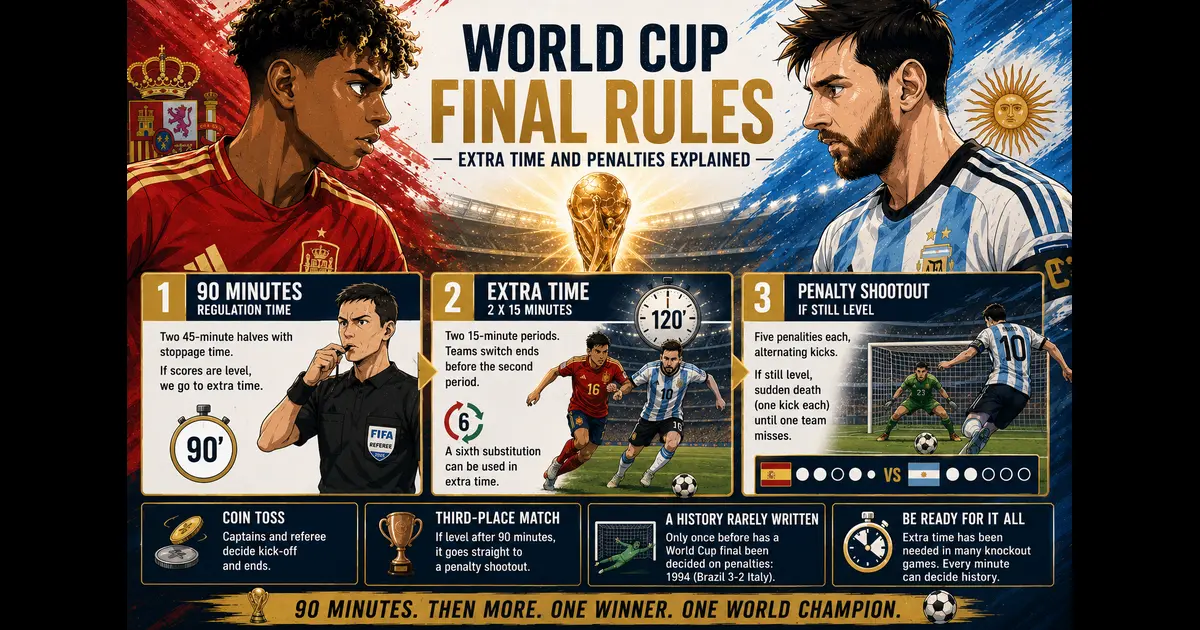
Unlike group-stage matches, which can end in a draw, the World Cup final has to produce a winner — there’s no such thing as a shared trophy. If Spain and Argentina are level after 90 minutes on Sunday, here’s exactly what happens next, step by step.
Step One: 90 Minutes of Regulation Time
The final follows the same basic structure as every other match at the tournament: two 45-minute halves, with stoppage time added at the discretion of the referee, Slavko Vinčić, to account for injuries, substitutions, VAR reviews, and time-wasting. Given how significant a World Cup final is, and how closely officials tend to track exactly this kind of detail in knockout football, it wouldn’t be a surprise to see a heavier-than-usual stoppage time allocation in either half.
If one team is ahead after 90 minutes plus stoppage time, the match ends there and that team is crowned champion. It’s only if the scores are level that the format changes.
Step Two: Extra Time
If the match is drawn after 90 minutes, it moves straight into extra time — two additional periods of 15 minutes each, played in full regardless of whether a goal is scored partway through (the “golden goal” rule that once ended extra time the instant a goal went in was abolished after the 1998 and 2002 tournaments). There’s a short break between the two periods of extra time, similar to a mini-halftime, and teams switch ends before the second period begins.
Extra time brings its own tactical wrinkle worth knowing: FIFA’s substitution rules allow for a sixth substitution to be used specifically during extra time, on top of the five permitted across normal time, giving both managers an additional fresh option to call upon if the match goes the distance. That detail matters given how gruelling this tournament’s knockout rounds have already been for both finalists — Argentina in particular have needed extra time once already this tournament, in their round of 32 win over Cape Verde.
Step Three: Penalty Shootout
If the scores are still level after both periods of extra time — 120 minutes of football in total — the match is decided by a penalty shootout. Each team selects five players to take alternating kicks from the penalty spot, with the team scoring more of its five kicks declared the winner. If the shootout is still tied after five kicks each, it moves into sudden-death rounds, one kick per team per round, until one side scores and the other misses.
Shootouts have decided a World Cup final once before, in 1994, when Brazil beat Italy 3-2 on penalties after a goalless 120 minutes — still the only men’s World Cup final in history to reach that stage. Whether this final joins that list is impossible to predict, but both finalists arrive with contrasting shootout pedigrees worth knowing: Argentina’s Emiliano Martínez built much of his reputation on shootout heroics during the 2022 triumph, while Spain have had more mixed fortunes in the format, having been eliminated on penalties by both Russia in 2018 and Morocco in 2022 during the round of 16.
What About the Coin Toss and Other Pre-Match Procedures?
Before kickoff, the two captains and the referee conduct a coin toss to determine which team kicks off and which end each side defends in the first half — standard procedure for every match at the tournament, final included. There’s no special format quirk here; it’s the same process used throughout the competition.
Does the Same Format Apply to the Third-Place Match?
England and France’s third-place playoff on Saturday, the day before the final, follows a slightly different structure. Third-place matches at the World Cup typically go straight to a penalty shootout if the scores are level after 90 minutes, skipping extra time altogether — a detail worth knowing if you’re following both matches over the closing weekend, since the two fixtures don’t follow identical rules despite being played under the same tournament.
The Bottom Line
Ninety minutes, then extra time if needed, then penalties as an absolute last resort — that’s the full picture for Sunday’s final. Given how many of this tournament’s knockout matches have gone the distance already (Argentina needed extra time against Cape Verde, and both finalists have been involved in tense, tightly poised knockout football throughout), don’t be surprised if Sunday’s final is decided by something other than a straightforward 90-minute result.
🔹🔹 follow us on facebook 🔹🔹
About the Author