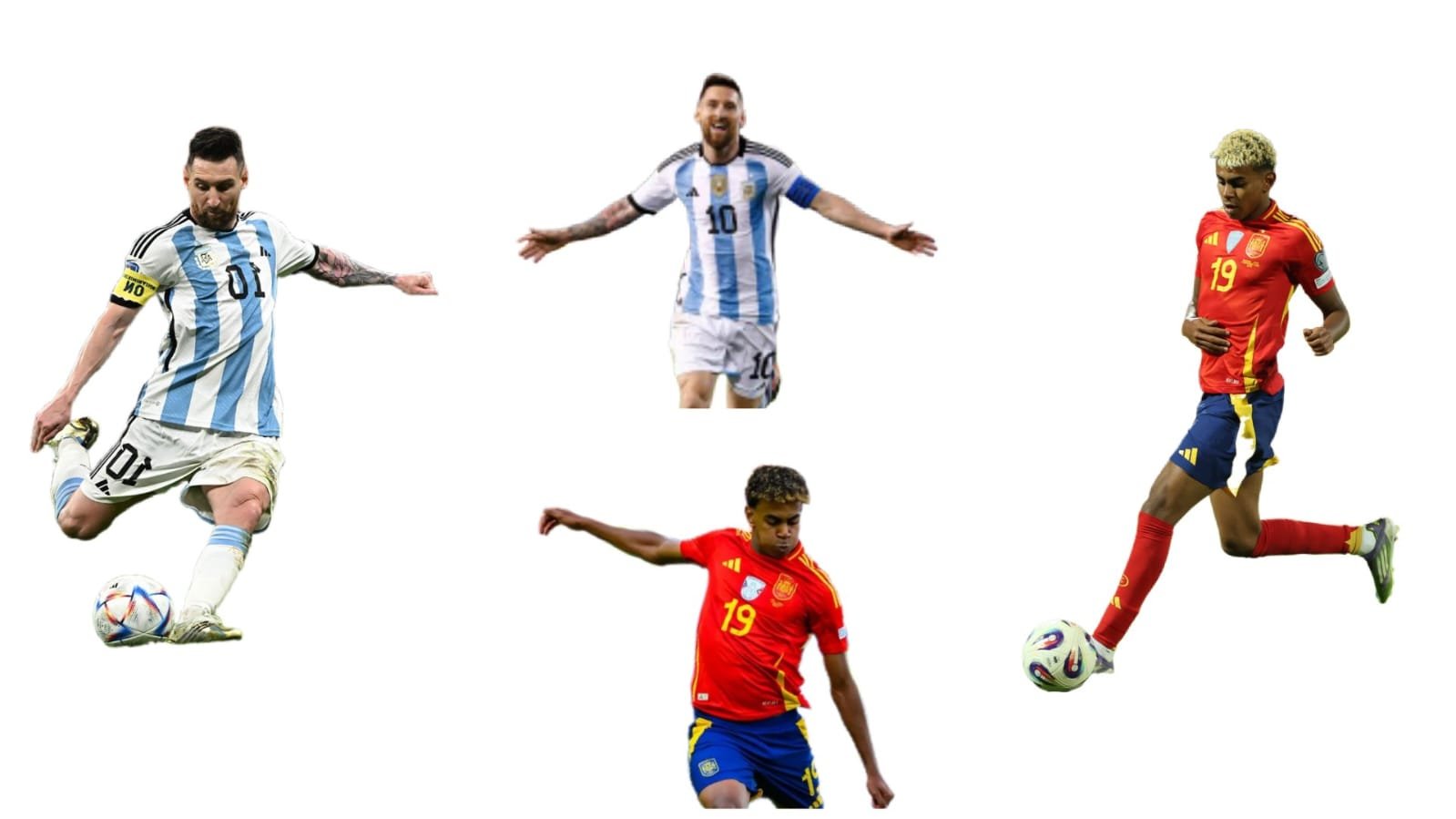
 Two Careers, Two Eras, One Pitch in New Jersey: Messi vs Yamal
There is a photograph that Argentine and Spanish football fans alike have shared endlessly this week — Lionel Messi, still years from his first World Cup, holding a baby who would grow up to become Lamine Yamal. Messi first met Yamal as a baby; their next meeting will be in a World Cup final. Football does not often hand you symmetry this clean. Messi vs Yamal is not just a subplot of Sunday’s final at MetLife Stadium. For a lot of people watching, it will be the whole story.
Lionel Messi 2026 World Cup Journey: Why the World Is Watching Closely
Lamine Yamal FIFA World Cup 2026: Profile, Stats & Career | StrikerReport
The Master, One Last Time
Start with the number that should silence any lingering debate about whether Messi still belongs on football’s biggest stage. Messi became the FIFA World Cup’s all-time leading men’s goalscorer during this tournament’s group stage, overtaking Miroslav Klose’s long-standing record with a brace against Austria that took his tally to 18. He has added to that total since. He is, by the sport’s own ledger, the most prolific World Cup scorer who has ever lived — and he achieved it not in his athletic prime, but at an age when most professional careers have already ended.
There were real doubts about Messi heading into this tournament — three years playing in MLS rather than Europe’s top leagues, an injury scare beforehand, and the simple, unavoidable fact of turning 39 during the competition. Those doubts have been answered in the most emphatic way possible: not with the explosive dribbling of his Barcelona prime, but with something arguably rarer — a 39-year-old reading the game two moves ahead of defenders half his age, popping up with exactly the right pass, at exactly the right moment, in match after match. His two assists in Argentina’s semifinal comeback against England, both delivered in the final ten minutes, are the clearest recent example: a player who no longer needs to win every physical battle, because his understanding of space and timing has become the more devastating weapon.
This tournament run began, fittingly, twenty years to the day after his World Cup debut as a substitute against Serbia and Montenegro at Germany 2006 — a two-decade arc that has now produced a hat-trick in a group-stage opener, an all-time scoring record broken in the group stage, and a shot at becoming the first player to captain back-to-back World Cup-winning Argentina squads since the country’s 1978 and 1986 generations, and the first team since Brazil in 1958 and 1962 to defend the World Cup outright. Whatever happens Sunday, Messi has already secured his answer to the “one more World Cup” question that has followed him around for a decade. He came back, and he was, if anything, more decisive than ever.
The Future, Arriving Early
Now turn to the other side of the pitch. Lamine Yamal turned 19 the day before Spain’s semifinal win over France — and the very next day, he drew the penalty that opened the scoring, becoming the second-youngest player in sixty years to win a penalty in a World Cup knockout match, behind only England’s Michael Owen against Argentina in 1998. That last detail is almost too neat to be coincidental: a teenage Spanish prodigy matching a feat achieved against this exact opponent, in this exact tournament stage, twenty-eight years apart.
Yamal’s tournament has been defined less by highlight-reel individual moments and more by a maturity that seems to arrive a decade early in almost everything he does. He made his first World Cup start against Saudi Arabia and needed just ten minutes to score, becoming, at 18 years and 343 days old, Spain’s second-youngest scorer on the finals stage.Of the seven teenagers to start a World Cup semifinal in the tournament’s history, two of them started for Spain against France this summer — Yamal and Pau Cubarsí — a statistic that says as much about the structural depth of Spain’s academy system as it does about Yamal’s individual talent.
There’s a quieter, more pointed storyline buried in Yamal’s tournament, too. Since joining Real Madrid, Kylian Mbappé has lost every single knockout match, for club or country, against Lamine Yamal.That is not the résumé of a promising teenager anymore. That is the résumé of a player who has already established a genuine psychological edge over one of the two or three best forwards alive, at an age when most players are still fighting for regular first-team minutes.
What Makes This Matchup Different From Every Other “Passing the Torch” Story
Football loves a changing-of-the-guard narrative, and most of them are overstated — two players from different generations sharing a pitch does not automatically mean anything is being “passed” between them. This one is different, for a specific reason: Messi and Yamal are not just symbolically linked. They are literally, personally connected, through the same Barcelona academy system that shaped Messi into the player he became and that, two decades later, produced Yamal.
It’s a clash of eras: 19-year-old phenom Lamine Yamal and a relentless Spain machine against Lionel Messi and Argentina in what is widely expected to be his final World Cup match. Whether that expectation proves accurate is something only Messi himself will decide in the coming months. But if this genuinely is the last time these two players share a World Cup pitch, Sunday offers something remarkably rare in sport: not a passing of the torch in the abstract, but two players from the same footballing lineage, at opposite ends of their careers, meeting with the sport’s biggest prize on the line.
World Cup 2026 Results: Complete Scores and Updated Tables
The Head-to-Head That Isn’t Really a Head-to-Head
It’s worth being precise about what Sunday’s matchup actually is, tactically. Messi and Yamal will not spend ninety minutes directly marking each other — they play different positions, on different sides of the pitch, for different teams with different defensive responsibilities. The “Messi vs Yamal” framing is a narrative device, not a literal positional battle. What it really represents is two different theories of how a World Cup final gets won: Messi’s, built on twenty years of accumulated wisdom, timing, and the kind of gravitational pull that reshapes how an entire opposing defense sets up around him; and Yamal’s, built on searing, fearless directness that has already unsettled some of the best defenders in the world at an age when most of his peers are still playing academy football.
The Verdict, Such As It Is
There is no way to definitively settle which version of footballing genius — the accumulated wisdom of a 39-year-old operating on pure instinct, or the fearless directness of a 19-year-old who has never known what it’s like to not be the best player on the pitch — will matter more on Sunday. That’s precisely what makes this final, and this specific matchup, worth watching beyond the result itself. Argentina need Messi to conjure one more piece of vintage magic. Spain need Yamal to keep proving that football’s future has already arrived, ahead of schedule, wearing the number 10 — sorry, in Yamal’s case, a very different number, but with an unmistakably similar weight of expectation. Whatever happens at MetLife Stadium on Sunday, both stories are already secure in football history. Only the final chapter remains unwritten.
About the Author


1 thought on “Messi vs Yamal: One Last Master Against Football’s Future”