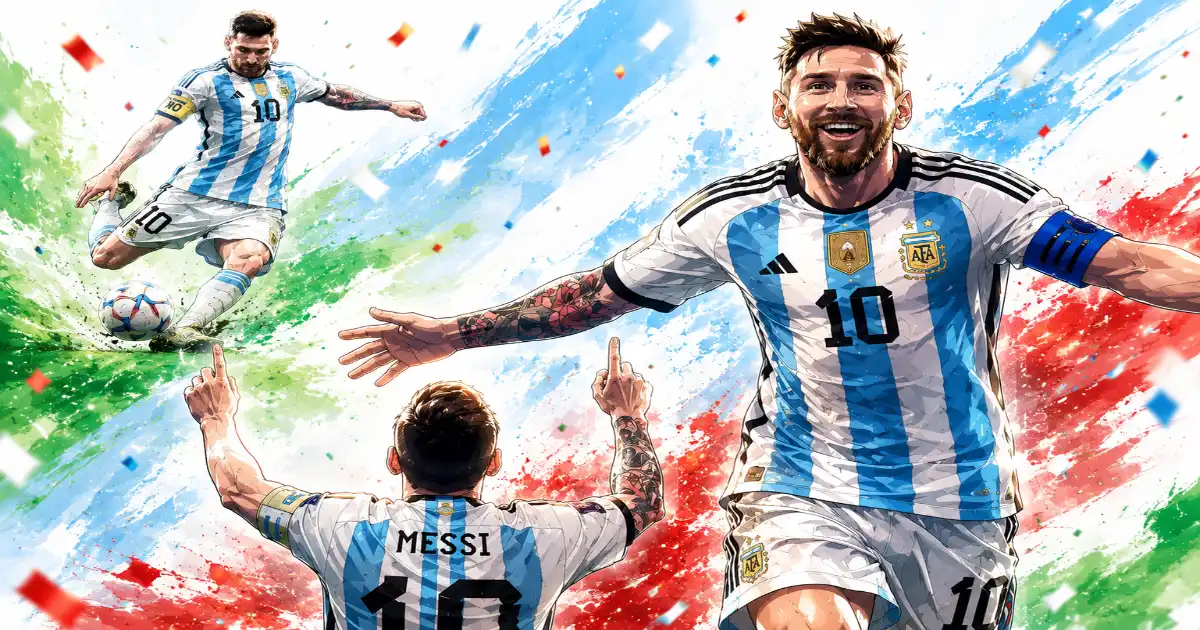
 Lionel Messi 2026 World Cup: How Argentina’s Legend Finished His World Cup Career
Messi’s Last World Cup Ends in a Final Defeat, But His Legacy Grows Even Stronger
The question that followed Lionel Messi throughout the 2026 World Cup has finally been answered. The tournament in North America was indeed his sixth and, almost certainly, his final appearance on football’s biggest stage.
It did not end with another trophy.
Instead, Messi and Argentina reached the World Cup final for the third time in his career before losing 1-0 to Spain after extra time. Ferran Torres scored the decisive goal in the 106th minute, ending Argentina’s hopes of becoming back-to-back world champions.
From Legend to Lightning Rod: Why Messi Is Being Criticized Now
Lionel Messi World Cup 2026 Inspiration: The Legacy That Inspired a Generation
NBA Schedule 2026-27: Christmas Day Rivalries, Ring Night and the Games to Watch
Yet the defeat should not overshadow what Messi achieved during his final World Cup. At 39 years old, he scored eight goals, registered four assists and finished second in the tournament’s scoring race behind France’s Kylian Mbappé. He also extended his World Cup goals record to 21.
Messi’s final tournament became another remarkable chapter in a career that already includes almost every major individual and team honour football can offer.
Lionel Messi’s 2026 World Cup Journey
Messi arrived at the tournament with questions surrounding his age and physical condition. Instead of simply playing a supporting role, he remained one of Argentina’s most influential players.
His tournament began spectacularly against Algeria. Messi scored a hat-trick as Argentina won 3-0, immediately demonstrating that age had not eliminated his ability to decide major matches. The performance also helped him move closer to becoming the leading scorer in World Cup history.
Against Austria, Messi continued his scoring run with two goals in a 2-0 victory. Those goals moved him beyond Miroslav Klose’s previous World Cup scoring record.
He later scored against Jordan and added another goal against Cabo Verde in the knockout rounds. Against Egypt, he scored again in the round of 16 after initially missing a penalty, helping Argentina survive a difficult contest.
His influence was not limited to scoring.
Against England in the semi-final, Messi did not find the net, but he provided both assists as Argentina came from behind to win 2-1 and reach the final.
That performance summed up his role at this stage of his career. Messi no longer needed to dominate every minute or score in every match. He could control games through passing, movement and decision-making while allowing younger teammates to provide the running.
Messi’s 2026 World Cup Statistics
| Category | Messi |
|---|---|
| World Cup | 2026 |
| Matches | 7 |
| Goals | 8 |
| Assists | 4 |
| Argentina Finish | Runners-up |
| World Cup Career Goals | 21 |
| World Cup Appearances | 6 editions |
| World Cup Finals | 3 |
| Tournament Scoring Rank | 2nd |
His eight goals placed him second behind Mbappé, who finished with 10. Messi also became the first player to score in six different World Cup tournaments. His 21 World Cup goals now stand among the greatest individual scoring achievements in tournament history.
The Final Against Spain
The final was ultimately the one game in which Argentina could not find an answer.
Spain controlled large portions of the match and prevented Argentina from producing a shot until extra time. Emiliano Martínez kept Argentina alive with several outstanding saves, but Spain continued to apply pressure.
The decisive moment arrived in the 106th minute. Nico Williams headed the ball down at the far post and Ferran Torres finished first time to give Spain a 1-0 lead.
Argentina were unable to respond.
Spain became world champions for the second time, while Messi finished his sixth World Cup as a runner-up.
Thiago Messi: Club Career, Playing Style, Lifestyle and Future Prospects
Cristiano Ronaldo Jr.: Club, Lifestyle, Career and Future Prospects
Even in defeat, Messi made history. At 39 years and 25 days, he became the oldest outfield player to appear in a World Cup final. It was also his third World Cup final, a feat previously achieved by only one other player, Brazil legend Cafu.
From Qatar Glory to North American Heartbreak
The contrast between 2022 and 2026 is striking.
Four years earlier, Messi finally won the World Cup in Qatar after Argentina defeated France in one of the most dramatic finals ever played. That triumph completed the missing piece of his career.
In 2026, he returned as the defending champion and came within one match of winning the trophy again.
This time, Spain stopped him.
But the difference is important. Messi did not leave the World Cup searching for validation. He had already achieved that in Qatar. His 2026 campaign was instead about demonstrating that he could still influence the world’s biggest tournament at an age when most players have long retired.
He succeeded.
Messi’s Legacy After 2026
There is very little left to debate when discussing Messi’s place in football history.
His World Cup career alone now includes six tournaments, 21 goals, three final appearances and one championship. His Argentina career also includes Copa América success and the 2022 World Cup, ending decades of debate about whether he could deliver international silverware.
His 2026 performance adds another dimension to that legacy.
Messi was not simply a sentimental selection for Argentina. He was still productive. He scored eight goals, created four more and helped Argentina reach another final.
That is extraordinary for a player approaching 40.
What Happens to Messi After the World Cup?
The biggest question now concerns what comes next.
Messi’s international future remains the major unknown. The 2026 World Cup was almost certainly his final appearance at the tournament, but that does not automatically mean an immediate retirement from Argentina duty.
For now, the more realistic expectation is that Messi will take time before making a definitive decision about his international future.
His club career with Inter Miami also remains important. Messi has continued to be the centrepiece of the project in South Florida, where his arrival helped transform the club’s global profile and contributed significantly to the growth of football in the United States.
At this stage of his career, the question is no longer whether Messi can prove himself.
It is how long he wants to continue.
Messi’s Six World Cups
| World Cup | Argentina Finish | Messi’s Age |
|---|---|---|
| 2006 Germany | Quarter-finals | 19 |
| 2010 South Africa | Quarter-finals | 23 |
| 2014 Brazil | Runners-up | 27 |
| 2018 Russia | Round of 16 | 31 |
| 2022 Qatar | Champions | 35 |
| 2026 North America | Runners-up | 39 |
The progression is remarkable. Messi went from teenage debutant in 2006 to World Cup champion in 2022 and then to 39-year-old finalist in 2026.
Few players in football history have maintained that level of relevance across six editions.
The End of an Era
Lionel Messi’s final World Cup did not end with the perfect Hollywood script.
There was no second consecutive trophy. No winning goal in the final. No final celebration with the trophy.
Instead, there was a narrow defeat against an outstanding Spain side.
But perhaps that makes the story more fitting.
Messi’s World Cup career was never a straight line. There were disappointments, lost finals, criticism, injuries and years when Argentina appeared unable to give their greatest player the ending he deserved.
Eventually, he won the trophy.
Then, when almost everyone expected him to step away, he came back at 39 and took Argentina to another final.
That is the lasting image of Lionel Messi at the World Cup: not simply the champion of 2022, but the player who kept competing at the highest level long after almost everyone expected his international story to be over.
The 2026 World Cup was Messi’s final chapter on football’s biggest stage.
It was not his greatest ending.
But it was another extraordinary performance from a player whose career has made the definition of greatness feel almost inadequate.
From Tunisia to Spain: Every World Cup 2026 Team Ranked
Golden Ball Winner Rodri: The Case for Football’s Quietest Superstar
Golden Glove Winner Unai Simon: The Historic World Cup Goalkeeping Masterclass
🔹🔹🔹 Follow us on Facebook 🔹🔹🔹
About the Author

6 thoughts on “Lionel Messi 2026 World Cup: Final Tournament, Argentina’s Run and His Last World Cup Chapter”