 France’s Journey in FIFA World Cup 2026
For six matches, it looked like nothing could stop them. Then, on a Tuesday night in Texas, everything stopped at once. This is France’s journey in FIFA World Cup 2026 — the dominance, the record-breaking numbers, and the single result that ended it all.
NBA Schedule 2026-27: Christmas Day Rivalries, Ring Night and the Games to Watch
Kylian Mbappé Golden Boot Prediction: Can Anyone Stop Him in 2026?
A Brief Word on 2022, First
To understand how heavily this tournament weighed on France, it helps to remember where they left off. Four years ago in Qatar, France reached the final and were seconds away from retaining their title, only for Argentina to win an all-time classic 3-3 (after extra time) on penalties. Kylian Mbappé scored a stunning hat-trick in that final — the first in a World Cup final since Geoff Hurst in 1966 — and still ended up on the losing side. That defeat left a scar. Coming into 2026, France arrived not just as favorites, but as a team with genuine unfinished business.
Group I: A Statement From Day One
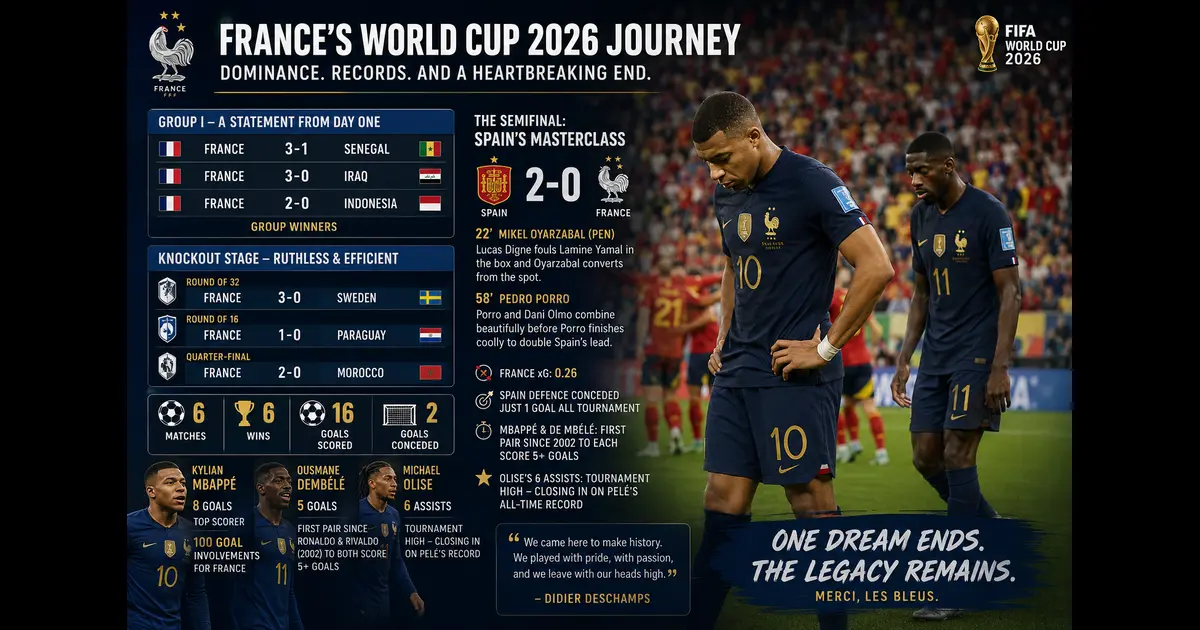
France opened their 2026 campaign in ruthless fashion, beating Senegal 3-1 courtesy of a Kylian Mbappé brace. It was an early signal of the tournament to come — Mbappé, already France’s all-time leading scorer heading into the summer, immediately looked sharper and more dangerous than he had at any previous World Cup.
The statement continued against Iraq, where France won 3-0, with Mbappé scoring twice more to reach 16 career World Cup goals and draw level with Germany’s Miroslav Klose on the all-time list. France closed out the group with a game to spare, topping Group I comfortably and heading into the knockout rounds with total control of their own form.
The Knockout Rounds: Ruthless, Efficient, Unbeaten
What followed was as clean a run through the knockout stage as any team has managed in recent tournament history. France dispatched Sweden 3-0 in the Round of 32, with Mbappé scoring another brace to push his knockout-stage World Cup goal tally to double figures — the most of any player in the competition’s history. A tighter Round of 16 tie against Paraguay was settled by a single Mbappé penalty, a 1-0 win that demanded patience rather than fireworks. The quarterfinal against Morocco followed the same pattern: a 2-0 win, controlled and professional, with Mbappé again on the scoresheet.
By the time France arrived in Dallas for the semifinal, the numbers were extraordinary. Six matches played, six wins, sixteen goals scored, only two conceded. Ousmane Dembélé had joined Mbappé as a five-goal threat, and the pair became the first attacking partnership since Brazil’s Ronaldo and Rivaldo in 2002 to each reach five goals in a single tournament for the same team. Michael Olise, a squad addition many neutral fans barely knew before the tournament, had quietly built a tournament-high six assists, closing in on Pelé’s all-time record for assists in a single World Cup edition. Manager Didier Deschamps had reshaped his side’s identity entirely, shifting from a 4-3-3 to a more attacking 4-2-3-1 and blending proven winners with a new generation of talent pulled from the under-23 setup.
France looked less like a team chasing history and more like a team writing an entirely new chapter of it. Only one obstacle remained between them and a third consecutive World Cup final — a feat matched previously only by West Germany (1982-1990) and Brazil (1994-2002).
The Semifinal: Spain’s Masterclass
That obstacle turned out to be insurmountable. Spain, the tournament’s stingiest defensive side, delivered a performance of near-total control at Dallas Stadium. The breakthrough came in the 22nd minute when left-back Lucas Digne fouled 19-year-old Lamine Yamal inside the box, and Mikel Oyarzabal calmly converted the resulting penalty. France, for all their attacking reputation, simply could not find a way past a Spanish defense that had conceded only once all tournament.
The second goal, in the 58th minute, was the moment that truly settled the tie. Pedro Porro combined with Dani Olmo in a swift one-two before finishing coolly past Mike Maignan, exposing a rare defensive lapse from a French backline that had otherwise been excellent throughout the summer. France pushed for a way back — Ousmane Dembélé forced a save from Unai Simón, and Mbappé skied a late chance over the bar in a rare moment of imprecision — but the game finished 0-2. France’s expected-goals tally for the match was a meagre 0.26, a startling number for a team that had scored sixteen goals in its previous six games combined.
What Went Wrong
Several factors combined to end France’s run in Dallas, and it is worth being specific about each of them rather than reducing the loss to a single explanation.
Spain’s structural discipline neutralized France’s biggest weapon. Mbappé, the tournament’s Golden Boot leader entering the match, found almost no space to operate. Spain repeatedly crowded him in transition zones, cutting off exactly the kind of one-on-one running situations that had defined his entire tournament. A player who had scored eight goals in six matches was rendered almost anonymous for ninety minutes.
A moment of individual carelessness proved costly. Lucas Digne’s foul on Yamal inside the box gifted Spain a clean, low-risk route to the opening goal — precisely the kind of avoidable error that gets punished against a team as clinical as Spain proved to be all tournament.Can You Score 30/30? France World Cup 2018 & 2026 Quiz
The second goal exposed a structural gap, not just bad luck. Porro and Olmo’s combination play found space behind France’s press at exactly the moment the French shape was transitioning after half-time substitutions — Deschamps had just replaced a booked Adrien Rabiot with Manu Koné in search of fresh energy, and Spain exploited the resulting adjustment period ruthlessly.
France never found their rhythm in buildup play. Spain’s 56% first-half possession share forced France into a more reactive posture than they had shown all tournament, and without their usual platform of quick transitions, the French attack — for all its individual talent — never generated the clean chances it had produced against Senegal, Iraq, Sweden, Paraguay, or Morocco.
An injury didn’t help matters. William Saliba was forced off in the 29th minute, disrupting a defensive partnership that had conceded just twice in six matches before kickoff.
The Legacy of This Run, Regardless of the Ending
It would be a mistake to let the manner of the exit erase what this France team actually accomplished across five weeks. They equalled a knockout-stage scoring record. Mbappé finished the group-and-knockout stage of the tournament with 20 career World Cup goals, second all-time behind only Lionel Messi, and became the first player in history to be directly involved in 100 goals for the French national team. Olise emerged as a genuine world-class creative force. Deschamps proved, yet again, that he could reshape a squad’s identity mid-cycle without losing its winning habits.
France’s World Cup 2026 ends in the semifinals, with one final match remaining — Saturday’s third-place playoff — before this remarkable group of players heads home. It is not the ending anyone in the French camp wanted. But for a team that arrived with the weight of a heartbreaking 2022 final still fresh in memory, this tournament was, in almost every measurable way except the final scoreline in Dallas, a story of genuine redemption.
🔹🔹 follow us on facebook 🔹🔹
About the Author


1 thought on “France’s Journey in FIFA World Cup 2026: How the Dream Ended”