Every World Cup tells two stories at once. There’s the one about the legends closing out their careers — and this tournament has that story in abundance, from Cristiano Ronaldo’s tearful farewell in Dallas to the growing sense that Lionel Messi may be playing his final World Cup matches for Argentina right now. But there’s always a second story running underneath it, quieter at first and then suddenly impossible to ignore: the one about the players just arriving, the ones who’ll be doing this all again in 2030 and 2034 while this generation’s icons watch from home or the punditry desk.
LaLiga 2026/27 Schedule: Fixtures, Dates & Times
Premier League 2026/27 Schedule: This Week and Next Week
Champions League 2026/27 Schedule: Fixtures, Dates & Times
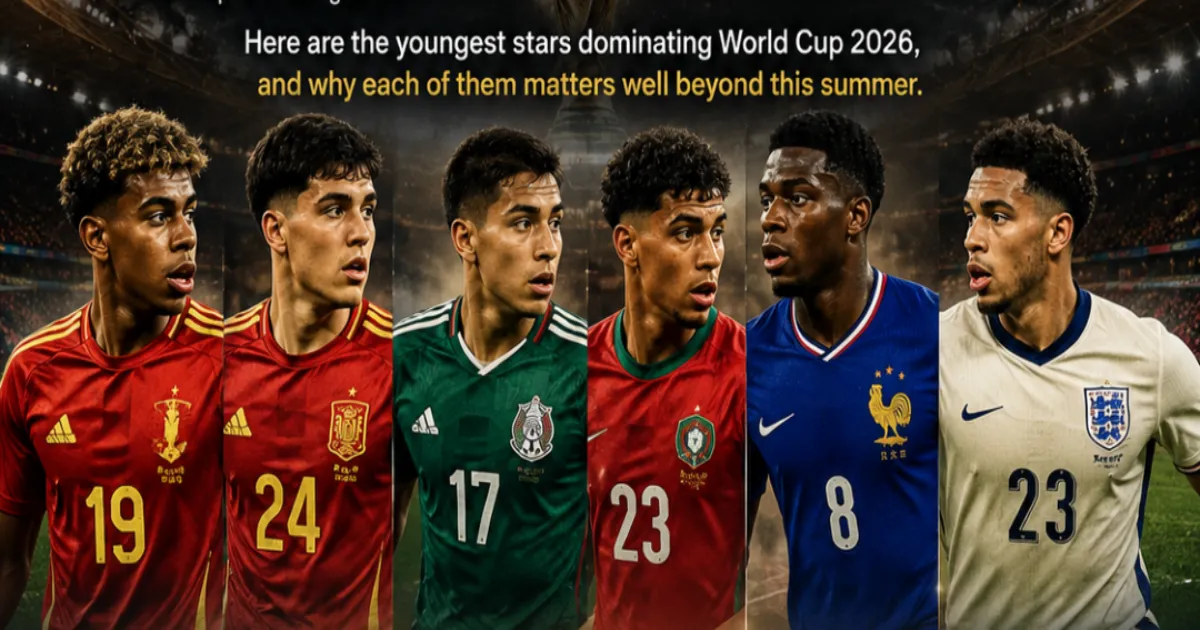
This World Cup’s version of that second story has been genuinely remarkable. A wave of teenagers and early-twenty-somethings has not just featured at this tournament — they’ve actively shaped it, scored the goals that decided knockout matches, and forced their way into conversations usually reserved for players twice their age. Here are the youngest stars dominating World Cup 2026, and why each of them matters well beyond this summer.
Lamine Yamal (18) — Spain
If there’s a single name that defines this tournament’s youth movement, it’s Yamal. At 18 years old, the Barcelona winger has been described by his own national team manager, Luis de la Fuente, as a player “touched by magic,” and nothing about his performances at this World Cup has done anything to undercut that description. Yamal has been central to Spain’s run through the tournament unbeaten and with the best defensive record of any side left in the competition — nine goals scored, only two conceded across five matches — combining relentlessly with fellow winger Nico Williams to stretch every defensive shape Spain has faced.
What separates Yamal from the long line of hyped teenage prospects who’ve come before him isn’t just the end product, impressive as that is. It’s the composure. Thierry Henry once described him as being “ahead of the game,” and that maturity showed clearly in Spain’s tense 1-0 round of 16 win over Portugal — the match that ended Ronaldo’s World Cup career — where Yamal’s ability to keep Spain calm and patient in a high-stakes, emotionally loaded fixture belied his age entirely. He’s already been called the future Messi by pundits weary of the comparison but unable to find a better one. Whether or not that label ever proves fair, Yamal heading into a potential quarterfinal against Belgium already looks like the most important teenager left in the tournament.
Pau Cubarsí (19) — Spain
Yamal isn’t even the only teenager driving Spain’s remarkable defensive record. Nineteen-year-old center-back Pau Cubarsí has been a revelation in a role that rarely produces breakout young stars the way attacking positions do. A mainstay of Hansi Flick’s Barcelona for over two years, Cubarsí has translated his club composure directly onto the World Cup stage, defending with an aggressive, proactive style — stepping forward to intercept passes rather than sitting passively — that has been central to Spain conceding just twice across five matches.
That aggression carries real tactical significance heading into the quarterfinals. Cubarsí’s willingness to step out of the defensive line and win the ball high up the pitch has been a genuine asset against every opponent Spain has faced so far, but it also represents the one area of real risk in an otherwise flawless defensive campaign — any forward intelligent enough to exploit the space he vacates when he steps forward has a route to goal that few other teams have found. For a defender not yet 20 years old to already be the subject of that level of tactical scrutiny says everything about how far his game has already come.
Gilberto Mora (17) — Mexico
Nicknamed “the Mexican Pedri,” Gilberto Mora entered this World Cup as the tournament’s youngest player and immediately justified the hype that had been building since his breakout run in the 2025 Gold Cup, where he became the youngest player ever to win a major international tournament. Despite a spell on the sidelines through injury earlier in 2026, Mora returned to full fitness in time to anchor Mexico’s midfield through the group stage and into the knockout rounds, playing with a level of composure on the ball that repeatedly drew comparisons to far more experienced players.
Mexico’s run ultimately ended in the round of 16 against England, one of three co-host nations eliminated at that stage, but Mora’s tournament should be remembered as one of its genuine individual success stories regardless of the team result. At 17 years old, controlling midfield play against senior international opposition on home soil, with the weight of an entire nation’s World Cup hopes attached to a squad that had failed to escape the group stage in 2022, Mora delivered performances that suggest Mexican football has found a genuine generational talent to build around for the next decade.
Ayyoub Bouaddi (18) — Morocco
Morocco’s run to the quarterfinals — unbeaten in five matches, having eliminated co-host Canada along the way — has rightly generated headlines for veterans like Achraf Hakimi and the injury-enforced absence of top scorer Ismael Saibari ahead of Thursday’s meeting with France. But threaded through that same campaign has been the emergence of 18-year-old Ayyoub Bouaddi, whose composure in midfield has given Morocco’s famously disciplined defensive structure an additional passing outlet under pressure.
Bouaddi’s role hasn’t been about headline goals or viral highlight reels; it’s been about the unglamorous, structural work that allows a team built on defensive organization to also progress the ball cleanly under the intense pressure of knockout football. That distinction matters. The teenagers who make the biggest long-term impact on a national team’s fortunes are often not the ones scoring the eye-catching goals, but the ones quietly ensuring the team’s core defensive and possession structures hold up when the stakes are highest — exactly the role Bouaddi has filled for Morocco all tournament.
Warren Zaïre-Emery (20) — France
France’s midfield has understandably been overshadowed by Kylian Mbappé’s seven-goal Golden Boot campaign, but 20-year-old Warren Zaïre-Emery has provided a genuinely important secondary storyline within Didier Deschamps’ squad. Though he hasn’t played every minute for a loaded French midfield that also features N’Golo Kanté, Aurélien Tchouaméni, and Adrien Rabiot, Zaïre-Emery’s appearances have consistently shown the kind of two-way ball control that suggests he’ll be the player France’s midfield is built around once this current veteran core eventually moves on.
That France look their most fluent, sustained best specifically when Zaïre-Emery is controlling tempo in both defensive and attacking transitions speaks to a level of tactical maturity remarkable for a player his age, especially within a squad this deep and this experienced. As France push for another World Cup final, Zaïre-Emery represents the clearest bridge between this era of French dominance and whatever comes after it.
Nico O’Reilly (21) — England
Labeled a defender on England’s official World Cup roster, 21-year-old Nico O’Reilly has spent this tournament proving he’s considerably more versatile than that designation suggests, operating in a hybrid role that pushes into midfield when England are in possession. Fresh off winning the Premier League’s Young Player of the Year award, O’Reilly’s transfer value has reportedly doubled over the course of this season, and his performances at this World Cup — including throughout England’s dramatic run through the knockout rounds, culminating in a 3-2 win over Mexico at the Azteca Stadium — have done nothing to slow that rise.
O’Reilly’s growing importance to Thomas Tuchel’s setup takes on added significance heading into England’s quarterfinal against Norway and Erling Haaland, given the suspension of centre-back Jarell Quansah forces a reshuffled back line. Whether O’Reilly is asked to fill a more central defensive role or continue his hybrid function further forward, his tournament has already confirmed he’s no longer just a promising academy graduate — he’s a first-team fixture for one of the World Cup’s genuine title contenders.
Why This Youth Wave Matters Beyond This Summer
What makes this collection of young players genuinely significant isn’t just that they’ve performed well individually — every World Cup produces a handful of breakout teenagers who fade back into relative obscurity once the spotlight moves on. It’s that so many of them have been central, rather than peripheral, to their teams’ actual tactical structures. Yamal and Cubarsí aren’t complementary pieces in Spain’s system; they’re arguably its two most important players. Zaïre-Emery isn’t a squad rotation option for France; he’s the bridge to their next era. Bouaddi isn’t a token youth inclusion for Morocco; he’s part of the defensive discipline that has kept them unbeaten and one win from a second consecutive World Cup semifinal.
That distinction matters because it suggests this is not simply a strong crop of prospects, but the genuine beginning of the sport’s next generational shift. As Ronaldo’s international career closes and questions swirl around whether Messi will follow suit, football has understandably spent much of this tournament looking backward at what two extraordinary careers are leaving behind. But the youngest stars dominating World Cup 2026 offer the clearest possible answer to the question of what comes next — and on this evidence, whatever comes next may arrive sooner, and with considerably more immediate impact, than anyone expected.
StrikerReport.com will continue tracking the tournament’s breakout performers through the semifinals and final.
About the Author


4 thoughts on “The Youngest Stars Dominated World Cup 2026”