 World Cup 2026 VAR Controversy, Reversed Bans, Referee decisions Puts FIFA’s Credibility on Trial
Every World Cup produces its share of refereeing arguments. Few, if any, have produced a controversy that pulled in a sitting head of state, a formal rebuke from a continental confederation, and a coach openly using the word “rigged” in a press conference, all inside the space of a single knockout round. The World Cup 2026 VAR controversy has become as much a storyline of this tournament as anything happening on the pitch, and at its center sits a question football has been asking with increasing urgency for years: does video review actually make the sport fairer, or does it simply create new, more visible ways for inconsistency to play out in front of a global audience.
The Balogun Case: Where It All Started
The controversy that set the tone for everything that followed began in the Round of 32, when United States forward Folarin Balogun was shown a straight red card by referee Raphael Claus during USA’s win over Bosnia and Herzegovina, after his foot landed on defender Tarik Muharemović’s ankle during an aerial challenge. The decision was contentious from the moment it was made; even Muharemović himself said afterward that he didn’t believe the challenge warranted a sending-off, and neutral pundits widely described the card as excessive.
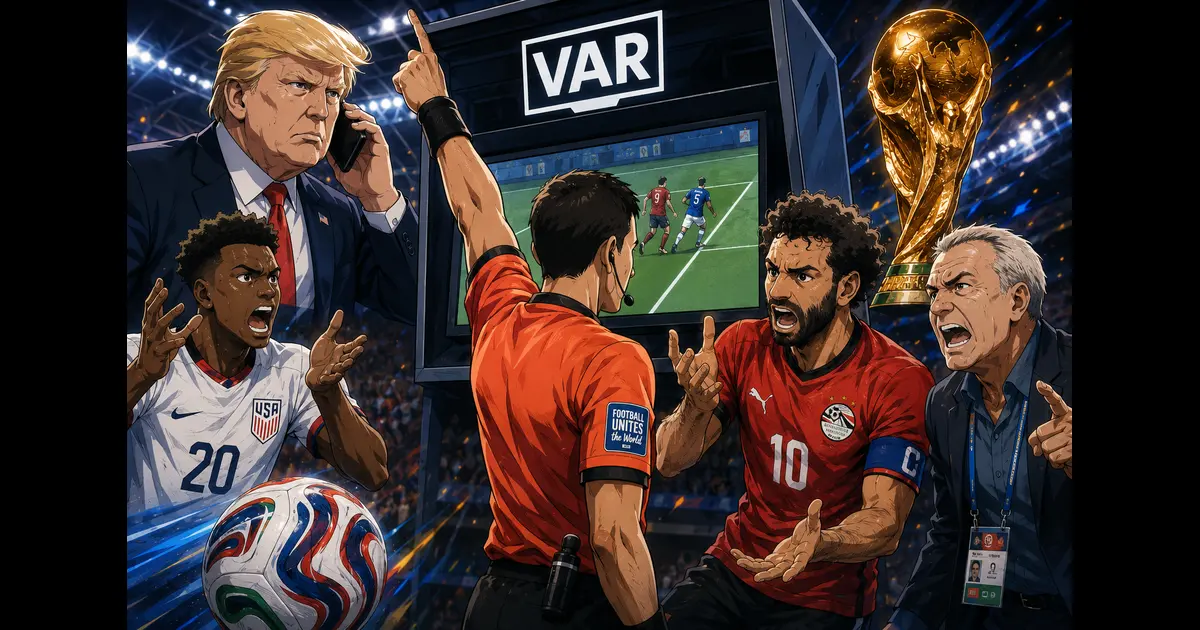
What happened next turned a routine disciplinary dispute into a genuine international incident. President Donald Trump placed a direct call to FIFA president Gianni Infantino, reportedly asking why the red card had been issued and questioning the automatic one-match ban that came with it. Days later, FIFA announced that Balogun’s suspension would be paused under a one-year probationary period rather than served immediately, clearing him to play in the Round of 16. Trump publicly took credit for the reversal, posting online that FIFA had corrected “a great injustice.”
The backlash was immediate and came from unusually authoritative sources. UEFA issued a statement saying FIFA had “crossed a red line,” pointing out that the automatic one-match suspension following a red card is embedded directly into football’s regulations and “is not a discretionary option.” Belgium’s football federation, whose team was set to face the United States in the very match Balogun’s ban had threatened to affect, said it was “astonished” by the decision and demanded clarification on the process, the applicable rules, and FIFA’s reasoning.
FIFA’s Own History Undercuts Its Defense
FIFA has defended the reversal by pointing to Article 27 of its disciplinary code, which allows a judicial body to suspend a sanction and place a player on probation instead. Taken in isolation, that’s a legitimate legal mechanism. The problem is context. FIFA had already quietly deferred bans for several other high-profile players earlier in the tournament, including final rounds of suspensions for stars picked up during qualifying, without anything close to the scrutiny the Balogun case attracted. That pattern stretches back decades; Brazil’s Garrincha was sent off in the 1962 semifinal but still played in the final after political pressure was applied on his behalf.
Set against that same history is FIFA’s treatment of Russia, banned entirely from FIFA and UEFA competition since 2022 with no case-by-case appeals process, no probationary period, and no individual review of any player’s circumstances, a blanket exclusion that has survived multiple legal challenges. The contrast is exactly what critics mean when they invoke FIFA double standards: discretion appears to travel toward whichever party has the political or commercial leverage to demand it, not toward whoever has the strongest procedural case.
The Egypt-Argentina Fallout
If Balogun’s case was the controversy that introduced politics into the tournament’s officiating debate, Argentina’s Round of 16 comeback against Egypt was the one that turned the argument toward VAR’s actual on-field application. Egypt led 2-0 with under fifteen minutes remaining before conceding three times to lose 3-2, and one of the most-discussed moments of the entire tournament came in between: a disallowed Egyptian goal, ruled out after VAR determined that forward Marwan Attia had committed a foul in the buildup, holding an Argentine defender’s shirt and standing on his foot simultaneously.
ESPN’s own VAR review panel concluded the intervention was correct, since the foul directly affected Argentina’s ability to defend the attacking sequence. But Egyptian coach Hossam Hassan wasn’t willing to accept it quietly. “We haven’t seen respect or fair play,” Hassan told reporters afterward. “A penalty was ruled out, and a second incident that should have been checked for a penalty for us was not even checked by the VAR. A second goal was remarkably, for whatever reason, disallowed.” He went further, adding, “I want to put it in beautiful words and say, ‘Hard luck,’ but we have been treated unfairly, and it has been an injustice.”
Egyptian players echoed the complaint, pointing specifically to an apparent shirt pull on Mohamed Salah inside the penalty area moments before Argentina’s decisive third goal, a moment that went entirely unreviewed despite the VAR’s evident willingness to intervene over similarly marginal contact just minutes earlier in the same match. Commentators highlighted the inconsistency directly: VAR reviewed extensively to penalize Egypt for a minor infraction in their own buildup, but didn’t review a comparable, arguably more significant contact moments before Argentina scored the winner.
A Pattern Repeating Across the Bracket
The Egypt-Argentina match wasn’t an isolated flashpoint. Senegal were eliminated from the tournament in the Round of 32 after Belgium were awarded a stoppage-time-of-extra-time penalty, following a seven-minute VAR review of a challenge by Lamine Camara on Youri Tielemans, converted to complete a comeback from 2-0 down. Critics argued Tielemans had stepped into Camara rather than the other way around, and the review’s length alone became part of the controversy, turning what should have been a moment of triumph or heartbreak into an extended, uncomfortable wait.
Portugal’s Round of 32 win over Croatia carried its own VAR sting, with a penalty awarded after contact between Nikola Vlašić and Renato Veiga that Croatia captain Luka Modrić dismissed as mutual grappling that shouldn’t have resulted in a spot kick at all. An offside call in the closing moments of the same match further denied Croatia a chance to force extra time. In the group stage, Egypt and Iran saw a stoppage-time Iranian “winner” controversially disallowed via semi-automated offside technology, with replays showing Shoja Khalilzadeh marginally offside by the tip of his boot, while Egyptian players separately protested an unreviewed handball in the same buildup sequence. A Qatar-Switzerland group match added a different flavor of controversy entirely, when a broadcast technical outage prevented VAR’s offside graphic from being shown to viewers during a penalty review, forcing FIFA to issue a statement afterward confirming the underlying decision, a penalty for Switzerland converted by Breel Embolo, had been correct all along.
Managers Are Losing Patience Publicly
The frustration hasn’t stayed confined to eliminated teams complaining after the final whistle. England manager Thomas Tuchel has been openly critical of VAR’s threshold for intervention, arguing in one instance that a reviewed penalty decision did not meet the “obvious and clear error” standard the system is supposed to require before overturning an on-field call, adding pointedly that the referee “had not even called a foul in the first place.” Former Iran assistant Carlos Queiroz criticized officials after a separate match for what he described as two major missed incidents that went unpunished despite VAR’s involvement. Even touchline conduct has become part of the story: Bosnia and Herzegovina boss Sergej Barbarez was shown a yellow card for unsporting behavior after picking up the match ball to protest a non-decision and refusing, briefly, to hand it back for a Bosnian free-kick.
A Reuters report picked up widely across international outlets summarized the broader mood succinctly, noting that technology has been “at the center of all major controversies in this tournament,” with criticism ranging from excessive intervention and inconsistent application to outright conspiracy theories about bias toward specific teams or players. Whether or not any individual conspiracy theory holds up, the sheer volume of contested calls, several of them directly deciding whether a team advanced or went home, has visibly eroded trust in the system among fans, coaches, and players alike.
The Suspension Problem Nobody’s Fully Addressed
Underlying all of this is a structural tension FIFA has never fully resolved: automatic suspensions following red cards are meant to be exactly that, automatic, yet the tournament has repeatedly shown they aren’t applied with anything close to consistency. Balogun’s ban was suspended entirely following political pressure. Other players picked up cautions and suspensions that carried through to subsequent knockout rounds without any comparable review, including England defender Jarrell Quansah, ruled out of the quarterfinal against Norway following his red card against Mexico, and defenders across multiple squads carrying suspension risk into the semifinals over accumulated yellow cards. Nobody is arguing those specific cards were wrongly given. The argument is that a disciplinary system claiming to apply automatic, non-discretionary punishment cannot credibly do so while simultaneously carving out a politically negotiated exception for one specific, high-profile case.
Beyond the Pitch: A Tournament Under Wider Strain
The card and VAR controversies haven’t unfolded in isolation from the tournament’s broader political tensions. A Paraguayan senator’s racist social media attack on France captain Kylian Mbappé, condemned by the United Nations human rights office as reflecting a “broader problem” within football, added another layer to a tournament already being described by some outlets as one of the most politically and socially charged editions of the World Cup in recent memory. Add in continued scrutiny of FIFA’s sustainability commitments given the tournament’s expansion and its sponsorship arrangements, and the disciplinary controversies start to look less like isolated incidents and more like symptoms of an organization whose credibility is being tested on multiple fronts simultaneously.Zico Scores on the Counter, But VAR Rules Out Egypt’s Second Goal vs Argentina
Calls for Reform Are Growing Louder
The debate has already shifted from whether VAR should exist toward what specifically needs to change about how it’s applied. Some pundits and former officials have floated the idea of a challenge-based system, similar to what’s used in tennis or American football, where coaches get a limited number of reviews per match rather than leaving every intervention to the discretion of the video assistant referee, arguing it would reduce the sense that certain decisions are being selectively escalated while comparable ones are ignored. Others have focused specifically on the offside protocol, questioning whether semi-automated technology capable of ruling a player offside by the width of a bootlace tip is actually serving the sport’s interests, or whether a small tolerance margin would better preserve the spirit of decisions without meaningfully changing outcomes in the vast majority of cases.
There’s also been renewed discussion about separating refereeing decisions from disciplinary ones entirely, since much of this tournament’s controversy has stemmed not from whether VAR correctly identified an incident, but from what happened to the punishment afterward. A clearer, publicly documented standard for when Article 27 probationary suspensions can be applied, one that doesn’t appear to hinge on which nation’s head of state happens to make a phone call, would go a long way toward addressing the specific credibility problem the Balogun case created, independent of whatever changes eventually get made to VAR’s on-field review process itself.
What This Means for FIFA Going Forward
None of this controversy has stopped the tournament from producing genuinely thrilling football, and FIFA’s own defenders point out that VAR has still corrected plenty of clear, obvious errors that pre-technology refereeing would have simply gotten wrong. But the cumulative effect of the Balogun reversal, the Egypt-Argentina fallout, and a string of contested penalty and offside calls across nearly every round has shifted the conversation in a way FIFA will find difficult to walk back. The debate is no longer simply whether VAR works. It’s whether the rules governing when and how it intervenes, and who gets the benefit of discretion when those rules are bent, can survive sustained scrutiny from a global audience watching every review in real time. Until FIFA can answer that question with something more convincing than a probationary clause buried in its own disciplinary code, the World Cup 2026 VAR controversy is likely to remain the tournament’s most persistent storyline, regardless of who ultimately lifts the trophy.
◾◾ follow us on facebook ◾◾
About the Author