 Analysing Belgium’s World Cup Journey: What Worked, What Didn’t, and What’s Next
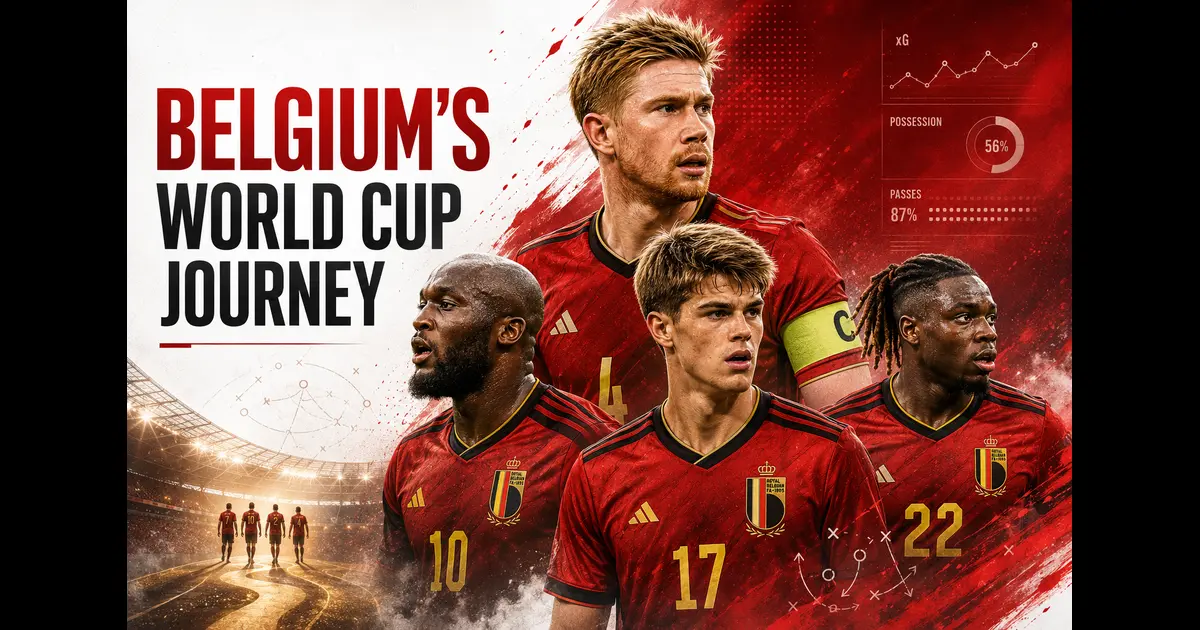
Every tournament review needs a clear framework to be useful, and Belgium’s World Cup journey offers an unusually clean one to work with: three distinct phases, each with its own tactical logic, ending in a quarter-final defeat that was closer on the scoreboard than it was in the underlying numbers. This is a data-informed breakdown of how Rudi Garcia’s side got from a shaky Group G opener to a fifth-place-adjacent finish, who the tournament’s standout performer actually was, and what the exit means for a squad widely assumed to be playing its last tournament together.PSG v Arsenal: How Paris Won the Champions League Final on Penalties
Cristiano Ronaldo Jr.: Club, Lifestyle, Career and Future Prospects
Phase One: A Group Stage That Undersold the Squad
Belgium’s group campaign does not, on paper, tell a flattering story. A 1-1 draw with Egypt, a goalless stalemate against Iran — played out a man down for most of the second half after Nathan Ngoy’s red card — and only a 5-1 rout of New Zealand to show for genuinely convincing form. Belgium finished top of Group G on five points from a win and two draws, scoring six goals and conceding two across the three matches, numbers that reflect a functional campaign rather than a dominant one.
The tactical picture behind those results is more instructive than the scorelines themselves. Garcia set his side up in a 4-2-3-1, using Tielemans and Onana as a double pivot to shield the defence, with De Bruyne operating as the created focal point at number 10 and Doku and Trossard stretching play from the flanks. That structure gave Belgium control in midfield without necessarily translating into control of matches, and the group stage stands as the clearest evidence that this Belgian squad’s ceiling was always going to be determined more by knockout-stage moments than sustained group-phase dominance.
Phase Two: The Knockouts Where Everything Clicked
If the group stage undersold Belgium, the knockout rounds corrected the record almost immediately. The Round of 32 against Senegal produced one of the most dramatic individual results of the entire tournament: trailing 2-0, Belgium scored twice to force extra time before winning 3-2, aided by a late VAR-awarded penalty. It was the kind of result that could easily have broken a less experienced squad and instead appeared to galvanise one that had, by that point, seen almost everything international football could throw at it across a collective decade and a half of major tournaments.
The Round of 16 against co-host United States delivered Belgium’s most statistically dominant performance of the tournament, a 4-1 win built on a Charles De Ketelaere brace. What made the performance notable from a pure team-management perspective was Garcia’s selection logic: De Bruyne did not feature at all, while Lukaku and Doku were held back until the game was already 3-1 in Belgium’s favour. It was a deliberate, calculated decision to rest three of the squad’s most important, and most physically taxed, senior players ahead of a tougher quarter-final test — full-strength readiness prioritised over full-strength starting selections, a luxury Belgium’s convincing scoreline against the US afforded them.
Phase Three: The Quarter-Final Where the Numbers Turned Against Them
Belgium’s meeting with Spain in the quarter-final represents the clearest data point of their entire tournament, because the underlying numbers diverge so sharply from the final outcome. Spain generated 2.08 expected goals across the match to Belgium’s 0.38 — a gap that should, on paper, have produced a considerably more comfortable Spanish win than the 2-1 scoreline that resulted. Fabián Ruiz opened the scoring in the 30th minute from a goalmouth scramble, but Belgium responded with genuine quality rather than fortune: Kevin De Bruyne recycling a Timothy Castagne delivery into the box for Charles De Ketelaere to power home a header just before half-time, level at 1-1 heading into the interval.
The match turned on an injury, not a tactical breakdown. Thibaut Courtois, arguably Belgium’s most important player across the tournament’s biggest moments, was forced off with an injury in the second half, replaced by back-up Senne Lammens. It was Lammens who, under pressure from a long-range Pau Cubarsí effort in the 88th minute, spilled a save directly into the path of substitute Mikel Merino — Spain’s second consecutive knockout-stage match decided by an identical late script. Belgium’s tournament ended not because their statistical output collapsed, but because one specific, isolated moment of misfortune arrived at the single worst possible time.
Top Performer: Charles De Ketelaere’s Breakout Tournament
If Belgium’s golden generation defined this tournament’s narrative, Charles De Ketelaere defined its statistical output. His brace against the United States in the Round of 16, followed by the equalising header against Spain in the quarter-final, made him comfortably Belgium’s most productive attacking outlet across the knockout stage — a genuine changing of the guard within the team’s own attacking hierarchy, with De Ketelaere outscoring both Lukaku, the nation’s all-time leading scorer, and a De Bruyne more focused on creation than direct goal involvement.
De Ketelaere’s emergence carries real tactical significance beyond his individual numbers. Garcia’s willingness to build attacking phases around his movement, rather than exclusively around Lukaku’s physical presence or De Bruyne’s passing range, gave Belgium a more varied attacking profile than the side that limped out in the Qatar 2022 group stage. Whether De Ketelaere becomes the genuine successor to this generation’s attacking identity, rather than simply its best performer in one specific tournament, is the more important question his displays this summer have opened up.
Other Parameters: Squad Management, Political Subplots, and Historical Context
Garcia’s rotation strategy throughout the knockout rounds deserves specific credit as a team-level parameter separate from individual performances. Resting De Bruyne, Doku, and Lukaku for large portions of the US match, then reintroducing all three for the Spain quarter-final, reflected a level of squad management that Belgium’s golden generation has not always received credit for during previous tournament disappointments. It is a small, technical decision that nonetheless shaped the physical condition of Belgium’s most important players heading into their toughest fixture of the summer.
Belgium’s Round of 16 win over the United States also became entangled in one of the tournament’s more unusual political subplots, following a controversial FIFA ruling that allowed American striker Folarin Balogun to play despite a Round of 32 red card, reportedly influenced by external pressure. Belgium’s own social media response to the eventual result — a pointed “Overturn this” posted after their 4-1 win — reflected a squad well aware of the noise surrounding the fixture, and unbothered by it once the whistle blew.
Historically, this campaign represents a clear improvement on Belgium’s group-stage exit in Qatar 2022, restoring the Red Devils to the quarter-final stage for the first time since their third-place finish in 2018 — still comfortably the best World Cup performance in the nation’s history. Reaching the last eight again, four years after their worst modern tournament showing, offers a reasonable claim that this campaign should be viewed as a partial redemption rather than simply another near-miss.
The Full Statistical Picture
Zoom out from the individual matches and Belgium’s tournament-wide numbers paint a picture of a team that consistently punched at or above their underlying data throughout the knockout rounds, right up until the exact moment it stopped working. Their round of 32 win over Senegal came despite trailing for the majority of normal time, a result built on second-half game management rather than dominant underlying numbers. Their Round of 16 demolition of the United States, by contrast, was as statistically one-sided as the scoreline suggests — a rare match this tournament where Belgium’s data and result told the exact same story.
The quarter-final against Spain inverts that pattern entirely. Generating just 0.38 expected goals against Spain’s 2.08 represents comfortably Belgium’s worst underlying attacking performance of the tournament, yet it produced their most competitive knockout-stage scoreline. That contradiction is worth sitting with: Belgium’s golden generation, so often accused across multiple tournaments of underperforming their attacking talent on the biggest occasions, instead overperformed a genuinely poor underlying data set against the tournament’s eventual semi-finalists, and still lost. It is a more sympathetic read of this specific defeat than the “one big mistake” narrative alone suggests — Belgium were, statistically, second best for large periods, and still came within one goalkeeping error of forcing extra time.
Historical Context: Measuring Against a Decade of Near-Misses
To properly evaluate this campaign, it helps to place it against Belgium’s own recent tournament history rather than judging it in isolation. The 2018 side reached the semi-finals and beat England to a third-place finish — still, by a clear margin, the best World Cup showing in the nation’s history. The 2022 vintage, by contrast, produced one of the most disappointing campaigns of the entire golden generation era, eliminated at the group stage despite a talented squad that many pundits had rated among the tournament’s genuine contenders heading into Qatar.
Measured against that backdrop, 2026’s quarter-final finish represents a clear and meaningful bounce-back, restoring Belgium to a stage they had not reached since 2018 and doing so with several of the same senior players who endured the 2022 humiliation. It is not the storybook ending many hoped this specific generation of players might produce together, but it is a considerably more respectable send-off than the alternative history in which this golden generation’s final major tournament ended the way their previous one did.
What Comes Next for Belgium
The subplot hanging over every Belgian match this tournament was the sense of finality surrounding several of its central figures. Axel Witsel, 37, Kevin De Bruyne, 35, Thibaut Courtois, 34, and Romelu Lukaku, 33, all played what is, in all likelihood, their final World Cup together, closing out a golden generation that reached one final (loosely defined, via third place in 2018) but never quite delivered the trophy many observers felt this specific group of players deserved across the better part of a decade.
What Belgian football does with the transition matters more than how this particular tournament ended. De Ketelaere’s emergence, alongside Doku’s continued development and Onana’s midfield presence when fit, suggests the next generation already has recognisable building blocks in place — a considerably healthier position than many nations find themselves in immediately after a golden generation’s presumed farewell. Belgium’s World Cup journey in 2026 will likely be remembered less for the quarter-final defeat itself, and more for offering genuine, statistically supported evidence that the transition to whatever comes next has already quietly begun.
There is also a broader lesson here for how tournaments like this one ought to be judged. It is tempting, in the immediate aftermath of elimination, to reduce an entire campaign down to its final scoreline — a single Lammens error, a single De Ketelaere header that wasn’t quite enough. But Belgium’s World Cup journey, read in full, is a more layered story than that: a shaky group stage that undersold a talented squad, a knockout stretch that showcased genuine tactical intelligence from Rudi Garcia, and a quarter-final defeat that flattered the winning side’s underlying numbers more than it exposed any fundamental flaw in Belgium’s own approach. Whatever comes next for Belgian football, this golden generation’s final chapter was written with more credit than the scoreline alone will ever fully capture.
◾◾ follow us on facebook ◾◾
About the Author