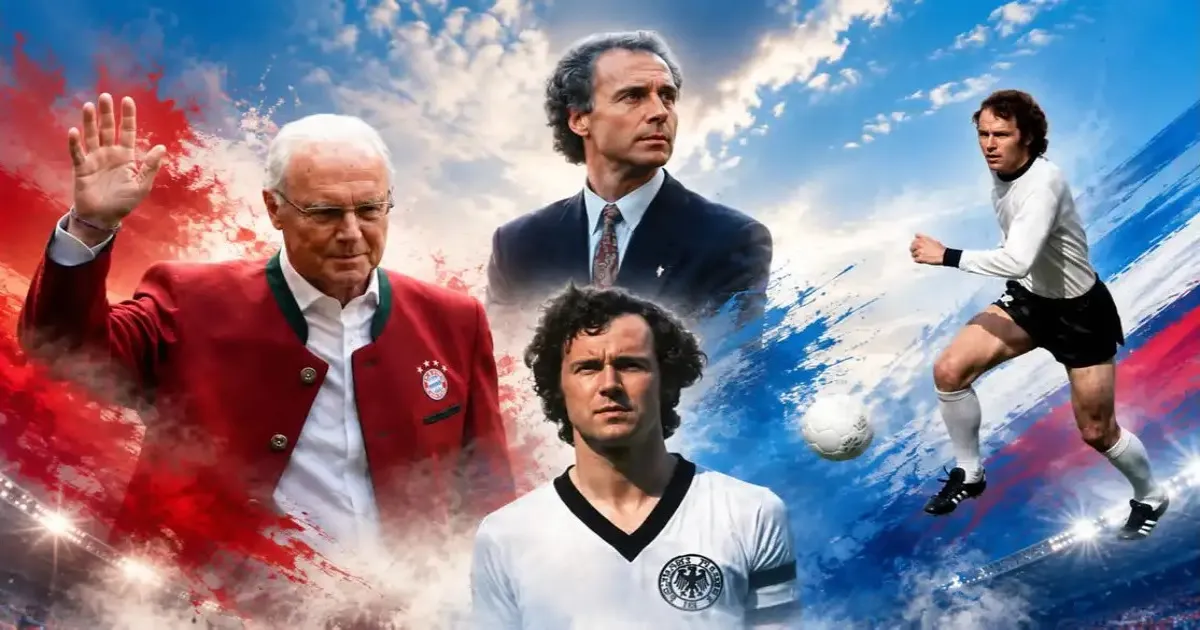
 Long before ball-playing center-backs became fashionable, one German defender proved a player could defend and dictate a match at the same time
Football has produced plenty of players who redefined a position, but few did it as completely, or as elegantly, as Franz Beckenbauer. Nicknamed “der Kaiser” — the Emperor — Beckenbauer took a defensive role that had always been considered purely reactive and turned it into the most creative position on the pitch. He won the World Cup as both a player and a manager, captained one of the greatest club sides Europe has ever seen, and along the way, permanently changed what fans, coaches and players believed a defender was capable of. This is the story of how he did it.
Who Is Gianluigi Buffon? The Journey of Italy’s Legendary Goalkeeper
Yan Diomandé Stats: The Numbers Behind Football’s Hottest Young Winger
From Munich’s Working-Class Streets to Bayern’s First Team
Franz Anton Beckenbauer was born on September 11, 1945, in the Munich borough of Giesing, the son of a postal worker in a city still rebuilding from the devastation of World War II. He began playing organized football at nine years old, joining the youth ranks of SC Munich ’06 before moving to Bayern Munich’s academy system in 1959, a decision that would shape the rest of his career and, in many ways, the entire trajectory of German football’s next three decades.
Beckenbauer made his Bayern first-team debut in 1963 at just 18 years old, marking the occasion with a goal. Initially deployed as a midfielder, he shared the pitch with future club legends like goalkeeper Sepp Maier and forward Gerd Müller, forming the nucleus of a Bayern side that would soon transform from a solid regional club into one of Europe’s dominant forces.
Reinventing the Sweeper
Beckenbauer’s true tactical legacy began to take shape once he transitioned from midfield into central defense, playing the sweeper — or libero — role that had traditionally been used across European football as a purely defensive last line, positioned behind the back four to cover for mistakes and clear away danger. Beckenbauer looked at that same position and saw something entirely different: an opportunity.
Rather than simply sweeping up behind his defense, Beckenbauer began carrying the ball forward himself, using his vision and composure on the ball to launch attacks directly from the heart of his own defensive third. It was a genuinely radical idea at the time — defenders were expected to defend, and playmaking was the job of midfielders and forwards. Beckenbauer effectively erased that distinction, combining defensive responsibility with attacking creativity in a single position, and in doing so, invented what’s now widely recognized as the modern sweeper role.
The transformation didn’t happen overnight. Beckenbauer played much of the 1966 and 1970 World Cups in more advanced midfield positions, only fully settling into his now-iconic libero role for West Germany once national team coach Helmut Schön recognized how much more valuable his vision and ball-carrying ability were from deep positions than from midfield. Once that shift was complete, the 1970s became, in every meaningful sense, Beckenbauer’s decade.
Building a Dynasty at Bayern Munich
At club level, Beckenbauer’s influence transformed Bayern Munich from a good German side into a genuine European superpower. As captain from 1971 onward, he led Bayern to three consecutive Bundesliga titles between 1972 and 1974, and then to an even more remarkable achievement: three straight European Cup titles from 1974 to 1976, a run of sustained continental dominance that earned Bayern the right to keep that year’s trophy permanently. That achievement made Beckenbauer the first player in history to captain a club to three consecutive European Cups, a record that placed Bayern alongside the sport’s most decorated dynasties of the era.
Across his career at Bayern, Beckenbauer made 582 appearances for the club, won four Bundesliga titles and four DFB Cups, and helped establish the foundation for a Bayern Munich identity — technical, tactically disciplined, and relentlessly successful — that the club has carried forward ever since.
1974: The World Cup at Home
Beckenbauer’s individual brilliance reached its peak at the international level in the 1974 World Cup, held on home soil in West Germany. As captain, he guided his country to the final against a Netherlands side built around Johan Cruyff’s revolutionary “Total Football” and widely considered the tournament’s most entertaining team. West Germany won 2-1, with goals from Paul Breitner and Gerd Müller securing the trophy in Munich’s Olympiastadion — the same city where Beckenbauer had begun his career as a nine-year-old academy player.
It wasn’t West Germany’s first World Cup title, but it was arguably its most symbolically important, arriving on home soil under the leadership of a captain who had, by that point, already redefined what his position could achieve. Beckenbauer was twice named European Footballer of the Year, in 1972 and 1976, and remains one of only ten men in football history to have won the World Cup, the European Cup and the Ballon d’Or.
America Calls: The Cosmos Years
In 1977, at the height of his career, Beckenbauer made a decision that stunned German football: he left Bayern Munich for the New York Cosmos of the North American Soccer League. Beckenbauer later recalled the helicopter ride Cosmos officials arranged to fly him from the roof of the Pan Am Building across Manhattan to Giants Stadium in New Jersey as the moment that sealed his decision — a made-for-television introduction to American football’s brief but glamorous 1970s boom.
Playing alongside global stars like Pelé, Beckenbauer became one of the faces of the NASL’s golden era, helping the Cosmos win championships and eventually earning induction into the U.S. National Soccer Hall of Fame — a rare distinction for a player who never made his name in an American youth system. He returned briefly to European football with Hamburg between 1980 and 1982 before rejoining the Cosmos for one final stint, finally retiring from playing in 1984.
Making History as a Manager
Beckenbauer’s story could easily have ended there as one of the greatest playing careers in football history. Instead, he added an entirely new chapter by moving into management, taking charge of the West German national team and guiding them to the 1990 World Cup title in Italy — a triumph that arrived just months after the fall of the Berlin Wall, adding profound symbolic weight to a German football victory achieved during the early stages of national reunification.
That win made Beckenbauer one of only three men in football history — alongside Brazil’s Mário Zagallo and France’s Didier Deschamps — to have won the World Cup as both a player and a manager. Few achievements better capture the completeness of his influence on the sport: he didn’t just win as an individual talent, he understood the game deeply enough to lead an entire generation of players to the same summit from the touchline.
Life After the Dugout
Beckenbauer’s post-managerial career kept him at the center of German football for decades. He became president of Bayern Munich in 1994, a position he held for 15 years before being named honorary president, and he later spearheaded Germany’s successful bid to host the 2006 World Cup, chairing the tournament’s organizing committee. For 34 years, he also worked as a columnist for the German tabloid Bild, cementing his status as one of the most recognizable and beloved public figures in the country, well beyond football circles alone.
That later chapter wasn’t without controversy. Beginning in 2016, Beckenbauer faced a lengthy investigation into fraud and money laundering allegations connected to Germany’s 2006 World Cup hosting bid, a case that was ultimately closed in 2020 without a verdict after the statute of limitations expired. Former Bayern teammate Paul Breitner once offered a candid summary of how Germans nonetheless continued to view Beckenbauer despite the personal and legal controversies that occasionally surrounded him: “He did everything that a German is not supposed to do… but he is forgiven for everything because he’s got a good heart, he’s a positive person and he’s always ready to help.”
The Kaiser’s Final Years
Beckenbauer’s health declined significantly in his final years, and he underwent several surgeries before his death. He passed away peacefully in his sleep on January 7, 2024, at his home, surrounded by family, at the age of 78 — news that prompted an outpouring of tributes from across the football world. FIFA president Gianni Infantino called him “a legend of German and world football,” while German Chancellor Olaf Scholz noted that Beckenbauer had “inspired generations of enthusiasm for German soccer.” Bayern Munich lit the Allianz Arena in his honor, and the stadium’s address was later renamed Franz-Beckenbauer-Platz in permanent tribute.PELÉ: WHY THE GREATEST FOOTBALLER WHO EVER LIVED STILL DEFINES THE GAME IN 2026
His death came just two days after that of Mário Zagallo, the Brazilian who had first achieved the World Cup player-and-manager double that Beckenbauer would later match — a striking coincidence that saw football lose two of the sport’s most significant historical figures within 48 hours of one another.
Why Beckenbauer’s Influence Still Matters
It’s difficult to overstate how much of modern football’s tactical language traces back to what Beckenbauer accomplished as a player. Every ball-playing center-back who steps forward to launch an attack, every defender celebrated as much for vision and passing range as for physical defending, owes a clear debt to a role Beckenbauer essentially invented through sheer individual brilliance. The libero position itself has all but disappeared from the modern game, phased out by offside law changes and zonal pressing systems — but the demand for defenders who can do more than simply defend, which Beckenbauer proved was possible more than fifty years ago, is now considered a basic requirement at the top level of the sport.
Beckenbauer’s elegance on the ball, his composure under pressure, and his willingness to redefine what his position could contribute to a team’s attack remain the standard against which every subsequent “modern” defender has, whether they realize it or not, been measured.
Final Word
Franz Beckenbauer didn’t just play the sweeper position — he reimagined what it could be, turning a role built purely around damage control into a genuine platform for controlling matches from deep. From Bayern Munich’s European Cup dynasty to West Germany’s home triumph in 1974, and from the bright lights of the New York Cosmos to the historic manager’s role that completed his unmatched legacy in 1990, Beckenbauer’s career remains one of the most complete the sport has ever produced. More than a decade after his final match and over a year since his passing, “der Kaiser” remains the standard-bearer for every defender who has ever tried to do more than simply defend.
Thiago Messi: Club Career, Playing Style, Lifestyle and Future Prospects
Cristiano Ronaldo Jr.: Club, Lifestyle, Career and Future Prospects
◾◾ follow us on facebook ◾◾
About the Author