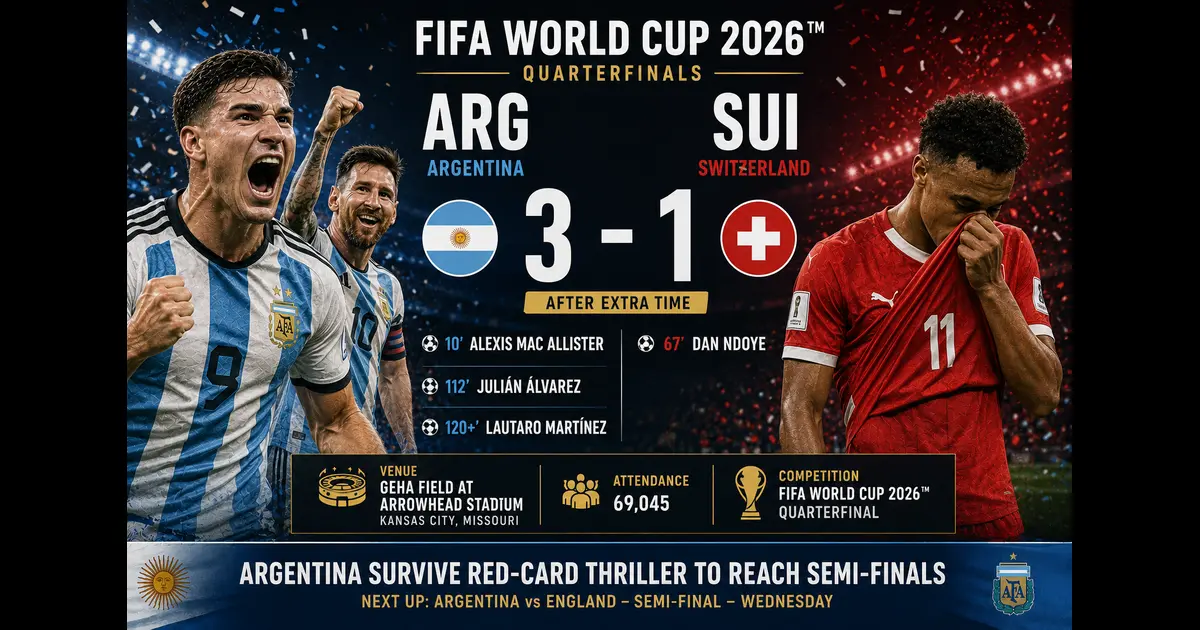
Final Score: Argentina 3-1 Switzerland (after extra time) Goals: Alexis Mac Allister 10′ (Argentina), Dan Ndoye 67′ (Switzerland), Julián Álvarez 112′, Lautaro Martínez 120+’ (Argentina) Venue: GEHA Field at Arrowhead Stadium, Kansas City, Missouri Attendance: 69,045 Competition: FIFA World Cup 2026, Quarterfinal
Defending champions Argentina survived a red-card thriller against ten-man Switzerland, needing extra time and a moment of individual brilliance from Julián Álvarez to eventually pull away for a 3-1 win in Kansas City. It sends Lionel Scaloni’s side into a second consecutive World Cup semi-final, where they will face England, but not before Switzerland — for over 50 minutes with a numerical disadvantage — pushed the champions considerably closer to the exit door than the final scoreline suggests.
An Early Lead, and a Familiar Face Behind It
Argentina made the early breakthrough that has become something of a hallmark of their tournament. In the 10th minute, Lionel Messi’s pinpoint corner picked out Alexis Mac Allister, who rose above the Swiss defence to head a superb finish into the far corner — Argentina’s earliest goal of the entire tournament, and their first genuine chance of the match. The goal shifted control firmly in Argentina’s favour for the remainder of the first half, with Scaloni’s side limiting Switzerland to sporadic, low-threat possession and Emiliano Martínez required to make only a single meaningful save before the interval.
Frustration built steadily in a Swiss side that lacked penetration in the final third, relying largely on sideways possession rather than testing Argentina’s back line directly. That frustration boiled over just before the break, when Breel Embolo was booked for a late challenge on Leandro Paredes that sparked a brief confrontation between both sets of players — a moment that would prove significant well before the match’s conclusion.
Ndoye Levels It, Then Embolo’s Night Unravels
Switzerland’s response arrived in the 67th minute, and it was a genuine moment of quality. Dan Ndoye fired a right-footed finish into the middle of the goal from the left side, converting a well-worked through ball from Ricardo Rodríguez to level the score at 1-1 and inject fresh belief into a Swiss side that had, until that point, struggled to create anything of note.
The momentum swing lasted only five minutes. In the 72nd minute, referee João Pedro Silva Pinheiro initially booked Paredes for what looked like a foul on Embolo inside Argentina’s half — only for a VAR review to overturn the decision entirely, replays showing Embolo had gone down without contact. The yellow card was transferred to Embolo for simulation, and because the Swiss forward had already been cautioned earlier in the match, the second yellow became a red — leaving Switzerland to play the entire remainder of the match, including 53 more minutes plus a full period of extra time, with ten men. Embolo was in tears as he left the pitch, consoled by teammates on his way to the touchline.
Ten Men Hold Firm, Until They Couldn’t
What followed was one of the more remarkable rearguard performances of the tournament. Switzerland, down a man from the 72nd minute onward, somehow kept Argentina at bay through the remainder of normal time and deep into extra time, with goalkeeper Gregor Kobel producing a string of important saves, including a diving stop to deny Lisandro Martínez’s acrobatic effort from a Messi corner in the closing minutes of normal time that sent the match to extra time level at 1-1.
Argentina’s pressure finally told in the 112th minute, and it arrived through a moment of genuine quality rather than simple attrition. Julián Álvarez received the ball around the top of the penalty area and curled a stunning strike into the top corner — a finish some observers immediately compared to a Puskás Award contender — to put Argentina back in front. Notably, it was Messi’s own scoring streak that ended on the night rather than continuing; his run of scoring in nine consecutive World Cup matches, a record in itself, came to a close, though Argentina’s progression continued regardless.The Players Who Became Household Names This Summer 2026
Switzerland, remarkably, continued to push forward even with the tie seemingly beyond them, but Argentina finished the contest in the second period of extra time. A breakaway saw substitute Thiago Almada drive into the box and force a save, and Lautaro Martínez reacted quickest to the rebound to slot home a third and settle the contest for good, sparking wild celebrations among the Argentina bench as the final whistle approached.
The Embolo Decision, Explained
The red card that shaped the remainder of the match deserves closer scrutiny given how directly it altered the contest. Referee João Pedro Silva Pinheiro’s initial read — a foul by Paredes on Embolo — was entirely understandable in real time, given the contact appeared to occur as both players competed for the ball near the halfway line. VAR intervention is designed precisely for moments like this one, where slow-motion replay can reveal what the naked eye at full speed cannot: in this case, that Embolo had begun his fall a fraction of a second before any contact was actually made. Referee Pinheiro’s decision to not only overturn the original call but book Embolo for simulation, compounding his earlier first-half yellow into a red card, reflected a stricter application of the simulation law than fans have typically seen enforced at this level — a subplot that added yet another layer to a World Cup already defined by heavy VAR scrutiny in its knockout rounds.Messi’s Last World Cup? The Signs Are Hard to Ignore
For a Switzerland side missing further attacking depth after Renato Steffen’s tournament-ending injury and a reshuffled front line following Zeki Amdouni’s own fitness concerns, losing Embolo specifically compounded an already difficult attacking equation. That his dismissal came from a decision reversed by technology, rather than a clear-cut, undisputed sending-off, only sharpened the sense of injustice among Swiss players and supporters inside Arrowhead Stadium.
A Numbers Game Switzerland Very Nearly Won
What makes Switzerland’s performance genuinely remarkable is how competitive they remained for so long while playing with ten men. From Embolo’s 72nd-minute dismissal to the final whistle in extra time, Switzerland held out for well over 50 minutes of match time, conceding only twice more despite Argentina’s sustained territorial dominance and repeated set-piece pressure. Gregor Kobel’s save to deny Lisandro Martínez’s spectacular late header, in particular, stands as one of the individual goalkeeping performances of the tournament’s knockout stage, and it very nearly earned Switzerland a penalty shootout against the reigning champions that would have been considered a genuine triumph in itself given the numerical disadvantage.
What It Means
The result extends Argentina’s unbeaten run to 12 consecutive World Cup matches and sends the defending champions into a semi-final meeting with England on Wednesday — a repeat of the tournament’s growing reputation for producing draining, extra-time knockout football, with this now the second successive 120-minute match for Argentina and the second in three matches overall. For Switzerland, the exit ends a campaign defined by defensive resilience, undone in the end by a single moment of refereeing controversy and the individual brilliance Argentina’s front line was always capable of producing once given enough time to break down ten men.
For Álvarez, the extra-time winner adds another signature moment to a World Cup in which he has increasingly looked like Argentina’s most reliable source of goals beyond Messi himself, while Lautaro Martínez’s late fourth cements a squad depth that Scaloni has been able to call upon match after gruelling match through this tournament’s business end.
◾◾ follow us on facebook ◾◾
About the Author