 FIFA has made the 2026 World Cup the richest edition in the tournament’s history, and the World Cup 2026 prize money now scales all the way from a group-stage exit to a champion’s payday that dwarfs anything paid out before. Here’s the full breakdown, stage by stage, in actual dollar figures.
The Full Prize Money Table
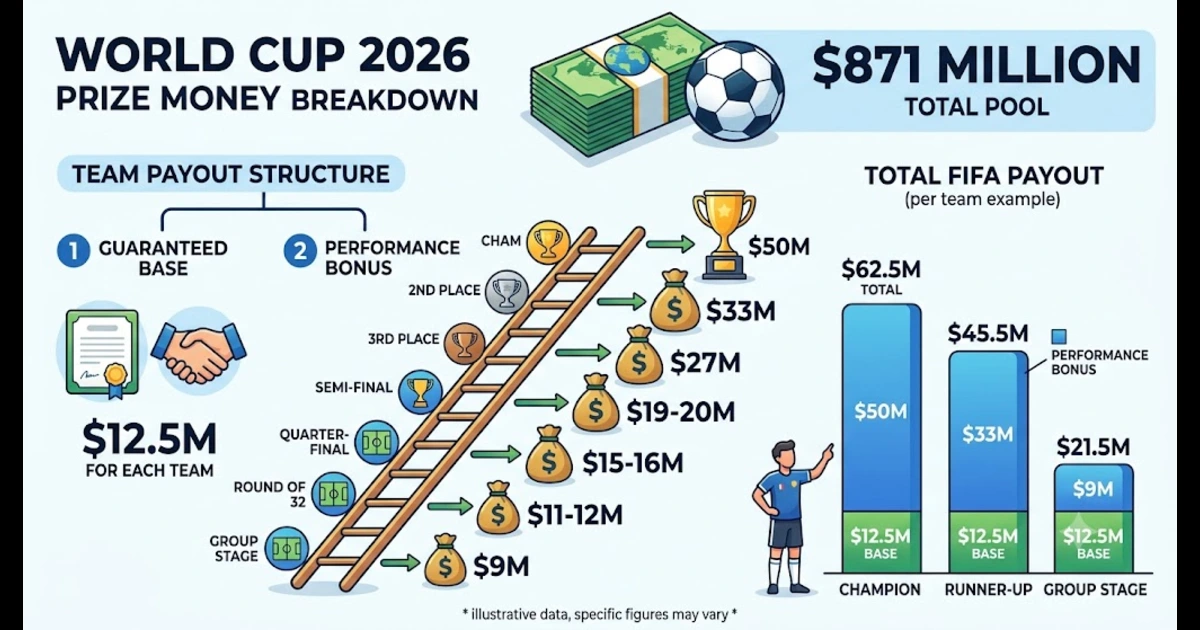
| Stage | Performance Prize (per team) | Teams at This Stage |
|---|---|---|
| Champion | $50 million | 1 |
| Runner-up | $33 million | 1 |
| Third place | $29 million | 1 |
| Fourth place | $27 million | 1 |
| Quarterfinal exit | ~$19–20 million | 4 |
| Round of 16 exit | ~$15–16 million | 8 |
| Round of 32 exit | ~$11–12 million | 16 |
| Group stage exit | $9 million | 16 |
On top of the performance prize, every one of the 48 qualified nations also receives a flat guaranteed payment of $12.5 million ($10 million in qualification money plus $2.5 million in preparation funding), regardless of how the team performs. That means even the team that goes out in the group stage without a win still walks away with roughly $21.5 million in total FIFA money, and the champion’s overall payout — performance prize plus the guaranteed base — comes to somewhere in the region of $62–63.5 million once every component is added together.
Why This Prize Pool Is Different
The total pool for the tournament sits at roughly $871 million, close to double the $440 million distributed at Qatar 2022. Two things explain the jump. The obvious one is the expansion to 48 teams, which adds an entire extra knockout round — the round of 32 — that didn’t exist in the previous 32-team format, spreading the performance pool across more payout tiers than ever before. The less obvious one is simply revenue: FIFA has said the increase reflects stronger-than-expected broadcasting, sponsorship and ticketing income across the three host nations, and the governing body has chosen to reinvest a larger share of that back into the teams themselves.
Where the Champion’s Money Actually Comes From
The $50 million performance prize is the headline number, but it’s only part of what the winning federation collects. Add the $12.5 million guaranteed base payment that every team receives regardless of results, and the champion’s total FIFA payout climbs into the low-to-mid $60 millions — comfortably the largest single payout in World Cup history, and a significant jump from the $42 million Argentina collected for winning in 2022.Haaland’s Unfulfilled World Cup Dream: How He Won Every Heart But the Trophy
Does the Money Go Straight to the Players?
No. FIFA pays every cent to the national federation, not to individual players. It’s then up to each federation, usually in coordination with the players’ union, to decide how much of that filters down to the squad as bonuses. Reports suggest player shares typically land somewhere between 20% and 30% of the total FIFA payment, though the exact split varies enormously by country — some federations split bonuses close to evenly among the whole squad, while others use very different formulas involving staff, youth programs, or general federation funds.
The Bigger Picture
Prize money is still only a fraction of what the tournament generates overall. FIFA’s broadcasting, sponsorship and ticketing revenue for the 2026 cycle is expected to run into the billions, dwarfing the $871 million handed directly to competing teams. The prize pool exists specifically to reward on-field performance and support federations that might otherwise struggle to fund a World Cup campaign — not to reflect the tournament’s total commercial value.
About the Author