 Everyone Fell in Love With Haaland This Summer — Except the Scoreboard
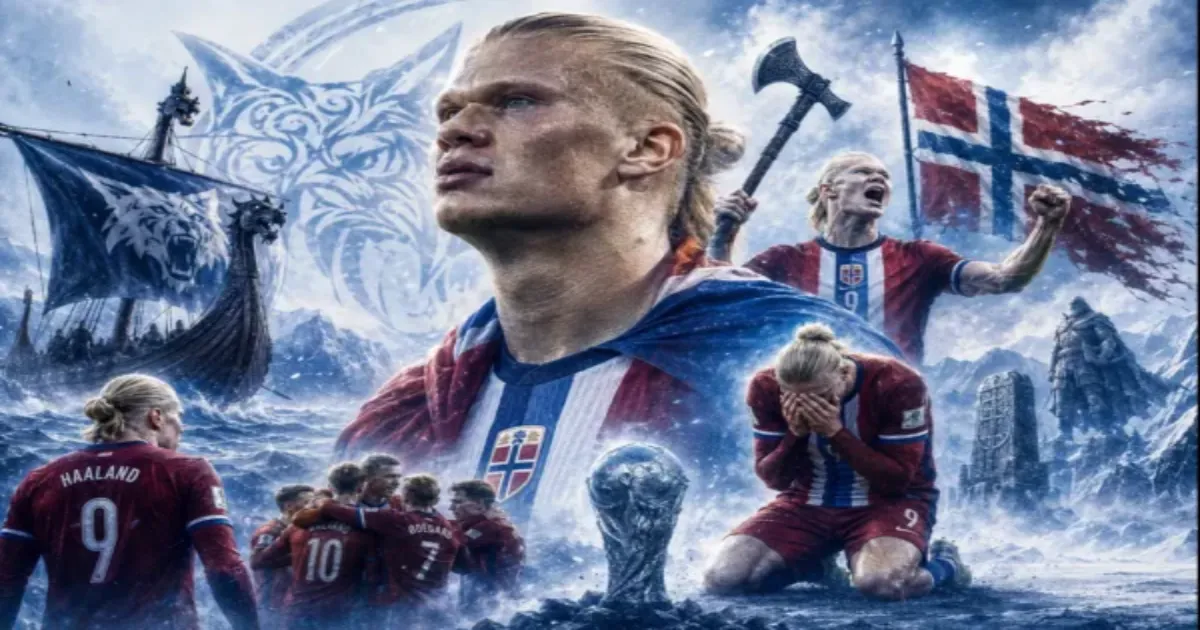
There is a particular kind of heartbreak reserved for the player everyone was rooting for. Not the villain, not the diva, not the player fans love to hate — the one whose humility and joy made neutral supporters across the world quietly hope his story would end differently. That is exactly what happened to Erling Haaland at his first World Cup. He scored in five straight matches, dragged a nation with no business being in the quarterfinals into the quarterfinals, and cried in front of a global television audience when it all ended two matches too soon. Haaland’s unfulfilled World Cup dream is, by now, one of the defining emotional threads of this entire tournament — and it says as much about the player’s character as it does about the football he produced.
Erling Haaland: The Goal Machine Rewriting Football’s Record Books
Football’s New Generation Has Arrived: The Young Stars Who Shined at World Cup 2026
Erling Haaland Baby Names Peru: Why Hundreds of Newborns Are Being Named After the Norway Star
A First World Cup, and an Instant Connection With the World
Haaland arrived in North America as one of the most feared strikers on the planet but, in a strange quirk of football’s biggest stage, a complete newcomer to the World Cup itself. At 25, playing in his first tournament, he wasted no time making up for lost time — scoring twice against Iraq, twice against Senegal, and once in the dramatic late winner against Ivory Coast that gave Norway their first-ever World Cup knockout victory. By the time his brace eliminated five-time champions Brazil in the Round of 16, Haaland had scored in every match he’d played at the tournament, a run matched at a World Cup by a European player only once before, by Germany’s Gerd Müller back in 1970.
What made Haaland’s rise through this tournament so charming wasn’t just the volume of goals — it was how he talked about them. After his stunning second goal against Brazil, a strike that skimmed through Danilo’s legs and across the turf into the bottom corner, Haaland didn’t reach for the usual footballer clichés about hard work and preparation. He simply called it “almost a gift from God,” adding, with what looked like genuine disbelief at his own good fortune, “It’s absolutely crazy.” It was the reaction of a man still capable of being amazed by his own talent, rather than someone treating World Cup history as simply another item to check off a list.Born in Leeds, Built in Norway: The Erling Haaland Story His Country Never Stops Celebrating
The Teammate Who Made Everyone Around Him Better
Part of what made Haaland so easy to fall in love with this summer was how visibly his teammates adored playing alongside him. Andreas Schjelderup, the 22-year-old Benfica winger who assisted both of Haaland’s goals against Brazil, put it about as plainly as a teammate possibly could: “All you have to do is give the ball to Erling and he’ll score. We have the best striker in the world, so everything becomes easier. When you pass the ball to him, you know he’ll deliver. He’s a beast, a natural goalscorer.” Haaland, for his part, immediately turned the credit back around, praising Schjelderup’s delivery rather than dwelling on his own finishing: “The cross was perfect. The second assist was too.”
Cristiano Ronaldo Jr.: Club, Lifestyle, Career and Future Prospects
Thiago Messi: Club Career, Playing Style, Lifestyle and Future Prospects
That instinct to share credit rather than hoard it ran through Norway’s entire tournament narrative. Captain Martin Ødegaard’s calm, understated creativity in midfield gave Haaland the service he needed to thrive, and rather than positioning himself as the lone superstar carrying a supporting cast, Haaland consistently spoke about Norway’s run as a collective achievement — a nation of five million people finally seeing three decades of quiet footballing development pay off together, rather than a single generational talent doing it alone.ERLING HAALAND’S DIET, SLEEP & RECOVERY: THE SCIENCE BEHIND THE MACHINE
The Class Haaland Showed in Defeat
Norway’s tournament ended in Miami against England, in a 2-1 extra-time defeat built on a passage of play Haaland felt, with justification, went against his team. A Torbjørn Heggem goal midway through the second half was disallowed by VAR for a push Haaland made on England’s Elliot Anderson in the build-up to the corner — a decision Haaland didn’t hide his frustration with afterward. “It feels a bit empty, to be honest,” he told TV 2. “I felt we deserved more. I don’t think it’s a free kick. It’s been disallowed because I push Elliot Anderson to the ground, like I get pushed in every single duel. It’s a bit bitter. Small moments decide things in the World Cup. Against Brazil we managed to turn it in our favour. Today when we get the 50/50 decisions against us it will be difficult.”
It would have been easy for that frustration to curdle into something bitter and lasting, the kind of sore-loser narrative that follows plenty of eliminated stars home from major tournaments. Instead, in the same set of post-match interviews, Haaland pivoted to something considerably more generous and forward-looking. “We’re building on something in Norway,” he told reporters. “I think we’re there now, and it’s about maintaining this because, again, we’ve shown that it’s possible… We gave them a good fight.” It was a remarkably composed piece of perspective from a player who, by every visible account, was devastated in the moment — and it is precisely that combination, raw disappointment paired with immediate grace, that has made Haaland such a compelling figure to watch this summer.
Why “Loving” and “Charming” Are the Right Words
Football fans have seen plenty of brilliant strikers before. What set Haaland apart at this World Cup wasn’t simply the goals — it was the visible, unguarded emotion behind them. He cried after the England defeat, in front of cameras, without the practiced stoicism many elite athletes are trained to project in defeat. He credited teammates constantly rather than positioning himself as a solitary genius. He described his own goals with childlike wonder rather than manufactured confidence. And even in his most frustrated post-match interview, he stopped short of attacking the officials personally, framing the disallowed goal as simply one of the “small moments” that decide World Cup football rather than a grievance to nurse indefinitely.The 10 Highest-Paid Footballers in the World
That combination — dominant on the pitch, disarmingly human off it — is precisely what turned Haaland into a player neutral fans across the tournament found themselves quietly cheering for, even when their own nations weren’t involved. It is a rare thing for a striker this clinically ruthless in front of goal to also come across as this emotionally transparent everywhere else, and it is exactly why his elimination landed as such a widely felt disappointment rather than simply a result affecting one Scandinavian nation.
An Unfulfilled Dream, But Not an Unfinished Story
Haaland leaves this World Cup with seven goals, level with Kylian Mbappé and one behind eventual Golden Boot contender Lionel Messi, and with four match-winning goals — a tally bettered at a World Cup only twice in the competition’s history. He leaves it having delivered Norway’s first-ever World Cup knockout win, the greatest victory in the nation’s football history against Brazil, and a quarterfinal finish nobody outside Norway’s own dressing room seriously predicted before the tournament began. What he doesn’t leave with is the trophy, or even the semi-final appearance that felt, for exactly two minutes of extra time in Miami, tantalisingly close.
That is Haaland’s unfulfilled World Cup dream in its simplest form: a player who did almost everything right, who won over a global audience with as much heart as skill, and who still went home earlier than the story seemed to deserve. At 25, with Norway’s golden generation still years from its peak and a nation that hasn’t reached a major tournament semi-final ever suddenly believing it might be possible, there is little reason to think this was Haaland’s only chance at finishing what this World Cup started. If anything, the tears in Miami looked less like an ending, and more like a player already impatient for his next opportunity to try again.
◾◾ follow us on facebook ◾◾
Football After Messi and Ronaldo: Inside the End of an Era
Golden Ball Winner Rodri: The Case for Football’s Quietest Superstar
What Cristiano Ronaldo Doesn’t Have: The One World Cup Trophy That Couldn’t Define His Greatness
About the Author


1 thought on “Haaland’s Unfulfilled World Cup Dream: How He Won Every Heart But the Trophy”