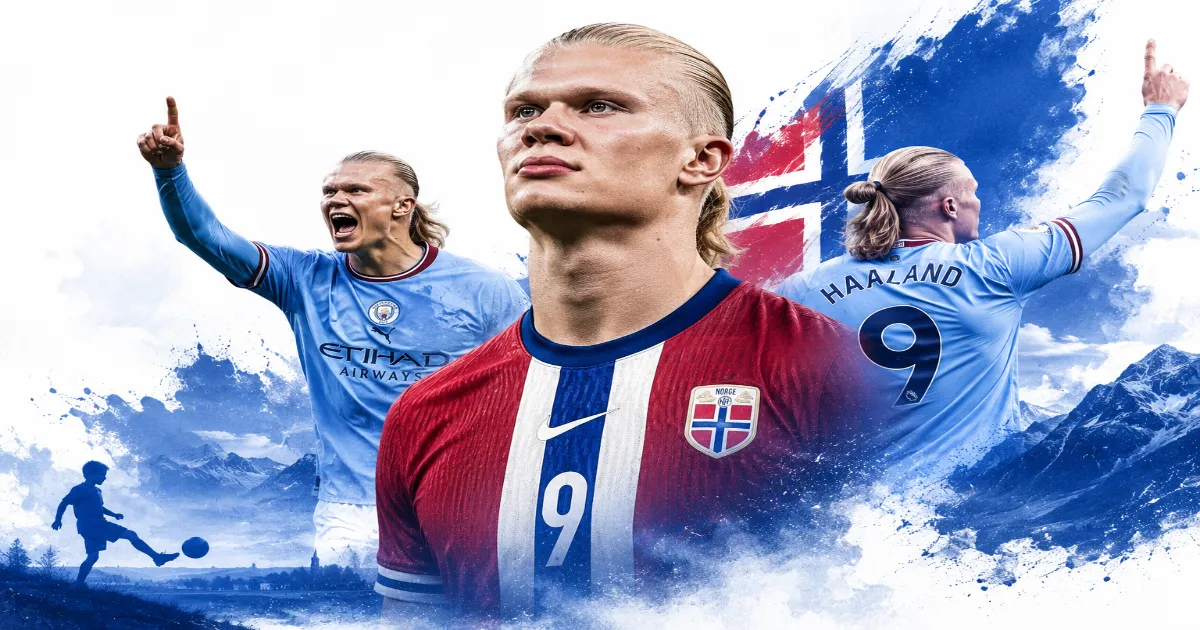
Norway’s World Cup 2026 Journey was a historic run, from a perfect qualifying campaign and a 28-year wait to a first-ever World Cup quarter-final.
For a nation that had not sniffed a World Cup in 28 years, simply qualifying for North America 2026 was itself a story. What Norway’s World Cup 2026 journey actually became — a run to the quarterfinals, the best finish in the country’s football history, powered by the most complete individual tournament by any player not named Messi — turned a feel-good qualification narrative into one of the genuine sporting stories of the summer. It ended in Miami, agonisingly, against England. But almost nothing about how it ended should overshadow how far this team travelled to get there.LaLiga 2026/27 Schedule: Fixtures, Dates & Times
Champions League 2026/27 Schedule: Fixtures, Dates & Times
Premier League 2026/27 Schedule: This Week and Next Week
The Long Road Back
Norway’s absence from the World Cup stage had stretched back to 1998, when a squad featuring Alfie Haaland — father of the striker who would eventually define this campaign — was eliminated by Italy in the Round of 16 under the old format. In the decades since, Norway watched the tournament from home, missing not only successive World Cups but also every European Championship since 2000, even as a golden generation of Norwegian talent quietly assembled itself across Europe’s biggest leagues.
Ståle Solbakken, who took charge in December 2020, built his qualifying campaign around a suffocating 4-3-3 shape and a golden generation finally converging at the right moment. Norway went through UEFA qualifying unbeaten at 8-0, scoring 37 goals and conceding only five, including a pair of statement wins over Italy — the very nation that had ended their previous World Cup dream in 1998. By the time the draw placed them in Group I alongside France, Senegal, and Iraq, Norway arrived in North America with genuine expectation attached to their name for the first time in a generation.
Group Stage: Statement Wins and a Meaningless Defeat
Norway’s tournament opened in emphatic fashion, thrashing Iraq 4-1 to announce their return to the World Cup stage in style. A tighter test followed against Senegal, won 3-2 in a genuine end-to-end contest that showcased both Norway’s attacking talent and defensive vulnerabilities in equal measure. With qualification for the knockout rounds already secured, Norway’s final group match against France became a dead rubber in all but name — Solbakken made ten changes, rested Haaland entirely as an unused substitute, and Norway lost 1-4, finishing second in Group I behind an unchanged French side.
That defeat mattered not one bit in the context of what followed. Norway’s place in the Round of 32 was secured regardless, and resting their most important asset for a genuinely meaningless fixture proved a shrewd piece of squad management rather than any cause for concern.
The Knockouts: History, One Round at a Time
Norway’s first-ever World Cup knockout victory arrived in the Round of 32 against Ivory Coast in Arlington, and it needed a nerve-settling finish to get there. Antonio Nusa gave Norway the lead in the 39th minute with a superb solo finish, only for Amad Diallo to level for Ivory Coast in the 74th. The decisive moment arrived in the 86th minute, when Oscar Bobb found Patrick Berg breaking into the box, and Berg’s cutback found Haaland completely unmarked to tap home the winner — a goal that, for the first time in the nation’s history, sent Norway through a World Cup knockout tie.
If that result made history, what followed in the Round of 16 rewrote it entirely. Facing five-time champions Brazil in New York New Jersey, Norway produced the single biggest shock result of the entire tournament, winning 2-1 in a match that instantly became the greatest in Norwegian football history. Ørjan Nyland saved a first-half penalty from Bruno Guimarães to keep the match level, before Haaland struck twice in the closing stages — in the 79th and 90th minutes — to give Norway what appeared to be an unassailable lead. Neymar pulled one back from the penalty spot deep into stoppage time, in what proved to be his final act in a Brazil shirt before announcing his international retirement, but Norway held on. Brazil’s earliest World Cup exit since 1990 was Norway’s crowning achievement.
The Quarterfinal: A Heartbreaking Full Stop
Norway’s historic run finally ended against England in a sweltering Miami quarterfinal that needed extra time to be settled. Andreas Schjelderup’s stoppage-time opener gave Norway the lead heading into half-time, only for Jude Bellingham to equalise within two minutes. A Torbjørn Heggem goal midway through the second half was chalked off by VAR for a Haaland push in the build-up, and after 90 goalless additional minutes, Bellingham struck again just three minutes into extra time to complete his brace and end Norway’s tournament 2-1. Haaland, who had scored in every previous match of the tournament, could not add a sixth goal that would have taken the match to penalties.
Why This Run Matters Beyond the Scoreline
Context matters enormously when evaluating what Norway actually achieved this summer. This is a football nation that had gone 28 years without appearing at a World Cup and had not featured at a European Championship since 2000 — an absence so prolonged that an entire generation of Norwegian football fans had never watched their senior men’s team compete at a major tournament until this year. Against that backdrop, simply qualifying was a genuine national event; reaching the quarterfinals, beating a five-time World Cup champion along the way, turned a feel-good return into something considerably more significant for the country’s football culture and its next generation of players.
The manner of Norway’s progress also matters. This was not a run built on a favourable draw or a soft knockout bracket. Ivory Coast were a physical, well-organised Round of 32 opponent; Brazil were five-time champions and, at the time, among the tournament favourites; England, whom they ultimately lost to, went on to reach the semi-finals themselves. Norway’s quarterfinal finish came against a run of opposition that gives the achievement considerably more weight than a lucky path through weaker sides might have offered — this was a team that beat good opposition to get where it did, and lost, ultimately, only to a side that went one round further than they did.
Top Performer 1: Erling Haaland, the Story of the Tournament
No player at this World Cup carried a smaller nation further on pure individual output than Erling Haaland. He scored in each of his first five matches — two against Iraq, two against Senegal, one against Ivory Coast, and two more against Brazil — a run matched at a World Cup only by Germany’s Gerd Müller among European players, going back to 1970. His seven goals left him level with Kylian Mbappé and one behind Golden Boot leader Lionel Messi heading into the quarterfinal, and his tournament included four separate match-winning goals, a tally bettered only twice in World Cup history. At 25, playing in his first-ever World Cup, Haaland didn’t just perform — he carried a nation that had never previously experienced anything like this stage of the tournament through it.
Top Performer 2: Martin Ødegaard, the Quiet Architect
While Haaland collected the headlines, captain Martin Ødegaard was the player making his teammates better throughout the tournament. His assist for Antonio Nusa’s goal against Ivory Coast made him the first player to record assists in three consecutive World Cup matches since the Netherlands’ Dirk Kuyt in 2010, and his composure in Norway’s advanced midfield areas gave Solbakken’s counter-attacking system the creative fulcrum it needed to function against considerably more talented opposition. Ødegaard’s tournament may lack Haaland’s box-office numbers, but Norway’s run simply doesn’t happen without his control of the game’s tempo.
Top Performer 3: Ørjan Nyland, the Unlikely Shot-Stopper
At 35, Sevilla’s Ørjan Nyland became one of the most important figures of Norway’s tournament almost by accident, thrust into the spotlight by circumstance rather than reputation. His penalty save against Bruno Guimarães in the Round of 16 against Brazil was arguably the single most important individual moment of Norway’s entire campaign — without it, Haaland’s late brace may never have had the chance to matter. Nyland’s calm, unspectacular handling behind Solbakken’s low defensive block became the platform that made Norway’s entire counter-attacking approach possible, a reminder that historic tournament runs are rarely built on attacking talent alone.
Best Moments: A Highlight Reel Norway Will Replay for Decades
Three moments define this Norwegian World Cup above all others. Haaland’s 86th-minute winner against Ivory Coast delivered the country’s first-ever World Cup knockout victory, a genuine watershed after 28 years away from the tournament. His brace against Brazil in the Round of 16 — completing what was voted one of the tournament’s best individual goals — produced the single greatest result in Norwegian football history, eliminating a five-time champion and confirming this squad’s status as legitimate contenders rather than merely a feel-good story. And even in defeat, Schjelderup’s audacious stoppage-time strike against England, momentarily putting Norway ahead of the eventual semi-finalists, will be remembered as the moment this Norwegian generation announced they belonged at this level, regardless of the eventual scoreline.
What’s Next for Norway
Norway’s exit leaves a squad with almost nothing but growth potential ahead of it. Haaland is only 25, Nusa and Schjelderup are considerably younger still, and Ødegaard remains firmly in his prime years as a creative playmaker at Arsenal. Solbakken’s counter-attacking system has been proven to work against elite opposition, not just against nations of a similar footballing stature — beating Ivory Coast and Brazil back to back is not a fluke produced by a favourable draw. The immediate task ahead is qualification for the 2028 European Championship, a tournament Norway has not featured in since 2000, followed by the challenge of proving this quarterfinal run reflects a genuine step change in Norwegian football rather than a single golden generation’s one-off moment in the sun. Given the age profile of this squad and the sheer weight of history it has already rewritten in a single summer, there is little reason to think this was Norway’s last dance on football’s biggest stage — more likely, it was the opening chapter of one.
◾◾ follow us on facebook ◾◾
About the Author



1 thought on “Norway’s World Cup 2026 Journey: How the Vikings Made History Before Falling Just Short”