Belgium vs Iran World Cup 2026 match analysis
Belgium arrived in Los Angeles needing a statement performance. Instead, they left SoFi Stadium with more questions than answers.
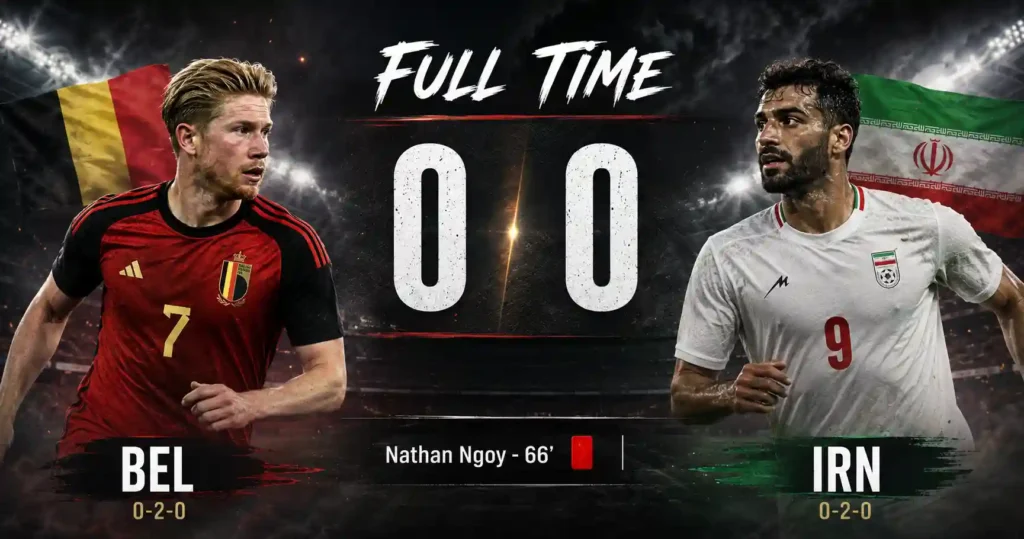
A tense and often frustrating 0-0 draw against Iran has left the Red Devils facing enormous pressure heading into the final round of Group G fixtures. While Belgium controlled possession, territory, and the majority of chances, they once again lacked the cutting edge required to turn dominance into goals.
Iran, meanwhile, produced another display built on discipline, resilience, and collective determination. At the center of it all stood goalkeeper Alireza Beiranvand, whose remarkable performance preserved a precious point that could ultimately prove decisive in the race for the knockout rounds.
Belgium Control the Ball but Not the Match
From the opening whistle Belgium looked intent on imposing themselves.
Kevin De Bruyne operated between the lines, Jeremy Doku stretched the Iranian defense with his pace, and Belgium consistently pushed forward in search of an early breakthrough. Yet despite long spells of possession, clear-cut opportunities remained scarce.
Iran’s defensive structure frustrated Belgium throughout the first half. The midfield stayed compact, the back line rarely lost its shape, and every Belgian attack seemed to run into a wall of white shirts.
Belgium attempted to increase the tempo after the break, moving the ball more quickly and committing additional numbers forward. However, the familiar problem resurfaced: finishing.
The Red Devils generated pressure but rarely looked clinical.
Beiranvand Produces a Goalkeeping Masterclass
The defining performance of the match belonged to Iran goalkeeper Alireza Beiranvand.
His most spectacular intervention came shortly before the hour mark when he somehow recovered position to deny Maxim De Cuyper from close range. It was a save that shifted momentum and visibly frustrated Belgium’s attackers.
As the game wore on, Beiranvand’s confidence grew.
Crosses were claimed confidently. Long-range efforts were pushed away. Through balls were anticipated quickly. Every Belgian attempt seemed destined to end in the goalkeeper’s gloves.
World Cups often create unlikely heroes. On this occasion, Beiranvand reminded everyone why he remains one of Asia’s most experienced and dependable goalkeepers.
Iran Threaten on the Counter
Although Belgium controlled the ball, Iran were not passive.
Mehdi Taremi continuously tested the Belgian defense with intelligent movement and direct running. One moment briefly appeared to put Iran ahead before an offside flag denied celebrations.
The Asian side recognized Belgium’s vulnerability whenever possession was lost in advanced areas. Quick transitions created several dangerous moments and forced Thibaut Courtois into important saves of his own.
Iran’s approach was pragmatic but effective.
Rather than chasing possession, they focused on limiting space and exploiting opportunities when Belgium committed too many players forward.
Turning Point: Nathan Ngoy Sent Off
Belgium’s task became significantly harder when defender Nathan Ngoy received a red card after bringing down Taremi during a dangerous Iranian attack.
The dismissal altered the rhythm of the contest.
Instead of increasing pressure, Belgium appeared less organized after going down to ten men. Iran sensed the opportunity and became more adventurous, forcing Courtois into several key interventions.
For a team already struggling for confidence, the red card highlighted Belgium’s growing frustration.
Tactical Analysis
Belgium
Belgium’s build-up play was generally strong.
De Bruyne consistently found spaces between midfield and defense, while Doku offered width and acceleration. The issue emerged in the final third.
Crosses lacked precision.
Runs were not coordinated.
Finishing was hesitant.
Belgium’s attack often looked disconnected despite enjoying long periods of possession.FIFA World Cup 2026 Group G : Belgium Faces Rising Pressure as Egypt, Iran, and New Zealand Chase History
The statistics reflected territorial dominance, but football matches are decided in penalty areas, and Belgium again failed to convert control into goals.
Iran
Iran delivered one of the tournament’s most disciplined defensive performances.
Their midfield shielded the back four effectively, limiting central spaces for Belgium’s creators. Every player understood his role.
When opportunities emerged, Iran transitioned quickly through Taremi and the wide players, creating enough danger to keep Belgium cautious.
Most importantly, they remained mentally strong throughout the contest.
Group G Implications
The result keeps Group G remarkably balanced.
Neither side has managed a victory after two matches, meaning qualification will likely be decided on the final matchday.
Iran will feel optimistic after taking points from two difficult fixtures.
Belgium, meanwhile, face growing scrutiny. Despite possessing one of the tournament’s most talented squads, they have yet to produce a convincing performance.
Their final group match against New Zealand has effectively become a must-win encounter.
Final Verdict
This may not have been the most entertaining match of the tournament, but it could prove one of the most significant.
Belgium dominated possession yet failed to solve Iran’s defensive puzzle. Iran displayed courage, discipline, and belief. Above all, Alireza Beiranvand delivered the kind of World Cup performance that enters tournament folklore.
For Belgium, the warning signs are becoming impossible to ignore.
For Iran, qualification dreams remain very much alive.
About the Author