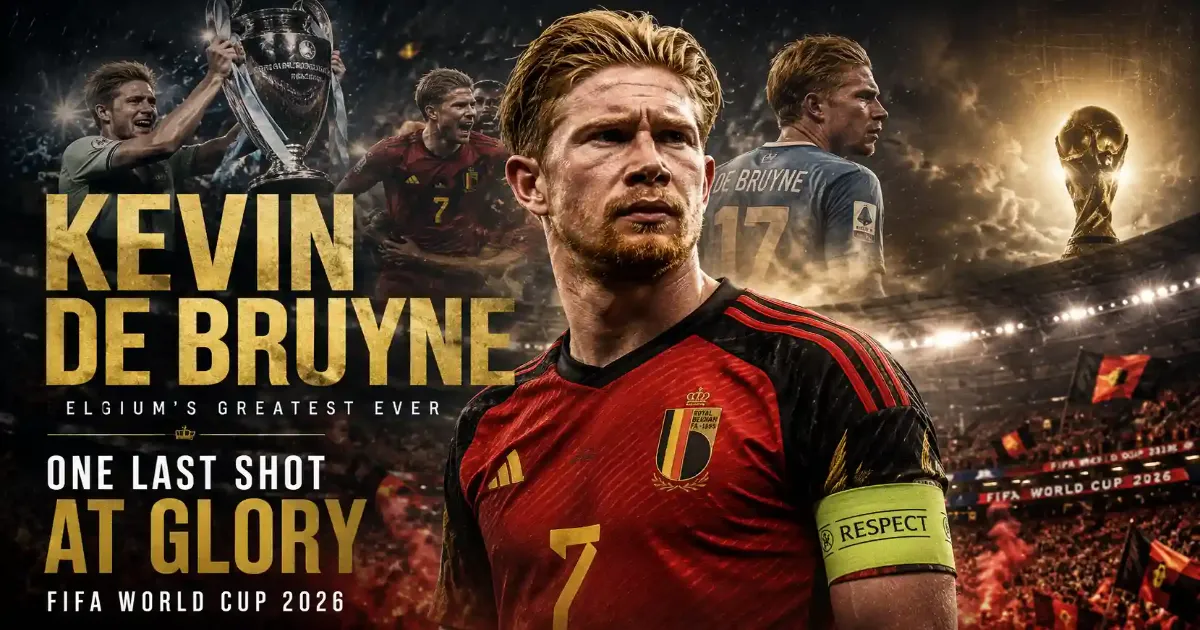
Kevin De Bruyne FIFA World Cup 2026 — Belgium’s Greatest Ever Goes for One Last Shot at Glory
Belgium | Attacking Midfielder | Age at WC 2026: 34 | Napoli (Serie A) | 115+ Caps | Belgium Captain
- 115+ senior caps for Belgium | 36+ international goals | Belgium’s all-time captain and leader
- 16 major trophies at Manchester City including 6 Premier League titles, 1 UEFA Champions League, 2 FA Cups
- Second-highest assist maker in Premier League history — 118 assists, joint-record 20 in a single season
- 6 goals and 1 assist in 6 World Cup 2026 qualifying matches — highest-scoring midfielder in European qualifying
- Estimated net worth: $70–100 million | Weekly wage at Napoli: approximately €213,654
Quick Facts — Kevin De Bruyne FIFA World Cup 2026
| Category | Details |
|---|---|
| Full Name | Kevin De Bruyne |
| Date of Birth | 28 June 1991 |
| Age at World Cup 2026 | 34 years old |
| Nationality | Belgian |
| Place of Birth | Drongen, Belgium |
| Height | 1.81 m (5 ft 11 in) |
| Preferred Foot | Right |
| Current Club | Napoli (Serie A) |
| Jersey Number | #17 (Belgium) |
| Position | Attacking Midfielder / Central Midfielder |
| Notable Transfer Fee | £54–55 million (Wolfsburg to Manchester City, 2015) |
| Market Value (Est.) | €10 million |
| Contract Until | June 2027 (Napoli) |
| Weekly Wage at Napoli | €213,654 per week |
| Wife | Michèle Lacroix (married June 2017) |
| Children | Mason Milian (2016), Rome (2018), Suri (2020) |
| Net Worth (Est.) | $70–100 million USD |
| Languages Spoken | Dutch, English, French, German |
Thiago Messi: Club Career, Playing Style, Lifestyle and Future Prospects
Cristiano Ronaldo Jr.: Club, Lifestyle, Career and Future Prospects
Kevin De Bruyne FIFA World Cup 2026 — One Last Dream, One Final Stage
There is a particular kind of courage that belongs only to great athletes who refuse to go quietly. Not the courage of the young man with everything ahead of him, who risks without knowing the full weight of what loss feels like. But the courage of someone who has seen everything, won almost everything, been broken by injury and rebuilt by will, who stands at the edge of their career and chooses — deliberately, defiantly — to chase the one thing that has always been missing. That is the courage of Kevin De Bruyne in the summer of 2026. And it is one of the most compelling storylines that any World Cup in recent memory has produced.
At 34 years old, Kevin De Bruyne is at the FIFA World Cup 2026 in North America representing Belgium for what almost every observer agrees is the final time. The last hurrah. The last chance. He has won six Premier League titles, a UEFA Champions League, two FA Cups, and 16 major trophies in total across a decade at Manchester City that redefined what it meant to be a midfielder in the modern game. He holds the second-highest number of assists in Premier League history. He has been named the best player in the world’s most competitive league more times than almost anyone alive. And yet the World Cup — the one trophy that belongs to nations, not clubs — has always sat just beyond his reach. Belgium came closest in 2018, finishing third in Russia. But closest is not the same as there.
Kevin De Bruyne FIFA World Cup 2026 is not simply a player profile. It is the story of a generational talent standing at the door of football’s greatest tournament for the last time, asking the sport one final question: is there enough left in these legs, this vision, this will — to finish it? Belgium, and the watching world, are about to find out.
Biography — From Drongen to the Summit of World Football
Kevin De Bruyne was born on 28 June 1991 in Drongen, a quiet municipality in the East Flanders province of Belgium. His father, Herwig De Bruyne, worked in a profession that required frequent travel — including regular visits to London — which meant that Kevin spent portions of his childhood between Belgium and England, developing the multilingual fluency and cultural adaptability that would later make his transition to the Premier League feel entirely natural. He speaks Dutch, English, French, and German, a detail that sounds like a footnote but reveals something important about the environment in which he was formed: one that demanded flexibility, intelligence, and the ability to communicate across boundaries.
He began playing football at the age of four and showed ability early enough that structured coaching found him quickly. He joined the youth academy of KRC Genk at fourteen — leaving home, leaving the comfort of his neighbourhood, and beginning the long solitary grind that turns gifted children into professional athletes. It was not an easy transition. He has spoken in interviews about the loneliness of those early years away from family, surviving on modest youth earnings, regularly visited by his grandmother who worried about the teenager living alone while pursuing a dream that offers no guarantees. It built in him a self-reliance and inner toughness that would prove more valuable than any technical attribute.
One detail from his teenage years stands out for what it reveals about his character: at fifteen, he was rejected by a foster family arranged to house young academy players. The experience, which could have been deeply destabilising for an adolescent already far from home, instead became fuel. Those who coached him at Genk during this period describe a player who responded to adversity not with withdrawal but with a doubling down of effort — a pattern that would repeat throughout his career every time injury, criticism, or disappointment tried to define him. He was, from the very beginning, built differently.
Club Career Highlights — A Decade of Dominance and the Move to Naples
Kevin De Bruyne’s professional career began at KRC Genk, where he made his senior debut in 2010 and immediately demonstrated that he was operating at a level beyond what the Belgian Pro League could contain for long. He won the Jupiler Pro League title with Genk in the 2010–11 season, contributing 5 goals and 16 assists and attracting the attention of Chelsea, who signed him in January 2012 for approximately £7 million. The Chelsea experience was brief and largely unsuccessful — he played only three league matches and was loaned to Werder Bremen — but it provided exposure to the highest level of European football and, perhaps more importantly, gave him the motivation of a point left unproven. When Chelsea released him in 2014, selling him to VfL Wolfsburg for around £12 million, many assumed it was the story of a player who had been found out at the elite level.
Wolfsburg proved them spectacularly wrong. In two seasons in the Bundesliga, De Bruyne became the best creative midfielder in German football — delivering 20 assists in 2014–15 alone, winning the DFB-Pokal, and performing at a level that attracted the attention of every elite club in Europe. It was Manchester City, under Manuel Pellegrini and then Pep Guardiola, who won the race, paying £54–55 million in August 2015 — a record fee for a midfielder at the time and an investment that would prove to be one of the most transformative signings in the history of English football.
What followed across a decade at the Etihad was one of the great individual careers in Premier League history. Under Guardiola, De Bruyne became the beating heart of the most tactically sophisticated club side England had ever seen. The trophies accumulated in extraordinary fashion: six Premier League titles, one UEFA Champions League, two FA Cups, five League Cups. His statistical records became the benchmarks against which all other midfielders were measured — 118 Premier League assists, joint-record 20 in a single season (shared with Thierry Henry), eight PFA Team of the Year inclusions. In April 2022, he scored four goals against Wolves in one of the fastest hat-tricks — across the full match — the Premier League had witnessed. In 2022–23, he was central to the historic Treble, a season that sealed Manchester City’s status as the dominant force of their era.
Injuries in his final seasons at City — hamstring, thigh, and muscle problems — reduced his availability and contributed to the club’s decision not to extend his contract beyond June 2025. He departed as a free agent at 33, carrying the weight of a legend’s farewell and the curiosity of the football world about what would come next. The answer was Napoli. The Italian club, with their sun-drenched city, their volcanic passion for football, and a squad building toward European relevance again, signed him on a two-year deal. The move — romantic, unexpected, and entirely consistent with a career that has never followed the obvious path — gave him a new stage. And in 2025–26, he showed that the stage was not too big. Eight appearances, 4 goals, 1 assist, and performances of sufficient quality to confirm that the best of Kevin De Bruyne, even at 34, is something most midfielders could spend a career trying to reach.
International Career — Belgium’s Greatest, Still Unfinished — Kevin De Bruyne FIFA World Cup 2026
Kevin De Bruyne made his senior debut for Belgium in August 2010 and has since become the defining player of the most talented generation in Belgian football history — a golden generation that included Eden Hazard, Romelu Lukaku, Thibaut Courtois, and Axel Witsel, and that promised, for nearly a decade, to be the group that finally delivered Belgium their first major international trophy. That promise remains unfulfilled at the senior level, which is the central tension and the central motivation of De Bruyne’s presence at this World Cup.
His tournament record is remarkable in the context of the teams he has represented. At the 2014 World Cup in Brazil, De Bruyne was exceptional as Belgium reached the quarter-finals, and his performances announced him as one of the next generation’s truly elite players on the global stage. At Russia 2018, Belgium produced their finest tournament run in decades — third place — and De Bruyne was the creative engine throughout: his vision, range of passing, and ability to manufacture chances from seemingly impossible angles were the difference between Belgium surviving in knockout matches and going home. At Euro 2020 and the 2022 World Cup in Qatar, Belgium disappointed — the Qatar exit at the group stage in particular felt like a brutal and premature end to the golden generation story.
But De Bruyne refused to accept that Qatar was his last chapter. He continued with Belgium, continued to perform at a level that made his retirement from international football unthinkable, and led the qualification campaign for World Cup 2026 with performances that, statistically, were among the finest of any midfielder in the entire European qualifying process. Six goals and an assist in six qualifying matches. The highest-scoring midfielder in European World Cup qualifying. The most shots (23), joint-most accurate crosses (14), and second-most key passes (21) among midfielders across the entire European qualification. At 34. With the freshness of a man who plays as though every match might be his last, because he knows it might be.
He now arrives at the FIFA World Cup 2026 with 115+ caps and 36+ international goals — numbers that make him Belgium’s most capped outfield player and their greatest creative force across four decades. Coach Rudi Garcia has been clear: De Bruyne is the captain, the playmaker, and the irreplaceable fulcrum around which Belgium’s entire attacking structure is organised. Around him, a newer generation — Jeremy Doku, Charles De Ketelaere, Lois Openda — provides the energy and the legs. De Bruyne provides the brain, the vision, and the finishing touch that makes all of it coherent.
Career Timeline — Kevin De Bruyne FIFA World Cup 2026 Journey
📅 2010 — Senior Debut at KRC Genk, Age 18
Kevin De Bruyne made his professional debut for KRC Genk and his senior international debut for Belgium in the same calendar year. At eighteen, playing in the Belgian Pro League, he already possessed the range of passing and spatial intelligence that coaches described as unlike anything they had encountered in a domestic player of his age. The Jupiler Pro League title with Genk in 2010–11 was his first senior honour — and the first confirmation that he would not be staying at this level for long.
📅 2014 — World Cup Brazil and the Wolfsburg Renaissance
After Chelsea’s unsuccessful experiment with him, De Bruyne joined VfL Wolfsburg and delivered one of the great individual Bundesliga seasons — 20 assists in 2014–15 — before representing Belgium at the World Cup in Brazil, where his performances in the knockout stage announced him as one of the elite midfielders of his generation. The combination of club form and international quality made the summer of 2014 and 2015 the period when the football world truly understood what it was dealing with.
📅 2015 — £55 Million Move to Manchester City
Manchester City paid a then-record fee for a midfielder to bring De Bruyne to the Etihad in August 2015. It remains one of the most consequential transfers in Premier League history. What followed — a decade of dominance, six league titles, a Champions League, and statistical records that may never be broken — justified every penny and more. He arrived as a world-class player. He left as a legend.
📅 2018 — World Cup Russia, Third Place, The Golden Generation’s Peak
At Russia 2018, De Bruyne led Belgium to their best-ever World Cup finish — third place. His performances in the knockout stage, particularly against Brazil in the quarter-final, were among the finest individual displays of that tournament. Belgium’s 2-1 defeat of Brazil — arguably the tournament’s best team — was orchestrated almost entirely by De Bruyne’s vision, movement, and delivery. It remains the moment that comes closest to defining what this generation of Belgian football could have been.
📅 2023 — The Treble with Manchester City
De Bruyne was a central figure in Manchester City’s historic 2022–23 treble — Premier League, FA Cup, and UEFA Champions League — becoming only the third player in Premier League history to win the league title six times. His contribution to the Champions League campaign was remarkable, and his final display in the Istanbul final against Inter Milan, despite carrying a hamstring injury sustained earlier in the match, displayed a will to compete that defined his entire career.
📅 2025 — Free Transfer to Napoli, A New Chapter in Italy
After ten years and sixteen trophies, De Bruyne departed Manchester City as a free agent in the summer of 2025 and signed for Napoli on a two-year deal. The move surprised many, but those who understood his character recognised it immediately: a player who had never taken the easy or obvious route, choosing instead a club that needed him, a city that would love him, and a challenge that would demand something from him. His debut season in Serie A confirmed that the story was not yet finished.
📅 2026 — Kevin De Bruyne FIFA World Cup 2026 — The Final Frontier
Having led Belgium’s World Cup qualifying campaign with six goals in six matches — the finest qualifying numbers of any midfielder in Europe — De Bruyne arrives in North America at 34 years old for what is almost certainly his final World Cup. The one trophy his cabinet does not hold. The one stage where everything he has built, everything he has overcome, and everything he still believes he is capable of will be tested one last time.
2025–26 Season Statistics — Kevin De Bruyne FIFA World Cup 2026
Club Statistics — Napoli (Serie A)
| Competition | Apps | Goals | Assists | Avg Rating |
|---|---|---|---|---|
| Serie A 2025–26 | 8 | 4 | 0 | 7.5 |
| Coppa Italia | 1 | 0 | 1 | 7.2 |
| UEFA Europa League | 2 | 0 | 0 | 7.0 |
| Total 2025–26 | 11 | 4 | 1 | 7.4 |
International Statistics — Belgium
| Competition | Apps | Goals | Assists | Note |
|---|---|---|---|---|
| WC 2026 Qualifying (UEFA) | 6 | 6 | 1 | Top scoring midfielder in Europe |
| UEFA Nations League 2024–25 | 4 | 1 | 2 | Commanding displays |
| Euro 2024 (Germany) | 4 | 1 | 1 | Group stage exit |
| Senior Career Totals | 115+ | 36+ | 50+ | Belgium’s greatest ever |
Playing Style Breakdown — Kevin De Bruyne FIFA World Cup 2026
1. Attacking Qualities
Kevin De Bruyne’s attacking qualities are built on a foundation that most footballers cannot access: the ability to see the game three or four moves ahead of where it currently is. His movement into attacking positions is timed with the precision of a chess grandmaster — he arrives at the right moment, in the right space, at the right angle, consistently enough that it cannot be attributed to chance or instinct alone. It is the product of a football intelligence so developed that it has become second nature. His shots from distance are struck with genuine venom and accuracy, and his delivery into the penalty area — whether from open play, set pieces, or crosses struck first-time at pace — regularly creates the clearest chances of any phase of play his teams construct.
2. Technical Skills and Vision
The pass that no one else sees is the De Bruyne signature. He has made a career — a legendary career — out of identifying and exploiting the spaces that exist for fractions of a second in organised defensive structures, and delivering the ball into those spaces before defenders have time to close them. His through-balls are not simply accurate: they are weighted with a touch so precise that the receiving player can take them in full stride without adjusting. His crossing, both from wide positions and from central areas, is among the finest the Premier League era has produced — 118 assists over a decade are not numbers that arrive through luck. They are the product of a technical ability that belongs to the rarest category of footballers.
3. Physical Attributes
At 34, the conversation about De Bruyne’s physicality is necessarily different from what it was five years ago. He is no longer the player who covers every blade of grass across ninety minutes with electric intensity. Injuries across the latter part of his Manchester City tenure — hamstring, thigh, and muscle problems — have required him to manage his physical output more carefully, playing within himself in moments where a younger De Bruyne might have pressed harder. What he has retained, and what remains exceptional, is his upper body strength for holding off challenges, his first-step quickness in tight spaces, and the stamina to sustain influence across the full duration of matches when his fitness levels are right. At Napoli, the reduced physical demands of Serie A compared to the Premier League have allowed him to recover something approaching his best physical condition.
4. Tactical Intelligence
Pep Guardiola has described De Bruyne as one of the most tactically intelligent players he has ever coached — and Guardiola has coached Messi, Xavi, and Iniesta. That context makes the statement worth pausing on. De Bruyne understands systems at the level of a coach, not merely a player. He knows not just his own position but the positions of every other player on the pitch, and he adjusts his movements in real time based on where he identifies the defensive weakness before it has fully opened. This quality — reading and responding to the game as a living, shifting system rather than a fixed set of instructions — is what makes him capable of producing moments of decisive quality even in matches where the overall play is constrained.
5. Areas to Watch / Weaknesses
The central question surrounding De Bruyne at World Cup 2026 is not one of quality — that remains beyond serious debate — but of durability. He has missed significant portions of each of the last three seasons through injury, and a World Cup campaign of seven matches across five weeks makes demands on a thirty-four-year-old body that even the most brilliantly managed fitness programme cannot fully offset. Belgium’s coaching staff will need to manage his minutes carefully in the group stage, protecting him for the knockout rounds where his influence will be most decisive. The other consideration is Belgium’s overall squad depth — while the new generation around De Bruyne is genuinely talented, the team’s ability to win without him performing at his maximum is less clear than it has been in previous cycles.
Skill Ratings — Kevin De Bruyne FIFA World Cup 2026
| Skill | Rating |
|---|---|
| Finishing | 84 / 100 |
| Pace | 74 / 100 |
| Dribbling | 80 / 100 |
| Passing | 98 / 100 |
| Physicality | 76 / 100 |
| Vision | 99 / 100 |
| Movement / Positioning | 93 / 100 |
| Defensive Work | 72 / 100 |
| Leadership | 91 / 100 |
Records & Milestones — Kevin De Bruyne FIFA World Cup 2026
🏆 Second-Highest Assist Maker in Premier League History
Kevin De Bruyne finished his Manchester City career with 118 Premier League assists — the second-highest total in the history of the competition, behind only Ryan Giggs. He achieved this in ten seasons, a rate of accumulation that no player across the same number of years has matched. This record alone places him among the two or three most creative players the Premier League era has ever produced. Achieved: 2015–2025.
🏆 Joint-Record 20 Assists in a Single Premier League Season
In the 2019–20 season, De Bruyne equalled Thierry Henry’s all-time record of 20 assists in a single Premier League campaign — a record that had stood since the 2002–03 season. He achieved it in 35 appearances, maintaining the pace of contribution across the full season rather than front-loading it, which made the record even more impressive in statistical terms. Achieved: 2019–20 season.
🏆 Six Premier League Title Winner
De Bruyne is one of only a handful of players in history to have won the Premier League six times, doing so consecutively with Manchester City from 2018–19 through to 2023–24 (with the exception of 2020–21, in which he still contributed before injury curtailed his season). The six titles make him one of the most decorated players in the competition’s modern era. Achieved: 2018–2024.
🏆 Belgium’s All-Time Leading Assist Maker
With 50+ international assists across his senior career, De Bruyne holds Belgium’s all-time record for assists at international level — a record that speaks directly to the creative nature of his game and the sustained excellence of his output across four World Cups and three European Championships. Achieved progressively from 2010 onwards.
🏆 Highest-Scoring Midfielder in European World Cup 2026 Qualifying
De Bruyne entered the World Cup 2026 qualifying campaign in 2024–25 and produced one of the most remarkable individual qualifying performances of any outfield player in Europe — six goals in six matches, the most shots (23), and joint-most accurate crosses (14) of any midfielder across the entire European qualifying process. At 33–34 years old. Achieved: 2024–25.
🏆 Four Goals vs Wolves in 23 Minutes — One of Premier League’s Fastest Hauls
In April 2022, De Bruyne scored four goals against Wolverhampton Wanderers in a stunning 23-minute burst — one of the fastest four-goal individual contributions in Premier League history. It was the moment that silenced any remaining suggestion that his value lay primarily in creation rather than direct goal contribution. Achieved: April 2022.
World Cup 2026 Preview — Can De Bruyne Finally Conquer the World? — Kevin De Bruyne FIFA World Cup 2026
Belgium arrive at the FIFA World Cup 2026 as a team in transition — no longer the golden generation of 2018, not quite yet the fully formed next generation, but something interesting in between: a squad that combines the irreplaceable experience and leadership of Kevin De Bruyne with the electric energy of players like Jeremy Doku, Lois Openda, and Charles De Ketelaere, who are young enough to be unencumbered by the weight of expectation that crushed their predecessors in Qatar. Coach Rudi Garcia faces a tournament with more uncertainty around Belgium than at any point since before the golden generation emerged, but also with a genuine dark-horse argument that the combination of De Bruyne’s genius and the new generation’s hunger could take them further than the oddsmakers currently suggest.
Tactically, Belgium under Garcia are likely to set up in a shape that maximises De Bruyne’s influence from a slightly withdrawn central position — a false ten or a deep-lying creator — rather than deploying him in the most physically demanding role of a box-to-box midfielder. This makes sense at 34: the goal is not to ask De Bruyne to cover every blade of grass but to put him in positions where the ball finds him in space, where his one-touch distribution and shooting range can be decisive, and where the runners ahead of him — Doku wide left, Openda through the centre — can exploit the space his vision creates. When Belgium are attacking with tempo and De Bruyne is on the ball in the final third, they are one of the most dangerous sides in the tournament to face.
The group stage presents a manageable path to the knockout rounds, and Belgium’s quality — even without the full golden generation — should be sufficient to progress. The knockout stage is where the real questions will be asked: of De Bruyne’s fitness across back-to-back matches, of the younger players’ ability to perform on the biggest stage for the first time, and of Garcia’s tactical flexibility when faced with organised, well-structured opponents who will specifically prepare to limit De Bruyne’s influence. The historical pattern of Belgian near-misses at major tournaments suggests that they are capable of the extraordinary and the disappointing in equal measure. This time, with De Bruyne knowing it is his last, the motivation to write a different ending feels different. More urgent. More raw.
The tournament prediction for Belgium is a quarter-final, with a realistic case for the semi-final if the knockout bracket opens in their favour and De Bruyne maintains his fitness. For De Bruyne individually, a World Cup goal — he has four across all tournaments — and a deep run with Belgium would represent one of the great late-career international narratives the sport has produced.
Head-to-Head: Kevin De Bruyne FIFA World Cup 2026 vs Luka Modrić (Croatia)
| Attribute | Kevin De Bruyne (Belgium) | Luka Modrić (Croatia) |
|---|---|---|
| Age at WC 2026 | 34 | 40 |
| Club | Napoli | Al Qadsiah (Saudi Arabia) |
| International Caps | 115+ | 185+ |
| International Goals | 36+ | 25+ |
| World Cup Goals | 4 | 7 |
| Ballon d’Or | Not won (runner-up 2020) | Winner (2018) |
| Premier League Assists | 118 (all-time record runner-up) | N/A |
| Champions League Winner | Yes (x1 — 2023) | Yes (x5 — Real Madrid) |
| Market Value (Est.) | €10 million | €5 million |
| Threat Rating 2026 | 8.7 / 10 | 7.5 / 10 |
The Case for De Bruyne
At 34, De Bruyne remains physically and mentally closer to his peak than Modrić at 40. His qualifying campaign numbers — six goals in six matches, more shots and more accurate crosses than any other midfielder in Europe — demonstrate that the quality is not merely lingering but active and decisive. He has a range of passing that almost no midfielder in this tournament can match, a shot from distance that goalkeepers genuinely fear, and the intelligence to manage his energy across a full match in a way that maximises his impact in the moments that matter most. Belgium without De Bruyne are a decent side. Belgium with De Bruyne are something considerably more dangerous.
The Case for Modrić
Luka Modrić at 40 is still Luka Modrić — the Ballon d’Or winner, the five-time Champions League winner, the man who led Croatia to the 2018 World Cup final and the 2022 semi-final with performances that remain among the finest in the tournament’s modern history. His reading of the game has not diminished with age; if anything, it has deepened, because his football intelligence now compensates completely for whatever physical qualities time has taken. He is an inspiration to everyone who believes that football is ultimately a mental game, and Croatia’s ability to compete with larger nations at major tournaments is built almost entirely around his continued presence.
Verdict
In 2026, De Bruyne takes this comparison on current form and physical condition. Modrić is six years older, has moved to a less competitive league, and while his quality remains extraordinary for his age, the gap between what De Bruyne can still do and what Modrić can still do has widened since they were last compared as direct peers. This is De Bruyne’s tournament to make a final statement. Modrić has already made his, multiple times, across multiple editions. The baton is passing — and De Bruyne intends to take it.
Fun Facts & Personal Life — The Man Behind the Vision
Kevin De Bruyne proposed to his wife Michèle Lacroix in December 2016 beneath the Eiffel Tower in Paris — a gesture of straightforward romance from a man who, on a football pitch, deals exclusively in complexity and surprise. They married in June 2017 in a ceremony in Sorrento, Italy — a location that, given his eventual move to Napoli, now carries an almost prophetic quality. They have three children: Mason Milian, born in 2016, Rome, born in 2018, and Suri, born in 2020. Family, by all accounts, is the centre of everything for De Bruyne away from football.
He speaks four languages — Dutch, English, French, and German — fluently. This is not merely a biographical footnote: it reflects a mind that processes complexity with comfort and communicates across cultural boundaries without friction. It is also, arguably, one of the reasons his transition to Napoli felt natural while others predicted difficulties. He arrived in Italy not as a foreign import struggling to adjust, but as a man perfectly equipped to integrate, communicate, and lead.
As a child growing up in Drongen, De Bruyne’s favourite club was Liverpool — not a Belgian side, not a geographically obvious choice, but a club he admired for their history and their style. He has spoken in interviews about watching Michael Owen and Steven Gerrard as a boy and imagining himself in those kinds of matches. The irony that he would eventually spend a decade dismantling Liverpool’s title ambitions with Manchester City, repeatedly and efficiently, is one that Belgian football supporters enjoy greatly.
In 2016, he founded the Kevin De Bruyne Cup in his hometown of Drongen — a youth football tournament designed to give young players in the region the kind of competitive experience that shaped his own early development. The tournament has run annually since its founding and has become a meaningful part of the local football calendar, reflecting a commitment to his roots that his international career and enormous wealth have never erased.
His autobiography, Keep It Simple, published in 2014, is a candid and unusually honest account of his early career — including the Chelsea period, the personal difficulties of life as a young professional far from home, and the relationship scandal involving his then-girlfriend and Thibaut Courtois that became one of the more unusual football stories of that era. The book’s title is his philosophy in compressed form: remove the unnecessary, focus on what matters, and execute it with precision. It is, in three words, also the explanation for why he has been so good for so long.
StrikerReport Verdict — Kevin De Bruyne FIFA World Cup 2026
StrikerReport Rating: 9.1 / 10
The career of Kevin De Bruyne is one that future football historians will return to repeatedly, not just for the trophies and the statistics, but for the shape of the story — the rejection at Chelsea, the renaissance at Wolfsburg, the decade of dominance at Manchester City, the surprising late chapter at Napoli, and now this: a final World Cup at thirty-four, leading a Belgium side that no longer has the full complement of the golden generation but still has its greatest individual player. There is something profoundly moving about that. A talent of this magnitude, at the absolute end of his international career, still producing the best qualifying numbers of any midfielder in Europe, still believing, still turning up with the pass that no one else sees and the shot that goalkeepers cannot reach.
He arrives at the Kevin De Bruyne FIFA World Cup 2026 not as a passenger along for one final ride, but as Belgium’s most important player, their captain, and the man their entire tactical identity flows through. The one absence on his trophy shelf — the World Cup medal — is not a failure of quality. It is a reminder that football is a team sport played on a team stage, and that even the greatest individuals need the right collection of people around them at the right moment. In 2026, in North America, in what is almost certainly the last competitive chapter of an extraordinary international career, Kevin De Bruyne will find out if this is finally that moment.
The football world, regardless of nationality, will be watching with something close to reverence. Because players like Kevin De Bruyne — players who see what others cannot, who deliver what others cannot attempt, who refuse to leave the stage until they have given everything the stage deserves — do not come along very often. And when their final chapter is being written, you do not look away.
This is Kevin De Bruyne FIFA World Cup 2026. And the last page has not been written yet.
Also read : Jude Bellingham — FIFA World Cup 2026 Profile, Stats & Career
About the Author