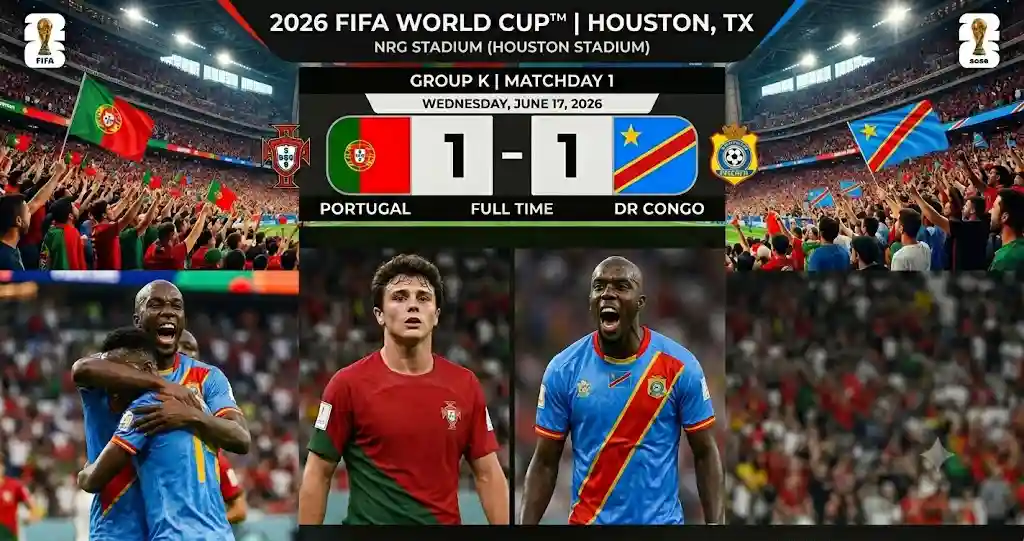
Group K | Matchday 1 | NRG Stadium (Houston Stadium), Houston, Texas June 17, 2026 | Full Time: Portugal 1–1 DR Congo
Result at a Glance
| Portugal | 1 – 1 | DR Congo |
| João Neves 6′ | Yoane Wissa 45+5′ |
| Detail | Info |
|---|---|
| Date | Wednesday, June 17, 2026 |
| Venue | NRG Stadium (Houston Stadium), Houston, Texas |
| Kick-off | 3:00 PM ET / 8:00 PM BST |
| Attendance | ~68,000 |
| Referee | TBC |
| Group | K — Portugal, Colombia, Uzbekistan, DR Congo |
The Match in One Sentence
Portugal dominated this match so completely that the numbers should be displayed as a cautionary exhibit — 75% possession, 2 shots to DR Congo’s 6, xG of 0.07 for the side with the ball and 0.49 for the side that barely had it — and yet when referee’s whistle blew on 95 minutes, the most extraordinary number was the only one that mattered: 1-1.
Match Statistics
| Stat | Portugal | DR Congo |
|---|---|---|
| Goals | 1 | 1 |
| Possession | 75% | 25% |
| Total Shots | 2 | 6 |
| Shots on Target | 1 | 2 |
| Expected Goals (xG) | 0.07 | 0.49 |
| Big Chances Created | 0 | 1 |
| Corners | 1 | 3 |
| Passes Completed | 724 | 197 |
Big Chances Missed | 0 | 0 |
| Offsides | 1 | 1 |
| Yellow Cards | 1 | 1 |
These statistics are simultaneously the most impressive and most damning set of numbers produced by any team in the first week of the 2026 FIFA World Cup. No side has controlled a match more thoroughly on the possession metrics and created less with it. Portugal’s xG of 0.07 from 80% possession across 95 minutes is a figure that will be studied in sports science departments. It means that across an entire match in which they had the ball for four minutes out of every five, they created statistically near-zero genuine goal threat.
Phase-by-Phase Analysis
The Perfect Start That Became a Lie (1–45 minutes)
The first six minutes of Portugal vs DR Congo World Cup 2026 read exactly as the pre-match script predicted. Pedro Neto, operating on the right side of Portugal’s attack, received the ball in space and delivered an outswinging cross toward the back post. João Neves — running from the midfield positions he occupies at PSG — timed his run perfectly and headed cleanly into the far corner.
Portugal made the perfect start when João Neves opened the scoring in the sixth minute, heading home an outswinging cross from Pedro Neto. The goal was briefly reviewed by VAR — a precautionary check for offside in the build-up — and confirmed. Portugal 1-0 DR Congo, six minutes played, everything proceeding to plan.
What followed was one of the great tactical deceptions of the tournament’s opening days. Portugal dominated possession with extraordinary thoroughness. Portugal held 80% of possession and completed 461 passes compared to DR Congo’s 98. Their movement was fluid, their passing was crisp, and their positional organisation was textbook Roberto Martínez — four midfielders interchanging and a fluid front line pressing from high positions.
But they were not creating chances. Beneath the possession statistics lay a fundamental problem: Portugal were moving the ball horizontally and between their defensive midfielders, not vertically into dangerous positions. The passes were safe. The football was attractive in its tidiness. And DR Congo, defending in a compact 4-4-2 block that sat at the edge of their own penalty area, were absorbing it all without being genuinely threatened.
Bruno Fernandes produced a superb pass over the defense in the 19th minute, but Aaron Wan-Bissaka’s timely intervention and quick goalkeeping from Lionel Mpasi denied Nuno Mendes. This moment — Portugal’s only clear second-half type opening in the first 45 minutes — illustrated exactly the problem. When the vertical pass came, it came from a moment of individual quality from Fernandes rather than from systemic pressure. DR Congo’s defensive organisation was good enough to handle isolated moments of quality. It was not designed to handle sustained, structured attack — which Portugal were not producing.
The half-time statistics, though not publicly confirmed at the interval, would tell a story that the naked eye confirmed: Portugal were winning but not in control of the most important part of the match: creating genuine scoring opportunities.
The Catastrophic Final Minutes (45+5′ — Wissa Rewrites History)
The equaliser was so dramatic in timing and so clean in execution that it deserves extended analysis.
DR Congo equalized when Yoane Wissa headed home right on half-time to make it 1-1. A corner was played short, the cross came in, and Wissa was left totally unmarked.
At 90+5′, Yoane Wissa scored, assisted by Arthur Masuaku — a corner played from the left side, Masuaku delivering the cross, Wissa powering home a header to the top left corner.
Let us break down exactly what went wrong in Portugal’s defensive organisation on this corner kick.
DR Congo played the corner short — a deliberate trigger designed to move Portugal’s zonal defenders out of their positions. Masuaku received from the short corner and drove to the byline before delivering a cross that curled toward the near post. Yoane Wissa, the Newcastle United forward, had made his run from a deep starting position, arriving at the near-post delivery zone with momentum while Portugal’s nearest defenders were caught between their zonal assignment and tracking Wissa’s physical run.
The result: Wissa was left totally unmarked as he rose and powered home a header to spark wild celebrations among DR Congo’s fans.
This was the first point DR Congo have ever earned at a World Cup, and they also scored their first-ever goal to spark wild celebrations among their fans.
The historical weight of that goal cannot be overstated. DR Congo’s last World Cup appearance was in 1974 — when they were still known as Zaire. They had returned to the tournament 52 years later, against one of the world’s great football nations, in Houston, and with the last meaningful action of the first half they had equalised. The celebrations on the pitch, in the stands, and in cities across central Africa were instant and overwhelming.
The Second Half: Portugal’s Failure to Respond
If the Wissa equaliser was dramatic, what followed in the second half was the more analytically important part of this match.
Roberto Martínez made an immediate change at half-time, withdrawing Bernardo Silva — who had received a yellow card in the 13th minute and was therefore a booking risk — and replacing him with Francisco Conceição. The adjustment maintained Portugal’s positional structure but added a direct running option that Bernardo, at his best a combination player rather than a penetration runner, does not naturally provide.
Key second-half moments included corners and shots: Portugal took a corner in the 53rd minute through Bruno Fernandes, and DR Congo’s Bakambu had a shot on goal in the 57th minute.
The structure of the second half repeated the pattern of the first: Portugal had the ball, moved it accurately between players, and struggled to penetrate DR Congo’s defensive block. The xG accumulated slowly. The shots on target remained minimal. And DR Congo — now defending a point rather than chasing one — were even more structured and disciplined in their block.
What Portugal needed was directness: plays that committed DR Congo’s defenders to movement and created second-ball situations. What they produced was continuation of the same possession patterns that had generated an xG of 0.07 in the first half.
Cristiano Ronaldo — making history as the oldest outfield player to start a match in FIFA World Cup history at 41 years and 132 days — was increasingly peripheral. His movement into central positions was predictable enough for DR Congo’s centre-backs to read without difficulty. His link-up play was functional but not incisive. The moments of brilliance that have defined his six World Cup campaigns were not forthcoming against a defensive unit this organised.
Tactical Verdict
Roberto Martínez — The Possession Trap
Martínez’s Portugal have been built on total ball dominance — the philosophy that controlling possession means controlling the match. At its best, against less organised defences, this produces the kind of multi-goal victories that Portugal’s qualifying campaign generated.
Against DR Congo’s specific defensive structure — a low 4-4-2 block sitting in two banks of four at the edge of the penalty area, with physical midfielders winning second balls and forwards pressing the initial pass — the possession philosophy produced its worst-case outcome: ball control without penetration.
What Martínez got wrong:
1. No directness when possession failed to unlock the block. There is a moment in matches against low-block defences when a manager must recognise that passing around the block will not break it and must introduce direct runners, longer balls over the top, or wide overloads. Martínez did not make that adjustment until it was too late.
2. Set-piece defensive organisation was inadequate. The Wissa goal was a set-piece defensive failure that was visible in real time. Short-corner plays are a well-known tactical tool at elite level — Portugal’s defensive response to DR Congo’s short corner trigger was insufficiently rehearsed. Wissa arriving unmarked at the near post at the end of a 90-minute match in which Portugal had dominated possession represents an organisational failure that the coaching staff must address before the Colombia fixture.
3. Ronaldo as starter. This is the most uncomfortable tactical question Martínez faces, and the answer the evidence provides is difficult. Ronaldo’s movement was predictable, his positional play was passive in the pressing phase, and his presence in the starting lineup required the team to shape around his needs rather than around the most effective attacking structure available. Francisco Conceição’s impact as a substitute — direct, unpredictable, energetic — raised the question of whether starting him from the beginning would have generated more of the directness Portugal required.
Sébastien Desabre — The Perfect Game Plan
DR Congo’s manager constructed a masterpiece of disciplined organisation against a team that had every statistical advantage. The low 4-4-2 block was compact, well-coordinated, and executed with remarkable discipline.
Aaron Wan-Bissaka, Chancel Mbemba, Steve Kapuadi, and Arthur Masuaku formed a defensive unit that conceded just one goal — from open play — and demonstrated that DR Congo’s European-based defenders are capable of functioning at this level.
The short-corner trigger that produced Wissa’s goal was a designed play. It was recognised, rehearsed, and executed precisely. This was not luck. This was planning.
DR Congo’s xG of 0.49 from just 20% possession is the defining number of the match — they created more genuine scoring opportunities, probabilistically, from two-thirds less ball than Portugal. That is not a statistical quirk. It is a reflection of tactical intelligence and ruthless counter-attacking precision.
Player Ratings
Portugal
| Player | Rating | Assessment |
|---|---|---|
| Diogo Costa | 6.5 | Virtually untested for 85 minutes. Could not stop Wissa’s header — nobody could from that position. |
| João Cancelo | 6.5 | Provided width but failed to deliver crosses that threatened. |
| Rúben Dias | 6.0 | Solid in open play. Exposed on the set-piece that produced the equaliser. |
| Gonçalo Inácio | 6.0 | Comfortable aerially but let Wissa go unmarked at the crucial moment. |
| Nuno Mendes | 7.0 | Portugal’s most dangerous outlet going forward. His run in the 19th minute was their best first-half chance. |
| João Neves | 7.5 ⭐ | Scored the opening goal with an intelligent run and composed header. Covered vast midfield ground. Best Portuguese player. |
| Vitinha | 6.5 | Tidy in possession, rarely penetrating. Embodied the match’s core problem — accurate but unchallenging. |
| Bruno Fernandes | 6.5 | Created the best Portugal moments from open play but yellow card restricted his aggression. |
| Bernardo Silva | 6.0 | Booked early, managed himself cautiously thereafter. Rightly withdrawn at half-time. |
| Pedro Neto | 7.0 | His cross for the Neves goal was perfect. Consistently Portugal’s most direct wide attacker. |
| Cristiano Ronaldo | 5.5 | Increasingly irrelevant as the match progressed. Predictable movement, limited impact on the game’s key moments. History made as oldest outfield World Cup starter — but the performance did not match the occasion. |
DR Congo
| Player | Rating | Assessment |
|---|---|---|
| Lionel Mpasi | 7.5 ⭐ | Made crucial saves, organised his defence, and produced the composed distribution that launched DR Congo’s counter-attacks. Outstanding World Cup debut. |
| Aaron Wan-Bissaka | 8.0 ⭐ | Man of the Match. His recovery tackle denied Nuno Mendes in the 19th minute — the moment that kept DR Congo’s deficit at one. Physical, composed, and intelligent throughout. |
| Chancel Mbemba | 7.0 | Dominant in the air, composed under pressure. Booked for a foul on Neto but overall commanding. |
| Steve Kapuadi | 7.0 | Solid alongside Mbemba. Handled the physical demands of containing Ronaldo. |
| Arthur Masuaku | 7.5 | The corner delivery for Wissa’s goal was perfectly weighted. His set-piece delivery was DR Congo’s most consistent attacking threat. |
| Edo Kayembe | 7.0 | Screened the defensive block, won second balls, and protected the back four’s structure. |
| Samuel Moutoussamy | 6.5 | Physical in midfield, occasionally imprecise in distribution but effective in the defensive role. |
| Ngal’ayel Mukau | 6.5 | Limited with the ball but disciplined out of possession. |
| Cedric Bakambu | 6.5 | Had the best second-half chance from open play. Link-up play was useful. |
| Yoane Wissa | 8.0 ⭐ | The goal. The moment. 52 years in the making. His movement from deep, the timing of his run, the precision of the header — all perfect. DR Congo’s most important footballer in this match. |
The Historical Significance
This was the first point DR Congo have ever earned at a World Cup, as they also scored their first-ever goal.
DR Congo — the Leopards — last appeared at a World Cup in 1974, when they were still playing as Zaire. In that tournament, they lost all three group-stage matches and conceded 14 goals, including a 9-0 defeat to Yugoslavia. The memory haunted central African football for 52 years.
On June 17, 2026, in Houston, Texas, Yoane Wissa headed a ball into the top corner of Diogo Costa’s goal in the fifth minute of added time. The celebrations in the stadium, in Kinshasa, in every city across the Democratic Republic of Congo, lasted long after the final whistle.
This point — this single, hard-earned, magnificent point — is DR Congo’s greatest result in World Cup history. The goal-scoring record, the first point ever, the performance against a team ranked in the world’s top five — all of it achieved through discipline, organisation, and one moment of perfect set-piece execution.
Group K Implications
| Team | Played | W | D | L | GF | GA | GD | Pts |
|---|---|---|---|---|---|---|---|---|
| Portugal | 1 | 0 | 1 | 0 | 1 | 1 | 0 | 1 |
| DR Congo | 1 | 0 | 1 | 0 | 1 | 1 | 0 | 1 |
| Colombia | 0 | — | — | — | — | — | — | 0 |
| Uzbekistan | 0 | — | — | — | — | — | — | 0 |
Portugal’s failure to win this match means they now face Colombia — a significantly stronger Group K opponent — in a must-win situation. The Uzbekistan fixture closes the group, but a draw against Colombia would leave Portugal’s qualification dependent on goal difference calculations.
For DR Congo, the point against Portugal and the goal by Wissa changes their entire Group K arithmetic. Beating Uzbekistan — scheduled for June 27 — would put them in genuine contention for a third-place berth in the expanded 48-team format.
Post-Match Quotes
Roberto Martínez (Portugal Manager): “We controlled the game completely. But control of possession is not control of the result, and tonight we learned that lesson in a painful way. Wissa’s goal was an excellent set-piece goal and we must take full responsibility for allowing it. The group is still very open and we have two matches to put this right.”
Sébastien Desabre (DR Congo Manager): “My players were extraordinary. To defend like that, against Portugal, with that quality and that discipline — I am so proud. Yoane’s goal was magnificent. But this was a team goal. All 11 players gave everything for 95 minutes.”
Yoane Wissa (DR Congo): “I cannot describe what I feel. To score like that, at the World Cup, for my country — it’s the greatest moment of my life.”
Cristiano Ronaldo (Portugal): “We are disappointed. We controlled the match and deserved more. But this is football. We have two more games and we will qualify.”
“Ronaldo’s Last Dance? A Complete Tactical Breakdown of FIFA World Cup 2026 Group K”
The Final Assessment
This match will be studied in tactical coaching courses for years. Portugal vs DR Congo World Cup 2026 is the definitive modern illustration of a truth that every football analyst already understands but that the numbers here make impossible to dismiss: possession is a means, not an end. xG is a better predictor of results than ball retention. A team with 20% possession and disciplined defensive structure can, with one designed set-piece play, take a point from a team that controlled four-fifths of the ball.
Portugal will recover. Their squad depth, their attacking quality, and the motivation Martínez will bring to the Colombia preparation are real advantages. Cristiano Ronaldo will be managed. The set-piece defensive organisation will be fixed.
But DR Congo’s point stands. Yoane Wissa’s header stands. The wild celebrations in Kinshasa stand.
And for one night in Houston, Texas, at the 2026 FIFA World Cup, the Democratic Republic of Congo proved something that no possession statistic can disprove: you do not need the ball to win football matches.
Sometimes you just need one corner.
▪️▪️ Follow us on Facebook▪️▪️
.
.
About the Author