WAFCON 2026: A Tournament That Changed African Women’s Football
WAFCON 2026 will be remembered as one of the most unpredictable and significant editions in the history of the Women’s Africa Cup of Nations. Cameroon finally lifted the continental trophy for the first time, while Malawi went from tournament debutants to finalists in one of the greatest underdog stories African football has produced.
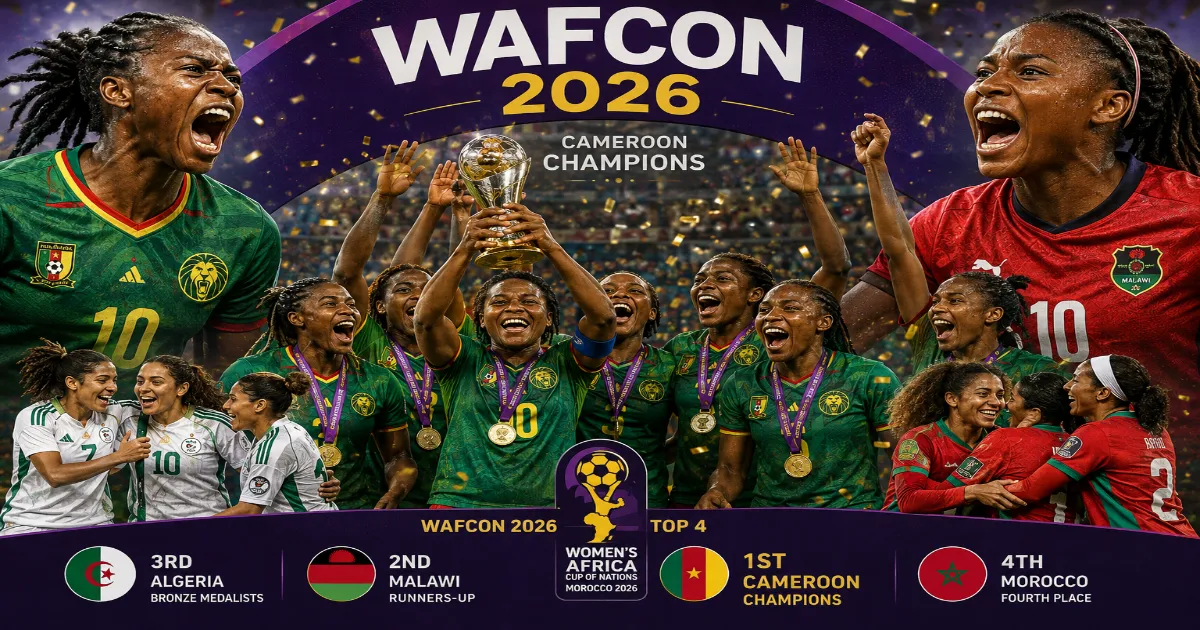
The tournament also produced a historic top four. Cameroon became champions, Malawi finished runners-up, Algeria won the bronze medal and hosts Morocco ended the competition in fourth place.
What made the tournament even more remarkable was the absence of several traditional powers from the final four. Nigeria, the record 10-time champions and defending title holders, were eliminated in the quarter-finals. South Africa, champions in 2022, also failed to reach the semi-finals.
Instead, WAFCON 2026 introduced a different picture of African women’s football. Emerging teams showed that reputation alone was no longer enough, while established nations discovered that the gap between the continent’s traditional giants and rising challengers is becoming smaller.
For Cameroon, it was the completion of a journey that had lasted decades. For Malawi, it was the beginning of something potentially much bigger.
WAFCON 2026 Format and Tournament Background
The 2026 Women’s Africa Cup of Nations was played in Morocco from July 26 to August 16. It was the first edition to feature 16 teams, with the participating nations divided into four groups of four.
The expansion gave more African nations the opportunity to compete at the continental level and also created a longer route toward the knockout stages. The top two teams from each group advanced to the quarter-finals.
The four semi-finalists also secured qualification for the 2027 FIFA Women’s World Cup in Brazil. That made the quarter-finals particularly important because reaching the last four meant more than competing for the continental championship — it guaranteed a place on football’s biggest international stage.
The groups contained several familiar names. Hosts Morocco were drawn with Algeria, Senegal and Kenya, while South Africa faced Côte d’Ivoire, Burkina Faso and Tanzania. Defending champions Nigeria were placed alongside Zambia, Egypt and debutants Malawi, while Ghana, Cameroon, Mali and debutants Cape Verde made up Group D.
On paper, the tournament appeared to have a familiar hierarchy. Nigeria, South Africa and Morocco were expected to challenge for the title, while Zambia, Ghana and Cameroon were regarded as potential semifinal contenders.
What happened instead was considerably more dramatic.
Group Stage: The First Signs of a New WAFCON
The group stage immediately produced results that suggested WAFCON 2026 would not follow the expected script.
Hosts Morocco began their campaign strongly, defeating Kenya 4-0. The result immediately created excitement among home supporters, who were hoping that Morocco could finally go one step further after finishing runners-up in previous editions.
Algeria also made a strong start, defeating Senegal 2-0 and showing that they were capable of competing with some of the continent’s more established teams.
But the biggest story of the opening round came from Malawi.
Malawi Shock Ten-Time Champions Nigeria
Malawi were playing in their first-ever WAFCON finals tournament. Their first opponent was defending champions Nigeria, who had won the competition a record 10 times.
Almost nobody expected the debutants to win.
Malawi, however, produced one of the biggest shocks in WAFCON history by defeating Nigeria 3-2.
The Chawinga sisters were at the heart of the victory. Temwa Chawinga scored twice, while Tabitha Chawinga also found the net as Malawi took a stunning 3-1 lead before Nigeria attempted a late comeback.
Nigeria managed to reduce the deficit, but Malawi held on.
The result was more than three points. It immediately transformed Malawi’s tournament from a historic first appearance into a genuine competitive campaign.
For Nigeria, it was a warning that their reputation would not be enough to defend the title.
Malawi Turn the Shock Into a Campaign
One of the biggest questions after Malawi defeated Nigeria was whether the result had been a one-off.
The Scorchers answered that question quickly.
They defeated Egypt 3-1 in their second group match, with Temwa Chawinga once again playing a major role. Malawi displayed confidence, attacking intent and the ability to recover quickly when opponents attempted to control the game.
Two wins from two matches put Malawi in an excellent position to reach the knockout stages.
Even after losing to Zambia in their final group match, Malawi progressed to the quarter-finals.
The achievement was already extraordinary.
A nation making its WAFCON debut had not simply survived the group stage. It had finished among the tournament’s strongest teams and had eliminated one of the biggest names in African women’s football from the position of defending champion.
Cameroon Begin Their Road to History
Cameroon entered WAFCON 2026 with a very different background.
The Indomitable Lionesses had a long history at the tournament and had reached the final several times without winning the trophy.
That history created a sense that Cameroon were one of the continent’s great teams still waiting for their defining moment.
They began their campaign with a 2-1 victory over Mali and followed it with another important win against Ghana.
Marie Ngah became one of the key attacking figures for Cameroon during the group stage, while veteran Gabrielle Aboudi Onguéné provided experience and leadership.
Onguéné also made history by appearing at her eighth WAFCON tournament at the age of 37.
Cameroon progressed from Group D and entered the knockout stage with genuine belief.
The question was whether they could finally turn their long history of near misses into a championship.
Morocco Give the Home Fans Hope
Morocco carried enormous expectations into the tournament.
The hosts had reached the final in 2022 and again in 2024, but had been unable to win the trophy.
Playing at home created an additional layer of pressure.
Their campaign began brilliantly with a 4-0 victory over Kenya. They then defeated Algeria 1-0 before drawing 0-0 with Senegal.
The results gave Morocco the top spot in their group and, importantly, they completed the group stage without conceding.
The defensive performances created belief that this could finally be Morocco’s year.
The Atlas Lionesses then faced South Africa in the quarter-finals.
It was one of the most anticipated matches of the knockout stage because South Africa had defeated Morocco in the 2022 final.
This time, Morocco won.
Quarter-Finals: The Tournament Turns Upside Down
The quarter-finals provided the clearest evidence that the established order was changing.
Algeria defeated Côte d’Ivoire 2-1 to reach their first WAFCON semi-final.
Morocco defeated South Africa 2-1, eliminating the 2022 champions.
Cameroon defeated Nigeria 1-0 in one of the tournament’s most important matches.
And Malawi continued their remarkable run by defeating Ghana 2-1.
Four teams remained.
None of them had won the previous edition.
Two had never won the competition.
One had never even reached the WAFCON finals before 2026.
The tournament had completely changed direction.
Cameroon Eliminate Nigeria
Cameroon versus Nigeria was arguably the most important quarter-final.
Nigeria had dominated this fixture historically and had built an extraordinary record at WAFCON.
The Super Falcons were also the defending champions.
Cameroon, however, refused to be intimidated by history.
The Indomitable Lionesses won 1-0 and eliminated Nigeria.
The result sent Cameroon into the semi-finals while ending Nigeria’s title defence.
Goalkeeper Michaely Bihina was one of the major reasons Cameroon survived. Her performance under pressure gave the team the confidence to defend their narrow advantage.
For Nigeria, it was a hugely disappointing tournament.
For Cameroon, it was the moment when the possibility of becoming champions began to feel real.
Malawi Defeat Ghana to Keep the Dream Alive
Malawi’s quarter-final against Ghana was another major test.
Ghana had considerable experience at the tournament and had been expected to challenge for the semi-finals.
Malawi again showed that they were not simply relying on momentum.
They recovered from difficult moments and defeated Ghana 2-1.
The result sent Malawi into the semi-finals and guaranteed them qualification for the 2027 Women’s World Cup.
For a nation playing at its first WAFCON, this was already an extraordinary achievement.
But Malawi were not finished.
They now had a chance to reach the final.
Algeria Complete a Historic Quarter-Final
Algeria had quietly developed into one of the tournament’s most impressive sides.
Their quarter-final against Côte d’Ivoire was another test of their defensive discipline and ability to perform under pressure.
Algeria won 2-1 and secured a place in the semi-finals.
The result guaranteed Algeria their first-ever appearance in the final four of WAFCON and also secured a place at the 2027 Women’s World Cup.
Their progress was particularly important because Algeria had not entered the tournament with the same level of attention as Morocco, Nigeria or South Africa.
By the end of the quarter-finals, however, they had become one of the teams everyone was watching.
Morocco Defeat South Africa
Morocco’s victory over South Africa was perhaps the most emotional quarter-final for the hosts.
South Africa had defeated Morocco in the 2022 final, and the memory of that loss had remained part of the Atlas Lionesses’ story.
Four years later, Morocco got their revenge.
A 2-1 victory sent Morocco into their third consecutive WAFCON semi-final.
The home crowd believed the trophy was finally within reach.
But Cameroon stood between Morocco and the final.
Semi-Final 1: Malawi 3-1 Algeria
The first semi-final produced another chapter in Malawi’s extraordinary story.
Algeria had already achieved their best-ever WAFCON result by reaching the last four.
Malawi, however, had something even bigger in mind.
The Scorchers defeated Algeria 3-1 to reach the final.
Once again, the Chawinga sisters were central to the story.
Their attacking movement, pace and finishing caused problems throughout the match, while Malawi’s overall confidence was remarkable considering the magnitude of the occasion.
The victory made Malawi the first Southern African team to reach the WAFCON final on their debut.
The impossible was suddenly one match away.
Semi-Final 2: Cameroon Survive Morocco
The second semi-final was far more defensive.
Morocco had home advantage, while Cameroon had just eliminated Nigeria.
Neither team wanted to make the mistake that would end their tournament.
After 90 minutes, the match remained goalless.
Extra time produced no breakthrough either.
The final would therefore be decided by penalties.
Cameroon goalkeeper Michaely Bihina once again became the hero.
She produced crucial saves during the shootout as Cameroon eventually won 3-1 on penalties.
Morocco’s dream of winning the tournament at home was over.
Cameroon, meanwhile, were heading into their fourth WAFCON final.
This time, they had a chance to change their history.
Third-Place Playoff: Algeria Win Bronze
Morocco still had one final opportunity to finish the tournament with a medal.
They faced Algeria in the third-place playoff.
The match finished 1-1 after regulation time, meaning penalties were again required.
Algeria held their nerve and won the shootout 3-2.
The victory gave Algeria their first-ever WAFCON bronze medal.
For a team that had entered the tournament hoping to make progress, finishing third represented an enormous breakthrough.
Algeria also secured their place at the 2027 Women’s World Cup.
Morocco finished fourth, but their tournament still represented another significant step forward.
WAFCON 2026 Final: Cameroon vs Malawi
The final brought together two nations with completely different histories.
Cameroon had reached three previous WAFCON finals and lost all three.
Malawi were playing in their first-ever WAFCON tournament.
The final therefore represented both redemption and fairytale.
Cameroon had spent decades waiting for the trophy.
Malawi had spent just a few weeks creating one of the greatest stories in African women’s football.
The match, however, quickly moved in Cameroon’s direction.
Marie Ngah Gives Cameroon the Lead
Cameroon opened the scoring in the 20th minute.
Marie Ngah found the breakthrough and immediately changed the atmosphere of the final.
Malawi had spent the tournament playing aggressive attacking football, but conceding first against an experienced Cameroon side created a completely different challenge.
The Scorchers now had to chase the match.
Cameroon, meanwhile, could use their defensive organisation and experience to control the game.
Naomi Ndjoah Eto Doubles the Advantage
Cameroon scored again just 10 minutes later.
Naomi Ndjoah Eto made it 2-0 after combining with Myriam Nyadjou.
The second goal gave Cameroon a huge psychological advantage.
Malawi had fought back from difficult situations throughout the tournament, but the final was becoming increasingly difficult to rescue.
Cameroon were not allowing the Chawinga sisters the same space they had enjoyed in previous matches.
Ngah Strikes Again Before Half-Time
Cameroon delivered the decisive blow just before the interval.
Ndjoah Eto turned provider for Marie Ngah, who scored again in stoppage time.
Cameroon went into half-time leading 3-0.
The final had effectively been decided in the opening 45 minutes.
Malawi had produced an incredible tournament, but Cameroon were now 45 minutes away from ending decades of frustration.
The second half did not change the outcome.
Cameroon maintained control and eventually won 3-0.
Cameroon Are Finally African Champions
The victory was historic.
Cameroon had reached three previous WAFCON finals and lost every one.
They had fallen short in 2004, 2014 and 2016.
For years, they had been regarded as one of Africa’s strongest women’s teams without possessing the trophy to confirm that status.
WAFCON 2026 finally changed that.
Cameroon became champions of Africa for the first time.
The 3-0 final victory also provided a fitting conclusion to a tournament built around unexpected results.
WAFCON 2026 Top Four
1. Cameroon — Champions
Cameroon were the best team when it mattered most.
Their tournament journey included a strong group stage, a 1-0 quarter-final victory over Nigeria, a penalty-shootout win over Morocco and a dominant 3-0 final victory against Malawi.
Their defensive organisation was one of their biggest strengths.
Bihina provided outstanding goalkeeping at crucial moments, while Marie Ngah became one of the most important attacking players of the tournament.
Most importantly, Cameroon combined experience with the hunger created by years of final defeats.
This time, they did not let the opportunity disappear.
2. Malawi — Runners-Up
Malawi were undoubtedly the tournament’s biggest surprise.
They entered WAFCON 2026 as debutants and left as finalists.
They defeated Nigeria, overcame Egypt, eliminated Ghana and then beat Algeria before finally losing to Cameroon.
The Chawinga sisters became the faces of their historic campaign.
Malawi did not win the trophy, but their achievement could have a lasting impact on women’s football in the country.
They qualified for their first Women’s World Cup and proved that emerging African nations can compete against the continent’s traditional giants.
3. Algeria — Bronze Medalists
Algeria produced their best-ever WAFCON performance.
They reached the semi-finals for the first time, secured World Cup qualification and then defeated Morocco in the third-place playoff.
Their defensive organisation and ability to remain competitive in close matches were central to their success.
The bronze medal could represent the beginning of a new era for Algerian women’s football.
4. Morocco — Fourth Place
Morocco entered WAFCON 2026 with hopes of winning their first continental title.
They started strongly and defeated South Africa in the quarter-finals, but their campaign ended with a penalty-shootout loss to Cameroon.
The hosts then lost to Algeria in the third-place playoff.
Fourth place was disappointing given the expectations, but Morocco still reached the semi-finals for the third consecutive edition and qualified for the 2027 Women’s World Cup.
What Happened to Nigeria and South Africa?
The absence of Nigeria and South Africa from the top four was one of the biggest stories of WAFCON 2026.
Nigeria entered as defending champions and record 10-time winners.
Their shock defeat to Malawi in the group stage immediately put them under pressure. Although they recovered and progressed to the knockout stages, Cameroon eliminated them in the quarter-finals.
South Africa also failed to reach the semi-finals.
The reigning 2022 champions were defeated by Morocco in the quarter-finals.
Their exits demonstrated that the competition is becoming more competitive.
Winning previous tournaments no longer guarantees success in the next one.
The Chawinga Sisters: The Faces of Malawi’s Fairytale
Tabitha and Temwa Chawinga were two of the biggest stars of WAFCON 2026.
Their performances gave Malawi an attacking identity and helped the Scorchers defeat opponents that had considerably more tournament experience.
Their influence extended beyond goals.
They provided confidence to teammates and repeatedly gave Malawi a threat in transition.
Although Cameroon ultimately stopped their run in the final, the sisters helped establish Malawi as a team that can no longer be underestimated.
Michaely Bihina: Cameroon’s Tournament Hero
If the Chawinga sisters represented Malawi’s attacking brilliance, Michaely Bihina represented Cameroon’s defensive strength.
Her performance against Nigeria was one of the most important individual displays of the tournament.
She made crucial saves to preserve Cameroon’s 1-0 advantage and then delivered again during the penalty shootout against Morocco.
Goalkeepers rarely receive as much attention as goalscorers, but Bihina’s contribution was fundamental to Cameroon’s championship.
Without her performances at key moments, Cameroon may never have reached the final.
WAFCON 2026 and the 2027 Women’s World Cup
One of the biggest consequences of the tournament is the impact it will have on the 2027 Women’s World Cup.
Cameroon, Malawi, Algeria and Morocco all secured their places in Brazil by reaching the WAFCON semi-finals.
For Malawi and Algeria, this is particularly historic.
Both nations will enter the Women’s World Cup with a new level of international experience and confidence.
Cameroon will return to the global stage with the belief of continental champions, while Morocco will look to build on their previous World Cup experience.
The tournament therefore did more than crown a champion.
It helped create the next generation of African women’s football contenders.
Why WAFCON 2026 Could Be a Turning Point
The biggest lesson from WAFCON 2026 is that African women’s football is becoming deeper.
Nigeria remain the most successful nation in WAFCON history, but their dominance is no longer enough to guarantee another title.
South Africa have emerged as a major power in recent years.
Morocco have reached consecutive finals and now multiple semi-finals.
Cameroon have finally converted their potential into a championship.
Algeria have reached the podium.
Malawi have reached the final on debut.
That variety is exactly what a growing continental competition needs.
Final Verdict: A New Era for African Women’s Football
WAFCON 2026 was about much more than Cameroon’s first title.
It was a tournament of changing expectations.
Nigeria, the record champions, were eliminated before the semi-finals. South Africa also failed to reach the final four. Morocco’s home advantage was not enough to deliver the trophy.
Instead, Cameroon finally broke their final curse, Malawi produced one of the greatest underdog runs in WAFCON history, and Algeria claimed their first continental bronze medal.
The final provided the perfect ending.
Cameroon scored three times before half-time, controlled the second half and defeated Malawi 3-0 to become African champions for the first time.
For Cameroon, it was redemption after decades of disappointment.
For Malawi, it was the beginning of a new football story.
For Algeria, it was proof that their women’s team belongs among Africa’s elite.
For Morocco, it was another step in a continuing rise.
And for the continent as a whole, WAFCON 2026 delivered perhaps its most important message yet:
African women’s football is no longer dominated by a small group of traditional powers. The gap is closing, the competition is growing, and a new generation of teams is ready to challenge for the biggest prizes.
PSG v Arsenal: How Paris Won the Champions League Final on Penalties
🔹🔹 follow us on facebook 🔹🔹
About the Author







1 thought on “WAFCON 2026: Cameroon Champions, Malawi Runners-Up and the Biggest Surprises”