 Football’s Greatest Club Dynasties, Ranked From Great to Untouchable
From Total Football to tiki-taka, these are the club dynasties that didn’t just win trophies, they changed how the game itself is played.
Winning a single trophy is an achievement. Winning consistently, across multiple seasons, with a style of play that reshapes how the entire sport is coached and played, is something else entirely. This is a ranking of football’s greatest club dynasties, judged not just on the sheer volume of silverware collected, but on how completely each one dominated its era and how lastingly it influenced the game that followed.
Messi Retires: Inside the Rise, Falls, and Redemption of a Legend
10. Manchester United (1993–2013)
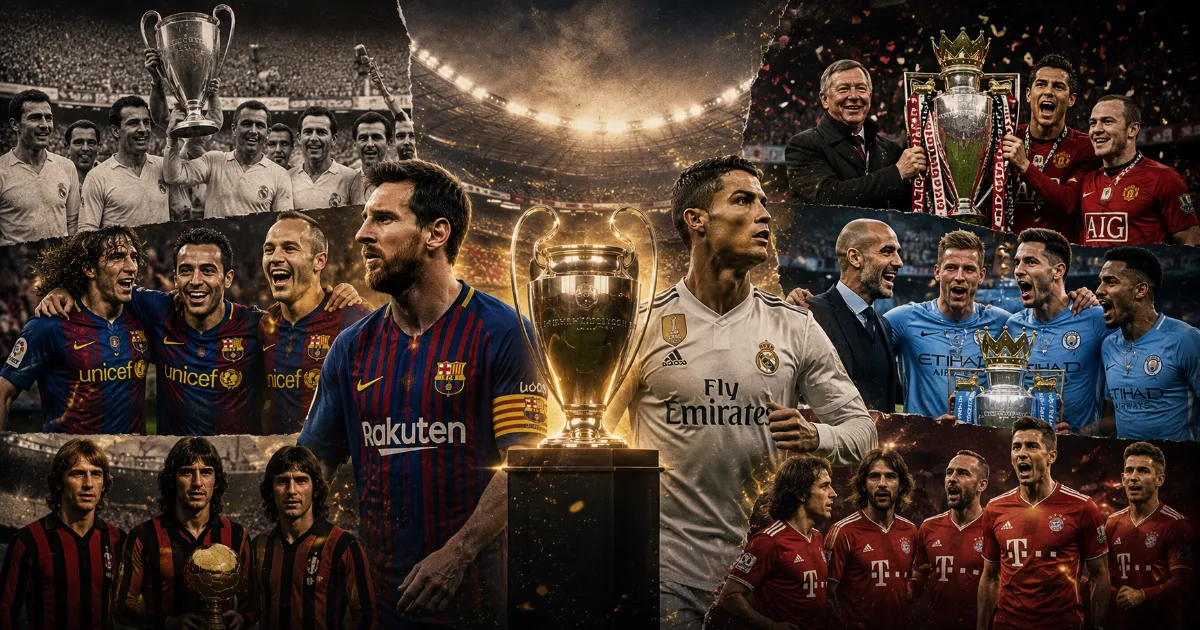
Alex Ferguson’s two-decade reign at Manchester United produced 13 Premier League titles and two Champions League triumphs, built across multiple distinct generations of players, from Eric Cantona and the famed Class of ’92 through to Cristiano Ronaldo and Wayne Rooney. What separates United’s dynasty from a simple accumulation of talent was Ferguson’s ability to continually rebuild and refresh a winning culture across 20 years, a feat of sustained man-management and squad renewal that few other managers in football history have come close to matching over such an extended period.
9. Bayern Munich (1970s and 2010s–Present)
Bayern Munich’s dynasty arguably comes in two distinct waves separated by decades. The club’s early 1970s squad, built around Franz Beckenbauer and Gerd Müller, won three consecutive European Cups, establishing Bayern as continental football’s dominant force during that era. More recently, Bayern’s near-total domestic dominance of the Bundesliga throughout the 2010s and into the 2020s, punctuated by their 2020 Champions League and Club World Cup treble under Hansi Flick, cemented the club’s status as arguably the most consistently successful domestic institution anywhere in modern European football, even if their more recent continental success has proven less predictable than their overwhelming domestic authority.
8. Liverpool (1970s–1980s)
Liverpool’s late-1970s and 1980s dynasty, built under successive managers Bob Paisley, Joe Fagan, and Kenny Dalglish, delivered an extraordinary run of English league titles alongside four European Cup triumphs across just eight seasons. That sustained continental success, achieved through a specific club philosophy often described as “the boot room,” a continuity of coaching staff and playing style passed down through successive managerial appointments, gave Liverpool’s dynasty a institutional stability that few rival clubs of the era could match, even as the tragic events at Heysel in 1985 brought an abrupt and painful end to the club’s period of European dominance.
7. PSG (2011–Present)
Paris Saint-Germain’s dynasty represents a fundamentally different model from every other entry on this list, built almost entirely on the financial power of Qatari state-backed ownership rather than organic footballing development or a distinctive playing philosophy. Since the Qatar Sports Investments takeover in 2011, PSG has established near-total dominance of Ligue 1, assembling squads featuring some of the most expensive individual talents in football history, including Neymar and Kylian Mbappé simultaneously for several seasons. The club’s continued pursuit of Champions League success, finally achieved in 2024-25 under manager Luis Enrique, adds a genuine footballing chapter to a dynasty that had, for over a decade, been defined primarily by financial dominance rather than continental silverware.
6. Manchester City (2016–Present)
Manchester City’s dynasty under Pep Guardiola represents the most tactically influential domestic era of the modern Premier League, built on positional play principles that reshaped how English football’s biggest clubs approach possession, pressing, and squad rotation. City’s remarkable 2022-23 treble, claiming the Premier League, FA Cup, and Champions League in a single season, stands as the definitive validation of Guardiola’s methods, backed by Abu Dhabi United Group ownership that provided the financial resources necessary to assemble and continually refresh a squad capable of sustaining Guardiola’s demanding tactical system across an entire decade of domestic dominance.
5. Ajax (1970s)
Ajax’s early 1970s dynasty, built around Johan Cruyff and managed by the visionary Rinus Michels, produced three consecutive European Cup titles between 1971 and 1973, but the club’s true legacy lies in the “Total Football” philosophy it pioneered, a fluid, interchangeable positional system in which outfield players could seamlessly swap roles across the pitch depending on the flow of play. That underlying tactical philosophy proved vastly more influential than the trophies themselves, directly shaping Cruyff’s own later work as Barcelona manager and, through that lineage, the entire tiki-taka movement that would go on to dominate Spanish and international football decades later.
4. AC Milan (1988–1994)
Arrigo Sacchi’s AC Milan side of the late 1980s, later continued under Fabio Capello into the early 1990s, is frequently cited by football historians as one of the most tactically revolutionary club sides ever assembled, built around a coordinated zonal marking system, aggressive collective pressing, and a compact defensive structure that fundamentally departed from Italian football’s traditionally more individualistic, man-marking defensive culture. Built around the legendary Dutch trio of Marco van Basten, Ruud Gullit, and Frank Rijkaard, Milan won back-to-back European Cups in 1989 and 1990, and later completed an entire unbeaten Serie A season under Capello in 1991-92, a run of dominance that reshaped Italian football’s tactical culture for a generation of coaches who followed.
3. Bayern Munich, Real Madrid, and the Modern Continental Arms Race
Rather than a single club, this entry acknowledges the broader dynasty of financial and structural dominance that has come to define Champions League qualification and success over the past fifteen years, with a handful of super-clubs, chiefly Real Madrid, Bayern Munich, and Barcelona during their peak years, systematically outspending and outperforming the rest of European football to the point where genuine surprise semifinalists have become considerably rarer than in previous decades. This collective dynasty of financial concentration, rather than any single club’s specific tactical innovation, represents one of the most consequential structural shifts in the sport’s modern history, reshaping European competition itself around a small, largely fixed group of elite institutions.
2. FC Barcelona (2008–2012)
Pep Guardiola’s Barcelona squad, built around homegrown talents Lionel Messi, Xavi Hernández, and Andrés Iniesta, produced arguably the most complete and influential single-club dynasty of the modern era, winning fourteen trophies across just four seasons, including two Champions League titles and three La Liga championships. The tiki-taka philosophy this squad perfected, an evolution of Cruyff’s original Total Football principles filtered through decades of La Masia academy development, became the single most imitated tactical system in world football for the better part of a decade, studied and partially replicated by coaches and national teams across the globe, including the Spanish national team’s own historic run of three consecutive major tournament titles built on largely the same core group of players.
1. Real Madrid (1950s and 2014–2018)
Real Madrid earns the top spot on this list through two entirely distinct but equally dominant periods separated by more than six decades. The club’s original 1950s dynasty, built around Alfredo Di Stéfano and Ferenc Puskás, won the first five editions of the European Cup, establishing continental dominance so complete that it directly shaped the competition’s early prestige and identity. More recently, Real Madrid’s 2014 to 2018 stretch delivered four Champions League titles in five seasons, including an unprecedented three consecutive triumphs between 2016 and 2018, built around Cristiano Ronaldo’s era-defining goalscoring form and a squad specifically assembled and managed to prioritize knockout-stage continental success above all else. No other club in football history has produced two entirely separate periods of continental dominance this complete, separated by such an enormous span of time, a testament to Real Madrid’s uniquely sustained institutional commitment to prioritizing the Champions League above every other competition.
What Separates a Dynasty From a Great Team
Looking across this ranking, a clear pattern emerges distinguishing a genuine dynasty from simply a great team enjoying a strong run of results. Every entry on this list combines sustained success across multiple seasons with a genuine, lasting influence on how the broader sport is played or structured, whether that’s Ajax and Barcelona’s shared tactical lineage, AC Milan’s zonal marking revolution, or the financial models pioneered by PSG and Manchester City that other ambitious clubs around the world have since attempted to replicate. A single golden generation or one exceptional season, however spectacular, doesn’t earn a place among football’s true dynasties. What does is the rarer combination of sustained trophy-winning success and a genuine, lasting fingerprint left on how the sport itself subsequently evolved.
Honorable Mentions Just Outside the List
Several other club eras deserve at least a mention, even if they narrowly missed inclusion in the main ranking. Nottingham Forest’s remarkable back-to-back European Cup triumphs in 1979 and 1980 under Brian Clough remain one of the most improbable dynasties in football history, achieved by a provincial English club with a fraction of the resources available to the continent’s traditional powers, a feat considered by many football historians to be essentially unrepeatable in the modern financial landscape of the sport. Juventus’s dominant Serie A run through the 2010s, winning nine consecutive league titles between 2012 and 2020, represents one of the most sustained periods of purely domestic dominance any club has produced anywhere in Europe, even though the club’s continued pursuit of a corresponding Champions League triumph during that same stretch repeatedly fell short.
Porto’s 2003-04 Champions League triumph under a young José Mourinho, while not a sustained multi-season dynasty in the traditional sense, deserves recognition for how directly it launched Mourinho’s subsequent managerial career and indirectly influenced the broader tactical trends of counter-attacking, defensively disciplined football that several major European clubs would go on to adopt during the following decade. And Celtic’s 1967 European Cup triumph, achieved with a squad composed entirely of players born within roughly 30 miles of the club’s Glasgow home stadium, remains a genuinely unique achievement in continental football history, one that stands as a reminder of just how differently the sport’s financial and recruitment landscape once operated compared to today’s globally sourced squads.
Why Dynasties Have Become Harder to Build
One of the more interesting questions raised by compiling a list like this is whether football’s modern financial landscape makes building a genuine dynasty easier or harder than in previous eras. On one hand, the enormous financial resources now available to a handful of state-backed or otherwise extraordinarily wealthy clubs, PSG and Manchester City chief among them, arguably make sustained domestic dominance more achievable than ever, since these clubs can simply outspend nearly every domestic rival on player wages and transfer fees year after year. On the other hand, the sheer strength and increasing financial depth of European football’s broader elite tier, now numbering considerably more genuine Champions League contenders than existed during Ajax’s or Liverpool’s respective eras of continental dominance, has arguably made sustained continental success considerably harder to achieve consistently across multiple seasons, even for the sport’s wealthiest and most tactically sophisticated institutions.
This tension helps explain why so many entries on this list cluster around either significantly older eras, when a handful of clubs faced considerably less competitive depth across the wider continental field, or the specific financial arms race of the post-2010 period, when a small number of extraordinarily well-resourced clubs have been able to simply outspend the traditional football establishment. Genuine, sustained dynasties built purely on organic footballing development without either historically shallow continental competition or extraordinary modern financial backing, Ajax’s Total Football side representing perhaps the purest example, have become increasingly rare, a reflection of just how much more competitively and financially complex the sport has become since football’s earliest decades of continental competition.
The Dynasties Still Being Written
Whether any current club era eventually earns a place on future versions of this list remains an open question that will likely take years, if not decades, to properly answer. Manchester City’s continued domestic dominance under Guardiola, PSG’s ongoing pursuit of sustained continental success following their long-awaited 2024-25 Champions League triumph, and Real Madrid’s ability to continually reload with new generational talent whenever an era-defining player like Ronaldo eventually departs, all represent genuine candidates for future inclusion, pending how completely and how lastingly their respective eras of success ultimately reshape the broader sport around them. That uncertainty is, in many ways, exactly what makes ranking football’s greatest dynasties such a compelling and endlessly debatable exercise, since the full weight of any single era’s true influence often only becomes fully clear with the benefit of considerable historical hindsight.
How to Judge a Dynasty That’s Still Unfolding
Part of what makes evaluating an active club’s claim to dynasty status so difficult is that trophies alone rarely tell the full story until years, sometimes decades, after the fact. Manchester United’s Ferguson era wasn’t fully appreciated as a genuine dynasty until well after its conclusion, once football writers and analysts had the benefit of comparing its sustained 20-year run against the shorter, more fragile periods of dominance enjoyed by nearly every subsequent Premier League title challenger. Similarly, Guardiola’s Barcelona side wasn’t immediately recognized in real time as more tactically influential than, say, José Mourinho’s contemporaneous Inter Milan treble-winning squad of 2010, until tiki-taka’s broader influence on global coaching became fully apparent over the following decade.
This lag between a dynasty’s active period of dominance and its eventual historical recognition is worth keeping in mind whenever more recent entries on this list, particularly Manchester City’s ongoing Guardiola era and PSG’s still-developing continental ambitions, are evaluated against the older, more historically settled dynasties further down this ranking. Some current eras of dominance may well be remembered decades from now as considerably more influential than they currently appear, while others may fade in historical significance once football’s tactical trends move on to newer, as yet unforeseen innovations. That inherent uncertainty is simply part of what makes attempting to rank football’s dynasties, rather than merely listing its most decorated clubs, such a genuinely difficult and endlessly rewarding exercise for anyone who takes the sport’s history seriously.
▪️▪️ Follow us on Facebook ▪️▪️
The Maracanazo: How Uruguay Silenced 200,000 Brazilians in 1950
About the Author