“Wait, Is the Match Today or Tomorrow?” — Welcome to World Cup 2026
If you’ve spent the last few days staring at your phone, switching between three different apps, and still ended up confused about whether tonight’s match starts at 9 PM or 7 AM — you are not alone. You are, in fact, in very good company. The 2026 FIFA World Cup is the first tournament in history to be hosted across three countries at once — the United States, Mexico, and Canada — and that single fact is the root cause of almost every scheduling headache fans around the world are currently experiencing.
This article is here to fix that. By the end of it, you’ll understand exactly why World Cup 2026 time zone schedule confusion is happening, how to read any match time you see online, and — most importantly — how to convert any US kickoff time into the time you’ll actually be watching it in India or wherever you happen to be.
No jargon. No complicated formulas. Just a simple system that, once you understand it, you’ll never have to think about again.
First, the Big Picture: 104 Matches, 39 Days, 16 Cities
Let’s set the scene properly. The 2026 World Cup features 104 total matches in the expanded 48-team format — 72 group stage matches from June 11 to 26, 16 Round of 32 matches, 8 Round of 16 matches, 4 quarterfinals, 2 semifinals, and the final on July 19.
The tournament begins with the opening match in Mexico City at 1 PM local time on June 11, 2026, and concludes with the final at 3 PM local time in New Jersey on July 19, 2026 — a span of 39 days.
The tournament is co-hosted by three countries: the United States with 11 venues, Mexico with 3 venues, and Canada with 2 venues — marking the first time three nations have shared hosting duties, and the first-ever 48-team World Cup with 16 host cities. Of the 104 matches, 78 take place on American soil — including every single match from the quarter-finals onward — while Canada and Mexico each host 13 matches, concentrated in the group stage and early knockout rounds.
Now here’s the part that actually causes all the confusion: those 16 host cities aren’t all in the same time zone.
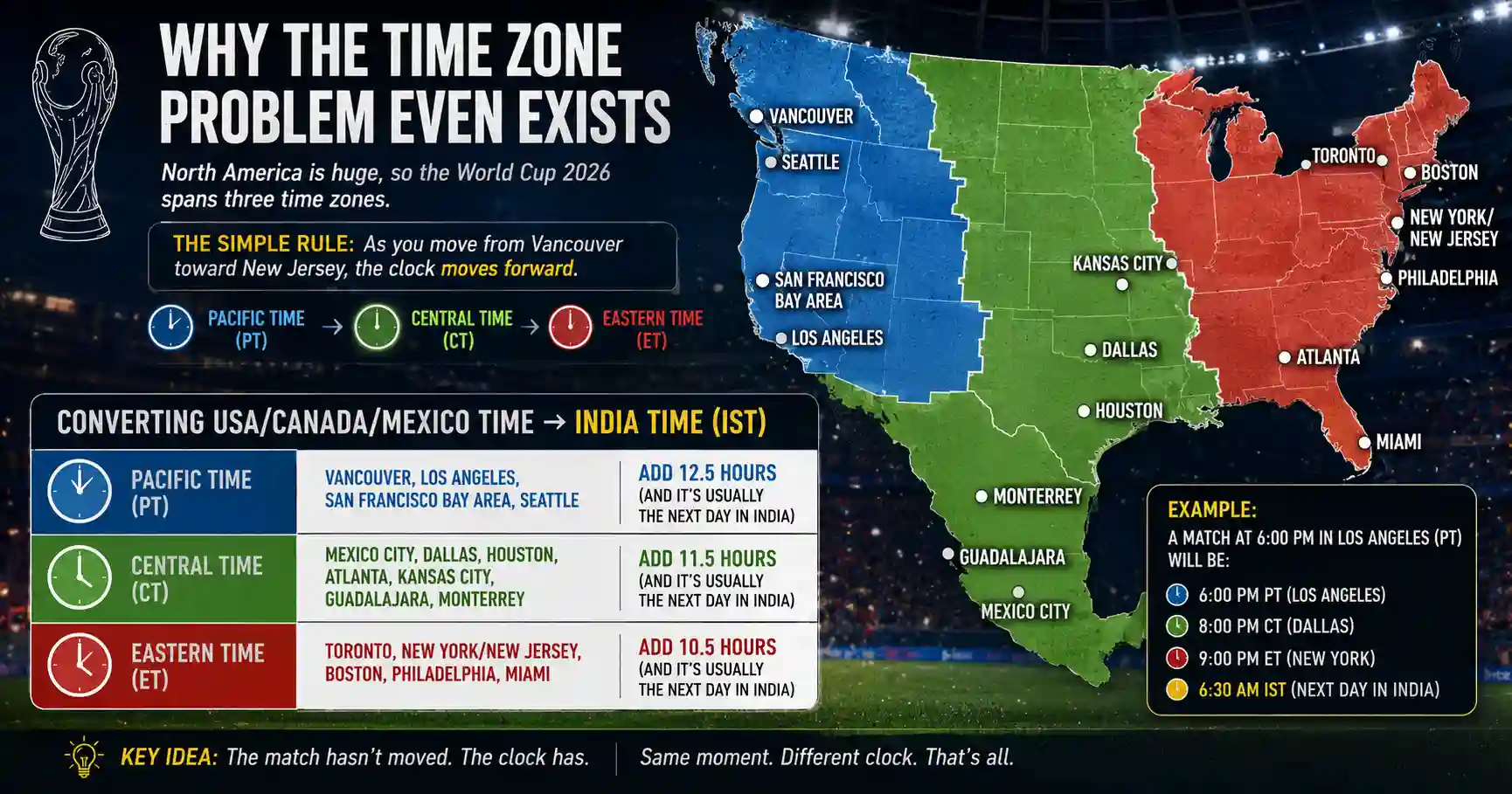
Why the Time Zone Problem Even Exists
North America is enormous. The distance between Vancouver (on Canada’s west coast) and New Jersey (on the US east coast) is roughly the same as the distance between London and Moscow. When a continent is that wide, it gets split into multiple time zones — and the World Cup 2026 host cities span three of them:
- Pacific Time (PT) — covers Vancouver, Los Angeles, San Francisco Bay Area, and Seattle
- Central Time (CT) — covers Mexico City, Guadalajara, Monterrey, Dallas, Houston, Kansas City, and Atlanta
- Eastern Time (ET) — covers Toronto, Boston, New York/New Jersey, Philadelphia, and Miami
Here’s the simple rule to remember: as you move from Vancouver toward New Jersey, the clock moves forward. Pacific Time is the “earliest” clock, Central Time is one hour ahead of Pacific, and Eastern Time is one hour ahead of Central (so two hours ahead of Pacific).
That means a match that kicks off at, say, 6 PM in Los Angeles (Pacific Time) would actually be 8 PM in Toronto (Eastern Time) — even though both cities are hosting the exact same World Cup, on the exact same day, at the exact same global “moment.” The match hasn’t moved. The clock has.
Once you accept that one simple idea — that the same instant in time gets a different clock-number depending on where you are — the rest of this becomes much easier.
How FIFA Lists the Times (And Why It’s Confusing)
When FIFA, broadcasters, and websites publish the schedule, they typically show the local time of the host city where the match is being played. So you might see something like:
South Korea vs Czechia — 10 PM, Estadio Guadalajara, Zapopan, Mexico
That “10 PM” is Mexico’s local time (Central Time). If you’re sitting in India, that means absolutely nothing to you until you convert it. This is the single biggest source of confusion for fans outside North America — the time shown is almost never your time, and most schedules don’t bother to explain that clearly.
Some outlets do try to help. For example, one schedule listed “South Korea vs TBD at 10pm (04:00 GMT on Friday)” — giving both the local Mexican time and the GMT (Greenwich Mean Time) equivalent. GMT is useful because it’s a global reference point — but most people in India still don’t think in GMT day-to-day, so even that requires one more conversion step.
This is exactly the gap this article closes.
The Simple Conversion Chart: USA/Canada/Mexico Time → India Time (IST)
Here is the only chart you actually need. India is on a single time zone — Indian Standard Time (IST) — which is ahead of every North American time zone (because India is much further east). To convert, you generally need to add hours and often move to the next day.
| If the match is shown as… | …in India (IST), it’s roughly… |
|---|---|
| Pacific Time (PT) — Vancouver, LA, SF, Seattle | Add 12.5 hours (and it’s usually the next day in India) |
| Central Time (CT) — Mexico City, Dallas, Houston, Atlanta, Kansas City | Add 11.5 hours (and it’s usually the next day in India) |
| Eastern Time (ET) — Toronto, New York/NJ, Boston, Philadelphia, Miami | Add 10.5 hours (and it’s usually the next day in India) |
Let’s make this real with examples:
Example 1 — An evening match in Los Angeles (Pacific Time) If a match kicks off at 9 PM Pacific Time in Los Angeles, add 12.5 hours. That lands you at 9:30 AM the next day in India. So a Friday night match in LA becomes a Saturday morning match for someone watching in Mumbai or Delhi.
Example 2 — An afternoon match in Mexico City (Central Time) If a match kicks off at 1 PM Central Time in Mexico City, add 11.5 hours. That gives you 12:30 AM the next day in India — a late-night/early-morning kickoff for Indian fans.
Example 3 — A night match in Toronto (Eastern Time) If a match kicks off at 8 PM Eastern Time in Toronto, add 10.5 hours. That gives you 6:30 AM the next day in India — an early breakfast-time kickoff.
The pattern you’ll notice: almost every World Cup 2026 match, regardless of which North American time zone it’s played in, will land somewhere between late night and mid-morning the next day for viewers in India. This is simply the unavoidable reality of the 12-13 hour time difference between India and North America’s various zones.
A Quick “Cheat Sheet” for Common Kickoff Slots
To make this even faster, here’s a ready-made cheat sheet for the most common kickoff times you’ll see in the schedule, already converted to India time. Bookmark this section.
| US/Canada/Mexico Local Time | Time Zone | India Time (Next Day) |
|---|---|---|
| 12 PM (Noon) | Eastern (ET) | 10:30 PM (same day) |
| 12 PM (Noon) | Central (CT) | 11:30 PM (same day) |
| 12 PM (Noon) | Pacific (PT) | 12:30 AM |
| 3 PM | Eastern (ET) | 1:30 AM |
| 3 PM | Central (CT) | 2:30 AM |
| 3 PM | Pacific (PT) | 3:30 AM |
| 6 PM | Eastern (ET) | 4:30 AM |
| 6 PM | Central (CT) | 5:30 AM |
| 6 PM | Pacific (PT) | 6:30 AM |
| 9 PM | Eastern (ET) | 7:30 AM |
| 9 PM | Central (CT) | 8:30 AM |
| 9 PM | Pacific (PT) | 9:30 AM |
| Midnight | Pacific (PT) | 12:30 PM |
The takeaway: Indian fans should expect most marquee evening matches in the USA to fall in the late-morning-to-evening window in India — making them very watchable — while early afternoon US matches often land in the dead of night in India.
What This Means for India’s Biggest Match Days
For fans following specific teams, broadcasters typically also publish times in local broadcast time zones — for instance, UK broadcasters list all kickoffs in UK time, and similar conversions exist for every country. The good news for India is that, because of the roughly 10.5-to-12.5-hour gap, many matches that air in the evening in North America become genuinely convenient morning or daytime viewing in India — perfect for fans who want to watch live without losing a night’s sleep, especially on weekends.
The matches to watch out for are the late-night North American kickoffs (typically anything after 9 PM local US/Canada/Mexico time) — these will often fall in the early afternoon in India, while the earliest North American afternoon kickoffs (around noon to 1 PM local) tend to land close to midnight in India.
Where to Find the Official, Match-by-Match Schedule
The complete FIFA World Cup 2026 schedule — including every fixture, date, venue, and live result — is available on FIFA’s official website, covering all 104 matches across the 16 host cities in Canada, Mexico, and the United States. All 104 games will also be available to stream, with broadcasters confirming comprehensive live coverage of the tournament.
Because match times vary so much depending on venue and broadcast scheduling — ranging from early afternoon to late evening in local time, and not limited to fixed slots — many fans are now relying on digital calendars and automatic reminders to stay aligned with their key fixtures rather than trying to remember conversions manually. This is genuinely the easiest solution: most sports apps and calendar tools allow you to add fixtures with automatic time zone conversion built in, so the match shows up correctly in your local time without you doing any maths at all.
The Three-Step Method: Never Get Confused Again
If you remember nothing else from this article, remember this three-step method for any World Cup 2026 match:
Step 1: Find out which host city the match is in, and identify its time zone (Pacific, Central, or Eastern).
Step 2: Use the conversion chart above — add roughly 10.5 hours (Eastern), 11.5 hours (Central), or 12.5 hours (Pacific) to get the time in India.
Step 3: If the resulting time is past midnight, remember it’s the next day in India compared to the date shown on the US schedule.
That’s it. Three steps, and you’ll never again find yourself setting an alarm for the wrong time, or worse, waking up to discover you slept through your team’s biggest match of the tournament.
Final Word: Embrace the Chaos, Plan Ahead
A World Cup hosted across three countries and three time zones was always going to create this kind of confusion — it’s simply the price of the most ambitious tournament format in football history. With 48 teams and 104 matches over 39 days spread across the United States, Canada, and Mexico, this truly is a “dream tournament” for fans — but only if you know when to actually watch.
The good news: now that you understand the system — local US/Canada/Mexico time, converted using the simple addition rule above — you can plan your entire World Cup 2026 viewing schedule in advance, set your alarms correctly, and never again ask the question “wait, is the match today or tomorrow?”
Bookmark this page, share it with your group chat, and get ready. The world’s biggest football tournament is here — and now, so is your timetable.
WORLD CUP 2026 POINTS TABLE: GROUP STANDINGS TRACKER FOR ALL 12 GROUPS — UPDATED LIVE
About the Author