Before We Begin: A Country That Needed a Miracle
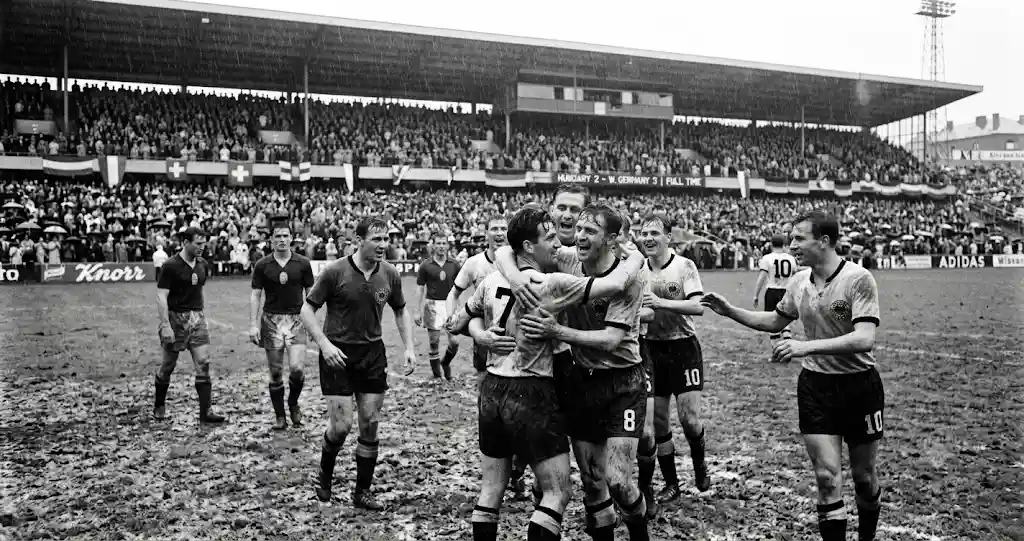
The Wankdorf Stadium, Bern, Switzerland. July 4, 1954.
Before we dissect the tactics, the goals, the individual moments that turned one of football’s most bewildering upsets into a founding myth for an entire nation, we need to understand something that is not about football at all.
In 1954, West Germany was nine years removed from the end of the Second World War. The country was physically divided — West and East, separated by an Iron Curtain — and psychologically fragmented, still processing a catastrophic national shame that had no precedent in modern history. The phrase that would come to define German feelings about what happened in Bern that July afternoon — “Wir sind wieder wer”, or “We are somebody again” — wasn’t coined by a football analyst. It was the spontaneous expression of a people who had not had many occasions, in nine difficult years, to feel that their nation was capable of producing something worth celebrating.
Der Spiegel, Germany’s most respected news magazine, would later frame it with striking directness: “Every nation has a founding legend. For modern Germany it is the 3-2 victory over Hungary in the 1954 World Cup. After World War II, the championship became a sign of being accepted by the world again.”
In one 90-minute match, it argued, modern-day Germany was born.
This is the context into which the Miracle of Bern 1954 must be placed before a single tactical observation can be made. What happened at the Wankdorf Stadium was not merely an upset. It was an act of national reconstitution — the moment a divided, shamed, physically and economically depleted country found something it could put its flag next to again, and discovered that the flag didn’t need to mean what it had meant for twelve years.
The Hungarian Golden Team: Football’s Most Dominant Side
To understand how total the shock of West Germany’s victory was, you need to understand what Hungary had been for the preceding four years. The Hungarian national team — known as the Arany Csapat, the Golden Team, and sometimes the Mighty Magyars — was not merely the best team in the world in 1954. By the evidence of their record, they were quite possibly the most dominant international team ever assembled to that point in the sport’s history.
Between June 1950 and their 1954 World Cup final defeat, Hungary lost exactly one match from 49 played — and that single defeat was the 1954 World Cup final itself. They had been unbeaten for over four years heading into that match. In the 1952 Olympic Games, they won gold. Seven months before the 1954 World Cup began, they became the first overseas team in history to beat England at Wembley — not just beating them, but destroying them 6-3, in a result that shook England’s sense of itself as the natural home and natural master of the sport it had invented. As if to confirm it was not a fluke, they beat England again less than a month before the 1954 World Cup started — 7-1 in Budapest, the heaviest defeat England had ever suffered.
They then averaged 6.25 goals per game to reach the Wankdorf final. In their group stage, South Korea conceded 16 goals and scored none against them across their matches. In the quarter-final, they beat Brazil 4-2 in a match so violent it became known as the Battle of Bern — a different kind of Bern miracle than the one we’re discussing, four players were sent off and brawls continued in the changing rooms afterwards. In the semi-final, they beat Uruguay 4-2.
By every available metric, this was not just a good team. It was the most emphatic World Cup favourite in the tournament’s history, according to no less an authority than FIFA’s own historical analysis.
Their star was Ferenc Puskás — football’s first genuine global superstar, a man of such technical excellence and goal-scoring consistency that his name became an adjective in football evaluation long after his career ended. The Puskás Award, given annually by FIFA for the most beautiful goal of the year, bears his name. In 1954, at 27, he was at his peak — hungry, brilliant, and the fulcrum around which the Golden Team’s attacking play was built.
West Germany’s Preparation: The Genius of Sepp Herberger
Against this backdrop, West Germany arrived at the 1954 World Cup as distinct outsiders. Their coach, Sepp Herberger, was not a glamorous figure by the standards of the tournament’s favourites. He was methodical, pragmatic, and possessed of a tactical intelligence that his opponents consistently underestimated.
Herberger’s most consequential decision of the entire tournament came in the group stage. Facing Hungary — the most powerful team in the world — Herberger made a decision that no conventional football wisdom of the era would have suggested. He fielded what was essentially a reserve side, deliberately losing the match by a large margin while ensuring his key players were rested and uninjured. The result: Hungary 8, West Germany 3 — one of the most lopsided scorelines in World Cup group stage history.
The strategic logic was clear after the fact. By losing heavily to Hungary in the group stage, West Germany avoided the more difficult bracket that would have come from finishing top of their group, and could enter the knockout rounds with their first-choice squad fully fit. But in the moment, the decision required extraordinary confidence — the conviction that the visible humiliation of an 8-3 defeat was worth the tournament-level advantage it provided. That conviction was Herberger’s.
By the time his side reached the final, Herberger had a settled, confident team around the right winger Helmut Rahn — whose performances in the knockout phase had been decisive enough to transform him from a squad option into a clear starter. The West German side that took the field in Bern was not the same one that had conceded eight goals in the group stage. It was a team that knew exactly who it was, had played its best football in the knockout rounds, and was mentally prepared for a final that the rest of the football world assumed would be a formality.
The Match: Goal by Goal
The rain was falling on the Wankdorf Stadium when the two sides emerged before 62,500 spectators. This, as it turned out, was one of the small details that would matter enormously. Fritz Walter, West Germany’s captain and creative fulcrum, was reportedly particularly effective in wet weather — a player whose technical excellence allowed him to function optimally on the kind of heavy, rain-soaked pitch that stripped pace-based advantages from faster opponents. West Germany also came equipped with what was, in 1954, a genuine innovation: boots with interchangeable studs, allowing their players to adapt their grip as the wet conditions developed.
The match began in the way that a fully rational assessment of the two teams’ quality would have suggested it must. In the sixth minute, Puskás opened the scoring with a typically clinical finish — 1-0 Hungary. Two minutes later, Zoltán Czibor made it 2-0, capitalising on a moment of defensive uncertainty.
Two goals in eight minutes. Hungary 2-0 up. The final was proceeding according to the script.
Then West Germany scored. In the tenth minute, Max Morlock turned a moment of scramble in Hungary’s penalty area into a goal — 2-1. The comeback had begun so quickly after the original deficit that the crowd at Wankdorf barely had time to process the emotional whiplash.
Eight minutes later, in the 18th minute, Helmut Rahn — the right winger whose performances in the knockout rounds had defined West Germany’s tournament — scored with a shot that tied the match. 2-2. In eighteen minutes, the final had gone from Hungary’s expected coronation to a completely open contest.
For the next 66 minutes, the match hung in the balance in a way that the pre-match analysis could not have imagined possible. Hungary pressed for a third goal. Puskás was not fully fit — carrying an ankle injury from the group stage that he had concealed to ensure his place in the side — and his movement was not the explosive Puskás of his reputation. Goalkeeper Toni Turek, who would be named the tournament’s best goalkeeper at the final whistle, produced save after save to deny Hungary the goal their pressure deserved.
“We were thinking, ‘Have we really just come back from 2-0?'” — the reaction from the West German camp captured in multiple post-match accounts — reflects the genuine disorientation of players who were succeeding beyond their own pre-match expectations.
Then, six minutes from the end, Helmut Rahn received the ball on the edge of the penalty area. In what radio commentator Herbert Zimmermann would describe in the eight-second pause before he found words, Rahn dummied beautifully to create a shooting opportunity and fired in for 3-2.
The Commentary That Became History
Herbert Zimmermann’s radio call of Rahn’s winning goal is not merely famous within Germany — it has been ranked by Kicker, La Gazzetta dello Sport, and The Guardian as the most iconic piece of football commentary in history. Zimmermann paused for eight extraordinary seconds after the ball entered the net — eight seconds of radio silence that captured, better than words could have, the sheer enormity of what had just happened in Bern.
When he found his voice again, the call tumbled out in one of sport’s great emotional outbursts: “Rahn shoots! Goal! Goal! Goal! Goal!” — and then, later, as the final whistle approached: “Aus! Aus! Aus! Aus! Das Spiel ist aus!” The game is over.
The game was over. The Miracle of Bern was complete.
The Aftermath: A Nation on the Tracks
What happened next had no precedent in West German post-war experience. The locomotive returning Fritz Walter, Sepp Herberger, and the Jules Rimet Trophy to West Germany was stopped repeatedly — not by mechanical failure, not by weather, but by fans who had poured out of their houses and onto the railway tracks to catch a glimpse of the world champions. People standing on the tracks, waiting for a train carrying a trophy, because they needed to be part of it.
For Hungary, the aftermath was darker and more complicated. The Golden Team had not just lost a match. They had lost a match they were physically and technically superior in, against opponents who had been soundly beaten by them just weeks earlier, in conditions that many in the Hungarian camp believed were affected by factors beyond legitimate football. Allegations — never conclusively proven — that West German players had been administered performance-enhancing substances before the final hung over the result and contributed to the bitterness that accompanied it. Puskás’s late apparent equaliser, ruled out for offside in a call that remained disputed for decades, added to the sense of injustice.
The Hungarian players spent three days in the town of Tata, waiting for the furious protests on the streets of Budapest to subside before they could return home. The contrast with 1952 — when their Olympic gold medal return was greeted by 400,000 celebrating Budapestians — could not have been more complete.
Some historians have written that the seeds of the 1956 Hungarian Revolution — the popular uprising against the communist government, violently suppressed by Soviet forces — were planted in the national psychological wound of the 1954 defeat. The connection is indirect, and attributing a political revolution to a football match is a significant claim. But the general truth beneath it is documented: the loss of the 1954 final, to a team that Hungary had convincingly beaten months earlier, inflicted a damage on national confidence under an already-unpopular regime that proved impossible to quietly absorb.
Tibor Nyilasi, who played for Hungary’s national side decades later, put it with quiet sadness: “It is as though Hungarian football is frozen at that moment, as though we have never quite moved on from then.”
The Tactical Legacy
From a strictly football-analytical perspective, the Miracle of Bern 1954 established several principles that remain relevant to every major upset in tournament football since.PELÉ: WHY THE GREATEST FOOTBALLER WHO EVER LIVED STILL DEFINES THE GAME IN 2026
The first is the principle of deliberate group-stage defeat. Herberger’s decision to lose heavily to Hungary while preserving his best players for the knockout rounds was, at the time, regarded by some as shameful. Today, it would be recognized as sophisticated tournament management — the recognition that group-stage results matter only insofar as they affect bracket position and player availability, not as pride-based performances in their own right. Tournament football is a different discipline from season-long league competition, and Herberger understood this before the concept had a formal vocabulary.
The second is the principle of environmental advantage. The rain, the changeable studs, Fritz Walter’s wet-weather excellence — West Germany’s preparation for conditions as well as opponents gave them a marginal advantage that compounded across 90 minutes in ways that the scoreline retrospectively validates. Modern tournament preparation — altitude training, weather simulation, ground condition analysis — is a direct intellectual descendant of what Herberger was doing in 1954.
The third is the principle of the settled team. Hungary, carrying an injured Puskás who had concealed the severity of his condition, were not the same team that had averaged 6.25 goals a game in their earlier matches. West Germany, with the clarity of Herberger’s selection and Rahn’s confidence from the knockout rounds, were exactly the same team they had been when they were at their best. Freshness of selection and cohesion of unit are factors that major upsets consistently exploit — and the Miracle of Bern is one of the clearest examples in the sport’s history.
What It Means Seventy-Two Years Later
As the 2026 World Cup produces its own storylines and its own upsets — because there will be upsets, there always are — the Miracle of Bern 1954 provides the historical template against which they should all be measured. Not because it was the first World Cup upset, but because it was the most consequential one in terms of what it meant to the people involved.
West Germany won a football match. But what the football match gave them was something the football match alone couldn’t have delivered: a reason to stand on railway tracks at midnight, waiting for a train carrying a trophy, shouting and weeping and feeling, for the first time in almost a decade, that they were somebody again.
Football is capable of that. The Miracle of Bern is the proof.
About the Author