 How Italy Won the 2006 World Cup Under the Shadow of Scandal
Most World Cup-winning teams are remembered for how well things came together at exactly the right moment. Italy’s 2006 triumph is remembered for something almost the opposite: a squad that won the sport’s biggest prize while its entire domestic league was collapsing into scandal back home. Understanding Italy’s fourth World Cup title means understanding both halves of that story, the chaos consuming Italian football off the pitch, and the extraordinary, defense-built unity the national team built on it.
PSG v Arsenal: How Paris Won the Champions League Final on Penalties
WAFCON 2026: Cameroon Champions, Malawi Runners-Up and the Biggest Surprises
A Domestic League in Freefall
Weeks before the tournament kicked off in Germany, Italian football was rocked by what became known as the Calciopoli scandal, a wide-reaching match-fixing investigation that implicated some of Serie A’s biggest clubs, including Juventus, AC Milan, Fiorentina, and Lazio. Wiretapped phone calls revealed senior club officials allegedly influencing the selection of referees for specific matches, a scandal that would ultimately see Juventus stripped of two league titles and relegated to Serie B, with several other clubs docked points or demoted as punishment.
The timing could hardly have been worse for the national team. Several of Italy’s most important players, including captain Fabio Cannavaro and goalkeeper Gianluigi Buffon, were Juventus players at the very center of the storm, reporting for World Cup duty while their club’s entire future hung in the balance and Italian newspapers ran daily updates on the unfolding investigation. Rather than fracturing the squad, as many predicted it would, the scandal appeared to have the opposite effect. Manager Marcello Lippi, himself a former Juventus coach with deep ties to several implicated figures, later spoke about how the shared sense of being under siege from the Italian press and public seemed to bond the group tighter than almost any tactical or motivational speech could have managed on its own.
Building a Fortress
Whatever chaos surrounded them off the pitch, Italy’s on-field approach in Germany was a model of defensive discipline. Built around Cannavaro’s masterful reading of the game, alongside Alessandro Nesta, Gianluca Zambrotta, and the towering, combative Marco Materazzi, Italy’s back line, protected by Gennaro Gattuso and Andrea Pirlo’s midfield shield, produced one of the stingiest defensive records in modern World Cup history. Across seven matches, Italy conceded just two goals, an own goal against the United States and a first-half penalty in the final itself, an almost unthinkable level of defensive control across a full tournament run.15 Champions League Players to Watch in 2026/27: Superstars & Young Guns
LaLiga 2026/27 Schedule: Fixtures, Dates & Times
Buffon’s form throughout the competition bordered on the historic. He would later be named the tournament’s best goalkeeper, and statisticians have pointed out that Italy went well over 400 consecutive minutes without conceding a goal from open play across the entire tournament, a run broken only by the own goal against the USA. That defensive foundation gave Italy license to play patient, controlled football, absorbing pressure and waiting for moments of individual quality from players like Francesco Totti, Alessandro Del Piero, and a young, combative Gattuso in midfield, rather than needing to chase games from a position of defensive vulnerability.
A Group Stage Overshadowed by Controversy
Italy’s opening matches offered an early glimpse of the mixture of quality and chaos that would define their tournament. A comfortable win over Ghana got the campaign off to a strong start, but their second match against the United States descended into one of the most chaotic ninety minutes of the entire tournament, featuring three red cards, including one shown to an Italian player, and a bizarre own goal from Cristian Zaccardo that briefly threatened to derail Italy’s control of the group. A disciplined win over the Czech Republic in their final group match settled any lingering nerves and confirmed Italy’s place atop their group heading into the knockout stage.
The round of 16 brought another moment of controversy, this time in Italy’s favor. A tense, goalless contest against Australia looked destined for extra time until Totti converted a stoppage-time penalty, awarded for a challenge that remains debated by Australian fans to this day, sending Italy through in the most dramatic fashion possible and sparking accusations, not for the last time in the tournament, that Italy was benefiting from generous refereeing decisions. Whatever the truth of that particular claim, Italy’s next performance left no room for debate: a comprehensive 3–0 quarterfinal win over Ukraine, built on clinical finishing and defensive control, that announced Lippi’s side as genuine title contenders rather than merely a team riding good fortune.
The Greatest Ninety Minutes of the Tournament
If one match defined Italy’s 2006 campaign, it was the semifinal against host nation Germany in Dortmund, widely regarded as one of the greatest World Cup semifinals ever played. For 118 minutes, neither side could find a breakthrough against two of the tournament’s best defensive units, with Germany’s home crowd growing louder and more desperate as extra time wore on and penalties looked increasingly inevitable.
Then, in the space of two minutes right at the death of extra time, the match exploded into life. Fabio Grosso, a left-back who had come off the bench and would go on to become one of the tournament’s most unlikely heroes, curled a stunning left-footed strike into the far corner to break the deadlock in the 119th minute, silencing a stadium that had been roaring for German penalties moments earlier. Barely sixty seconds later, with Germany pushing bodies forward in desperation, Italy broke at pace, and Alessandro Del Piero, another substitute, calmly slotted home a second goal in the dying seconds, sealing a 2–0 win that remains one of the most dramatic finishes in World Cup history. It was a moment of pure release for a squad that had spent the entire tournament absorbing pressure both on the pitch and from the scandal consuming their domestic league back home.
The Final: Zidane’s Penalty, Materazzi’s Header, and a Night of Chaos
Italy’s final opponent, France, arrived in Berlin with their own golden-generation storyline, led by a rejuvenated Zinedine Zidane playing what everyone understood to be the final match of his legendary career. The final began dramatically, with Zidane opening the scoring inside the first ten minutes via a delicately chipped Panenka penalty that clipped the underside of the crossbar on its way in, an audaciously casual finish given the magnitude of the occasion. Italy responded before the first half had even ended, with Materazzi rising to head home an equalizer from a corner, silencing the doubts about whether Italy’s attack could match the quality of their defense on the sport’s biggest stage.
What followed was ninety more minutes of tense, cagey football that produced no further goals in regulation, before the match’s defining moment arrived deep into extra time. Materazzi and Zidane, already tangled in an ongoing personal battle throughout the match, exchanged words near the halfway line, and Zidane, in what would become the single most replayed and debated moment of his entire career, turned and headbutted Materazzi square in the chest, earning an immediate red card and ending his international career in the most infamous possible fashion, sent off in extra time of a World Cup final he had almost single-handedly dragged France into.
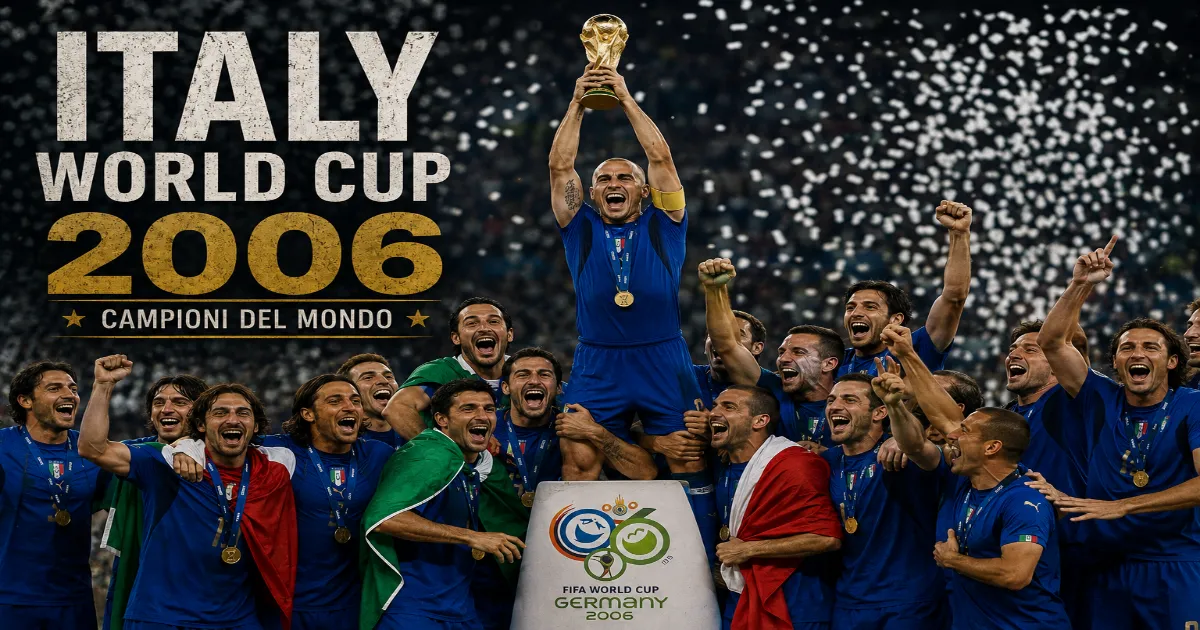
With Zidane gone, the match went to penalties, and it was Italy’s composure, the same defensive discipline and mental resilience that had carried them through the entire tournament, that ultimately proved decisive. Buffon and his defenders converted their spot kicks with total assurance, while France’s David Trezeguet, ironically an Italian-born player who had come through Italy’s youth system before choosing France, struck the crossbar with his attempt. Fittingly, it was Fabio Grosso, hero of the Germany semifinal, who stepped up to convert the winning penalty, sending Italy to a 5–3 shootout victory and a fourth World Cup title.
Cannavaro’s Crowning Year
No individual benefited more from Italy’s triumph than captain Fabio Cannavaro. Already regarded as one of the finest defenders of his generation, his commanding performances throughout the tournament, marshaling a defense that conceded almost nothing across seven matches, saw him named the tournament’s best player and, later that year, awarded the Ballon d’Or, an extraordinarily rare honor for a pure defender in an award historically dominated by attacking players. His triumph mirrored the team’s broader story: a defender’s tournament, won through discipline, organization, and collective resilience rather than individual attacking brilliance.
Coming Home to a Different Kind of Reception
Italy’s return home was complicated by the ongoing fallout from Calciopoli, with several of the tournament’s heroes facing an uncertain club future even as they were celebrated as national champions. Juventus, the club of Cannavaro, Buffon, Del Piero, and several other key squad members, was formally relegated to Serie B and stripped of its recent league titles within weeks of the World Cup final, forcing several World Cup winners to make difficult decisions about their club futures almost immediately after the greatest moment of their careers. Cannavaro left for Real Madrid, while Buffon and Del Piero chose to stay and help rebuild Juventus from Serie B, a decision that added another unusual layer to an already unusual championship story.
Lippi himself stepped down as national team manager shortly after the final, having achieved the ultimate success just as Italian football’s credibility was hitting one of its lowest points domestically. That contrast, a national team at the absolute pinnacle of the sport while its domestic league faced its greatest crisis in decades, remains one of the most singular aspects of Italy’s 2006 story, a triumph that had to be understood in two completely different contexts at once.
The Tactical System Behind the Clean Sheets
Lippi’s Italy is often remembered simply as a defensive team, but the reality of the system was more nuanced than that label suggests. Rather than sitting deep and inviting pressure, Italy’s back four, protected by Gattuso’s relentless tackling and Pirlo’s positional intelligence in front of the defense, was drilled to press aggressively in the middle third, cutting off passing lanes before opponents could even build meaningful attacks. This meant Italy’s celebrated defensive record wasn’t purely a product of individual quality at the back, Cannavaro and Nesta were both excellent, but of a whole-team structure that made life difficult for opponents from the first line of pressure all the way through to Buffon’s goal.
Pirlo’s role deserves particular attention in hindsight, given how his deep-lying playmaking style would go on to influence an entire generation of midfielders in the years that followed. Playing just in front of the back four rather than as a traditional advanced creator, Pirlo dictated tempo and distribution from deep, a role that wasn’t yet fashionable in 2006 but has since become one of the most sought-after templates in modern midfield design. His long-range passing and set-piece delivery were instrumental in several of Italy’s goals throughout the tournament, quietly underpinning a team that history has remembered primarily for its defense rather than its creative engine room.
A Squad Built on Unlikely Heroes
Part of what made Italy’s triumph so compelling was how many of its most decisive contributions came from players outside the traditional spotlight. Fabio Grosso entered the tournament as a relatively unheralded left-back, yet delivered both the extra-time winner against Germany and the decisive penalty in the final shootout, transforming himself from a squad player into a permanent fixture of Italian football folklore within the space of a single tournament. Alessandro Del Piero, whose place in the starting lineup had been far from guaranteed heading into the competition due to fitness concerns and Totti’s presence in a similar attacking role, scored the goal that effectively sealed Italy’s place in the final with his stoppage-time strike against Germany.
Even Materazzi’s tournament told a similar story of redemption through unexpected impact. A combative, sometimes error-prone centre-back who had endured a difficult club season before the World Cup, Materazzi scored Italy’s equalizer in the final and, whatever the ethics of his role in provoking Zidane’s headbutt, played a decisive part in one of the most talked-about moments in the sport’s history. These contributions from squad members outside Italy’s most recognizable stars reinforced the broader theme of the tournament: a genuinely collective triumph, built on total squad depth rather than reliance on one or two individual superstars to carry the team.
Why 2006 Still Stands Apart
Nearly two decades on, Italy’s 2006 World Cup remains a reference point for a very particular kind of tournament success, one built not on individual superstar quality up front but on total defensive commitment, tactical discipline, and a squad bonded by shared adversity rather than untroubled confidence. It’s frequently cited in football analysis as proof that a team under genuine external pressure can still find a way to peak at exactly the right moment, and Zidane’s headbutt has become one of the most enduring single images associated with any World Cup final in the tournament’s history.
For Italy, a nation with a long tradition of defensive football producing major trophies, 2006 remains the clearest modern example of that philosophy taken to its absolute peak, delivered by a group of players who somehow managed to block out one of the biggest scandals in football history and produce arguably the most complete defensive World Cup campaign the tournament has ever seen.
NBA Schedule 2026-27: Christmas Day Rivalries, Ring Night and the Games to Watch
About the Author