Why the Indian Super League’s World Cup 2026 footprint matters more than the absence of the national team
ISL Players at World Cup 2026
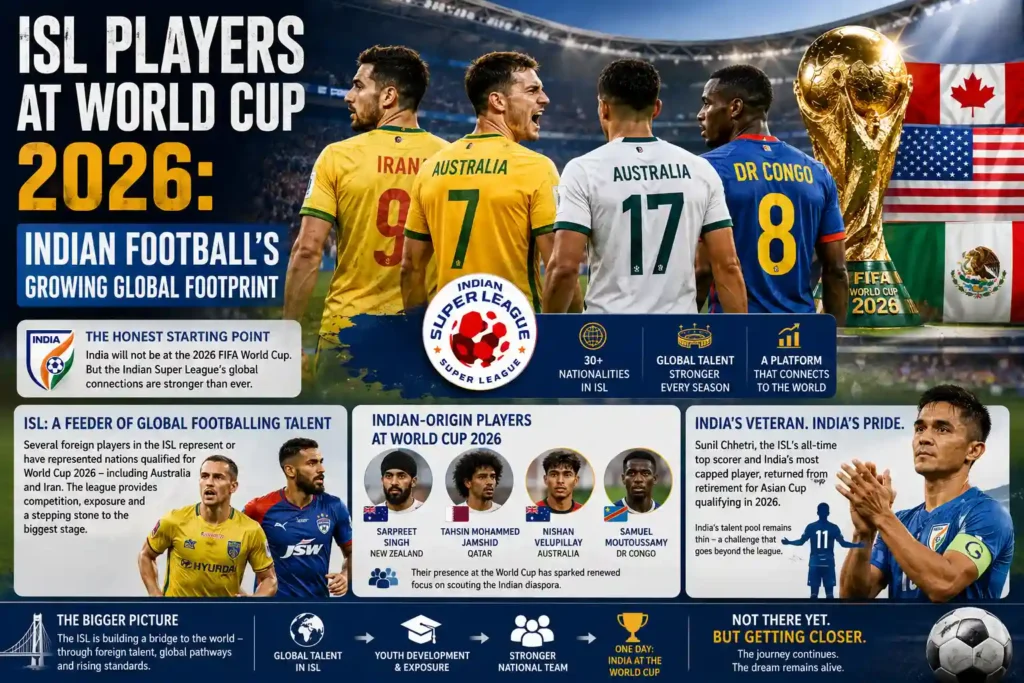
There is no escaping the uncomfortable headline first: India will not be at the 2026 FIFA World Cup. The Blue Tigers’ qualification campaign ended in the AFC’s second round, and the closest connection most Indian fans will have to the tournament is watching it unfold on television, the way they always have.
And yet, look a little closer at the rosters walking out in the USA, Canada, and Mexico this summer, and a quieter, more interesting story about Indian football’s global footprint starts to emerge — one that runs directly through the Indian Super League.
The Honest Starting Point: No India, But Plenty of India-Adjacent Stories
Let’s deal with the obvious tension up front. Phrases like “ISL players at World Cup 2026” can mislead casual readers into assuming Indian nationals are competing on football’s biggest stage. They are not — not as part of the senior men’s national team, at least. India sit outside the qualified 48, a familiar and painful position for a country with cricket-sized ambitions and football-sized infrastructure gaps.
But the Indian Super League’s relationship with the World Cup isn’t really about India qualifying. It’s about what the league has become: a genuine, if still modest, node in the global football economy — one that recruits from, develops players for, and increasingly sends storylines toward the very nations competing this summer.
The ISL as a Feeder of Global Footballing Talent
Over the past several seasons, the ISL has built rosters stretching across more than 30 nationalities, with clubs regularly fielding players from Spain, Brazil, Australia, Iran, and beyond. Several of these countries are represented at the 2026 World Cup — Australia and Iran among the AFC’s qualifiers, with players who have spent portions of their careers plying their trade in Mumbai, Goa, Bengaluru, or Kolkata before, alongside, or after representing their countries on bigger stages.
This matters analytically because it reframes what “ISL connection to the World Cup” actually means. It is not a tally of Indian caps. It is a measure of the league’s growing credibility as a destination league — one where international players sharpen their game, earn wages competitive with several second-tier European markets, and stay visible to national team selectors back home.
Indian-Origin Players Wearing Other Badges
Perhaps the most emotionally resonant thread of India’s World Cup 2026 story has nothing to do with the ISL directly, but everything to do with the diaspora the league has helped energise. Several players of Indian heritage will appear at this tournament for other nations: New Zealand’s Sarpreet Singh, who has previously played in India during the Intercontinental Cup; Qatar’s Tahsin Mohammed Jamshid, whose family traces back to Kerala; Australia’s Nishan Velupillay, with roots in Tamil Nadu; and DR Congo’s Samuel Moutoussamy, of Tamil-Guadeloupean descent.Top 15 Football Leagues in the World Ranked (2026): Star Players, Global Standings & Every Continent’s Best
None of them play in the ISL. But their visibility at the World Cup has reignited a domestic conversation in India about scouting the diaspora — a conversation the ISL’s marketing and growth-oriented leadership has been quick to amplify.
What India’s Veterans Make of It
It would be incomplete to discuss Indian football’s relationship to World Cup 2026 without mentioning Sunil Chhetri, the ISL’s all-time leading scorer and India’s most capped, most decorated player. Chhetri came out of retirement for Asian Cup qualifying duty in 2026, underlining just how thin India’s pool of senior, tournament-tested talent remains — a structural issue that no amount of ISL foreign investment alone can fix.
That’s the tension running underneath this entire story. The ISL has professionalised Indian football’s commercial side considerably since its 2014 launch. But converting that commercial momentum into actual World Cup qualification remains the unfinished business — one that AIFF, club academies, and the league itself will need to solve together before “India at the World Cup” stops being aspirational and starts being literal.
The Bigger Picture: A League Still Building Its Bridge
For now, the honest framing is this: the ISL’s World Cup 2026 footprint exists in foreign signings who once or will represent qualified nations, in Indian-origin talent emerging through global pathways the league has helped spotlight, and in the standard the league sets for what comes next. It is a bridge still under construction, not a finished crossing.
Indian football’s growing global footprint is real — visible in broadcast deals, in foreign player quality, in academy partnerships. But the destination that matters most, a World Cup berth for the national team itself, remains the one milestone still out of reach. Until that changes, every conversation about ISL players at the World Cup will carry this same asterisk — and that, more than any single headline, is the most useful insight a football analyst can offer Indian fans heading into this tournament.
About the Author