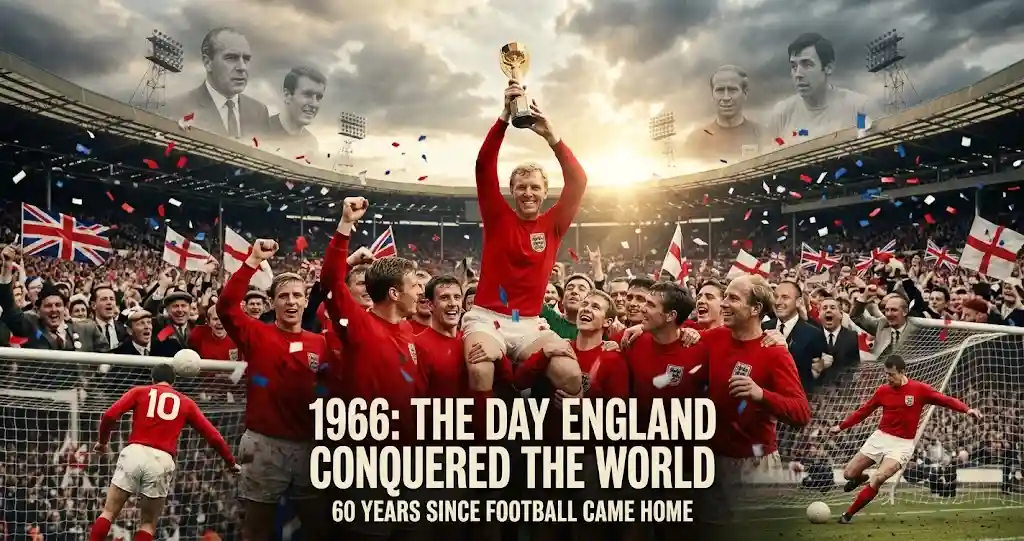
England’s 1966 World Cup win turns 60: The Trophy That Defined a Nation
Sixty years ago, on the afternoon of July 30, 1966, West Ham striker Geoff Hurst struck a rising shot that crashed down off the underside of the crossbar at Wembley Stadium. Whether it had fully crossed the line remains one of football’s most enduring debates. Referee Gottfried Dienst consulted his linesman, Tofiq Bahramov, who signalled that it had. The goal stood. England led West Germany 3-2, eleven minutes into extra time.
Moments later, with spectators already streaming onto the pitch in premature celebration, Hurst received a long ball from captain Bobby Moore, surged forward, and drilled a left-footed shot into the net to complete the only hat-trick ever scored in a men’s World Cup final.
The scenes at Wembley that afternoon — 96,924 spectators inside the stadium, an estimated 400 million watching worldwide, captain Bobby Moore lifting the Jules Rimet Trophy — became the defining images of English football. They still are. Because England have not won the World Cup since.
As the 60th anniversary of that victory approaches, it’s worth revisiting exactly what happened, why it happened, and what England’s only World Cup triumph still means today.
Alf Ramsey and the “Wingless Wonders”: A Tactical Shift
England’s manager, Alf Ramsey, had made his name guiding unfashionable Ipswich Town to the First Division title in 1962 through disciplined, intelligent organisation rather than star quality. Appointed England manager in 1963, he famously predicted that England would win the World Cup on home soil in 1966 — a statement many considered bold to the point of reckless.
Ramsey’s England became known as the “Wingless Wonders” for their unconventional attacking shape, built around industrious, two-way players rather than orthodox wide forwards hugging the touchline. The approach demanded discipline, fitness, and tactical intelligence from every outfield player — a collective system over individual flair.
It worked. England progressed through the tournament without conceding a single goal until the semifinal — a defensive record built on Ramsey’s carefully drilled structure.
The Road to the Final: England’s Tournament Journey
England’s group stage form was solid rather than spectacular: they won two and drew one of their three games, including a goalless opening draw against Uruguay that left some fans underwhelmed.
The quarter-final against Argentina became infamous for the sending-off of Argentine captain Antonio Rattín, who initially refused to leave the pitch and had to be escorted off by police — the first dismissal in a senior international at Wembley. With the game still scoreless when Rattín departed, Geoff Hurst’s headed goal twelve minutes from time settled a bitterly contested match 1-0.
The semifinal against Portugal — and the brilliant Eusébio, the tournament’s eventual top scorer with nine goals — was arguably England’s best performance of the competition. Bobby Charlton scored twice in a 2-1 win; Portugal’s consolation came from a Eusébio penalty after a handball on the goal line by Jack Charlton. It was the only goal England conceded before the final.
July 30, 1966: The Final at Wembley
The final against West Germany, managed by Helmut Schön, was a tense, dramatic contest that ultimately required extra time.
West Germany struck first in the 12th minute: Helmut Haller’s shot found the net after Ray Wilson’s headed clearance fell straight into his path. England levelled six minutes later when Bobby Moore’s quickly taken free kick — awarded after a foul by Wolfgang Overath — found Geoff Hurst, who rose unmarked to head home from close range. 1-1 at half-time.
With 12 minutes of normal time remaining, England retook the lead. Hurst’s shot was deflected into the path of Martin Peters, who finished from close range to make it 2-1. England appeared to be cruising toward the title — until, in the dying seconds, West Germany won a free kick on the edge of the England box. The kick deflected through a crowded penalty area, and Wolfgang Weber forced the ball home to level the score at 2-2, sending the final into extra time.
In extra time, with 11 minutes gone (the 101st minute of the match), Alan Ball’s cross found Hurst, who turned and struck a shot that crashed down off the underside of the crossbar. After consulting linesman Tofiq Bahramov, referee Gottfried Dienst awarded the goal — the most contested decision in World Cup final history, still debated by England and Germany alike six decades later. England led 3-2.
With the match in its final seconds, and pitch invaders already beginning to spill onto the field, Bobby Moore found Hurst with a long ball forward. Hurst drove toward goal and smashed a left-footed shot past goalkeeper Hans Tilkowski to complete his hat-trick and make the final score 4-2.
It was in these closing moments that BBC commentator Kenneth Wolstenholme delivered the most famous line in English football broadcasting: “Some people are on the pitch. They think it’s all over… It is now!”
England were world champions for the first, and to date only, time.
The Players: A Generation That Defined an Era
This England squad combined defensive solidity with quiet individual brilliance. Gordon Banks, in goal, anchored a defence that conceded just three goals across the entire tournament. Bobby Moore, the captain, was calm and composed even in the most chaotic moments of the final — supplying assists for both of Hurst’s first and fourth goals.
Bobby Charlton, a survivor of the 1958 Munich air disaster, provided creativity and energy through midfield, scoring twice in the semifinal against Portugal. His brother Jack anchored the defence alongside Moore. Martin Peters scored England’s second goal in the final, while Alan Ball — at just 21 years old — was widely regarded as England’s most tireless performer across the tournament.
And then there was Geoff Hurst — selected ahead of recognised goal-scorer Jimmy Greaves for the quarter-final and retained for the rest of the tournament — who delivered the single greatest individual performance in World Cup final history.Every FIFA World Cup Winner Since 1930 — Complete Champions List, Stats & History
What the 1966 Win Means 60 Years Later
The 1966 triumph remains both England’s greatest footballing achievement and, in some ways, the source of decades of subsequent pressure. Every England campaign since has, fairly or not, been measured against that single golden afternoon. Near-misses in 1990, 1996, 2018, and 2021 have each reopened the question of when — or whether — England will repeat the feat.
But revisiting 1966 on its 60th anniversary invites genuine admiration rather than mere nostalgia. This was a team built on tactical discipline, defensive resilience, and remarkable composure under pressure — values instilled by a manager who believed completely in his system and his players, even when many doubted him.
Sixty years on, the achievement of Alf Ramsey’s England remains a touchstone not just for English football, but for what collective organisation and self-belief can accomplish against the odds.
▪️▪️ Follow us on Facebook▪️▪️
About the Author



1 thought on “The 1966 World Cup: England’s Greatest Achievement Revisited 60 Years On”