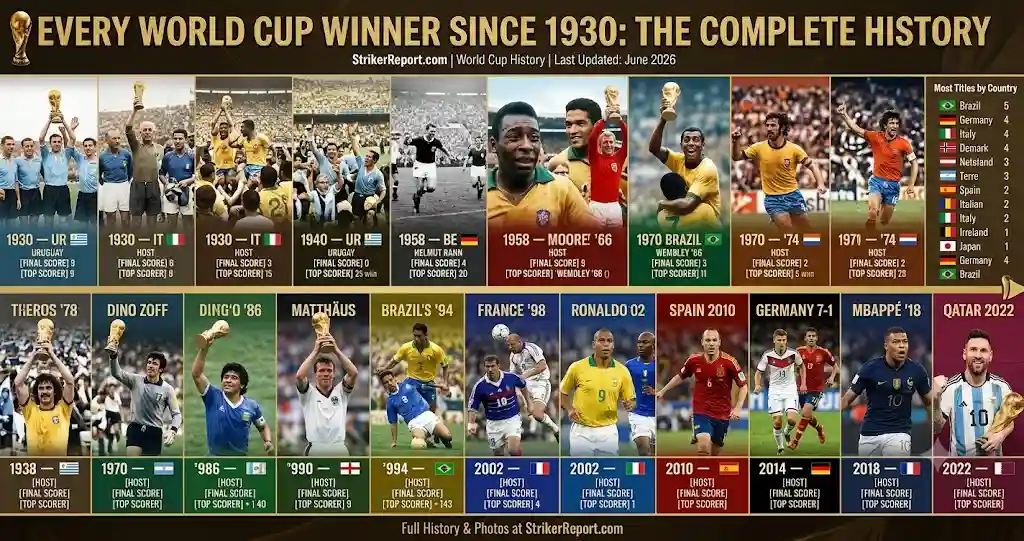
Every World Cup Winner Since 1930:
StrikerReport.com | World Cup History | Last Updated: June 2026
The FIFA World Cup is the most-watched sporting event on the planet. Every four years, nations clash, heroes emerge, and history is written in goals, tears, and golden trophies. But how much do you really know about every World Cup winner since 1930?
This is your complete guide — a tournament-by-tournament record of every FIFA World Cup champion, their key stats, standout players, and the moments that made each title unforgettable. Bookmark it, share it, argue about it with your friends. This is the full story.
1930 — Uruguay 🇺🇾
Host: Uruguay | Final Score: Uruguay 4–2 Argentina | Top Scorer: Guillermo Stábile (ARG, 8 goals)
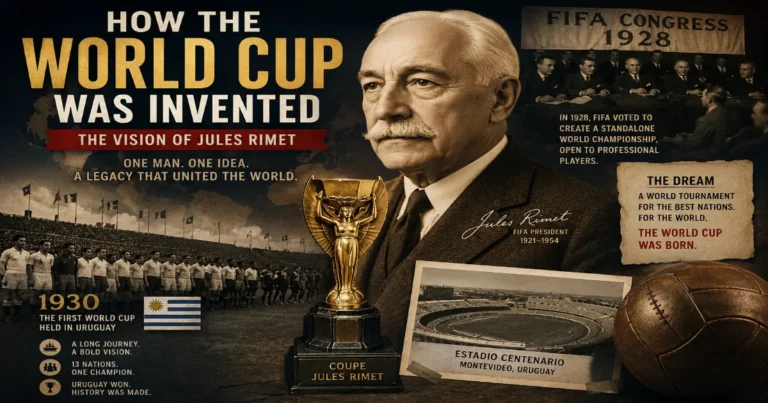
The very first World Cup took place on Uruguayan soil, and the hosts didn’t waste the privilege. With Europe largely boycotting the trip across the Atlantic, 13 nations competed in the inaugural tournament. Uruguay, led by the brilliant Héctor Scarone and a rock-solid defensive structure, defeated their fierce rivals Argentina in the final at the Estadio Centenario in Montevideo. It was a statement of South American football supremacy that would echo through the century.
Key Stat: Uruguay scored 15 goals and conceded just 3 throughout the tournament — a goals-against record that stood for decades.
1934 — Italy 🇮🇹
Host: Italy | Final Score: Italy 2–1 AET Czechoslovakia | Top Scorer: Oldřich Nejedlý (CZE, 5 goals)
Benito Mussolini wanted a propaganda win and Vittorio Pozzo delivered one. Italy were a formidable unit, blending tactical discipline with genuine quality. Giuseppe Meazza was the standout figure — creative, clinical, and electric. The Azzurri beat Czechoslovakia in extra time in Rome to claim the title on home soil. Controversial? Certainly. Deserved? Arguably yes.
Key Stat: Italy conceded just 4 goals across 5 matches. Their defensive record was among the best the tournament had seen.
1938 — Italy 🇮🇹
Host: France | Final Score: Italy 4–2 Hungary | Top Scorer: Leônidas (BRA, 7 goals)
Back-to-back. Vittorio Pozzo became — and remains — the only manager in history to win two World Cups. Italy were again formidable, with Silvio Piola and the returning Giuseppe Meazza powering them through a strong field. Hungary reached the final but were comprehensively outclassed. War would suspend the World Cup for 12 years after this edition.
Key Stat: Italy’s Gino Colaussi scored twice in the final. Italy became the first nation to defend the World Cup title.
1950 — Uruguay 🇺🇾
Host: Brazil | Final Match: Uruguay 2–1 Brazil
No knockout final in 1950 — a round-robin decided the winner. But one match stood apart from all others: Uruguay versus Brazil in the Maracanã, in front of an estimated 200,000 spectators. Brazil needed only a draw to win. Uruguay won 2–1. The silence that descended on that stadium became known simply as O Maracanazo — one of football’s defining catastrophes and greatest upsets. Alcides Ghiggia’s winner silenced a nation.
Key Stat: The 1950 Maracanã attendance of approximately 199,854 remains the largest crowd ever to attend a football match.
1954 — West Germany 🇩🇪
Host: Switzerland | Final Score: West Germany 3–2 Hungary | Top Scorer: Sándor Kocsis (HUN, 11 goals)
The Miracle of Bern. Hungary’s “Magnificent Magyars” — arguably the greatest national team ever assembled — were unbeaten in four years and had already hammered West Germany 8–3 in the group stage. But in the final, West Germany produced one of sport’s most stunning reversals. Fritz Walter led the charge; Helmut Rahn scored the winner. Hungary, and Puskás in particular, were heartbroken. The world was stunned.
Key Stat: The 1954 World Cup produced a tournament average of 5.38 goals per game — a record that still stands today.
1958 — Brazil 🇧🇷
Host: Sweden | Final Score: Brazil 5–2 Sweden | Top Scorer: Just Fontaine (FRA, 13 goals)
A 17-year-old boy named Edson Arantes do Nascimento — better known as Pelé — arrived on the world stage and immediately announced himself as something otherworldly. Brazil were brilliant from start to finish: Garrincha on the wing, Didi in midfield, Vavá and Pelé up front. They dismantled Sweden in the final with a 5–2 performance of breathtaking beauty. Just Fontaine’s 13-goal haul in a single tournament remains unbroken to this day.
Key Stat: Pelé became the youngest World Cup winner in history, aged 17 years and 249 days. That record has never been broken.
1962 — Brazil 🇧🇷
Host: Chile | Final Score: Brazil 3–1 Czechoslovakia | Top Scorer: Multiple players with 4 goals
Defending champions. Despite Pelé suffering an injury in the group stage, Brazil were too good for anyone in Chile. Garrincha stepped into the spotlight and was simply unstoppable — dribbling, creating, and scoring with trademark brilliance. Amarildo deputised superbly for Pelé in attack. Brazil cruised to a second straight title with a composed final performance against Czechoslovakia.
Key Stat: Garrincha was named Player of the Tournament — the only player to win that award and the Golden Boot simultaneously (though the awards were not formally presented as they are now).
1966 — England 🇬🇧
Host: England | Final Score: England 4–2 AET West Germany | Top Scorer: Eusébio (POR, 9 goals)
England’s finest hour. Alf Ramsey’s wingless wonders, built on Bobby Moore’s composure, Bobby Charlton’s engine, and Geoff Hurst’s predatory instinct, ground their way through the tournament before delivering a stunning final performance against West Germany. Hurst’s hat-trick — including the controversial third goal that bounced off the crossbar and may or may not have crossed the line — settled one of football’s greatest finals. England have not been back since.
Key Stat: Geoff Hurst remains the only player to score a hat-trick in a World Cup Final.
1970 — Brazil 🇧🇷
Host: Mexico | Final Score: Brazil 4–1 Italy | Top Scorer: Gerd Müller (GER, 10 goals)
The greatest team in World Cup history? Many say yes. Brazil 1970 — Pelé, Jairzinho, Tostão, Rivelino, Clodoaldo, and Carlos Alberto — played football that seemed to belong to a different plane of existence. Every game was a masterclass. The final against Italy was a coronation. Carlos Alberto’s thundering fourth goal remains perhaps the most perfect team goal ever scored. Brazil earned permanent custody of the Jules Rimet Trophy.
Key Stat: Jairzinho scored in every single match of the tournament — 7 goals in 7 games. No player has replicated this feat.
1974 — West Germany 🇩🇪
Host: West Germany | Final Score: West Germany 2–1 Netherlands | Top Scorer: Grzegorz Lato (POL, 7 goals)
Johan Cruyff’s Netherlands arrived with Total Football — a fluid, revolutionary, breathtaking system that captivated the world. They earned a penalty in the first minute of the final before West Germany had even touched the ball. But Cruyff’s team couldn’t finish the job. Gerd Müller — as he always did — punished them. Two goals from the Bomber sealed West Germany’s second title on home soil, and left Dutch football with the most famous trophy it never won.
Key Stat: The Netherlands became the first team in a World Cup Final to concede a penalty without the opposition touching the ball at kickoff.
1978 — Argentina 🇦🇷
Host: Argentina | Final Score: Argentina 3–1 AET Netherlands | Top Scorer: Mario Kempes (ARG, 6 goals)
Ticker tape, noise, a nation in frenzy — and Mario Kempes, hat pulled low, hair flying, carving through defences like they weren’t there. Argentina under César Luis Menotti played attractive, attacking football that swept the host nation to their first world title. Kempes scored twice in the final. The Netherlands, without Cruyff who controversially stayed home, were once again the nearly-men of world football.
Key Stat: Mario Kempes won the Golden Boot and the Golden Ball. He is the last player to win both individual awards at the same World Cup.
1982 — Italy 🇮🇹
Host: Spain | Final Score: Italy 3–1 West Germany | Top Scorer: Paolo Rossi (ITA, 6 goals)
Paolo Rossi had returned from a match-fixing suspension with zero competitive minutes under his belt. He then scored six goals in six days to drag Italy to the title. Three against Brazil. Two against Poland. One in the final. It is one of the most extraordinary individual performances in tournament history. Enzo Bearzot’s Italy played defensive football, counterattacking with lethal precision. Dino Zoff, 40 years old, lifted the trophy as captain.
Key Stat: Dino Zoff, aged 40 years and 133 days, remains the oldest World Cup-winning captain in history.
1986 — Argentina 🇦🇷
Host: Mexico | Final Score: Argentina 3–2 West Germany | Top Scorer: Gary Lineker (ENG, 6 goals)
One man. One tournament. One hand. One genius. Diego Maradona’s 1986 World Cup remains the most dominant individual performance in the competition’s history. He scored the Goal of the Century against England. He scored the Hand of God goal two minutes before it. He created, terrorised, and willed Argentina to the title. The final against West Germany was nerve-shredding. Jorge Burruchaga’s late winner sealed it. But this World Cup belonged to one man alone.
Key Stat: Maradona had a direct involvement (goal or assist) in 10 of Argentina’s 14 tournament goals. He completed 90 dribbles — a tournament record.
1990 — West Germany 🇩🇪
Host: Italy | Final Score: West Germany 1–0 Argentina | Top Scorer: Salvatore Schillaci (ITA, 6 goals)
Italia ’90 was a defensive, often suffocating World Cup — the lowest-scoring since 1930. Yet it produced moments of heartbreaking drama: Gazza’s tears, Schillaci’s scream, Milla’s shuffle. In the final, West Germany gained revenge over Argentina in a match settled by a contentious Andreas Brehme penalty. It was the least aesthetically pleasing final in decades but West Germany, marshalled by Lothar Matthäus, were worthy champions.
Key Stat: The 1990 World Cup averaged just 2.21 goals per game — the lowest in the tournament’s history.
1994 — Brazil 🇧🇷
Host: United States | Final Score: Brazil 0–0 AET Italy (Brazil win 3–2 on penalties) | Top Scorer: Hristo Stoichkov (BUL) & Oleg Salenko (RUS), 6 goals
The first World Cup decided by a penalty shootout in the final. Roberto Baggio, Italy’s most gifted player, stepped up for the crucial kick with the score at 3–2. He blazed it over the bar. The image of Baggio standing, head bowed, ponytail dropping — is one of the most iconic in World Cup history. Brazil’s fourth title was less beautiful than 1970 but no less cherished. Romário and Bebeto were a devastating partnership.
Key Stat: Roberto Baggio scored 5 goals to drag Italy to the final almost single-handedly, then missed the most important penalty of his career.
1998 — France 🇫🇷
Host: France | Final Score: France 3–0 Brazil | Top Scorer: Davor Šuker (CRO, 6 goals)
Zinedine Zidane. Two headers. One Final. History. France’s Zidane, the son of Algerian immigrants who grew up in the rough streets of Marseille, planted two headers past Taffarel to give France a commanding lead. Emmanuel Petit added a third. Brazil, mysteriously depleted — the circumstances around Ronaldo’s pre-match fit remain contested to this day — were a shadow of themselves. France became world champions for the first time. The Champs-Élysées erupted in a way it never had before.
Key Stat: Zidane was sent off in the group stage but returned to score twice in the final. No other player has replicated that arc.
2002 — Brazil 🇧🇷
Host: South Korea & Japan | Final Score: Brazil 2–0 Germany | Top Scorer: Ronaldo (BRA, 8 goals)
Redemption. Four years after the mystery of 1998, Ronaldo returned and was simply unstoppable. Eight goals. That smile. The haircut. Two goals in the final. It was the perfect narrative arc. Brazil’s Ronaldo won the Golden Boot, the Golden Ball, and a fifth World Cup for his nation — making them the most successful country in the history of the tournament. Scolari’s side played direct, devastating football. Germany were well-beaten.
Key Stat: Ronaldo’s 8 goals in 2002 brought his World Cup tally to 15 across three tournaments — a record that stood until 2006.
2006 — Italy 🇮🇹
Host: Germany | Final Score: Italy 1–1 AET France (Italy win 5–3 on penalties) | Top Scorer: Miroslav Klose (GER, 5 goals)
Zidane’s last dance ended with a headbutt. His career, his final act on the world stage — a moment of madness against Marco Materazzi in extra time of the World Cup Final. Italy, who had navigated the tournament amid a domestic match-fixing scandal that threatened Italian football’s very existence, held their nerve in the shootout. Fabio Grosso’s penalty, netted in the corner, was met with scenes of pure ecstasy. Italy’s fourth World Cup. Football’s theatre never gets old.
Key Stat: Zinedine Zidane received the Player of the Tournament award hours after his red card — the only player to win the award without finishing the final.
2010 — Spain 🇪🇸
Host: South Africa | Final Score: Spain 1–0 AET Netherlands | Top Scorer: David Villa (ESP, 5 goals)
Tiki-taka reached its zenith. Spain under Vicente del Bosque moved the ball with a fluency and precision the world had never seen at international level. Xavi, Iniesta, David Silva, David Villa, Sergio Ramos — this was a golden generation fulfilling its destiny. Andrés Iniesta’s extra-time winner, struck into the corner of the Dutch net, triggered scenes of national celebration across Spain. It was the completion of a triumphant cycle — Euro 2008, World Cup 2010, Euro 2012.
Key Stat: Spain completed 681 passes in the final — more than double the Netherlands’ 323. They held possession for 57% of the match.
2014 — Germany 🇩🇪
Host: Brazil | Final Score: Germany 1–0 AET Argentina | Top Scorer: James Rodríguez (COL, 6 goals)
The 7–1. Before the final, the story of 2014 was Germany’s semi-final demolition of hosts Brazil — O Sete a Um — a trauma that will define a generation of Brazilian football fans. But Germany were more than a meme. Mario Götze’s extra-time winner — a sublime first-time finish from a Schürrle cross — gave Germany their fourth World Cup. Löw’s side were technically excellent and had been building toward this moment for a decade.
Key Stat: Germany’s 7–1 win over Brazil is the largest victory in a World Cup semi-final in history.
2018 — France 🇫🇷
Host: Russia | Final Score: France 4–2 Croatia | Top Scorer: Harry Kane (ENG, 6 goals)
A new generation of French talent — led by the electric Kylian Mbappé — swept to the title in Russia with a mixture of defensive solidity and devastating counterattacking football. The final against a brilliant Croatia side was a classic: an own goal, a VAR penalty, a Pogba rocket, an Mbappé screamer, and a howler from Hugo Lloris. At 19 years old, Mbappé became only the second teenager — after Pelé — to score in a World Cup Final.
Key Stat: France scored 12 goals, 7 of which came from set pieces or own goals — the highest set-piece return in a single tournament.
2022 — Argentina 🇦🇷
Host: Qatar | Final Score: Argentina 3–3 AET France (Argentina win 4–2 on penalties) | Top Scorer: Kylian Mbappé (FRA, 8 goals)
The greatest World Cup Final ever played. Lionel Messi, 35 years old, on his fifth and final World Cup attempt. Argentina led 2–0 with ten minutes remaining. Then Mbappé scored twice in 97 seconds. Extra time. Messi scored again. Mbappé completed his hat-trick. Penalties. Messi lifted the trophy. The world exhaled. Messi’s odyssey was complete. Mbappé had scored the first hat-trick in a final since Geoff Hurst in 1966. Nobody won. Everyone won. Football won.
Key Stat: Mbappé’s 8 goals made him only the second player (after Eusébio, 1966) to finish as top scorer in a tournament his nation lost. The final was the first to feature a hat-trick since England 1966.Argentina vs France 2022 Final: Every Key Moment Relived — A Visual Guid
All-Time World Cup Winners: Summary Table
| Year | Champion | Final Opponent | Score | Host |
|---|---|---|---|---|
| 1930 | Uruguay | Argentina | 4–2 | Uruguay |
| 1934 | Italy | Czechoslovakia | 2–1 AET | Italy |
| 1938 | Italy | Hungary | 4–2 | France |
| 1950 | Uruguay | Brazil | 2–1* | Brazil |
| 1954 | West Germany | Hungary | 3–2 | Switzerland |
| 1958 | Brazil | Sweden | 5–2 | Sweden |
| 1962 | Brazil | Czechoslovakia | 3–1 | Chile |
| 1966 | England | West Germany | 4–2 AET | England |
| 1970 | Brazil | Italy | 4–1 | Mexico |
| 1974 | West Germany | Netherlands | 2–1 | West Germany |
| 1978 | Argentina | Netherlands | 3–1 AET | Argentina |
| 1982 | Italy | West Germany | 3–1 | Spain |
| 1986 | Argentina | West Germany | 3–2 | Mexico |
| 1990 | West Germany | Argentina | 1–0 | Italy |
| 1994 | Brazil | Italy | 0–0 AET (3–2 pens) | USA |
| 1998 | France | Brazil | 3–0 | France |
| 2002 | Brazil | Germany | 2–0 | South Korea/Japan |
| 2006 | Italy | France | 1–1 AET (5–3 pens) | Germany |
| 2010 | Spain | Netherlands | 1–0 AET | South Africa |
| 2014 | Germany | Argentina | 1–0 AET | Brazil |
| 2018 | France | Croatia | 4–2 | Russia |
| 2022 | Argentina | France | 3–3 AET (4–2 pens) | Qatar |
*1950 used a final round-robin; this was the decisive match.
World Cup Winners by Country: Most Titles
| Country | Titles | Years |
|---|---|---|
| Brazil | 5 | 1958, 1962, 1970, 1994, 2002 |
| Germany/W. Germany | 4 | 1954, 1974, 1990, 2014 |
| Italy | 4 | 1934, 1938, 1982, 2006 |
| Argentina | 3 | 1978, 1986, 2022 |
| France | 2 | 1998, 2018 |
| Uruguay | 2 | 1930, 1950 |
| England | 1 | 1966 |
| Spain | 1 | 2010 |
Key Records in World Cup Winner History
Most goals in a single tournament: Just Fontaine, France, 1958 — 13 goals. Unbroken for nearly 70 years.
Youngest winning captain: Cafu lifted the trophy for Brazil in 2002 aged 32; the youngest World Cup-winning captain was Bobby Moore, aged 25, in 1966.
Only manager to win twice: Vittorio Pozzo, Italy, 1934 and 1938.
Largest winning margin in a final: Brazil 5–2 Sweden, 1958.
Only player to score in five World Cups: Cristiano Ronaldo (2006–2022). Miroslav Klose holds the record for total World Cup goals with 16.
Final Word
From the dusty stadiums of Montevideo in 1930 to the blazing heat of Qatar in 2022, the FIFA World Cup has delivered 92 years of drama, heartbreak, genius, controversy, and unforgettable moments. Every World Cup winner since 1930 has left their mark on football history — and every four years, a new chapter begins.
The next World Cup, hosted by the United States, Canada, and Mexico in 2026, will expand to 48 teams for the first time. New names will be added to this list. New heroes will emerge. The story is never finished.
Follow StrikerReport.com for full World Cup 2026 coverage, team previews, and the most complete football history on the web.
▪️▪️ Follow us on Facebook ▪️▪️
About the Author

2 thoughts on “Every FIFA World Cup Winner Since 1930 — Complete Champions List, Stats & History”