Czechia vs South Africa : Match Details
| Competition | FIFA World Cup 2026 — Group Stage |
| Venue | Mercedes-Benz Stadium, Atlanta, Georgia, USA |
| Local Kickoff (Atlanta, ET) | 9:30 PM |
| Indian Standard Time (IST) | 7:00 AM (next day) |
| TV / Stream | JioStar, Sports18, Fox Sports (USA) |
Introduction: The Weight of Different Histories
There is a particular quality that distinguishes certain World Cup group-stage fixtures from others. Not the glamour of a Brazil versus France, nor the geopolitical charge of a USA versus Iran — but something quieter and in many ways more interesting. A match between two nations who understand the pressure of representation, who carry the stories of their peoples onto the pitch, and who approach the tournament with distinct but equally legitimate ambitions.
Czechia versus South Africa is such a fixture.
For Czechia — or the Czech Republic as it was formerly known in football — this World Cup represents a return to relevance. The generation that carried Czech football through the golden 1990s and early 2000s — Karel Poborský, Pavel Nedvěd, Jan Koller, Petr Čech — has long since retired. The work of rebuilding, of finding players in the Bundesliga and Premier League of sufficient quality to compete at the highest level, has been methodical rather than spectacular.
For South Africa, this match at Mercedes-Benz Stadium in Atlanta carries the particular significance of a nation that hosted the 2010 World Cup but has not qualified for the tournament since. Bafana Bafana’s absence from 2014, 2018, and 2022 was felt acutely by a football-loving country whose 2010 edition remains the most celebrated sporting event in the continent’s history. Their qualification for 2026 was received not merely as a sporting achievement but as the restoration of something that had been lost.
Czechia: The Programme, The Players, The Plan
Structural Identity
Czech football under their current coaching structure has embraced a 4-2-3-1 as the organisational foundation, with the capacity to shift to a 3-5-2 when circumstances demand. The primary concern has been finding a #10 — a creative, progressive attacking midfielder in the tradition of Nedvěd — capable of unlocking opposition in the final third.
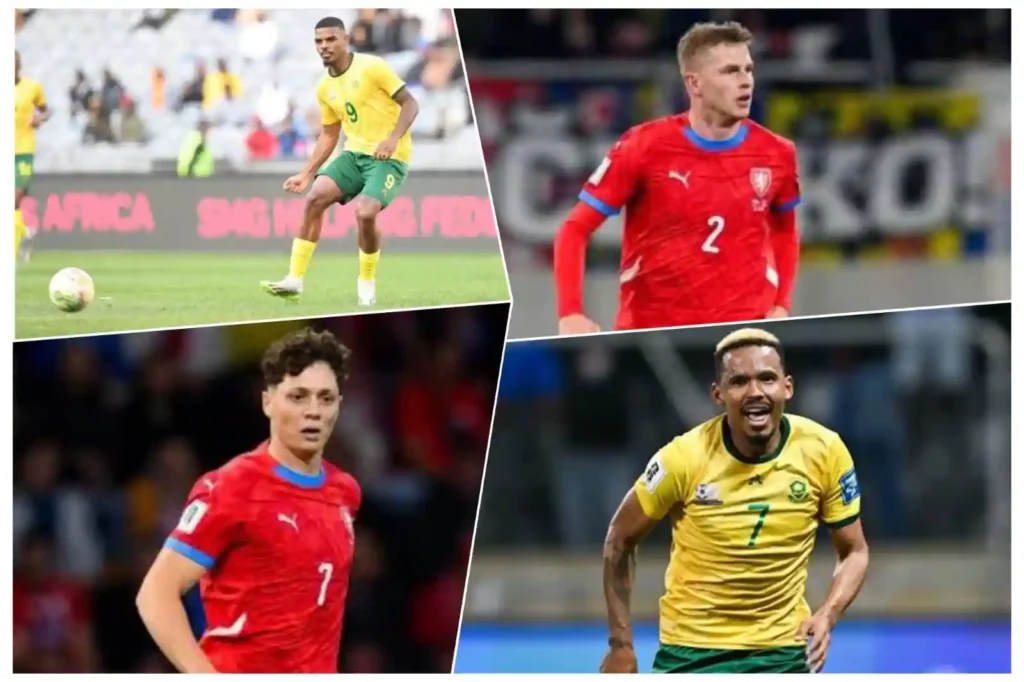
Patrik Schick remains the most recognisable name internationally — his Champions League goals at club level and his extraordinary Euro 2020 effort against Scotland have established him as a player of real quality. At 28, Schick is at the optimal point of his career. His combination of aerial ability, technical quality, and composure under pressure makes him the most dangerous point of Czechia’s attack.
Behind him, Tomáš Souček continues to provide the kind of honest, effective, high-volume midfield work that has made him a reliable Premier League performer for West Ham. Souček’s aerial contribution — both in attack and defence — will be central to Czechia’s set-piece strategy.
Vladimír Coufal and Jakub Kiwior form the core of Czech defensive organisation. Their club experience provides a stability that was less evident in earlier qualification campaigns.
Czech Republic — Qualification Record:
- EURO Qualification: Qualified for group stages consistently
- Friendly record in 2025–26: 3W 2D 1L
- Goals scored last 6 matches: 11
- Goals conceded last 6 matches: 6
The scoring numbers suggest an attacking side with genuine threat. The defensive tally reflects a degree of vulnerability that South Africa’s direct forwards could exploit.
South Africa: The Return of Bafana Bafana
Context and Qualification
South Africa’s qualification for the 2026 World Cup emerged from a CAF campaign that required considerable resilience. They were not the dominant force — Morocco, Nigeria, and Senegal remain the continent’s most consistent performers — but Bafana Bafana found a combination of collective organisation and individual moments that carried them through.
Hugo Broos, the Belgian manager who transformed Cameroon’s AFCON fortunes and subsequently brought his quiet tactical intelligence to South Africa, has built a side that is difficult to beat without being spectacular. The balance between defensive solidity and attacking threat has been the defining challenge, and his solution — a narrow 4-3-3 that compresses the central zone and attacks primarily through wide areas — has been effective if not always aesthetically compelling.
South Africa’s CAF Qualification:
- Matches played: 10
- Goals scored: 14
- Goals conceded: 8
- Clean sheets: 4
- Notable results: Beat Morocco (home), drew Nigeria (away)
A draw away at Nigeria and a home victory over Morocco — two of the continent’s top sides — demonstrate that Bafana Bafana can compete against genuinely strong opposition. Those results are worth more than the raw ranking suggests.
Key Players
Percy Tau — The most technically gifted player in South Africa’s squad. The Al Ahly forward’s career has taken him through Club Brugge, Brighton, and Egyptian football, and his combination of pace, dribbling technique, and decisive final ball makes him the most direct threat South Africa possess. On his best days, Tau is a player capable of deciding matches against higher-ranked opponents. His health and form going into the tournament will be the key variable.
Ronwen Williams — The Mamelodi Sundowns goalkeeper is one of the best in the African continent and a figure of genuine class in the CAF Champions League. Williams is the kind of goalkeeper who can single-handedly keep a side in a match — composed, well-positioned, and capable of the crucial save at the decisive moment.
Teboho Mokoena — The SuperSport United midfielder has emerged as South Africa’s most reliable central ball-winner. His pressing, his recovery runs, and his ability to break up opposition play make him the engine of Bafana Bafana’s defensive shape.
Evidence Makgopa — The Brentford striker has developed significantly in the Premier League and brings a different physical profile to South Africa’s attack than the more technical Tau. His holds-up-play and ability to bring teammates into the game are functions the team needs when they are absorbing pressure.
The Tactical Confrontation
This match will likely be decided by how successfully South Africa can defend the wide areas against Czechia’s attacking width, and conversely by how efficiently Percy Tau can create problems for Czech full-backs when Bafana transition.
Czechia will look to use the full width of the pitch, with their wingers running behind South Africa’s defensive line at pace. The Czech wide play will test South Africa’s defensive discipline in channels — an area where they have occasionally been vulnerable.
South Africa’s counter-attack, built around Tau’s runs from deep and Makgopa’s hold-up play, offers a genuine threat if Czechia’s defensive line is too high. Czech full-backs pushing forward creates the precise space South Africa will look to exploit on the turn.
Venue: Mercedes-Benz Stadium, Atlanta
Mercedes-Benz Stadium is among the most impressive venues in the World Cup 2026 portfolio. With a retractable roof, an advanced HVAC system, and a capacity of 71,000 expanded for the tournament, it offers a premium matchday environment. The artificial turf / natural grass question has been resolved through significant pitch work ahead of the tournament.Mercedes-Benz Stadium: The Halo Board, Fan-First Prices & Atlanta’s Untold Story
Atlanta’s summer conditions are warm and humid — typically around 28–32°C in June. The evening kickoff (9:30 PM local) means players will be competing in significantly cooler conditions than midday. For South African players accustomed to varying conditions across the African continent, this is largely manageable. Czech players, coming from Central European summer temperatures, should acclimatise well.
Head-to-Head Record
Czechia and South Africa have met twice in friendly competition, with both matches producing results of marginal predictive value. There is no competitive H2H record. The psychological preparation for both teams is conducted largely in the abstract — studying footage, modelling tactics, rather than drawing on competitive memories of previous encounters.
Analysis: Who Holds the Advantage?
On paper, Czechia hold the advantage. Their squad has more players operating at the elite level of European club football. Their tactical sophistication, built under Broos’s Czech counterpart, is marginally more refined. And historically — if tournament history means anything — European teams in group-stage openers tend to manage the occasion more effectively.
However, South Africa hold one advantage that analysis cannot adequately quantify: the weight of a nation’s expectation propelling them forward. Bafana Bafana’s return to the World Cup is an event of cultural significance that will be felt in the dressing room. Players who know what their qualification means — who have heard what it means from their families, their communities, their country — carry a particular kind of focus.
For Czechia, this is a professional obligation. For South Africa, it is something more.
Those two motivational energies collide in Atlanta, and the match will tell us which prevails.
Prediction
A close, competitive match with relatively few clear-cut chances. Czechia’s clinical finishing — if Schick is sharp — will likely prove decisive. South Africa will make Czechia work for every opportunity and Tau will create problems Czechia’s defenders will find uncomfortable throughout.
The strength of Czechia’s midfield, their European club pedigree in key positions, and Schick’s individual quality tips the balance.
Predicted Score: Czechia 1–0 South Africa
A narrow Czech victory that tells the full story of neither team. South Africa leave with credit, with a clear path back into the group, and with the knowledge that they belong here.
StrikerReport.com | World Cup 2026 Preview Series
▪️▪️ Follow us on Facebook ▪️▪️
About the Author