What Is Tiki-Taka? Spain’s Football Philosophy Explained Simply
StrikerReport.com | Football Education | Tactics Explained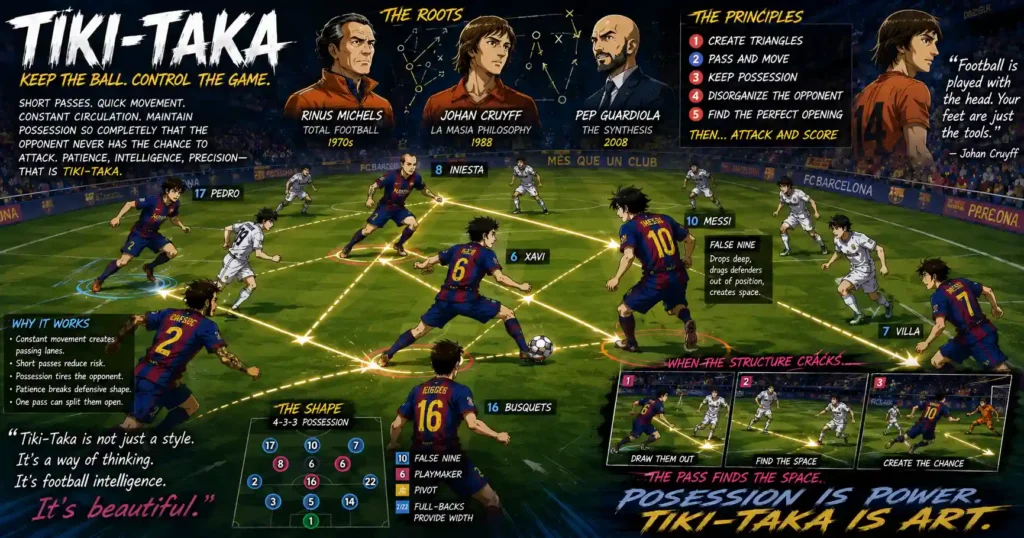
If you watched football between 2008 and 2012 and wondered how Spain and Barcelona were making it look so effortless — so almost irritatingly easy — the word you kept hearing was tiki-taka.
It was used to explain everything. The passing. The movement. The possession statistics that seemed to redefine what was possible. The way opponents chased the ball for 90 minutes and still couldn’t get it back.
But what actually is tiki-taka? Where did it come from? Why did it work so devastatingly well — and why did it eventually stop working?
This is the complete, simple explanation. No jargon. Just football.
The Simple Version First
Tiki-taka is a style of football built on keeping the ball.
That’s the core of it. Short passes, quick movement, constant circulation of the ball between players — the objective being to maintain possession so completely that the opponent never has the chance to attack, and eventually creates the precise opening that allows you to score.
It sounds simple. It is extraordinarily difficult to execute at the level Spain and Barcelona did between 2008 and 2013.
Think of it this way. Every team in football wants the ball. In most styles of play, winning the ball leads to carrying it forward — through dribbles, long passes, direct running. In tiki-taka, winning the ball leads to keeping it. Not necessarily progressing immediately. Not necessarily attacking at pace. Simply — keeping it. Circulating. Moving. Creating disorganisation in the opponent’s defensive structure through the act of passing alone.
When the structure cracks — when a defender steps out to press, when a midfield line breaks — the pass goes into the space and the chance is created. It is chess played with football. Patient, intelligent, and when done well, completely suffocating.
Where Tiki-Taka Came From
The word itself is onomatopoeic — “tiki-taka” mimics the sound of a ball being passed quickly back and forth. Tick-tack. Tick-tack. Short and rhythmic and constant.
The philosophy, however, has roots that go back decades before the term entered common use.
Johan Cruyff and Total Football
The most direct ancestor of tiki-taka is Total Football — the Dutch philosophy developed at Ajax and the Netherlands national team in the early 1970s under Rinus Michels and personified by Johan Cruyff. Total Football demanded that every player on the pitch could occupy every position — that space be constantly created and filled, that the ball be kept through intelligent movement rather than physical power.
When Cruyff arrived at Barcelona as manager in 1988, he brought those ideas with him. He built the “Dream Team” of the late 1980s and early 1990s. He established La Masia — Barcelona’s academy — with a specific footballing philosophy embedded in its DNA. He prioritised technical quality, positional intelligence, and ball retention above all else.
Every player who came through La Masia after Cruyff arrived was taught to play the same way. They were taught to receive the ball facing forward. To pass early. To move immediately after passing. To think in triangles — always offering the player on the ball two passing options at minimum.
Pep Guardiola’s Synthesis
Cruyff’s most devoted student was a quiet midfielder from Santpedor who played in his Dream Team: Pep Guardiola.
Guardiola absorbed Cruyff’s philosophy as a player and then spent his coaching career refining and intensifying it. When he took charge of Barcelona B in 2007 and the first team in 2008, he brought what is now recognisable as tiki-taka to its highest expression.
His Barcelona had Xavi Hernández at its core — possibly the most technically intelligent midfielder to ever play the game. It had Andrés Iniesta, whose close control and movement in tight spaces was unprecedented. It had Lionel Messi, who in a false nine role (more on this below) was the most dangerous player on the planet. It had Busquets, the defensive pivot who controlled tempo from deep. Dani Alves, the most offensively potent full-back in the game. Pedro, Villa, and Henry as wide threats.
This was not a team that happened to play possession football. It was a team built, from position one to position eleven, to play possession football at the absolute maximum level of sophistication.
How Tiki-Taka Actually Works: The Mechanics
To understand why tiki-taka is so effective, you need to understand what it does to the opposing team — not just what it does with the ball.
Step 1: Winning Possession Through Pressing
Tiki-taka doesn’t begin with keeping the ball. It begins with winning it.
Guardiola’s Barcelona pressed ferociously the moment they lost possession. The concept — later termed gegenpressing by Jürgen Klopp in a different tactical context — held that the six seconds immediately after losing the ball were the best opportunity to win it back, because the opponent had not yet organised their structure.
When Barcelona pressed, they pressed as a unit — forwards, midfielders, and full-backs all compressing space simultaneously. If they won the ball back in the high press, they were already in the attacking third. If the opponent escaped the press, Barcelona would drop into their organised possession shape and begin the patient phase.
Key principle: Ball retention begins with winning the ball back immediately.
Step 2: Building Through Short Passing Triangles
Once in possession, Barcelona — and later Spain — built through constant triangles. Wherever the ball was, two teammates were positioned to receive it at angles that created a passing triangle. When the ball moved to one of those players, they immediately created a new triangle.
Why triangles? Because a triangle offers the ball-carrier two passing options that are impossible for a single defender to cover simultaneously. The defender must choose. Whichever option they cover, the ball goes to the other. Space is opened through arithmetic — three players against one defender creates a numerical advantage that, repeated across the entire pitch, becomes impossible to defend.
Key principle: Every player in possession must have two easy passing options within 10 metres at all times.
Step 3: Positional Superiority — Creating Space Without the Ball
This is the most sophisticated element of tiki-taka and the hardest to see unless you know what to look for.
The players without the ball in a tiki-taka system are working as hard as the player with it. Their job is to position themselves in spaces that stretch the opponent’s defensive structure — pulling defenders away from where the ball is going to go, creating the lanes and gaps that will be exploited.
Guardiola divided the pitch into zones and demanded that his players occupy specific zones relative to where the ball was. No zone could have more than two Barcelona players in it — this prevented the opponent from defending compactly. Every zone the ball could potentially move into had to be occupied by someone ready to receive.
This positional discipline — relentlessly demanding, requiring total concentration across 90 minutes — is what separates tiki-taka from simply passing the ball around. It is a spatial chess game played at pace.
Key principle: Movement off the ball creates the space that ball movement exploits.
Step 4: The Patient Build and the Decisive Moment
Teams playing against tiki-taka often look fine for long periods. They’re defending well. They’re organised. They’re compact. They’re chasing the ball, yes, but they’re closing it down.
And then — in a moment that seems inevitable only in hindsight — the pass goes through the line. The defensive shape cracks. A player arrives in behind and scores. Or Messi receives in the half-space, turns, and you can’t stop what comes next.
The patience of tiki-taka is strategic. The constant circulation builds defensive fatigue. Players chasing the ball for 75 minutes are physically and mentally tired. When the decisive space opens — the pass into the channel, the through-ball, the quick combination through the defensive line — the tired defenders are a fraction too slow.
Key principle: Patience is a weapon. The decisive moment is earned by the 70 minutes of possession that precede it.
Spain’s Golden Era: Tiki-Taka on the International Stage
The translation of Barcelona’s club-level tiki-taka to Spain’s national team is the most remarkable achievement of the philosophy’s history.
Under Luis Aragonés (Euro 2008) and then Vicente del Bosque (World Cup 2010, Euro 2012), Spain fielded teams built almost entirely from Barcelona and Real Madrid’s possession-based systems. In 2010, a starting line-up could contain Casillas, Puyol, Piqué, Busquets, Xavi, Iniesta, and David Villa — all players fluent in the same football language.
The results were unprecedented:
- Euro 2008: Spain beat Germany 1–0 in the final, conceding only 2 goals in the entire tournament
- World Cup 2010: Spain beat Netherlands 1–0 AET — every match decided by a single goal, demonstrating control so complete that winning by margins didn’t matter
- Euro 2012: Spain beat Italy 4–0 in the final in their most complete performance — a masterclass of possession football that left the Italian press describing it as the end of football as a competitive concept
Three major tournaments in four years. Only one of the 7 matches in those three finals was remotely competitive (the 2010 final). This was dominance so comprehensive it changed how the world thought about international football.
Spain’s average possession during the 2010 World Cup: 58.4% — the highest in tournament history.
Why Tiki-Taka Eventually Stopped Working
Nothing in football lasts forever. Between 2012 and 2014, the world found answers to tiki-taka — and those answers were painful for Spain.
The pressing solution: Jürgen Klopp’s Dortmund and later Liverpool demonstrated that aggressive, organised high-pressing could disrupt possession football at the source. If you press the ball-carrier before the triangle forms, you break the chain before it starts. Pressing quickly enough and aggressively enough could turn tiki-taka’s patient build into a liability.
The physical solution: Playing against teams with the physical capacity to press for 90 minutes — to never allow the comfortable positioning that tiki-taka requires — made the system’s technical demands unsustainable. Short passes in tight spaces require composure. Composure requires time. Remove the time through pressing, and the composure disappears.
The tactical evolution: Coaches like Diego Simeone (Atlético Madrid) demonstrated that a deep, compact, aggressive defensive block with a quick direct counter-attack could neutralise possession football. Simeone’s Atlético beat Barcelona repeatedly during this period. His teams didn’t press — they sat deep, denied space, and attacked on the break. The football was the opposite of beautiful. It was extremely effective.
Player ageing: The Spain golden generation — Xavi, Iniesta, Villa, Puyol — were all entering their thirties simultaneously after 2012. Their replacements were technically gifted but not capable of operating the system at the same intensity.
Spain were eliminated in the group stage of the 2014 World Cup. Brazil 2014 was tiki-taka’s obituary.
Tiki-Taka’s Legacy: How It Changed Football Forever
Even in tactical defeat, tiki-taka remade the sport.
Before Spain’s golden era, the dominant conversations in football were about pressing, physicality, and direct play. After it, every elite programme in the world began prioritising technical education, positional play, and ball retention in academy coaching.
Guardiola’s subsequent work at Bayern Munich and Manchester City has taken the core principles of tiki-taka and evolved them into what he calls positional play — a more flexible, more direct version that retains the geometric intelligence of tiki-taka while allowing greater vertical speed.What Does a Football Manager Actually Do? The Job Behind the Tactics Board — A Full Week in the Life
Every major national team now devotes significant coaching resource to possession retention. La Masia’s influence on football education globally has been transformational.
Tiki-taka as a pure style died in 2014. Its DNA is in every elite team currently playing.
Tiki-Taka: The Key Principles, Summarised
If you want to explain tiki-taka to someone in thirty seconds, here it is:
Keep the ball. Don’t give it away. Make the opponent run after it until they’re tired and disorganised. Pass through tight spaces using quick triangles. Move immediately after every pass. Create space by occupying it intelligently before the ball arrives. When the defensive structure cracks from chasing the ball — pass into the crack and score.
Simple in concept. The hardest thing in football to execute perfectly.
That gap between the simplicity of the idea and the extraordinary difficulty of the reality is why it took one specific group of players, at one specific club, in one specific era, to show the world what it truly looked like.
And when they showed us, it was the most beautiful football anyone had ever seen.
Quick Reference: Tiki-Taka at a Glance
| Element | Detail |
|---|---|
| Origin | FC Barcelona / Pep Guardiola era, 2008–2012 |
| Philosophical root | Johan Cruyff / Dutch Total Football |
| Core principle | Ball retention through short passes and movement |
| Key tactical tool | Passing triangles / positional superiority |
| Defensive element | Immediate high press after losing possession |
| Peak achievement | Spain: Euro 2008 + World Cup 2010 + Euro 2012 |
| Why it stopped working | Counter-pressing, deep blocks, player ageing |
| Modern legacy | Positional play (Guardiola), global technical coaching |
StrikerReport.com | Football Education | Tactics Explained | ~2,050 words
▪️▪️ Follow us on Facebook▪️▪️
About the Author



1 thought on “What Is Tiki-Taka? Spain’s Football Philosophy Explained Simply”