Tunisia vs Japan : Group F | Estadio BBVA (Estadio Monterrey), Guadalupe, Mexico Full Time: Tunisia 0–4 Japan
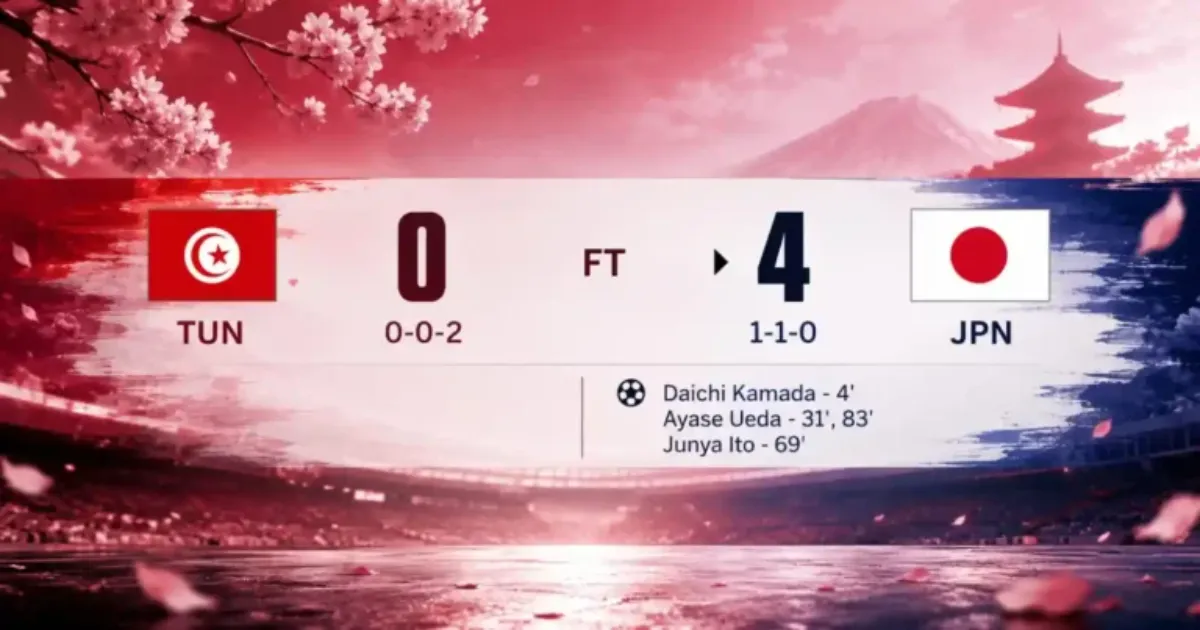
Result at a Glance
| Tunisia | 0 – 4 | Japan |
| Kamada 4′ Ueda 31′ Ito 69′ Ueda 83′ |
| Detail | Info |
|---|---|
| Date | June 20–21, 2026 |
| Kick-off | 12:00 AM ET |
| Venue | Estadio BBVA (Estadio Monterrey), Guadalupe, Mexico |
| Significance | The 1,000th match in FIFA World Cup history |
| Group | F — Netherlands, Japan, Sweden, Tunisia |
| Tunisia Manager | Hervé Renard — first match in charge |
LaLiga 2026/27 Schedule: Fixtures, Dates & Times
Champions League 2026/27 Schedule: Fixtures, Dates & Times
Premier League 2026/27 Schedule: This Week and Next Week
The Match in One Sentence
Ninety-six years after the World Cup began in Montevideo with France beating Mexico 4-1 and the USA beating Belgium 3-0, the tournament’s 1,000th match produced almost exactly the same kind of one-sided demolition — Japan dismantling a Tunisia side now on its second head coach in five days, with goals at 4 minutes, 31 minutes, 69 minutes and 83 minutes confirming that the Eagles of Carthage’s World Cup crisis is not a one-match aberration but a structural collapse.
A Match That Was Historic Before It Even Started
This fixture carried significance that had nothing to do with the scoreline before kickoff. Tunisia vs. Japan at Estadio Monterrey marked the 1,000th match in FIFA World Cup history — played 96 years after the tournament’s first-ever matches, when Montevideo hosted France 4-1 Mexico and USA 3-0 Belgium. FIFA legends Christian Karembeu, Éric Abidal and Mikaël Silvestre were on hand to mark the occasion.
For Tunisia, the historical weight of the occasion was overshadowed entirely by crisis. Five days earlier, Tunisia suffered the heaviest defeat in their World Cup history — a 5-1 mauling by Sweden that prompted the Tunisian Football Federation to sack head coach Sabri Lamouchi just 48 hours later. Lamouchi’s departure meant he became the first manager in World Cup history to be sacked after just one game of a tournament. He had been in the role for only five matches total, having been appointed in January 2026.
In his place: Hervé Renard, the 57-year-old Frenchman who guided Saudi Arabia to their stunning upset win over Argentina at the 2022 World Cup, and previously took Morocco to the 2018 tournament. Renard arrived in Monterrey having had less than five days to work with a shattered, demoralised squad before facing a Japan side that had just gone toe-to-toe with the Netherlands.
It did not go well.
Match Statistics
| Stat | Tunisia | Japan |
|---|---|---|
| Goals | 0 | 4 |
| Total Shots | 2 | 11 |
| Shots on Target | 0 | 5 |
| Expected Goals (xG) | 0.05 | 2.07 |
| Possession | ~35% | ~65% |
| Corners | 1 | 8 |
| Fast Breaks Conceded | 4 | — |
Tunisia created two shots, reflected by an xG of 0.05, whereas Japan registered 11 shots with five on target, highlighted by an xG of 2.07. The gap between these two numbers — 0.05 versus 2.07 — is one of the widest expected-goals disparities recorded at this World Cup. Tunisia did not simply lose. They were statistically incapable of threatening Zion Suzuki’s goal for the entire 90 minutes.
Goal-by-Goal Breakdown
1–0 | DAICHI KAMADA | 4th Minute
Scorer: Daichi Kamada (Japan) Assist: Keito Nakamura
That’s Japan’s fastest goal in World Cup history. Within four minutes of kickoff in the tournament’s 1,000th match, Japan had already scored — Nakamura combining quickly down the left before finding Kamada, who finished with the composure that has defined his international career under Hajime Moriyasu.
The goal set the tone immediately. Tunisia, fielding a back four for the first time under Renard after Lamouchi’s 3-5-2 had been torn apart by Sweden, were caught flat-footed before they had settled into the match. Hannibal Mejbri had a shot in the third minute that briefly suggested Tunisia might respond with intent — but Japan’s opener arrived 60 seconds later and the psychological initiative never returned to the African side.
2–0 | AYASE UEDA | 31st Minute
Scorer: Ayase Ueda (Feyenoord) Assist: Ko Itakura
Japan work it slowly across the back then hit Ueda with a quick pass. Ueda flicks it first time around the corner, past the offside trap, and continues the move himself before finishing emphatically. The build-up showcased exactly the patient, possession-based platform that Hajime Moriyasu has built his system around — long sequences of control before a sudden vertical thrust that catches the opposition’s defensive shape mid-transition.
Tunisia’s goalkeeper Aymen Dahmen — starting in place of the heavily criticised Abdelmouhib Chamakh, who had made two errors leading directly to goals against Sweden — could do nothing about the finish.
3–0 | JUNYA ITO | 69th Minute
Scorer: Junya Ito (KRC Genk)
Ito made it 3-0 in the 69th minute, rolling a finish past Dahmen after Japan had picked Tunisia’s right side apart in a sustained period of second-half pressure. Ito’s chasing everything down the right throughout the match — his relentless pressing forced Tunisia’s makeshift back four into repeated errors, and his goal was the inevitable conclusion of 25 minutes of territorial dominance following the restart.
By this point, Dahmen had brilliantly denied Tomiyasu’s close-range effort earlier in the half, clawing his shot off the line — the only moment of genuine Tunisian defensive heroics in an afternoon defined by near-total Japanese control.
4–0 | AYASE UEDA (2) | 83rd Minute
Scorer: Ayase Ueda (Feyenoord) Assist: Hayao Sano
Sano’s right-wing delivery was looped into the bottom-right corner by an unmarked Ueda, seven minutes from time, completing his brace and sealing the most emphatic possible statement of Japan’s tournament credentials. Japan pick it apart down the right and Sano stands up a cross to the far post. Ueda’s timing is perfect, he climbs above everyone and directs his header into the net.
Tunisia, by this stage, had made wholesale changes — Khedira on for the exhausted Skhiri, Achouri introduced for Abdi — but nothing could disrupt a Japan performance that had long since moved from “professional” into “ruthless.” Japan also saw a goal ruled out by millimetres during the match, an indication of just how dominant their attacking sequences had become by the closing stages.
Tactical Analysis: What Went Right for Japan
Hajime Moriyasu’s System Functioned Perfectly
Japan touts one of the most complex systems on the international stage, and this performance confirmed exactly why. Moriyasu’s structure — built on patient possession through Ko Itakura and Wataru Endo in deep positions, with Kamada and the wide forwards (Ito, Nakamura) given license to combine in central pockets — produced 65% possession and 11 shots without ever appearing rushed or desperate.
Itakura’s been everywhere. He hit 80 passes in the match — the first time a Japan player has done that in a World Cup match. More touches than anyone else on the pitch. He’s controlled this game from the back. The Ajax centre-back’s distribution from deep was the foundation that allowed Japan’s front four to receive the ball in advanced positions with time to pick their passes.
The Wide Areas Were Where the Damage Was Done
Three of Japan’s four goals — Kamada’s opener (from a Nakamura combination down the left), Ito’s third (down the right), and Ueda’s second goal (from a Sano cross from the right) — originated from wide areas. Tunisia’s makeshift back four, assembled in less than a week by a new manager, had no answer for the combination play between Japan’s full-backs and wide attackers.The Greatest World Cup Upsets of All Time — Ranked from Surprising to Unbelievable
This is a damning indictment of Tunisia’s defensive preparation, but it is equally a testament to the structural quality Moriyasu has built. Japan have notoriously failed to keep a clean sheet in their last 11 World Cup games — their attacking fluency, not their defensive solidity, remains their calling card, and on this occasion their attack alone was more than enough.
Ueda’s Movement Was the Difference Between Good and Devastating
Ayase Ueda’s brace showcased two completely different finishing qualities: the first, an exquisite 18-yard strike after intricate build-up play; the second, a textbook far-post header from a cross, timed to perfection to climb above Tunisia’s static defensive line. A striker who can score in both of those ways against the same opponent, in the same match, is exactly the profile Japan have been missing at previous tournaments — a genuine focal point capable of finishing chances created by the technical players around him, rather than purely a pressing outlet.
Tactical Analysis: What Went Wrong for Tunisia
A Crisis That Predates This Match
It’s fair to say that Tunisia have had a rather bumpy start to this World Cup. The 5-1 defeat to Sweden was their heaviest ever loss at the World Cup — they’ve only conceded more goals overall at a single edition of the tournament in 2018 (8 goals across the group stage) and 2006 (6 goals). Adding insult to that historical low point: Tunisia’s final pre-tournament friendly saw them concede five goals to Belgium as well. This was Tunisia’s second consecutive match conceding five — extended now to a third match conceding four against Japan.
After conceding nine goals across two matches paired with what Opta Analyst identified as a tournament-high 38.46% shot conversion rate allowed, the pattern is unmistakable: Tunisia’s defensive structure has been comprehensively broken by every opponent of genuine quality they have faced in 2026.
Renard’s Impossible Five-Day Job
No manager could realistically be expected to fix a defensive system in five days against a Japan side that had just drawn with the Netherlands. Renard switched to a back four — Omar Rekik and Montassar Talbi as the central pairing, Yan Valery and Ali Abdi at full-back — moving away from the 3-5-2 that had been torn apart by Sweden’s wide overloads.Every FIFA World Cup Winner Since 1930 — Complete Champions List, Stats & History
The change addressed one problem and immediately exposed another. Tunisia’s new back four lacked any cohesion or understanding of each other’s covering responsibilities — entirely predictable given they had trained together for less than a week. Japan’s combination play exploited the gaps between Tunisia’s new full-backs and centre-backs repeatedly, particularly in the buildup to the first and third goals.
Hannibal Mejbri’s Isolation
Hannibal Mejbri, operating in the advanced central role behind Tunisia’s front line, had Tunisia’s brightest moment of the match — a third-minute shot that, in different circumstances, might have settled the team. Instead, it was immediately cancelled out by Kamada’s opener, and Mejbri spent the remainder of the match increasingly isolated as Tunisia were forced into a defensive shape that offered him no support.
Tunisia recorded a tournament-high 4 fast breaks conceded against Sweden — a number that, against Japan’s more patient, possession-based approach, manifested differently but with the same underlying cause: a team set up reactively, without the structural platform to support its most talented attacking player.
Player Ratings
Japan
| Player | Rating | Assessment |
|---|---|---|
| Zion Suzuki | 6.5 | Barely tested. A routine evening behind a dominant defence. |
| Takehiro Tomiyasu | 7.5 | Excellent going forward, drew a brilliant save from Dahmen. Defensively untroubled. |
| Ko Itakura | 8.5 ⭐ | Man of the Match. 80 passes completed — a Japan World Cup record for a single match. Assisted Ueda’s first. Controlled the game from deep throughout. |
| Hiroki Ito | 7.0 | Composed alongside Itakura, rarely troubled by Tunisia’s limited attacking threat. |
| Yukinari Sugawara | 7.0 | Solid defensively, occasionally supported the attack down the right. |
| Wataru Endo | 7.5 | Screened the defence and recycled possession efficiently, allowing Japan’s front four freedom. |
| Ao Tanaka | 7.0 | Tidy, disciplined, rarely gave the ball away. |
| Keito Nakamura | 7.5 | Assisted the opening goal with quick combination play down the left. |
| Daichi Kamada | 8.0 | Scored Japan’s fastest-ever World Cup goal. Composed and intelligent throughout. |
| Junya Ito | 8.0 | Relentless press throughout, scored the third with a clinical finish, constant outlet down the right. |
| Ayase Ueda | 8.5 ⭐ | A brace of genuinely different quality — a stunning strike and a perfectly timed header. Japan’s most important attacking outlet. |
Tunisia
| Player | Rating | Assessment |
|---|---|---|
| Aymen Dahmen | 6.5 | Made a brilliant goal-line save to deny Tomiyasu. Could do nothing about any of the four goals conceded. |
| Yan Valery | 5.0 | Struggled with the pace and movement of Japan’s wide attackers throughout. |
| Omar Rekik | 5.5 | Had a shot late in the first half — Tunisia’s only other effort of note. Defensively overwhelmed. |
| Montassar Talbi | 5.0 | Part of a back four with almost no cohesion, assembled in days rather than months. |
| Ali Abdi | 4.5 | Withdrawn before the end as Japan repeatedly targeted his flank. |
| Rani Khedira | 5.5 | Brought on to add physicality but the match was already settled. |
| Ellyes Skhiri | 5.5 | Tunisia’s most experienced midfielder, unable to stem the tide of Japan’s possession. |
| Hannibal Mejbri | 6.0 | Tunisia’s brightest spark, isolated for long periods, had the team’s best chance of the match. |
| Elias Saad | 5.0 | Limited service, anonymous for most of the 90 minutes. |
| Anis Ben Slimane | 5.0 | Struggled to make any impact playing off a starved attacking line. |
| Elias Achouri | 5.5 | Introduced as a substitute, brought some energy but too late to change the outcome. |
Group F Standings
| Team | Played | W | D | L | GF | GA | GD | Pts |
|---|---|---|---|---|---|---|---|---|
| Netherlands | 2 | 1 | 1 | 0 | 7 | 3 | +4 | 4 |
| Japan | 2 | 1 | 1 | 0 | 6 | 2 | +4 | 4 |
| Sweden | 2 | 0 | 1 | 1 | 6 | 6 | 0 | 3 |
| Tunisia | 2 | 0 | 0 | 2 | 1 | 9 | -8 | 0 |
The result sees Japan move above Sweden into second place in Group F, whereas Tunisia remain fourth. With nine goals conceded across two matches and zero points, Tunisia’s World Cup hopes are mathematically alive but practically extinguished — they would need an extraordinary result against the Netherlands in their final group match while relying on results elsewhere.
Japan will next take on Sweden in Group F — a genuine title-decider for top spot — whereas Tunisia end their World Cup campaign against the Netherlands. It does not get any easier for Renard’s side.
Post-Match Reaction
Hajime Moriyasu (Japan Manager): “This was an important match for us, in a historic moment for the World Cup. My players showed exactly the qualities we have worked on — patience, movement, and clinical finishing when the moment arrived. Ueda’s performance was outstanding. Now we focus on Sweden.”
Hervé Renard (Tunisia Manager): “I arrived five days ago to a team that needed time to rebuild, and time is exactly what we did not have against a Japan side of this quality. I take responsibility for the result. We have one match remaining and we will fight for our pride and for the small mathematical chance that remains.”
The Historical Weight of This Result
This was the 1,000th match in FIFA World Cup history, and it produced a scoreline that echoed the tournament’s very first matches in 1930 — heavy, one-sided wins for the stronger side. Japan’s victory continues a remarkable run: despite conceding in each of their seven FIFA World Cup group games since 2018, Japan have only lost two of those matches, and have now positioned themselves as genuine contenders to top Group F.
For Tunisia, this was their heaviest ever loss at the World Cup just five days after recording it — except this time the margin was smaller in scoreline but, given the expected goals gap of 0.05 to 2.07, arguably even more comprehensive in terms of genuine competitive threat. Sabri Lamouchi’s sacking after one match will be remembered as a watershed moment in Tunisian football governance. Whether Hervé Renard’s vast international experience can engineer any kind of response against the Netherlands in the final group match remains, on this evidence, deeply uncertain.
The Eagles of Carthage came to Monterrey hoping for a new beginning. They leave with their World Cup in ruins, having conceded nine goals in two matches and scored only one.
▪️▪️Follow us on Facebook ▪️▪️
About the Author