Mohammed Kudus World Cup 2026: Ghana’s Biggest Absence — Injury, Impact and What the Black Stars Are Missing
StrikerReport.com | Player Profiles | Ghana | FIFA World Cup 2026 Published: June 28, 2026
The Sentence No Ghana Fan Wanted to Read
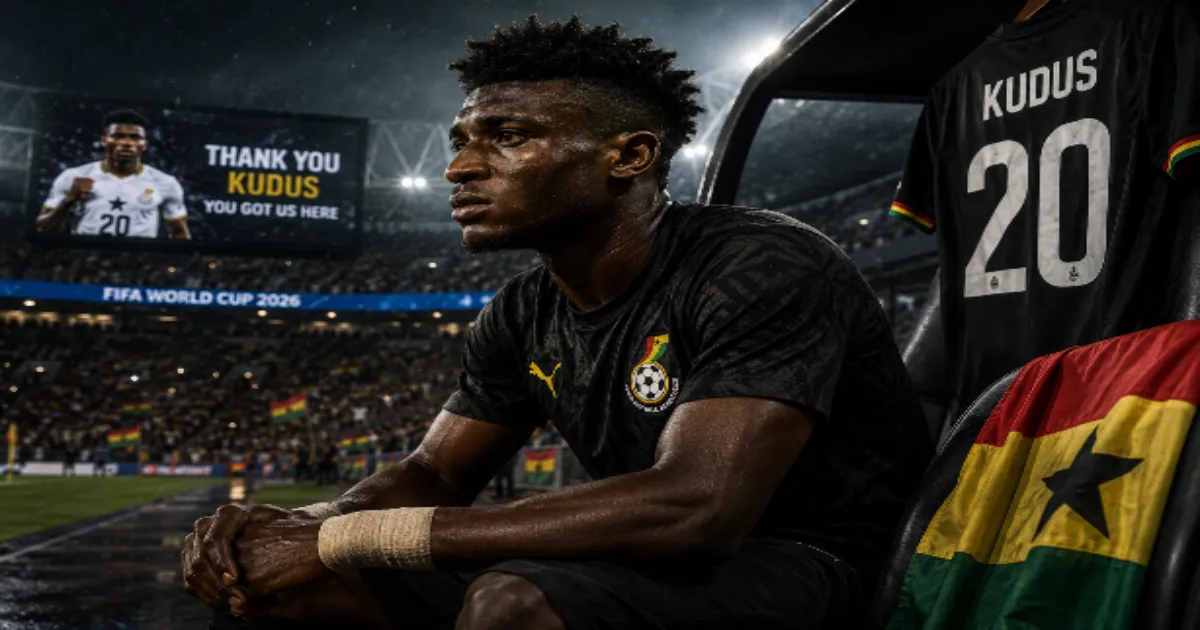
Mohammed Kudus will not play at the FIFA World Cup 2026.
That sentence deserves its own paragraph, its own moment of stillness. Because what it represents — to Ghana, to African football, to the player himself — is one of sport’s cruellest recurring narratives: the talent who should have been there, who had worked to be there, who scored the goal that sent his nation there, and who then watched it all slip away in a physio room in north London.
On January 4, 2026, Kudus exited a Premier League match between Tottenham Hotspur and Sunderland in the 19th minute with a quad injury. He has not played for club or country since that evening. The rehabilitation timeline, initially projected to clear by April 2026, was derailed by a hamstring relapse — a secondary injury that head coach Carlos Queiroz cited when he left Kudus out of Ghana’s final 26-man World Cup squad. The announcement in late May confirmed what most Ghana supporters had feared for months.
Kudus was the player who scored the only goal against Comoros in October 2025 that sealed Ghana’s qualification for this tournament. He sealed their ticket. He cannot use his own ticket.
This player profile of Mohammed Kudus at the World Cup 2026 is not the profile of a tournament campaign. It is the profile of a talent — one of West Africa’s finest — and the story of what Ghana lost when injury took him away.
Born in Nima: Where Everything Started
Mohammed Kudus Mohammed was born on August 2, 2000, in Accra, Ghana. He grew up in Nima — a densely populated, predominantly Muslim neighbourhood in central Accra that has produced several Ghanaian footballers and is characterised by the vibrant, communal street football culture that has long served as the first technical education for players who cannot afford formal academies.
In Nima, football is not organised into neat training sessions with cones and bibs. It is chaos on a concrete surface, with fifteen boys chasing the same ball at once and the technical survival skills developed through necessity rather than instruction. Kudus developed exactly the close-control, tight-space instinct that has since become his most recognisable quality.
The Right to Dream Academy changed his trajectory formally. Ghana’s most celebrated football development institution identified Kudus at a young age and provided the structured environment that translated his raw ability into exportable talent. By 2018, he was in Denmark. By 2020, he was at Ajax. By 2023, he was in the Premier League. By 2025, he was at Tottenham.
Career Timeline: From Nima to the Premier League
Nordsjælland (2018-2020) Kudus arrived at Danish club Nordsjælland from the Right to Dream Academy — the club and academy sharing ownership, making the pipeline one of the most natural in European football. He made his senior debut in a 2-0 defeat against Brøndby in August 2018, three days after his 18th birthday. His technical quality in the first division of Danish football was evident almost immediately — not the explosive, pace-built quality of a wide forward who wins races, but the technical, positional intelligence of a player who wins situations.
Ajax (2020-2023) Ajax paid a reported €9 million for Kudus in 2020. The early period was disrupted by a serious ankle injury in pre-season 2021 and a rib injury suffered on international duty in November 2021 that kept him out for three months. When fit, the picture was clear: Kudus was operating at a level significantly above the Eredivisie. The 2022-23 season — 18 goals in 42 appearances, including a Champions League goal against Rangers and a hat-trick in the Europa League qualifier against Ludogorets — announced him to a broader European audience. His combination of dribbling, pressing, positional flexibility, and clinical finishing made him one of the most coveted midfielders in European football.
West Ham United (2023-2025) The move to West Ham in August 2023 for a reported €44.5 million was the logical progression. His first season was excellent — goals, assists, and a technical profile that stood out in a Premier League where his ability to turn in tight areas and accelerate into channels was particularly dangerous. His second season was more turbulent, punctuated by a controversial red card against Tottenham and the kind of media scrutiny that intense expectation generates.
Tottenham Hotspur (2025-Present) The summer 2025 transfer to Tottenham felt like the moment Kudus truly arrived at a club with genuine Champions League ambitions alongside him. Manager Thomas Frank cited Kudus’s explosiveness, his pressing intensity, and his goal threat as the key reasons for the purchase. He started the 2025-26 season with the form that had London and European clubs monitoring transfer possibilities. Then January 4 happened.
What Made Kudus Irreplaceable for Ghana
To understand what the Black Stars are missing at this World Cup, you need to understand what Kudus does that no other player in the Ghanaian squad does with the same combination of qualities.
Direct goalscoring threat. Kudus scored 2 goals against South Korea at the 2022 World Cup in Qatar — two goals in a famous 3-2 victory that remain the most memorable individual performance by a Ghanaian player at a World Cup in over a decade. He can score from distance, he can finish one-on-one, he can arrive late into the box. No currently available Ghana player provides the same goalscoring volume and variety.
Pressing engine. Under Carlos Queiroz’s setup, Ghana’s defensive organisation relies on high pressing from the attacking midfield players. Kudus is one of the best pressing attackers in the Premier League — his intensity, his recovery speed, and his instinct for when to engage are elite-level qualities that cannot simply be replaced by deploying a different player.
Creativity between the lines. Kudus operates most dangerously in the pockets of space between defensive and midfield lines. His first touch, his awareness when receiving under pressure, and his ability to turn and play forward immediately are the qualities that unlock Ghana’s attacking play against organised defences. Without him, Ghana’s attack becomes more predictable and more easily contained.
Dual nationality as selection proof. The fact that Kudus, who was eligible for Ghana and the Netherlands through his background, chose Ghana and sealed their qualification with his goal against Comoros speaks to his commitment to the Black Stars project. His absence is therefore not just a footballing loss but an emotional one.
The 2022 World Cup: The Standard That Was Set
At Qatar 2022, Ghana were placed in Group H alongside Portugal, South Korea, and Uruguay. Their opening loss to Portugal was followed by the most important performance of the Ghanaian group stage — a 3-2 win over South Korea in which Kudus scored twice. The first goal, a calm finish that demonstrated his composure under tournament pressure. The second, a burst of direct running that South Korea’s defensive structure had no answer for.
He is Ghana’s most significant individual performer at a World Cup since the generations of 2006 and 2010. His absence from the 2026 edition is therefore not an inconvenience for Ghana. It is a genuine structural loss that the squad data confirms can only be partially addressed through collective organisation.
Ghana at World Cup 2026: Navigating Without Their Best Player
Ghana’s group stage campaign under Queiroz saw the Black Stars advance to the Round of 32 with four points — a 1-0 win over Panama, a 0-0 draw with England, and a 1-2 loss to Croatia. Captain Jordan Ayew provided leadership and experience. Abdul Fatawu Issahaku offered the directness that Kudus normally provides. Thomas Partey anchored the midfield.
But the evidence across all three matches was consistent with the absence of their most creative force. Ghana managed just two shots on target against England in a goalless draw — the joint-lowest shots-on-target count by any team at the 2026 tournament. Against Croatia, they created enough to win but could not convert. Against Panama, they were effective but not comfortable.
Group stage summary (Ghana, World Cup 2026):
- P3 W1 D1 L1
- Goals scored: 2
- Goals conceded: 3
- Shots on target vs England: 2 (joint-lowest any team)
Ghana face Colombia in the Round of 32 — a deeply challenging fixture against a well-organised South American side that will not give them the space that Panama did. Without Kudus, the burden on Issahaku and Iñaki Williams to create and convert has never been heavier.
Career Stats Summary (Mohammed Kudus)
| Category | Stat |
|---|---|
| Date of Birth | August 2, 2000 (age 25) |
| Current Club | Tottenham Hotspur |
| Position | Attacking midfielder / Winger |
| Senior Ghana caps | 40+ |
| International goals | 12+ |
| Ajax appearances (all competitions) | 100+ |
| West Ham appearances | 70+ |
| 2022 World Cup goals | 2 (vs South Korea) |
| 2026 World Cup | Did not participate (injury) |
| Reason for absence | Quad injury Jan 4, 2026 / hamstring relapse |
The Final Word on Kudus and the World Cup 2026
Mohammed Kudus at the World Cup 2026 is one of football’s most painful hypotheticals. A player in his prime years — 25, at a Champions League club, coming off an electric autumn of club football — misses the tournament he helped his nation reach.
Ghana can still advance. They have Jordan Ayew’s experience, Partey’s class, Issahaku’s brilliance in flashes. But they cannot replicate what Kudus brings. No squad can simply replace its best player with someone else and expect nothing to change.
The Mohammed Kudus story at the 2026 World Cup is the story of what wasn’t there. And in the moments when Ghana need a moment of individual genius to break down Colombia — in a crowded penalty area, in a tight game, in a moment that demands quality beyond organisation — the absence of that specific, irreplaceable player will be felt.
Related Articles:
Diego Maradona: The Rise, the Ruin and the Religion He Became
Zinedine Zidane: The Headbutt, the Magic and the Career No One Can Explain
El Fenómeno: Why the Ronaldo Nazario Career Remains the Most Complete Journey in Football History
About the Author